5-Amino-1MQ benefits are metabolic rather than appetite-driven, the reported side effects are mild but thinly documented, and dosage figures in circulation contradict each other by a factor of more than a hundred depending on which vendor you read. That last problem is the reason this guide leads with sourcing rather than with mechanism. Before anything else: despite being sold on peptide sites and shelved next to injectable peptides, 5-Amino-1MQ is not a peptide. It is a small molecule.
Key Takeaways
- 5-Amino-1MQ (5-amino-1-methylquinolinium) is a synthetic small molecule, not a chain of amino acids. Calling it a peptide is a marketing convention, not chemistry.
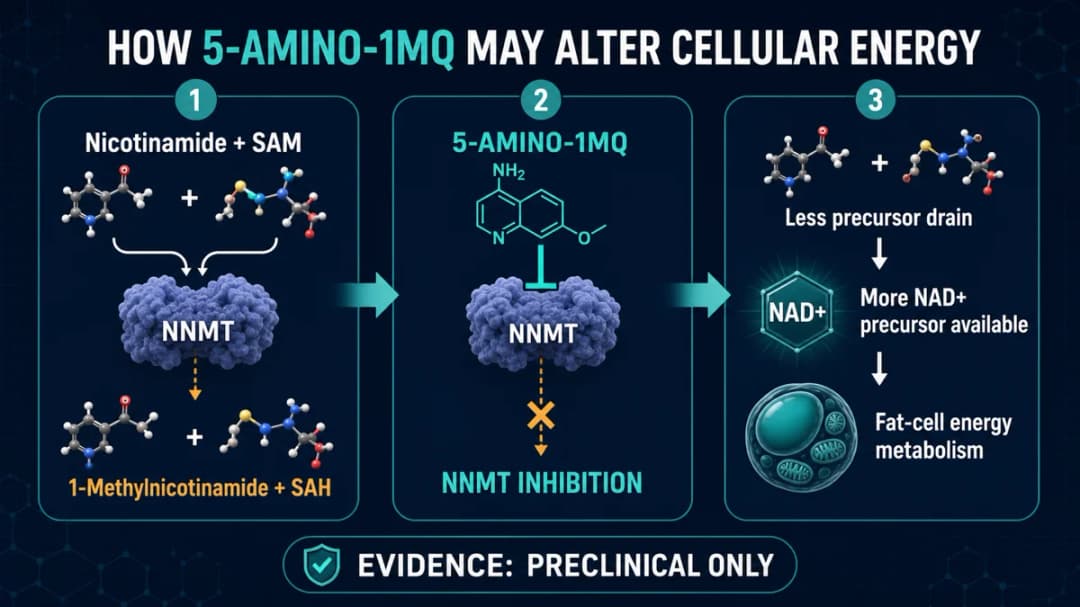
- It selectively inhibits nicotinamide N-methyltransferase (NNMT), an enzyme that consumes nicotinamide and SAM and is overexpressed in white adipose tissue in obesity.
- Evidence is preclinical. Cell work and rodent models are consistent, and no published human clinical trial supports any of the body composition claims.
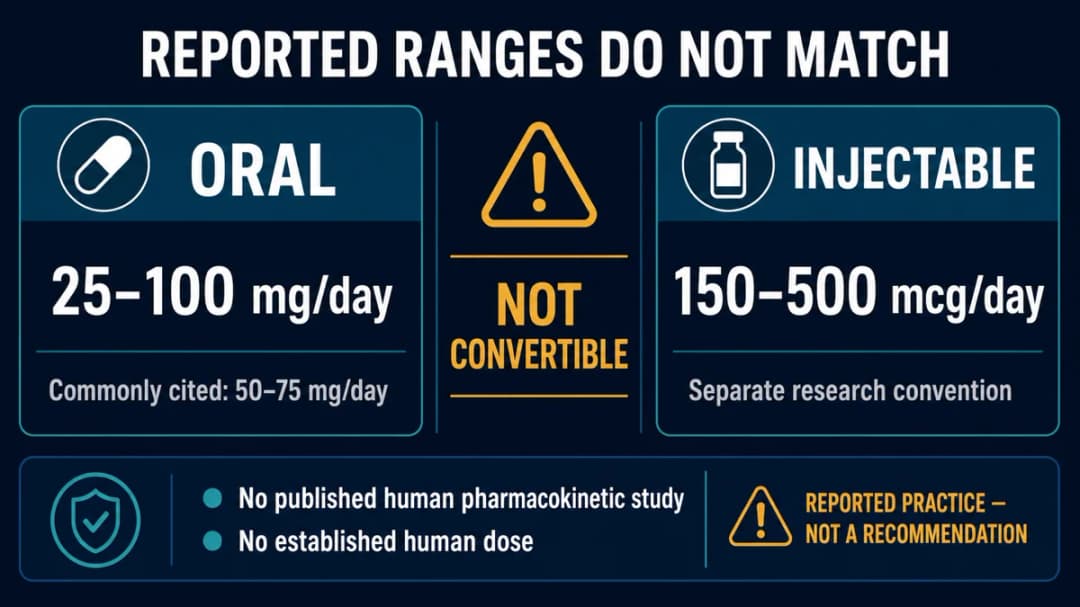
- Reported research ranges split into two incompatible camps: oral protocols around 25 to 100 mg per day, and injectable protocols around 150 to 500 mcg per day.
- Route is not a preference. In mice, subcutaneous dosing produced about 31 times the plasma exposure of a slightly larger oral dose, and every published efficacy study injected it.
- Because it is a small molecule rather than a peptide, standard peptide purity testing does not apply cleanly, which makes vendor documentation harder to interpret and more important to check.
Why the Dose Numbers Disagree, and What That Tells You
Start with the discrepancy, because it shapes how much weight anything else deserves. Search 5-Amino-1MQ dosage and you will find two sets of numbers that cannot both be describing the same exposure. Oral capsule vendors describe 50 to 75 mg per day. Injectable vial vendors describe 150 to 500 mcg per day. That is a roughly 150-fold gap, and it is not explained by bioavailability alone.
The two figures come from different lineages. The milligram range is approximately what you get by scaling published rodent dosing down to human body size. The microgram range appears borrowed from injectable peptide convention, which operates at that scale because peptides are receptor-active at very low concentrations. A small molecule enzyme inhibitor is not that kind of drug, and no published human pharmacokinetic study establishes what a microgram-scale subcutaneous dose achieves in tissue.
The scaling is worth doing explicitly, because it lands in an awkward place for both camps. The mouse studies that produced the fat loss results dosed 5-Amino-1MQ subcutaneously at 10 to 34 mg per kg per day. Converting animal doses to human-equivalent doses is normally done by body surface area rather than straight body weight, using the FDA's standard conversion for a first-in-human starting dose: multiply the mouse dose in mg/kg by 3/37, the ratio of the mouse and human Km scaling factors, which works out to dividing by about 12.3. That puts the mouse efficacy range at roughly 0.8 to 2.8 mg per kg in a human, or about 57 to 193 mg per day for a 70 kg adult, injected.
Set that against what is sold. The injectable convention of 150 to 500 mcg per day is between roughly 100 and 1,300 times below the scaled range. The oral convention of 25 to 100 mg per day sits in the right numerical neighbourhood, but by the wrong route, and oral absorption is the whole problem. Two caveats matter as much as the numbers: body surface area scaling estimates a safe starting dose for a clinical trial, not a dose that works, and nobody has run this compound through a human trial to check the estimate. Anyone presenting a single confident dose for 5-Amino-1MQ is presenting a convention, not a finding.
What 5-Amino-1MQ Actually Is
The full chemical name is 5-amino-1-methylquinolinium. Labelling is inconsistent across the market and the literature: 5-Amino-1MQ, 5 amino 1 MQ, 5amino1mq, 5-AMQ and 5A1MQ all refer to the same molecule. It also ships as different salts, with the iodide and the monochloride both appearing in published work, which changes the weight of powder in the vial without changing the active molecule. Researchers dose by the weight of the free compound rather than the salt, and vendors frequently do not say which one they are quoting.
Structurally it is a quinolinium ring with an amino group at the 5 position and a methyl group on the ring nitrogen, which gives it a permanent positive charge. It ships as a powder, and depending on the vendor it arrives as loose powder, capsules, or a lyophilized vial intended for reconstitution.
It has no amino acid sequence and no peptide bonds. It ended up in the peptide market because the same suppliers, research audience, and body composition interest carried it there. That matters practically: peptide vendors lean on HPLC purity and mass spectrometry identity for chains of amino acids, while for a quinolinium salt, identity confirmation and residual solvent data are the more relevant questions, and far fewer vendors publish them.
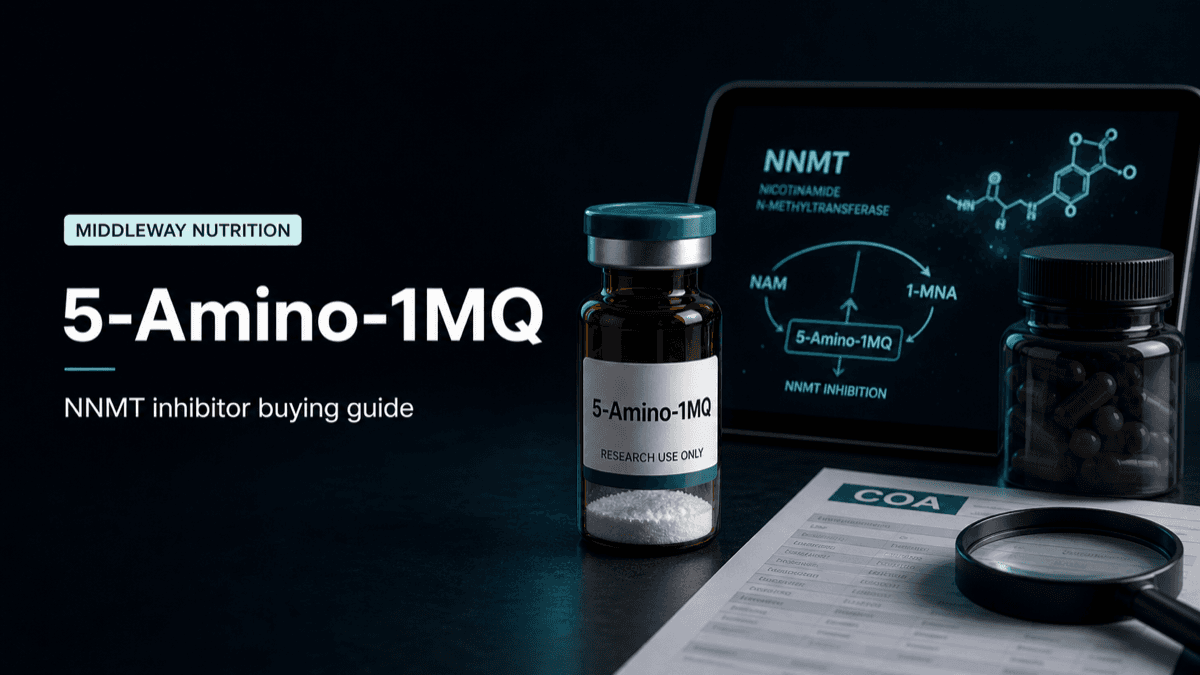
Its single documented mechanism is inhibition of NNMT. That enzyme takes nicotinamide, a form of vitamin B3, and attaches a methyl group borrowed from S-adenosylmethionine. The products are 1-methylnicotinamide and S-adenosylhomocysteine. Two things are consumed in the process: a NAD+ precursor and the cell's primary methyl donor.
In lean tissue this runs at a modest rate. In obesity, NNMT expression in white adipose tissue and liver is markedly elevated, and the byproduct 1-methylnicotinamide tracks upward with body mass and with insulin resistance. The proposed consequence is a fat cell that has less NAD+ available for the sirtuin and PARP enzymes that govern mitochondrial activity and fat oxidation, and therefore defaults toward storage. Suppress NNMT and, in theory, the precursor pool recovers and the cell shifts back toward burning.
This is the same destination that NAD+ precursor supplementation aims for by a different road. Precursors add raw material; NNMT inhibition reduces the drain. Our NAD+ guide covers the supply-side approach and where its own evidence is weaker than the marketing suggests.
5-Amino-1MQ is not approved as a drug in any jurisdiction. It is sold for laboratory research, and nothing below should be read as a protocol for personal use.
5-Amino-1MQ Benefits
The honest framing is that every claimed benefit traces to animal and cell data, and that the animal data is genuinely interesting. There are no controlled human trials. What follows separates the two.
| Claimed benefit | Strongest supporting finding | Species | Evidence grade |
|---|---|---|---|
| Fat loss without appetite suppression | Body weight and white adipose mass fell, or stopped rising, while food intake was unchanged | Mouse | Strong and reproduced across four studies |
| Better glucose control and insulin sensitivity | Improved oral glucose tolerance and suppressed high fasting insulin in obese mice | Mouse | Strong in animals, correlational only in humans |
| Lean mass and muscle retention | Fat mass fell without a matching fall in lean mass; separate studies show gains in muscle strength and repair | Mouse | Moderate, and better supported than most sources claim |
| Liver fat reduction | Less hepatic steatosis, lower liver triglycerides, normalised ALT and AST | Mouse | Moderate, from a single 28-day study |
| Higher energy expenditure | Increased cellular energy expenditure following NNMT knockdown in fat and liver | Mouse | Mechanistically supported, magnitude unquantified |
| Longevity | Touches the NAD+ and sirtuin pathway; no lifespan study exists | None | Speculative |
| Any of the above in humans | No published human trial of any kind | Human | None |
Reduced fat mass without reduced food intake. This is the finding that built the compound's reputation and it is the strongest one. In diet-induced obese rodent models, suppressing NNMT lowered adipose mass while food intake stayed flat. The effect sizes reported in knockdown work were large enough to attract drug development interest, though the specific figures vary by model and are not directly translatable to people. That decoupling from appetite is what distinguishes the mechanism from GLP-1 style intervention, where intake falls first and body composition follows. Evidence grade: strong and reproducible in rodents, absent in humans.
Improved insulin sensitivity and glucose handling. Where metabolic disease is present, the enzyme tends to be more active in fat tissue, and the methylated byproduct it generates shows up at higher levels in people whose glucose control is worse. That association has been observed repeatedly in humans, but observing an association is not the same as testing an intervention, and the intervention half has only been done in animals. In the most detailed of those, a 28-day study in diet-induced obese mice, daily subcutaneous 5-Amino-1MQ improved oral glucose tolerance and insulin sensitivity and brought down elevated fed-state insulin, with the insulin effect holding up statistically even after adjusting for body weight and fat mass. The same study found less liver fat, lower liver triglycerides and normalised ALT and AST. Evidence grade: strong mechanistic and correlational support, no human intervention data.
Higher resting energy expenditure. Preclinical work points to increased basal metabolic activity in adipose tissue following NNMT inhibition, with upregulation of thermogenic gene expression. The realistic magnitude is modest. Nothing in the literature supports the "burns fat while you sit still" framing that appears on product pages. Evidence grade: mechanistically supported, magnitude unquantified.
Lean mass preservation and muscle retention. In rodent studies fat loss occurred without a matching loss of lean tissue, which is the pattern caloric restriction typically fails to produce. That much is measured, not inferred: the 28-day obese-mouse study tracked lean mass by MRI alongside fat mass and reported the drug limiting fat gain without altering lean mass or food intake.
Separate work goes further than retention. In aged mice with an induced muscle injury, twice-daily subcutaneous NNMT inhibitor at 5 and 10 mg/kg increased muscle stem cell proliferation, produced nearly double the regenerating fibre cross-sectional area, and raised peak muscle torque by about 70% against saline controls. In 22-month-old mice given 10 mg/kg once daily for eight weeks, sedentary treated animals had roughly 40% greater grip strength than sedentary controls, exercise alone produced about 20%, and the two together produced about 60%, which is additive rather than redundant.
That is a stronger muscle signal than the compound is usually credited with, and it is still entirely in rodents, in old or injured animals rather than trained healthy ones. Evidence grade: moderate in animals, untested in humans.
Longevity and sirtuin signaling. Restoring NAD+ availability supports sirtuin activity, and sirtuins sit at the center of most cellular aging models. This is where claims run furthest ahead of data. A mechanism that touches a longevity pathway is not a longevity effect. Evidence grade: speculative.
For comparison, the fat loss compounds that work by direct lipolytic signaling operate on an entirely different axis. AOD-9604 is a growth hormone fragment that pushes triglycerides out of fat cells, while 5-Amino-1MQ changes what the cell does with its energy budget. MOTS-c is closer conceptually, since it also targets metabolic flexibility, but it does so through AMPK rather than through NAD+ availability.
The Studies Behind These Claims
Almost every claim made for this compound traces back to a small cluster of papers, most of them from one research group at the University of Texas Medical Branch and the company it spun out, Ridgeline Therapeutics. That is worth knowing when you read a product page citing "clinical research." Here is the actual body of work, with what each study dosed and what it measured.
| Study | Model | Route and dose | Duration | Reported outcome |
|---|---|---|---|---|
| Kraus et al., Nature 2014 | Mice; gene knockdown, not this compound | Antisense knockdown of Nnmt in fat and liver | — | Protection against diet-induced obesity via increased cellular energy expenditure; higher adipose NAD+ and SAM |
| Neelakantan et al., Biochem Pharmacol 2018 | Diet-induced obese mice | Subcutaneous, 20 mg/kg three times daily (~34 mg/kg/day) | 11 days | Lower body weight and white adipose mass, smaller adipocytes, lower total cholesterol, food intake unchanged, no observable adverse effects |
| Neelakantan et al., Biochem Pharmacol 2019 | 24-month-old mice, chemically injured muscle | Subcutaneous, 5 and 10 mg/kg twice daily | 1 to 3 weeks | More muscle stem cell activity, nearly 2x fibre cross-sectional area, peak torque up ~70% |
| Dimet-Wiley et al., Sci Rep 2022 | Obese mice switched to a low-fat diet | Subcutaneous, 32 mg/kg/day of active compound | — | Weight and adiposity losses that normalised toward age-matched lean animals faster than diet change alone |
| Awosemo et al., J Pharm Biomed Anal 2021 | Rats; pharmacokinetics only | Intravenous and oral | Single dose | Oral bioavailability 38.4%, terminal half-life 3.8 h IV and 6.9 h oral |
| Dimet-Wiley et al., Sci Rep 2024 | Aged mice, with and without exercise | Subcutaneous, 10 mg/kg once daily | 8 weeks | Grip strength ~40% above sedentary controls, ~60% when combined with exercise |
| Babula et al., Diabetes Obes Metab 2024 | Diet-induced obese mice, plus full PK | Subcutaneous, 10 and 32 mg/kg/day | 28 days | Dose-dependent limits on weight and fat gain, better glucose tolerance and insulin sensitivity, less hepatic steatosis, normalised liver enzymes |
| Yang et al., J Immunother Cancer 2024 | Bladder cancer mouse models | 5-amino-1-methylquinolinium iodide | — | Reduced tumour growth and enhanced response to anti-PD-L1 therapy |
Three things stand out. Every efficacy study injected the compound; none of them fed it. The doses used were 10 to 34 mg per kg per day, which is a pharmacological dose, not a supplement dose. And the human column is empty. Searching PubMed for both "5-amino-1MQ" and the full chemical name returns no human study, and a ClinicalTrials.gov search for either name returns no registered trial, completed or ongoing, as of this writing. If you encounter a page describing a human trial of this compound, ask for the registry number or the journal citation, because neither database has one.
5-Amino-1MQ Side Effects
This section is short because the data is thin, and padding it would misrepresent the situation. There is no human safety trial. What exists is animal toxicology at research doses and unstructured self-reports from people using it outside any research setting.
Reported in practice:
- Mild gastrointestinal upset with oral dosing, most often nausea, more common at the upper end of the milligram range and when taken on an empty stomach.
- Injection site redness or transient soreness with the subcutaneous form, which is a property of subcutaneous injection generally rather than of this compound.
- Sleep disturbance and a stimulant-like restlessness are occasionally mentioned. There is no mechanistic explanation for this and no way to separate it from expectation effects.
Plausible on mechanism, not documented:
- Methylation cycle disruption. NNMT consumes SAM, so inhibiting it changes methyl group flow. Whether that produces a meaningful shift in homocysteine, neurotransmitter synthesis, or gene methylation at research doses is unknown. It is the most biologically coherent concern on this list and the least studied.
- Interactions with methylation-dependent medications, including some antidepressants and folate-pathway agents. No formal interaction study has been conducted on this compound.
- Hepatic considerations, since liver NNMT activity is part of normal nicotinamide handling.
Found in animals, meaning unclear:
- In the 28-day obese-mouse study, white blood cell counts fell substantially on the high dose, driven by roughly 31% fewer lymphocytes and about 50% fewer monocytes than controls. The authors read this as obesity-elevated counts normalising alongside improved insulin sensitivity rather than as immune suppression, which is a reasonable interpretation in obese animals and an untested one in a healthy person.
- The same study reported no signs of organ toxicity, and the 2018 study reported no observable adverse effects at doses up to 60 mg/kg/day in a short escalation. Both are short studies in small groups.
What is not established either way: NNMT is not a single-purpose fat enzyme. It appears in cancer biology, neurodegeneration, and inflammatory signaling, and its role differs by tissue and context. The cancer link is often stated backwards on product pages: NNMT is overexpressed in several tumour types, and in the published work inhibiting it slowed tumour growth in mouse bladder cancer models and suppressed proliferation in cervical cancer cells. That is the opposite of a cancer risk signal, but it is also not a safety clearance, because none of it addresses what chronic NNMT suppression does in tissue that is not malignant. Suppressing it over months has not been characterized in any species at the timescales people actually use. Preclinical studies have not flagged major organ toxicity at research doses, which is reassuring as far as it goes, but rodent toxicology at fixed doses over weeks is not a human safety profile.
5-Amino-1MQ Dosage Chart
Everything below reflects ranges reported in preclinical work and in researcher community protocols. These are observations about what has been used, not recommendations, and the oral and injectable columns should be read as separate conventions rather than as convertible equivalents.
| Goal or context | Reported range | Frequency | Typical cycle |
|---|---|---|---|
| Oral, conservative start | 25 mg per day | Once daily | First 1 to 2 weeks, then reassess |
| Oral, most commonly cited | 50 to 75 mg per day | Once daily or split into two doses | 8 to 12 weeks |
| Oral, upper end reported | Up to 100 mg per day | Split dosing more common at this level | Shorter blocks, least characterized |
| Injectable, beginner convention | 150 mcg per day | Once daily subcutaneous | 8 to 12 weeks |
| Injectable, intermediate | 250 to 350 mcg per day | Once daily subcutaneous | 8 to 12 weeks |
| Injectable, upper end reported | Up to 500 mcg per day | Once daily subcutaneous | 8 to 12 weeks |
| Off period between cycles | Not applicable | Not applicable | Minimum 4 weeks, commonly matched to cycle length |
For context, the published mouse studies dosed 10 to 34 mg per kg per day by injection, which scales to roughly 57 to 193 mg per day for a 70 kg adult by body surface area. Neither vendor column is a translation of that figure.
Timing appears not to matter much: oral doses are taken with or without food, and no evidence establishes that time of day changes outcomes. Split dosing is usually justified by half-life. Human half-life has never been measured, though animal figures exist and are not short: about 13 hours after subcutaneous dosing in mice and about 7 hours after an oral dose in rats. On those numbers once-daily dosing is at least defensible, and splitting a dose is a preference rather than a pharmacokinetic requirement.
Cycling at 8 to 12 weeks with a 4-week break is universal in community protocols and universal in having no experimental basis. It is a precautionary default borrowed from peptide practice and applied to a compound whose long-term suppression profile is unknown. Reasonable instinct, but caution rather than a validated schedule. Treat the wide reported range as a measure of how unsettled this is, not as a menu.
Oral Capsules vs Injectable 5-Amino-1MQ
This is the question the dosing chaos actually turns on, and it is the one place where published pharmacokinetics gives a usable answer rather than a shrug. The short version: the compound is absorbed orally, but how well depends dramatically on the species tested, and every study that produced a body composition result injected it.
| Oral capsules | Injectable (subcutaneous) | |
|---|---|---|
| Typical vendor format | 50 mg capsules, sometimes 25 mg | Lyophilised vial, reconstituted |
| Reported vendor range | 25 to 100 mg per day | 150 to 500 mcg per day |
| Used in published efficacy studies | No | Yes, in all of them |
| Measured bioavailability | 3.5% in mice, 38.4% in rats | Reference route |
| Time to peak blood level | ~4 hours in mice | ~15 minutes in mice |
| Measured half-life | ~6.9 hours (rat, oral) | ~13 hours (mouse, subcutaneous) |
| Storage | Room temperature, dry and dark | Refrigerate after reconstitution |
| Practical friction | None | Reconstitution, syringes, sterile technique |
The bioavailability split is the part worth sitting with. In the mouse pharmacokinetic work, a 30 mg/kg oral dose produced a peak plasma level of 14.5 ng/mL, against 7,010 ng/mL from a smaller 25 mg/kg subcutaneous dose. Total exposure was about 31 times higher by injection despite the lower dose, and oral bioavailability came out at 3.5%. The authors attributed it to poor absorption from the intestine plus heavy first-pass metabolism in the liver, where the compound's half-life in mouse liver cells was under seven minutes. Notably, that oral peak of 14.5 ng/mL never reached 78 ng/mL, the concentration that half-inhibits mouse NNMT in the test tube.
In rats, the same compound behaved completely differently, with oral bioavailability of 38.4% and an oral peak of 2,252 ng/mL. The researchers who ran the mouse studies noted this explicitly, choosing subcutaneous dosing because oral bioavailability is poor in mice specifically and not in rats. Which species predicts a human is unknown, and that is not a rhetorical hedge, it is the actual state of the evidence.
What this means in practice: the capsule format is genuinely more convenient, does not require refrigeration or sterile technique, and is the format most people encounter first. It is also the format with the widest possible gap between best case and worst case absorption, and the one no published efficacy study has ever used. The injectable format bypasses the absorption question entirely, but the doses circulating for it are two to three orders of magnitude below anything that has produced a measured effect. Neither option is well characterised. Anyone claiming one is clearly superior is going beyond what has been published.
Storage and Reconstitution
Handling depends entirely on which form arrives. Capsules and loose powder need nothing beyond a cool, dark, dry place away from humidity. Unlike most research peptides, 5-Amino-1MQ does not require refrigeration in its dry state, which is a consequence of being a stable small-molecule salt rather than a foldable chain of amino acids.
The lyophilized injectable form follows standard practice: reconstitute with bacteriostatic water, add the diluent slowly against the vial wall rather than directly onto the powder, swirl rather than shake, and refrigerate afterward. Reconstituted material is generally treated as good for a few weeks refrigerated. Because no published stability study covers this compound in solution, that window is inherited convention rather than a tested figure.
Stacking
Only two combinations have any real rationale, and neither has human data behind it.
The pairing with a direct lipolytic agent such as AOD-9604 is mechanistically non-overlapping: one mobilizes stored triglycerides, the other alters the metabolic state of the cell storing them. That is a coherent argument on paper. No study has tested the combination in any species.
Pairing with growth hormone secretagogues is the other commonly described stack, on the reasoning that GH-driven lipolysis and NNMT inhibition act through separate pathways. The same caveat applies, with the added complication that GH axis manipulation carries its own monitoring requirements.
Combining it with NAD+ precursors is often suggested and is the least well-reasoned of the three. Both target the same endpoint from opposite directions, and whether that is additive, redundant, or self-limiting has not been examined.
How to Verify What You Buy
Because 5-Amino-1MQ is a small molecule sold in a market built around peptides, generic peptide COAs often do not test the right things, and identity confirmation matters more than a headline purity number. Ask specifically for identity data on the quinolinium salt and check that the certificate names this compound rather than a peptide template. Our where to buy 5-Amino-1MQ breakdown covers which suppliers publish usable documentation, and the 5-Amino-1MQ for sale page tracks current listings and formats.
Frequently Asked Questions
What does 5-Amino-1MQ do?
It inhibits NNMT, an enzyme concentrated in white adipose tissue and liver that consumes nicotinamide and SAM. Suppressing it is proposed to preserve NAD+ precursor availability inside fat cells, which in rodent models shifts those cells toward higher energy expenditure and lower fat storage. Every documented effect comes from animal or cell research.
Is 5-Amino-1MQ a peptide?
No. It is a small molecule, 5-amino-1-methylquinolinium, with no amino acid sequence and no peptide bonds. It is sold alongside peptides and often labeled as one, which is a market convention rather than an accurate description.
Is 5-Amino-1MQ safe?
Human safety has not been established, because no human clinical trial has been published. Animal studies at research doses have not shown major organ toxicity. The most coherent open question is what sustained NNMT inhibition does to methylation, since the enzyme consumes the body's main methyl donor and NNMT has functions beyond fat metabolism.
How much 5-Amino-1MQ is typically used in research?
Reported oral protocols cluster at 50 to 75 mg per day with 25 mg used as a starting point, while injectable conventions run 150 to 500 mcg per day. These two ranges come from different sources and have never been reconciled in published pharmacokinetic work. Both are reported practice, not established dosing.
Are 5-Amino-1MQ capsules or injections better?
No study has compared them head to head in any species, so there is no evidence-based answer. What is published is that every rodent study showing a fat loss or muscle result used subcutaneous injection, and that oral bioavailability measured 3.5% in mice and 38.4% in rats, a spread wide enough that the oral route cannot be called reliable or unreliable on current data. Capsules are far more convenient and need no refrigeration; injection removes the absorption question but is dosed by a convention far below anything tested.
What do 5-Amino-1MQ reviews actually report?
User reviews commonly describe gradual fat loss over 8 to 12 weeks without appetite change, a mild increase in energy, and few side effects beyond occasional nausea. Those reports are worth exactly what uncontrolled self-reports are worth: nobody is blinded, most people change diet or training at the same time, body composition is rarely measured with anything better than a scale, and vendor-hosted reviews are selected before you see them. There is no published human trial to check them against, so a positive review and a placebo response are indistinguishable from the outside.
Is 5-Amino-1MQ used in bodybuilding, and is it safe for that?
It circulates in bodybuilding and body recomposition circles, usually during a cut, on the reasoning that it targets fat metabolism without suppressing appetite and may support muscle. The muscle data is real but was generated in aged and injured mice, where NNMT inhibition improved stem cell activity, fibre size and strength; nothing has tested it in young, trained, well-fed humans, which is the opposite end of the population. On safety, there is no human data at all, no long-term animal data, and no interaction studies, so the honest position is that its safety in that context is unknown rather than established. It is also not an approved drug and is not permitted for human consumption.
Is 5-Amino-1MQ legal?
It is not a controlled substance under US federal law and is not DEA scheduled. It is sold legally for research purposes. It is not FDA approved for human use, and marketing it for human consumption is not permitted. Regulatory status varies by country and should be checked locally.