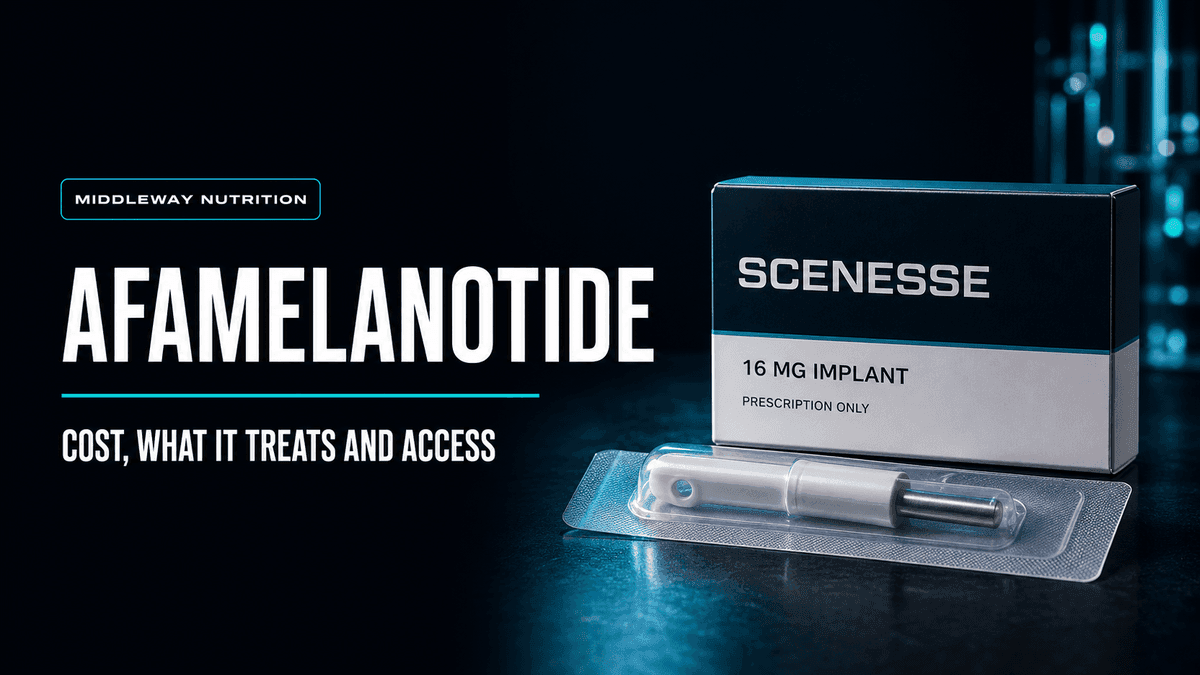
Afamelanotide (Scenesse) is the only melanocortin receptor agonist that has ever been approved as a medicine, and it is licensed for one thing: preventing phototoxicity in adults with erythropoietic protoporphyria. Cost is the question most people arrive with, and the answer is uncomfortable, since afamelanotide (Scenesse) is priced as an orphan drug, with reported US figures in the tens of thousands of dollars per implant.
It is also the same molecule sold in the research peptide market as melanotan-1, which creates a great deal of confusion and one genuinely dangerous misunderstanding. That is covered below.
What EPP Is and Why This Drug Exists
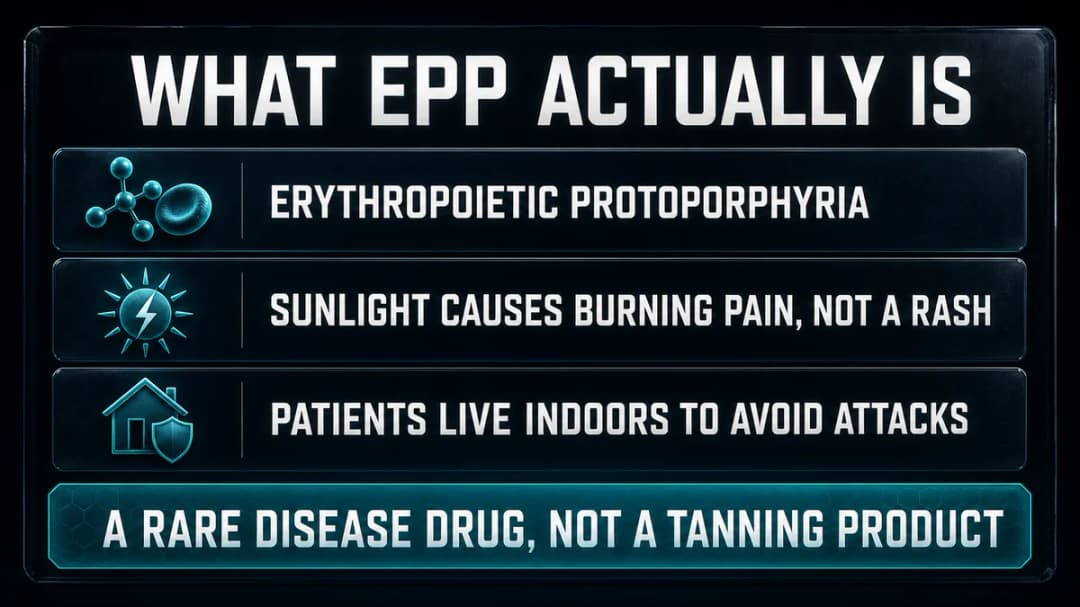
Erythropoietic protoporphyria is a rare inherited metabolic disorder. A deficiency in the enzyme ferrochelatase causes protoporphyrin to accumulate, and when light reaches it in the skin the result is a severe burning pain that begins within minutes of sun exposure and can last for days.
There is no rash to show people. The condition is invisible, and until this drug there was essentially no treatment beyond total sun avoidance, which shapes a person's entire life around staying indoors.
Afamelanotide works by increasing eumelanin, the dark ultraviolet-absorbing pigment, in the skin. More pigment means less light reaching the protoporphyrin, which means more time outdoors before pain starts. Phase 3 trials measured exactly that: pain-free time in sunlight, which increased meaningfully compared with placebo.
How It Is Given
Not an injection. A 16 mg bioresorbable implant, roughly the size of a grain of rice, inserted under the skin of the abdomen by a trained clinician. It releases the peptide slowly over about two months, and patients typically receive several implants a year timed around the months of highest sunlight.
The slow release is not just a convenience. Avoiding sharp plasma peaks reduces nausea, which is the most common side effect and which bolus injection makes considerably worse.
Approval History
| Regulator | Year | Indication |
|---|---|---|
| European Medicines Agency | 2014 | Prevention of phototoxicity in adults with EPP |
| US Food and Drug Administration | October 2019 | Same |
It holds orphan drug designation in both jurisdictions, reflecting how few people have the condition. That designation is directly relevant to the price.
Afamelanotide (Scenesse) Cost
Orphan drugs for very rare conditions are priced on the assumption of a very small patient population, and this one is no exception.
| Item | Reported figure |
|---|---|
| Cost per implant, United States | Widely reported in the region of $40,000 to $50,000 |
| Implants per year for a typical patient | Several, timed around the high-sunlight months |
| Annual cost | Consequently in the low to mid six figures at list price |
| What patients typically pay | Depends entirely on insurance and assistance programmes |
Those list figures are what appears in published US pricing analyses and should be treated as indicative rather than a quote. Almost nobody pays list price. Access in practice runs through specialty pharmacies, insurance authorisation, and the manufacturer's patient assistance programme, and in countries with national health systems through whatever process governs orphan drug funding there.
Anyone with a confirmed EPP diagnosis should be working with a specialist centre, which is where the access pathway starts. It is not a drug that a general practice prescription reaches.
Side Effects
From the clinical trial data, which is the most useful thing about having an approved product:
- Nausea, the most common, usually transient
- Headache
- Fatigue
- Implant site reactions, bruising and mild pain
- Skin darkening, which is the mechanism rather than a side effect
- Increased pigmentation of existing moles, with monitoring recommended
What is notably absent, compared with the reputation melanotan compounds have generally: no sexual effects, no reported blood pressure changes, no cardiovascular signal. That is a direct consequence of receptor selectivity, since afamelanotide acts on MC1R in skin rather than on the brain receptors that Melanotan II hits.
Long-term follow-up in EPP patients treated over years has not produced a cumulative toxicity signal, though prescribing guidance recommends ongoing monitoring of pigmented lesions. See our Melanotan I and II comparison.
The Melanotan-1 Confusion
This is the part that matters most and gets least attention.
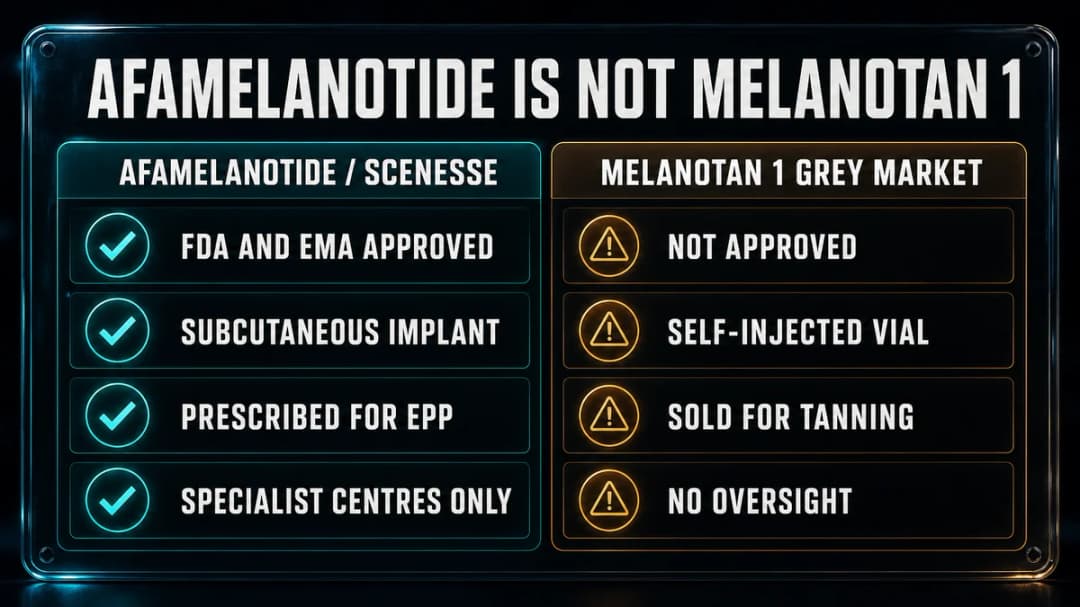
Afamelanotide and melanotan-1 are the same amino acid sequence. Afamelanotide is the international non-proprietary name used in medicine. Melanotan-1 is what the research chemical market calls it. On paper, identical.
In practice, almost nothing else is the same:
| Afamelanotide (Scenesse) | Melanotan-1 as a research peptide | |
|---|---|---|
| Manufacturing | Pharmaceutical standards, inspected | Depends on the supplier |
| Purity and identity | Guaranteed | Guaranteed by nobody. A batch certificate of analysis is the minimum |
| Delivery | Controlled release over two months | Manual injection, sharp peaks, variable dosing |
| Supervision | Inserted and monitored by a clinician | Self-administered |
| Regulatory status | Approved for EPP | Not approved for anything |
| Cost | Tens of thousands per implant | Tens of dollars per vial |
The dangerous inference is that because the pharmaceutical product has good clinical data, an unverified vial of the same sequence inherits it. It does not. The trial data describes a specific product delivered a specific way under supervision.
For anyone with EPP, the research peptide is not a cheaper version of the treatment. It is an unverified product with no supervision for a condition that requires specialist management.
For laboratory research on MC1R biology, melanotan-1 from a supplier that publishes batch-specific third-party certificates of analysis with HPLC purity figures is a legitimate research tool. That is a statement about research sourcing, not a suggestion that anyone should substitute it for a prescribed medicine. See our Melanotan 1 guide and where to buy Melanotan 1.
Research Beyond EPP
Afamelanotide has been studied in other light-related skin conditions, with results that are interesting rather than settled:
- Vitiligo, combined with narrowband UVB phototherapy, where repigmentation was better than phototherapy alone in published work
- Polymorphic light eruption, the common sun rash, where sun tolerance improved
- Solar urticaria, a rarer photosensitivity
None of these has reached approval, so none is a route to obtaining it. There is also research interest in MC1R's role in inflammation and oxidative stress, which is a long way from any clinical application.
FAQ
What is Scenesse approved for?
Prevention of phototoxicity in adults with erythropoietic protoporphyria, and nothing else. It is not approved for cosmetic tanning, vitiligo, or any other skin condition, despite research interest in some of them.
How much does afamelanotide cost?
Published US figures put a single implant in the region of $40,000 to $50,000, with patients typically needing several a year. Almost nobody pays that directly, since access runs through insurance, specialty pharmacies and manufacturer assistance programmes.
Why is it so expensive?
Orphan drug economics. EPP affects a very small number of people, and the cost of decades of development and trials is recovered across that small population. The pricing is a policy question rather than a manufacturing one.
Is afamelanotide the same as Melanotan I?
The same molecule, yes. The same product, no. One is manufactured to pharmaceutical standards and delivered as a supervised slow-release implant. The other is a powder from an unregulated market that a person reconstitutes and injects themselves.
Does afamelanotide cause the side effects Melanotan II is known for?
No. Melanotan II's nausea, appetite suppression and sexual effects come from binding receptors in the brain. Afamelanotide is selective for the pigment receptor in skin, so those effects do not appear in its trial data.
Can it be used just to get a tan?
It is not approved for that and it is not available for that. Anyone pursuing the research peptide version for cosmetic reasons is using an unverified product, and the mole monitoring recommendations that come with the approved drug apply just as much without any of the supervision that makes them useful.