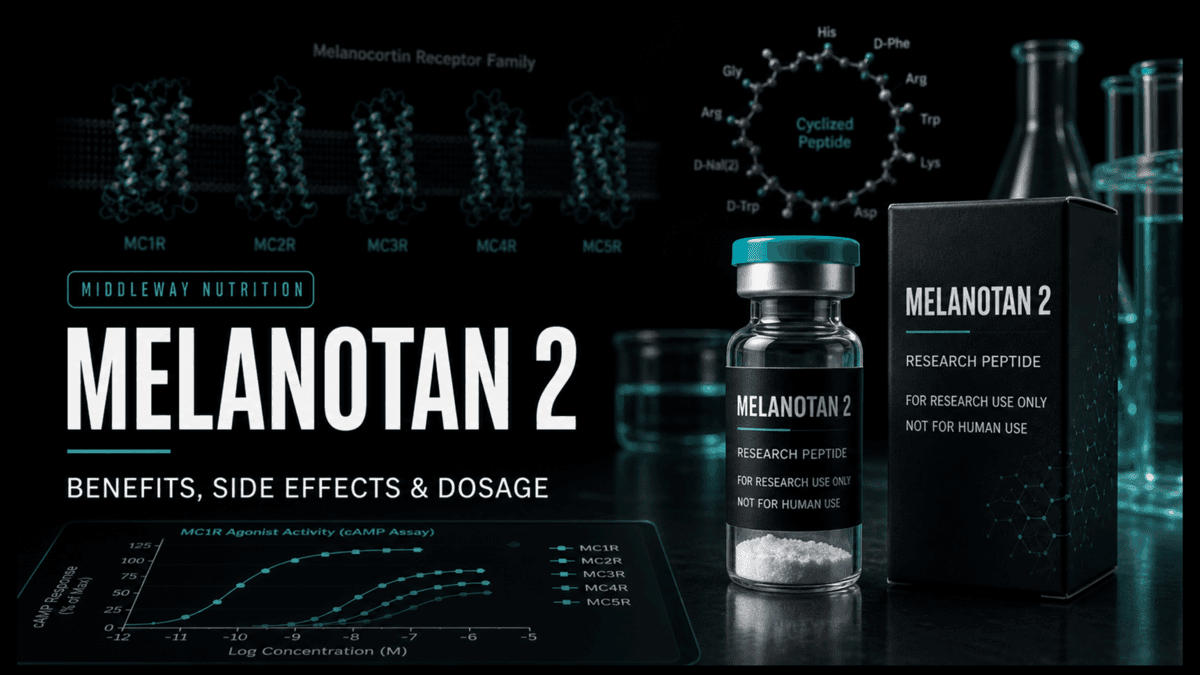
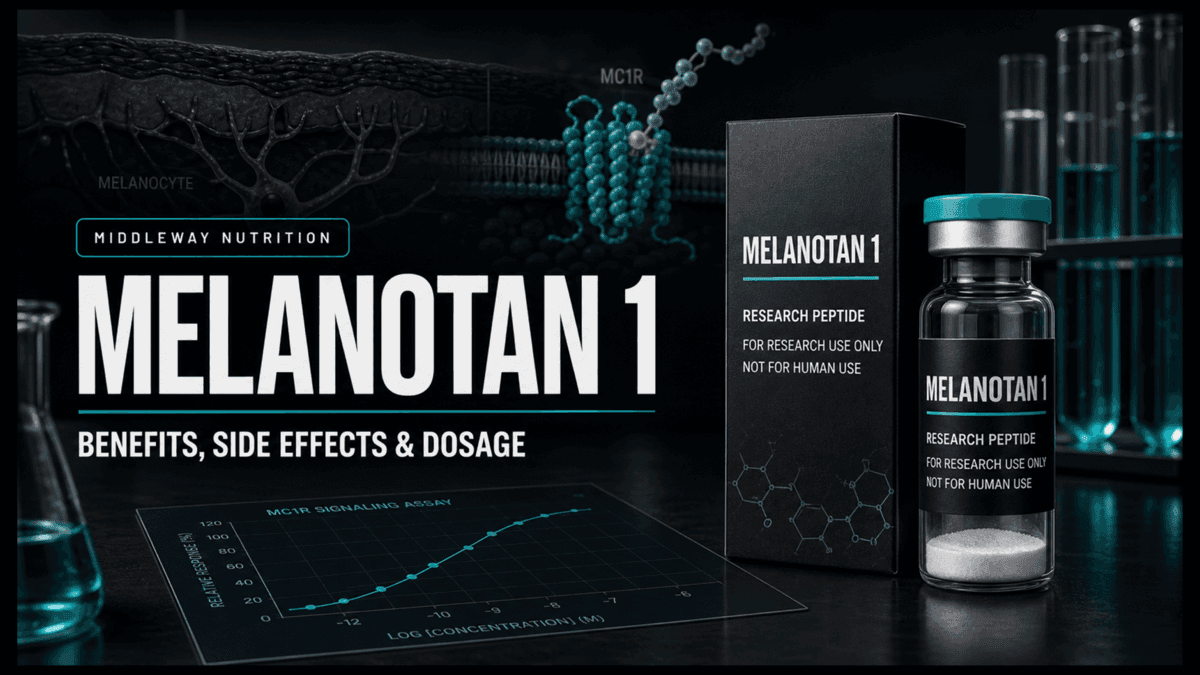
Melanotan 1 peptide benefits center on melanin production without UV, the side effects documented most are nausea and headache, and dosage sits in the microgram range. It is also, unusually, a research peptide with a real drug approval attached to it.
- Melanotan 1 and afamelanotide are the same molecule under two names. Afamelanotide is the pharmaceutical name, sold as Scenesse and approved in the EU in 2014 and by the FDA in 2019 for erythropoietic protoporphyria.
- It is a linear 13 amino acid analog of alpha-MSH, sequence Ac-Ser-Tyr-Ser-Nle-Glu-His-D-Phe-Arg-Trp-Gly-Lys-Pro-Val-NH2, molecular weight about 1,646.85 Da, with a plasma half-life near 30 minutes.
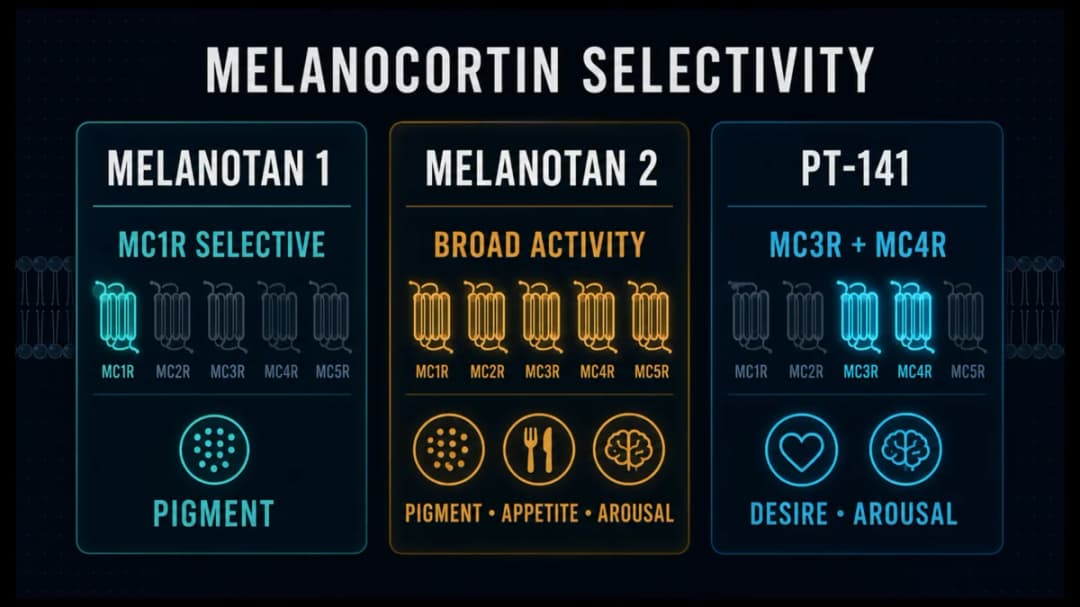
- Its selectivity for MC1R is the whole point. Unlike Melanotan 2, it has little meaningful MC3R or MC4R activity, so appetite and sexual effects are largely absent.
- Reported research doses run roughly 100 to 200 mcg subcutaneously, with a loading phase of 2 to 4 weeks followed by less frequent maintenance. The approved drug uses an entirely different route: a 16 mg implant every 60 days.
- The clinical safety record belongs to GMP-manufactured Scenesse, not to a lyophilized vial from an online vendor. That distinction is the single most important thing in this article.
- The Scenesse label recommends a full body skin examination twice yearly to monitor pre-existing moles and new pigmented lesions. That surveillance is part of the approved product, and it has no equivalent in unsupervised use.
What Melanotan 1 Actually Is
Melanotan 1 is a synthetic analog of alpha-melanocyte-stimulating hormone, the tridecapeptide your pituitary produces to regulate pigmentation. Chemists at the University of Arizona built it in the 1980s by making two changes to the natural sequence: norleucine in place of methionine at position 4, and D-phenylalanine in place of L-phenylalanine at position 7. Both swaps blunt enzymatic breakdown, which is why the synthetic version is more potent and longer lived than the hormone it copies.
The formal shorthand for this is [Nle4, D-Phe7]-alpha-MSH. In the research market it ships as a lyophilized powder, typically in 10 mg vials, under the name Melanotan 1 or MT-1. In a pharmacy it is afamelanotide, a bioresorbable implant rod. Same amino acid chain, two completely different products.
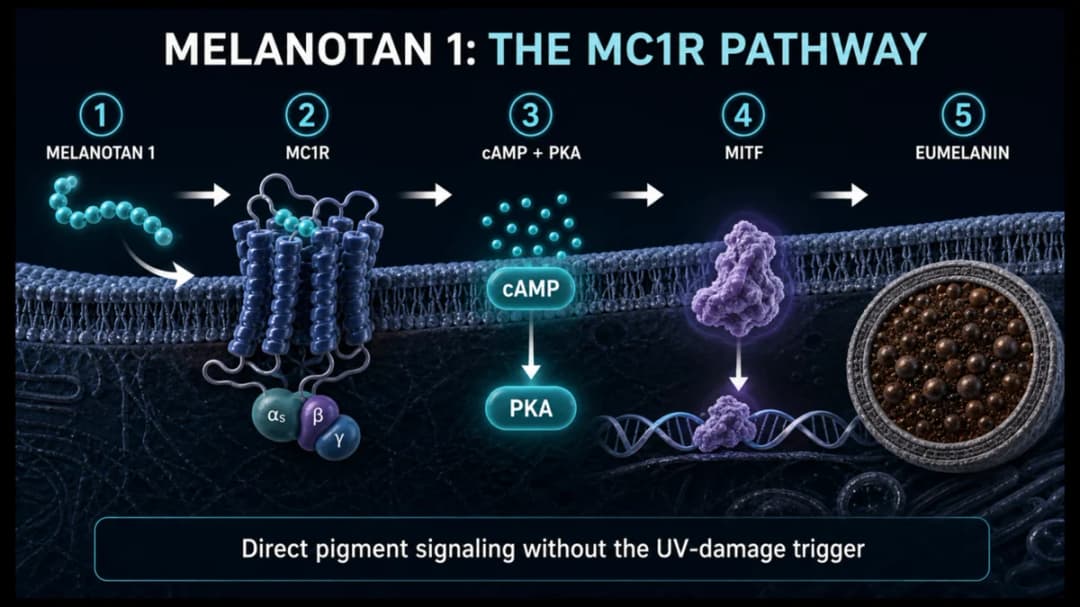
The receptor story. Melanotan 1 binds MC1R, which sits on melanocytes in the skin. That binding raises intracellular cAMP, activates protein kinase A, phosphorylates CREB, and pushes up MITF, the transcription factor that governs the melanin synthesis machinery. Downstream, tyrosinase and the tyrosinase-related proteins are upregulated and melanin output rises.
Why eumelanin matters. Melanin comes in two broad flavors. Eumelanin is the brown to black pigment that absorbs UV effectively. Pheomelanin is the red to yellow pigment that does not, and which some evidence suggests can generate reactive species under UV. MC1R activation shifts the balance toward eumelanin. For people with fair skin, who naturally sit heavier on the pheomelanin side, that shift is the entire mechanistic rationale.
No UV required, but pigment still takes time. Ordinary tanning begins with UV-induced DNA damage that then signals for melanin. Melanotan 1 skips the damage step and signals directly. What it cannot skip is skin biology: newly made pigment still has to be packaged and distributed through normal keratinocyte turnover. That is why visible change lags the first injection by a week or more.
Where the pigment actually goes. Melanocytes sit in the basal layer of the epidermis and do not keep what they produce. Finished melanosomes travel out along dendritic processes and are handed off to the surrounding keratinocytes, and one melanocyte together with the roughly 30 to 40 keratinocytes it supplies is what dermatology calls the epidermal melanin unit. In the basal layer the melanocyte to keratinocyte ratio runs about 1 to 10, and skin carries on the order of 1,200 melanocytes per square millimeter, a density that does not differ meaningfully between skin colors even though unit size varies by body region. Two consequences follow, and both are practical rather than academic. MC1R agonism cannot give anyone additional melanocytes, only more output from the ones already present, which is why fair and dark skin differ in pigment produced per unit rather than in how many units exist. And pigment only becomes visible once loaded keratinocytes migrate upward through the epidermis, which is the actual reason the effect trails the first injection rather than anything to do with the peptide's own kinetics.
Outside the approved EPP indication, this compound is not a licensed medicine anywhere. Nothing below is a protocol.
Melanotan 1 vs Melanotan 2
There is no single melanotan peptide. The name covers two different molecules with different lengths, different receptor coverage and completely different regulatory status, and listings routinely blur them.
| Melanotan 1 (afamelanotide, MT-1) | Melanotan 2 (MT-II) | |
|---|---|---|
| Structure | Linear 13 amino acid alpha-MSH analog | Cyclic 7 amino acid analog, cyclized between residues 2 and 7 |
| Molecular weight | About 1,646.85 Da | About 1,024 Da |
| Receptor coverage | MC1R selective, little meaningful MC3R or MC4R activity | MC1R plus MC3R and MC4R |
| Approved medicine | Yes, as Scenesse for erythropoietic protoporphyria, US, EU and Australia | None, in any country |
| Pigmentation effect | Yes, through MC1R | Yes, through MC1R |
| Appetite suppression | Not part of the profile | Characteristic |
| Spontaneous erections and libido effects | Not part of the profile | Characteristic, and PT-141 was developed out of this exact effect |
| Flushing | Not a defining feature | Pronounced flushing is a defining feature |
| Label-grade human safety data | Yes, from the implant trials in EPP patients | No approved product anywhere, so no equivalent dataset |
The practical reading of that table is short. Someone who wants pigment with the fewest confounding effects is describing MT-1. Someone who wants the appetite and sexual effects is describing MT-2, which carries a broader receptor footprint and has no approval to lean on. Since the two are sold under near-identical labels, confirming which molecule is in the vial is an identity question rather than a purity question, which is why mass spectrometry matters here more than an HPLC number. If MT-2 is the molecule you actually want, we cover where to buy Melanotan 2 separately.
Melanotan 1 Benefits
The evidence here splits cleanly into a well-studied clinical indication and a much softer set of extrapolations, and the MT-1 benefits lists on vendor pages almost never make that split. Keeping the two apart is the honest way to read this compound.
Photoprotection in EPP (strong human evidence). Erythropoietic protoporphyria is a rare metabolic disorder in which protoporphyrin accumulates in skin and causes burning pain within minutes of sun exposure. Randomized trials of afamelanotide implants, published in major journals, showed patients gained substantially more pain-free time outdoors alongside measurable increases in melanin density and improved quality of life scores. This is the one benefit supported by controlled human data adequate for regulatory approval, and it is the reason afamelanotide exists as a drug at all. The approved wording is narrower than most summaries suggest: Scenesse is indicated to increase pain free light exposure in adult patients with a history of phototoxic reactions from erythropoietic protoporphyria. That sentence is the entire approved use. Cosmetic tanning is not on the label in any country.
Reduced markers of UV damage (moderate human evidence). Studies in fair-skinned volunteers reported that pre-treatment with the peptide increased melanin and lowered biomarkers of UV-induced DNA damage after controlled exposure. The logic is coherent and the data are real, but these are surrogate endpoints in small groups, not outcome trials.
Tanning without sun exposure (consistent, but not the approved use). That the peptide darkens skin is not in question, since it is the mechanism and the documented pharmacodynamic effect. What is missing is any trial designed to evaluate cosmetic tanning as an endpoint, with the safety monitoring that would demand. It is not approved for that use anywhere, and the pharmaceutical evidence base does not transfer to it.
Skin cancer prevention (theoretical only). The chain of reasoning runs: eumelanin absorbs UV, UV damage drives skin cancer, so more eumelanin should mean less risk. Plausible, and no trial has tested it. Adding to the caution, any compound that stimulates melanocytes deserves scrutiny rather than assumption in a cancer context. Treat this as an open question, not a benefit.
Vitiligo repigmentation (early, adjunctive). Small studies combining afamelanotide with narrowband UVB phototherapy reported better repigmentation than phototherapy alone. Encouraging, still exploratory, and it is not a standalone treatment.
No off-target hormonal effects. This is genuinely a benefit relative to its sibling. Because MC1R selectivity is high and MC4R engagement is minimal, the appetite suppression, spontaneous erections, and pronounced flushing that define Melanotan 2 are not part of this compound's profile. Anyone interested specifically in the MC4R sexual pathway is looking for PT-141, a different peptide developed out of that exact side effect.
What is not on this list matters too. There is no credible evidence that Melanotan 1 improves skin texture, collagen, or general skin quality. For that mechanism you would be looking at something like GHK-Cu, which works on matrix remodeling rather than pigment.
Melanotan 1 Side Effects
Because afamelanotide went through formal trials, the side effect list for this molecule is better characterized than for most research peptides. Read it knowing the trial data came from a slow-release implant, not from bolus injections.
Documented in clinical trials:
- Nausea, generally mild and transient, most likely early in treatment
- Headache
- Fatigue
- Implant or injection site reactions including pain, bruising, redness, and swelling
- Skin darkening, which is the intended pharmacological effect
- Darkening of existing nevi and appearance of new moles, which prescribing guidance says to monitor
What the US label actually lists. The prescribing information for Scenesse names the adverse reactions seen in more than 2 percent of treated patients: implant site reaction, nausea, oropharyngeal pain, cough, fatigue, dizziness, skin hyperpigmentation, somnolence, melanocytic nevus, respiratory tract infection, non-acute porphyria, and skin irritation. Implant site reactions were the standout at 21 percent of treated patients against 10 percent on placebo. Two entries on that list are worth a second read. Skin hyperpigmentation appears as an adverse reaction because that is simply how trials record any change, intended or not. Melanocytic nevus means new moles turning up during treatment, recorded often enough to clear the reporting threshold.
The monitoring requirement is part of the drug. The label does not file mole changes under footnotes. It recommends a full body skin examination twice yearly to monitor pre-existing nevi and new skin pigmentary lesions, and it tells patients the drug may darken existing moles and freckles as a direct pharmacological effect. That schedule assumes a prescriber, a GMP product and a clinical relationship. None of that comes with a research vial, and the gap is not administrative. Twice-yearly examination is the specific mechanism by which a pigmented lesion that starts behaving oddly gets caught while it is still small.
Serious adverse events were uncommon in the trials, and multi-year follow-up in EPP patients has not surfaced a cumulative toxicity signal. Cardiovascular events, blood pressure changes, and sexual side effects were not features of the profile.
Plausible but less well quantified with injections. The implant releases peptide slowly and avoids sharp plasma peaks. A reconstituted subcutaneous injection does the opposite, producing a spike within the drug's short half-life window. Peak-related effects such as nausea and flushing are reasonably expected to be more pronounced with injection than the trial data suggest, particularly at higher single doses. That is a pharmacokinetic inference, not a measured finding.
Where the data is genuinely thin. Three areas deserve to be named rather than glossed over:
Melanocyte stimulation and melanoma. No causal link has been established, and trials did not detect increased melanoma risk. Equally, no study was ever powered or long enough to rule it out, and the biological question of stimulating melanocyte activity for years is unresolved. Anyone whose own history, or whose close relatives' history, includes melanoma or irregular moles has good reason to steer well clear. Note which way the regulator went with that uncertainty. It did not conclude the risk was disproven and move on. It attached a standing instruction to look twice a year, for as long as the drug is used.
Cosmetic-pattern use. Everything documented comes from EPP patients receiving supervised implants on a defined schedule. Frequent injection over long periods in otherwise healthy people has never been formally studied. There is no safety dataset for that pattern.
Product quality. The most common real-world risk with a research peptide has nothing to do with pharmacology. Uncontrolled manufacturing introduces the possibility of wrong identity, low or variable content, residual solvents, and bacterial endotoxins. Clinical trial safety data describes a GMP product and cannot be assumed to describe an unverified vial.
Melanotan 1 Dosage Chart
There is no human dosing standard for Melanotan 1 outside the approved EPP implant. The figures below are ranges reported in research and community protocol literature, compiled for reference. They are not instructions and not a recommendation.
| Goal or context | Reported range | Frequency | Typical cycle |
|---|---|---|---|
| Initial assessment | 100 to 200 mcg subcutaneous | Daily or every other day | First few doses |
| Loading phase | 100 to 200 mcg subcutaneous | Daily | 2 to 4 weeks |
| Maintenance once pigmentation established | 100 to 200 mcg subcutaneous | 2 to 3 times weekly | Ongoing in reported protocols |
| Approved pharmaceutical use (EPP, Scenesse) | 16 mg slow-release implant | Every 60 days | Before and during sun-exposure seasons, clinician placed |
A few points of context that the numbers alone do not convey.
The half-life is the design problem. At roughly 30 minutes in plasma, this peptide clears fast. The pharmaceutical answer was to stop injecting entirely and build a 60-day implant. The research market has no implant, so reported protocols compensate with frequency instead, which is a workaround rather than an equivalent.
Two dosing worlds, not one scale. The 16 mg implant figure and the microgram injection figures are not comparable. One is a total payload released over two months under medical supervision; the others are single subcutaneous doses. Reading the 16 mg number as a per-injection dose would be a serious error.
Timeline of effect. Melanin synthesis rises within days, visible pigmentation change generally appears over 1 to 2 weeks, and maximum effect takes several weeks. Pigment persists for weeks after the compound is stopped and then fades gradually.
UV is a modifier, not a requirement. The mechanism works without sun exposure. Reported protocols note that UV during loading deepens the result, which is real and also reintroduces the exact damage the compound is theoretically meant to reduce.
Reconstitution and Storage
Melanotan 1 arrives as a lyophilized white powder that has to be brought into solution before anything can be measured out of it.
Bacteriostatic water is the standard diluent, and 2 mL into a 10 mg vial is the commonly cited volume, giving 5 mg per mL. Diluent should run slowly down the inner wall of the vial rather than onto the powder directly, and the vial should be swirled, never shaken. A cloudy or particulate solution after full dissolution time is a reason to question the product.
Unreconstituted powder stores at minus 20 degrees Celsius long term, kept dry and out of light. Once reconstituted, the vial belongs at 2 to 8 degrees Celsius and is typically described as usable within about 14 days. Repeated freeze and thaw cycles degrade peptides.
Stacking
Genuine stacking documentation for Melanotan 1 barely exists, and it is more useful to say so than to invent combinations.
The one combination with actual published support is afamelanotide plus narrowband UVB phototherapy in vitiligo research, where the pairing outperformed phototherapy alone in small studies. That is a clinical protocol under dermatological supervision, not a peptide stack.
The pairing people usually ask about, Melanotan 1 with Melanotan 2, makes little pharmacological sense. Both drive the same MC1R pathway, so combining them mostly stacks MC1R agonism while adding MT-2's MC4R side effects, which is the profile MT-1 exists to avoid. Likewise, running it alongside PT-141 combines two melanocortin agonists with overlapping receptor coverage and no evidence base behind the combination. If the goal is skin quality rather than pigment, GHK-Cu operates through a separate mechanism entirely, though that is a matter of non-overlapping targets rather than any documented synergy.
How to Verify What You Buy
Melanotan 1 and Melanotan 2 are routinely confused in listings, and the two are not interchangeable, so identity confirmation by mass spectrometry matters at least as much as an HPLC purity figure. Ask for a third-party certificate of analysis from an accredited lab tied to the specific batch you are being sold, not a generic PDF for the product line. Our guide to where to buy Melanotan 1 covers which vendors publish batch-level testing and what the documentation should actually contain.
Frequently Asked Questions
What does Melanotan 1 peptide do?
It activates MC1R on melanocytes, which raises cAMP, upregulates tyrosinase, and increases production of eumelanin, the darker UV-absorbing pigment. The practical result is increased skin pigmentation without requiring UV exposure to trigger it. In its approved pharmaceutical form it uses that same mechanism to give patients with erythropoietic protoporphyria more pain-free time in sunlight.
Is Melanotan a peptide?
Yes. Melanotan 1 is a peptide, a linear chain of 13 amino acids modeled on alpha-MSH, the hormone that regulates pigmentation, with a molecular weight around 1,646.85 Da. The complication is that the term melanotan peptide gets used loosely for two molecules rather than one. Melanotan 1 is the MC1R selective version and is the same molecule as afamelanotide, an approved prescription drug for erythropoietic protoporphyria. Melanotan 2 is a shorter cyclic peptide that also engages MC3R and MC4R, which is where the appetite suppression and sexual effects come from. The comparison table earlier in this article sets the two side by side.
Is Melanotan 1 safe?
The molecule has a better-characterized safety profile than most research peptides because afamelanotide passed formal trials, where common effects were nausea, headache, fatigue, site reactions, and mole darkening, with serious events uncommon. That record belongs to a GMP-manufactured implant used under supervision. It does not automatically describe an unregulated vial injected on a self-directed schedule, and long-term melanocyte stimulation in healthy people has never been studied. The label's own answer to that open question is a full body skin examination twice a year, which is precisely the part that disappears when the compound is used without a prescriber. A history of melanoma or atypical moles is a strong reason for caution.
How much Melanotan 1 is typically used?
Reported research ranges are 100 to 200 mcg subcutaneously, given daily or every other day during a loading phase of 2 to 4 weeks, then 2 to 3 times weekly for maintenance. The approved pharmaceutical uses a completely different format, a 16 mg implant placed every 60 days by a clinician. These are reported figures for reference, not dosing advice, and no human dosing standard exists for the research form.
Is Melanotan 1 legal?
In the United States it is not a scheduled substance, and vendors sell it legally as a research chemical for non-human laboratory use only. Buying it with the intent to inject it is a different matter and sits outside that framework. Afamelanotide itself is an approved prescription drug for EPP in the US, EU, and Australia, available only through a prescriber. Some countries regulate or prohibit the research form more explicitly, so local law is worth checking before ordering.