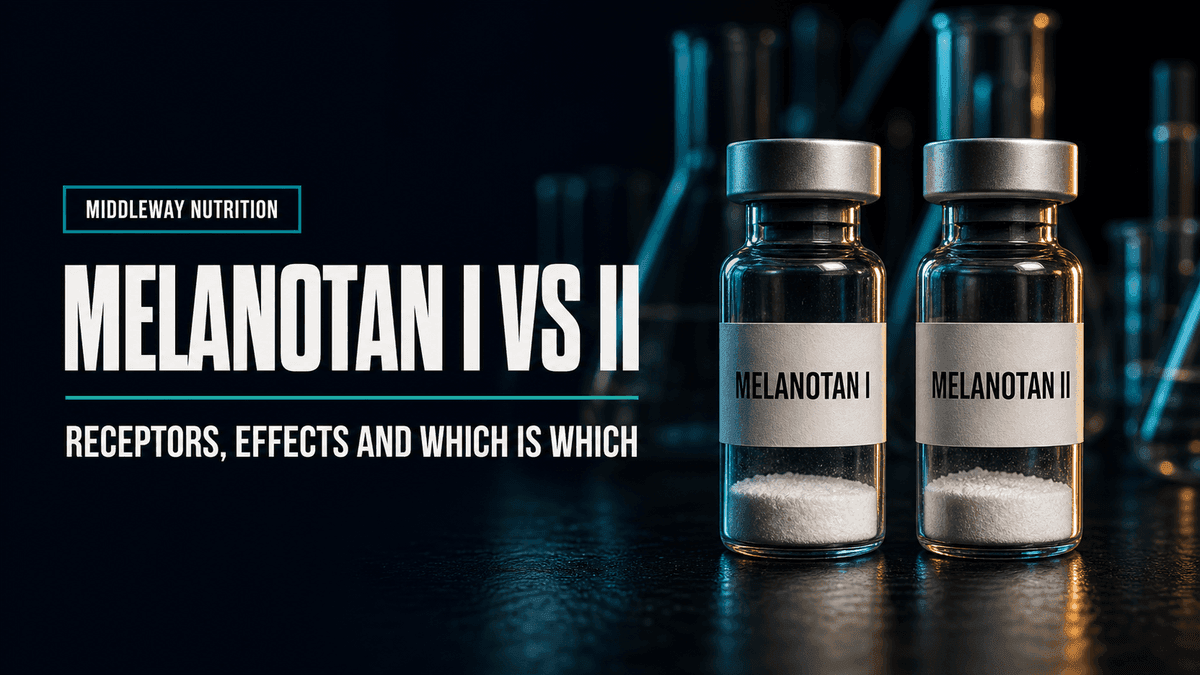
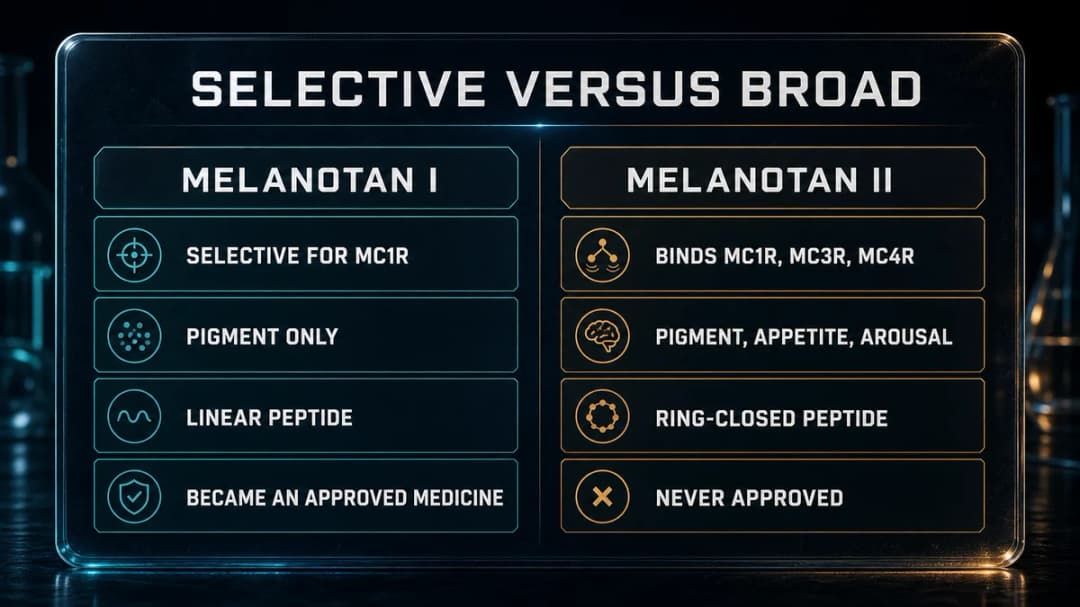
Melanotan I vs Melanotan II is a comparison people expect to be about strength, when it is really about selectivity. Melanotan I is a linear thirteen amino acid peptide that targets one melanocortin receptor. Melanotan II is a shorter cyclic peptide that hits four of them, which is why any discussion of Melanotan I vs Melanotan II ends up covering appetite, nausea and sexual arousal alongside skin colour.
One other difference dwarfs the pharmacology. Melanotan I, under its pharmaceutical name afamelanotide, is an approved medicine. Melanotan II is approved nowhere.
The Melanocortin System, Briefly
Both compounds are synthetic analogues of alpha-melanocyte stimulating hormone, a natural peptide that acts on a family of five receptors, each doing something different.
| Receptor | Where it acts | What it does |
|---|---|---|
| MC1R | Pigment cells in skin | Melanin production |
| MC2R | Adrenal cortex | Cortisol release, not relevant here |
| MC3R | Brain and gut | Energy balance |
| MC4R | Hypothalamus | Appetite and sexual arousal |
| MC5R | Exocrine glands | Sebaceous gland function |
Which receptors a compound binds determines everything about how it behaves. That is the whole comparison.
Melanotan I vs Melanotan II: The Core Difference
Melanotan I is a linear thirteen amino acid peptide, structurally close to the natural hormone with two modifications, a norleucine substitution and a D-phenylalanine, that make it resist enzymatic breakdown. It is largely selective for MC1R. It darkens skin and does very little else.
Melanotan II is a cyclic seven amino acid peptide, a much more heavily redesigned molecule. The ring in its structure locks its shape, which increases stability and binding affinity, and it binds MC1R, MC3R, MC4R and MC5R. It tans faster and it also suppresses appetite, produces nausea, causes flushing and drives sexual arousal, all through receptors that have nothing to do with skin.
Everything in the table below follows from those two paragraphs.
| Characteristic | Melanotan I | Melanotan II |
|---|---|---|
| Structure | Linear, 13 amino acids | Cyclic, 7 amino acids |
| Receptors | MC1R, largely selective | MC1R, MC3R, MC4R, MC5R |
| Tanning | Gradual, sustained | Faster, more potent per milligram |
| Nausea | Uncommon and mild | Common, often strong at first |
| Flushing | Mild | Moderate |
| Sexual effects | Minimal | Significant, including spontaneous erections in men |
| Appetite | Little effect | Suppression, dose dependent |
| Mole darkening | Yes | Yes |
| Approval status | Approved as afamelanotide for a rare disorder | Not approved anywhere |
| Route in clinical use | Slow-release implant | No clinical use |
How They Produce a Tan
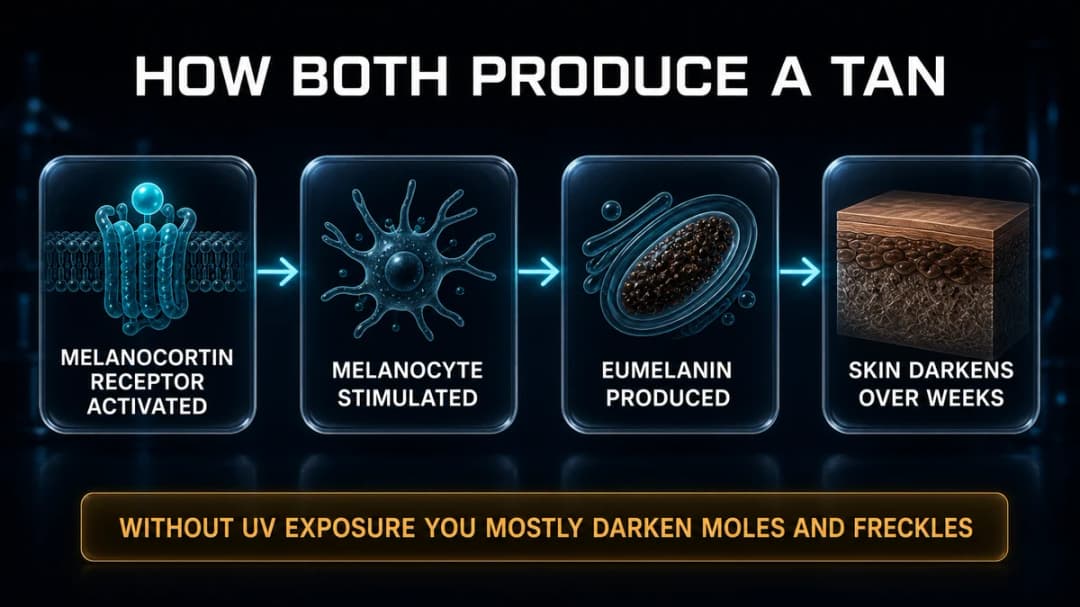
The pigment pathway itself is identical for both. Binding at MC1R activates adenylate cyclase, cyclic AMP rises, which drives expression of the transcription factor that controls the pigment machinery, which increases tyrosinase activity and eumelanin production. Eumelanin is the dark, ultraviolet-absorbing pigment.
The difference is not in this pathway. It is in everything happening in parallel through the other receptors.
Whether ultraviolet exposure is strictly required is often argued about. Melanocortin receptor activation does increase melanin synthesis on its own, but in practice the visible result is much faster and much more pronounced with UV exposure, which is why every real-world protocol includes it. That is also where the risk sits, since UV exposure is the established driver of skin cancer.
Melanotan I: The One That Became a Medicine
Melanotan I was developed in the 1980s at the University of Arizona. Its selectivity for MC1R is precisely what made pharmaceutical development possible, because a compound that only does one thing is a compound a regulator can evaluate.
Under the name afamelanotide, sold as Scenesse, it received European approval in 2014 and US approval in October 2019, for erythropoietic protoporphyria. EPP is a rare inherited disorder in which a build-up of protoporphyrin makes sunlight acutely painful. Trials showed the implant substantially increased pain-free time in sunlight, which for that population is a significant outcome.
It is delivered as a 16 mg bioresorbable implant placed under the skin by a clinician, releasing slowly over roughly two months. That delivery matters pharmacologically, because avoiding sharp plasma peaks reduces the nausea that bolus injection produces.
Research has also examined it in vitiligo alongside phototherapy, polymorphic light eruption and solar urticaria, with encouraging but not approved results. See our page on afamelanotide and Scenesse.
Note carefully: the research peptide sold as melanotan-1 is the same molecule, but nothing else about it is the same. Different manufacturing standards, different delivery, no medical supervision, and the clinical safety data from the approved product does not transfer to an unverified vial.
Melanotan II: The One That Did Not
Melanotan II was developed in the same programme and was never submitted for approval as a tanning agent. Its non-selective profile is the reason. A compound that causes nausea, appetite suppression and erections alongside pigmentation is difficult to develop for a cosmetic purpose.
That breadth did produce one clinical descendant. Research into its sexual effects led to bremelanotide, marketed as PT-141, which isolates the MC4R activity and is approved for hypoactive sexual desire disorder in premenopausal women. See our PT-141 guide.
Melanotan II remains an unapproved research compound sold online, and several national regulators have issued warnings about unlicensed products marketed for tanning.
Side Effects Compared
Melanotan I, from the clinical data on afamelanotide: nausea, headache, fatigue, implant site reactions, expected skin darkening, and increased pigmentation of existing moles with monitoring recommended. Notably absent are sexual effects, blood pressure changes and cardiovascular events.
Melanotan II, from user report rather than trials: nausea that is frequently strong on first use, facial flushing, yawning and fatigue after dosing, spontaneous erections in men, increased libido in both sexes, appetite suppression, and reports of blood pressure and heart rate changes.
Common to both: darkening of existing moles and reports of new pigmented lesions. This is the one that matters and it is not solved by choosing the more selective compound, since both act on pigment cells by design. Any mole changing shape, border or behaviour needs a dermatologist. See our page on Melanotan side effects.
Which One, for What
If the question is a rare photosensitivity disorder, the answer is afamelanotide through a specialist, not a vial from the internet.
If the question is pigmentation research, Melanotan I is the cleaner tool, because its effects are confined to the pathway being studied and there is genuine clinical safety data behind the molecule.
If the question is studying melanocortin signalling across receptors, Melanotan II is the compound that does that, with all the complexity that implies.
If the question is cosmetic tanning, both are unapproved for that purpose, both stimulate pigment cells throughout the skin, and both protocols in practice involve deliberate ultraviolet exposure. That is the honest answer, and it is why dermatology bodies advise against it.
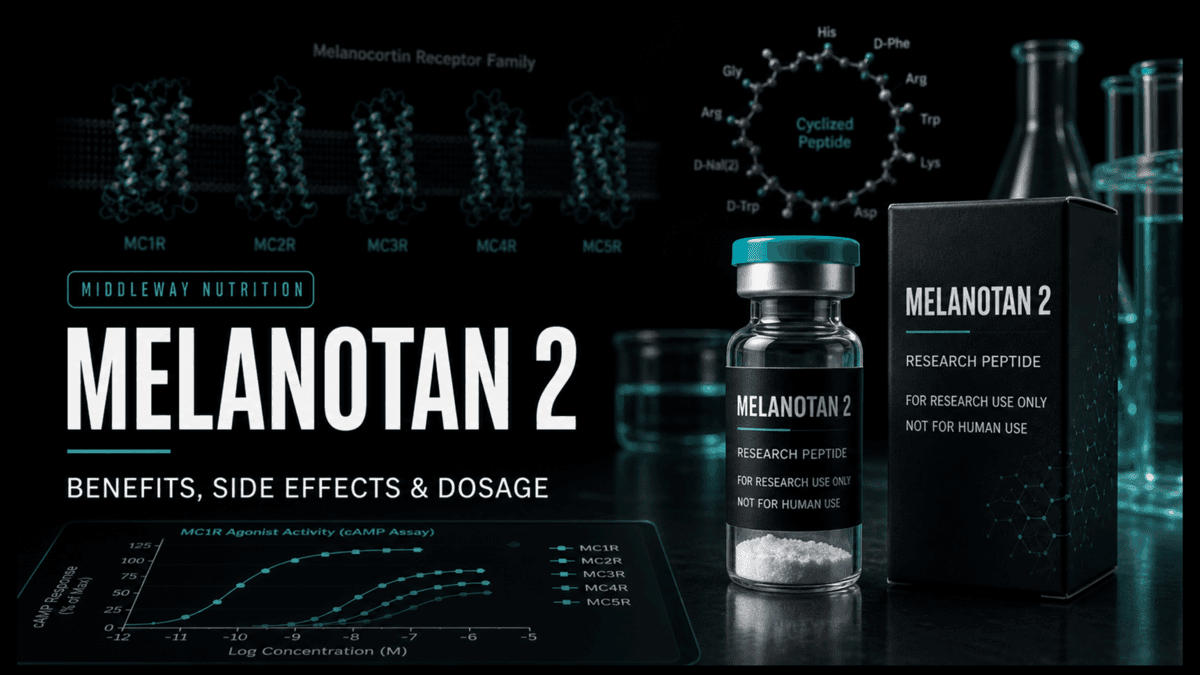
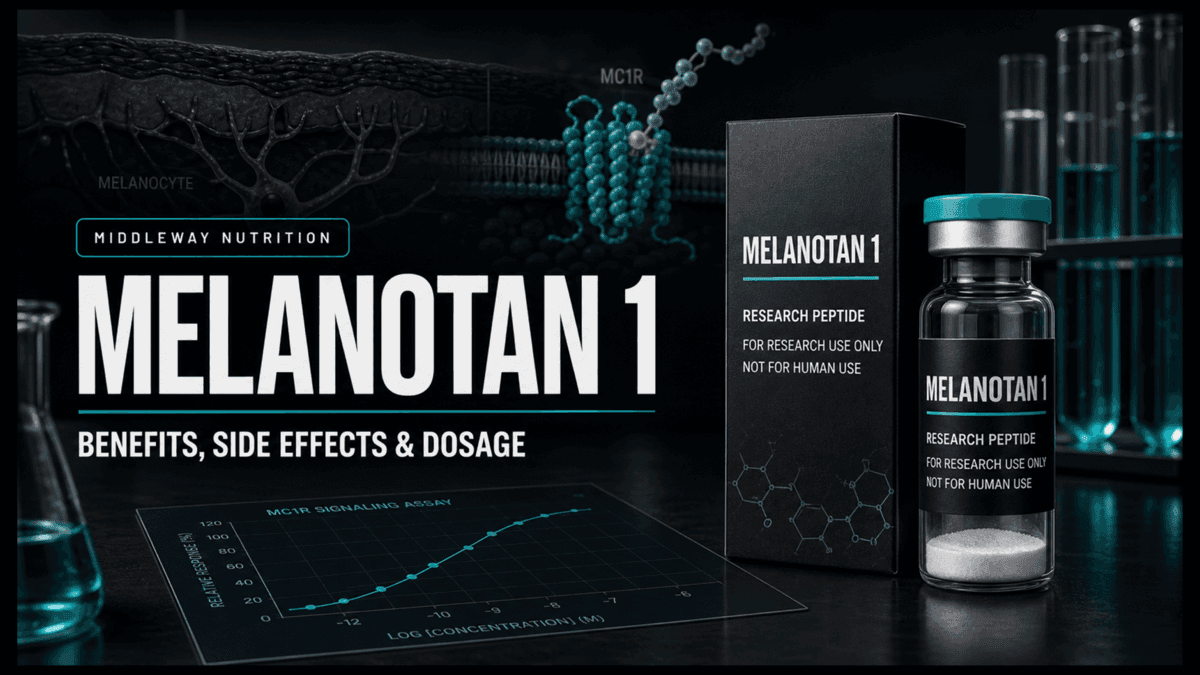
For reported dosing, see our Melanotan dosage guide, and for the individual compounds our Melanotan 1 guide and Melanotan 2 guide.
FAQ
Is Melanotan I safer than Melanotan II?
On the evidence available, yes, in the sense that it has completed clinical trials, has an approval and a documented safety profile, and does not produce the sexual, appetite and nausea effects that come from binding receptors in the brain. The pigment cell question applies to both.
Which one tans faster?
Melanotan II, both because it is more potent at the pigment receptor and because its cyclic structure makes it more stable. That speed comes with the side effects that made it undevelopable as a medicine.
Why does Melanotan II cause erections and Melanotan I does not?
Melanotan II binds MC4R and MC3R in the central nervous system, which sit in sexual arousal pathways. Melanotan I is selective for MC1R, which is on skin cells rather than in the brain.
Is afamelanotide the same thing as Melanotan I?
Same molecule, different worlds. Afamelanotide is the pharmaceutical name for a product manufactured to pharmaceutical standards and delivered as a supervised implant. Melanotan-1 is what the same sequence is called in the research chemical market, where nothing is guaranteed.
Do either require UV exposure?
Receptor activation increases melanin production on its own, but the visible result is far faster and stronger with ultraviolet exposure, which is why practical protocols include it. That exposure is also the main source of the risk.
Can either cause melanoma?
Neither has been shown to, and neither has been ruled out. Both stimulate pigment cells and both are associated with darkening moles and reports of new pigmented lesions. Any changing mole needs professional assessment rather than reassurance from an article.