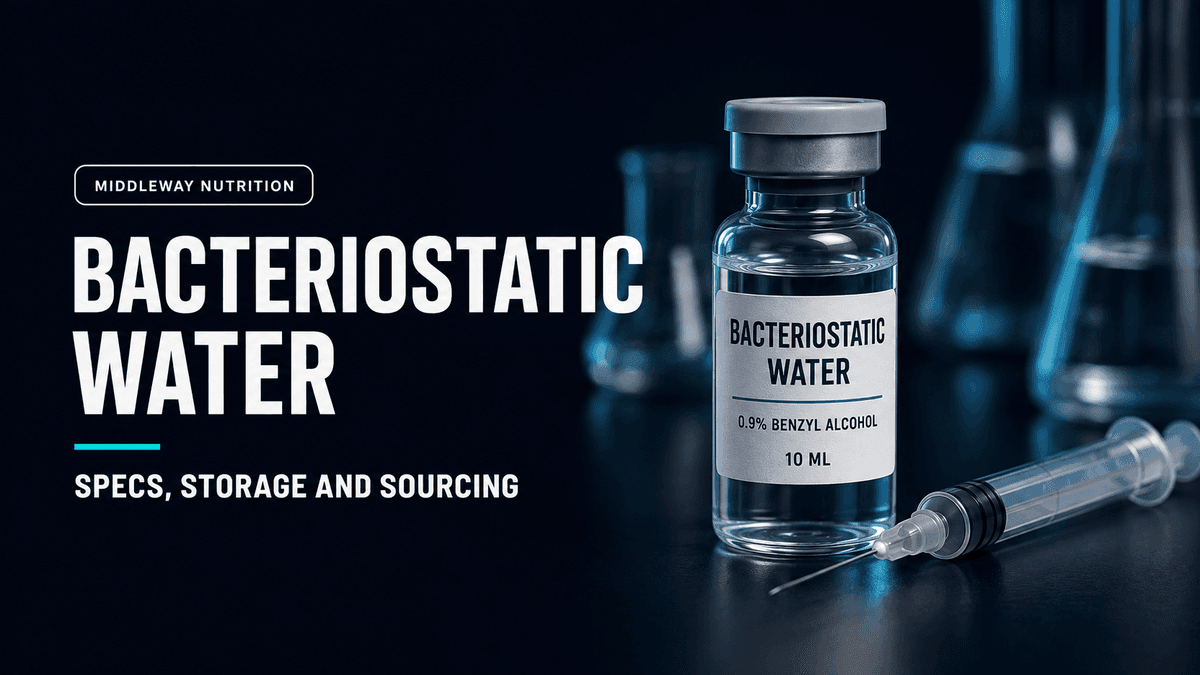
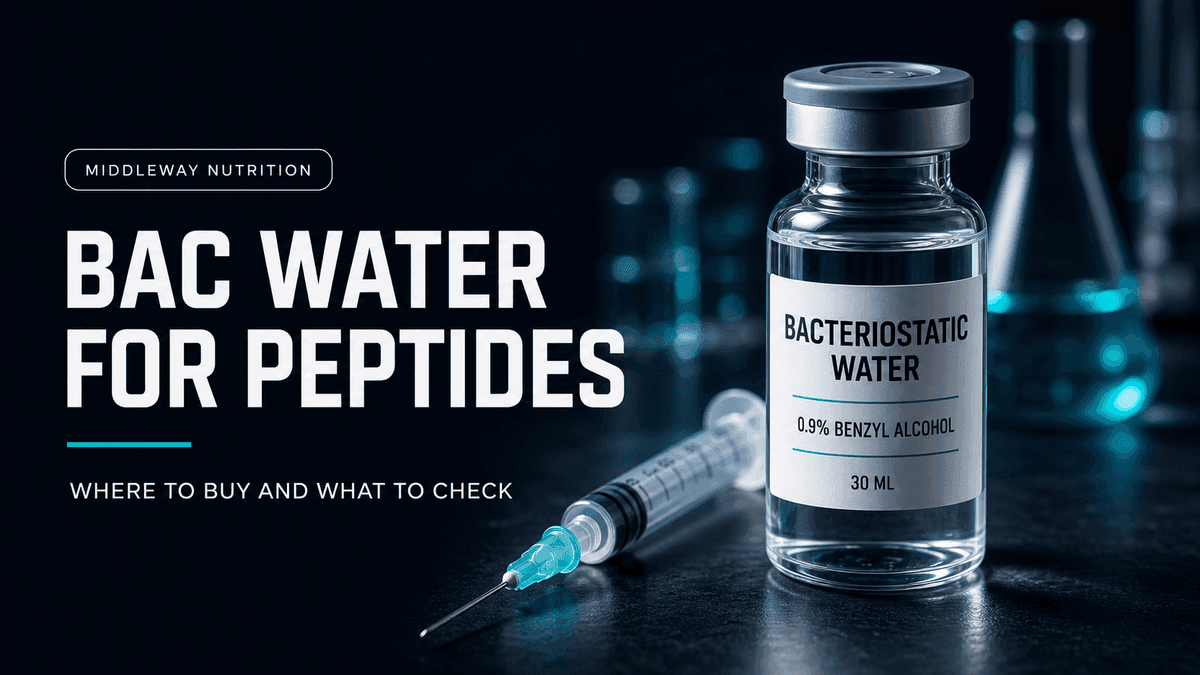
BAC water (bacteriostatic water) for peptides is sterile USP Water for Injection with 0.9 percent benzyl alcohol added, and that preservative is the only reason a reconstituted vial survives repeated needle punctures for about four weeks. Buying BAC water (bacteriostatic water) for peptides is harder than it should be, because chain pharmacies keep it behind the counter, the large marketplaces removed most listings, and the online sellers who remain vary enormously in what is actually in the vial.
The short answer on where: a specialist supplier that publishes batch-level testing. The longer answer, including how to tell one from the rest, is below.
What You Are Actually Buying
Two ingredients. Sterile water made to United States Pharmacopeia standards for injection, and benzyl alcohol at 0.9 percent, which is 9 mg per millilitre.
The benzyl alcohol is the entire product. It is bacteriostatic rather than bactericidal, meaning it prevents bacteria from multiplying rather than killing an existing contamination. That is enough to make a multi-dose vial workable: you can draw from the same reconstituted peptide across several weeks instead of discarding it after a day.
Real product looks like a glass multi-dose vial with a rubber stopper and an aluminium crimp seal, in 10, 20 or 30 ml. A soft plastic squeeze bottle is not bacteriostatic water regardless of what the label says.
BAC Water (Bacteriostatic Water) for Peptides: Where to Buy
| Source | Availability | Typical price | Verdict |
|---|---|---|---|
| Chain pharmacies | Behind the counter, usually needs a prescription | $20 to $35 for a 30 ml pharmaceutical vial | Excellent water, difficult access, no batch paperwork given to retail buyers |
| Large online marketplaces | Listings largely removed or restricted | Varies wildly | Not worth the risk. Frequently mislabelled |
| Peptide suppliers | Usually stocked alongside their vials | Roughly $14 to $16 for 10 ml | The practical route for most people, provided the supplier publishes testing |
| Specialist BAC water sellers | Online only | $10 to $20 for 10 ml | Good when batch certificates are public. Meaningless when they are not |
Why the pharmacy route is hard. Bacteriostatic water is an injectable drug product, not a consumer item. When a pharmacy stocks it at all, it sits behind the counter and often requires a prescription. Asking a pharmacist to order a pharmaceutical vial against a prescription can work. Walking in and picking one off a shelf does not.
Specialist sellers. A vendor that stocks nothing but bacteriostatic water lives or dies on its paperwork, so the batch certificate tends to be front and centre rather than buried. That is the row worth checking when a peptide supplier ships water with no certificate at all.
The practical route. Buying from a seller that does nothing else means the paperwork is the product rather than an afterthought. PureBac sells two SKUs and publishes a certificate of analysis for every batch, which is the standard the checks below are built around.

What you are paying for: 0.9% benzyl alcohol in USP Water for Injection, confirmed on every batch rather than stated on a label. PureBac runs a seven-point protocol per lot: purity against the USP Water for Injection standard, benzyl alcohol identity and concentration, net fill volume, heavy metals by ICP, endotoxins by LAL against the 0.25 EU/mL limit, sterility, and batch-to-batch variance. The certificates are published rather than sent on request.
Sizes and price: 10 mL at $14.99 for multi-dose work, 3 mL at $7.99 when one vial is all a single reconstitution needs. Free shipping over $150.
Check the current batch certificate — affiliate link, we earn a commission at no extra cost to you.
Whichever route someone takes, the checks in the next section are what matter more than the seller's name.
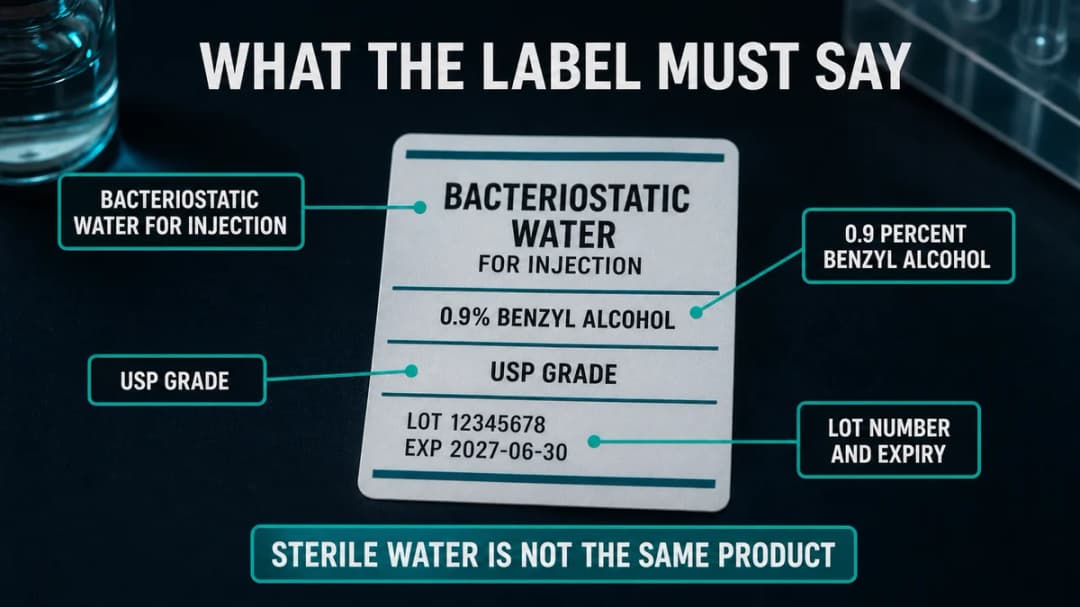
What to Check Before Buying
A clear liquid in a glass vial tells you nothing. These are the things that do.
A batch-specific certificate of analysis. Not a generic PDF, not a claim on the product page. A document tied to the lot number printed on the vial you receive. If it requires an account, a request form, or a conversation with support, that is a signal.
Benzyl alcohol assayed at 0.9 percent. This is the ingredient that makes it bacteriostatic. Sterile water sold as BAC water is a real problem in this market, and the only way to know the difference is an assay.
Sterility testing. Confirmed absence of aerobic and anaerobic bacteria and fungi. A clear vial is not necessarily a sterile vial.
Endotoxin testing. Bacterial endotoxins survive sterilisation and cause inflammatory reactions at the injection site. Water for Injection standards set a limit for a reason.
Heavy metals. Lead, arsenic, mercury and cadmium below pharmacopoeia limits.
A lot number on the vial itself, matching the paperwork. Without that link, the paperwork describes some other batch.
What It Should Cost
A 10 ml vial from a reputable seller sits in the $10 to $20 range, so roughly $1 to $2 per millilitre. Pharmaceutical 30 ml vials work out cheaper per millilitre, around $0.70 to $1.20, but come with the access problem and no per-lot documentation handed to the buyer.
Most people overbuy. A 10 ml vial reconstitutes several peptide vials, and once punctured it should be used within about 28 days anyway, so a bulk purchase often means paying for water that gets discarded. Buy to match how much you will actually draw in a month.
How Much You Need
The volume you add to a peptide vial is a choice rather than a fixed number, and it sets the concentration.
Concentration in mg per ml equals the peptide mass in mg divided by the millilitres of water added.
| Peptide vial | Water added | Concentration | 250 mcg dose | 500 mcg dose |
|---|---|---|---|---|
| 5 mg | 2 ml | 2.5 mg/ml | 10 units | 20 units |
| 5 mg | 1 ml | 5 mg/ml | 5 units | 10 units |
| 10 mg | 2 ml | 5 mg/ml | 5 units | 10 units |
| 10 mg | 5 ml | 2 mg/ml | 12.5 units | 25 units |
Units refer to a 100-unit insulin syringe, where 1 ml is 100 units. More water makes small doses easier to measure accurately, which usually matters more than the extra volume. See our peptide reconstitution calculator and our guide to what bacteriostatic water is.
Storage and the 28-Day Rule
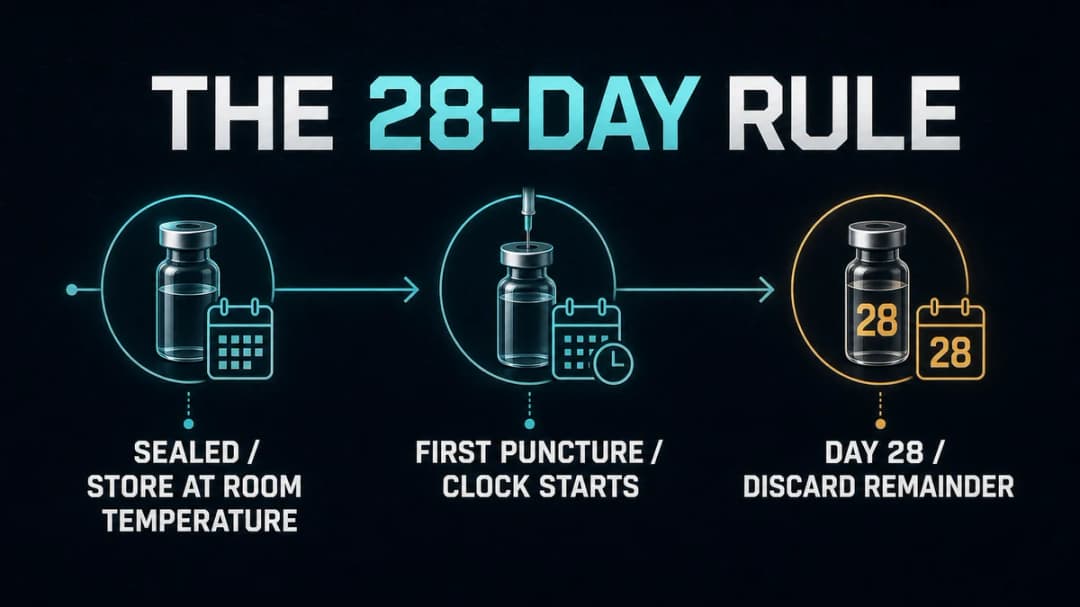
Sealed vials sit at room temperature until first use. Once a needle goes in, refrigerate and use within about 28 days, counted from that first puncture rather than from when it arrived.
That window is a property of the preservative, not a marketing number. After roughly a month of repeated punctures the assumption that the vial is still protected stops being safe.
Same rule applies to the reconstituted peptide it was used on. Wipe the stopper with alcohol before every draw, use a fresh needle each time, and keep both refrigerated.
When Not to Use It
A small number of peptides do not tolerate benzyl alcohol well, including some hCG and NAD preparations. For those, preservative-free sterile water is used instead, and anything mixed with it must be treated as single use and discarded within about a day.
A few poorly soluble peptides are reconstituted with dilute acetic acid instead, which is a specific situation rather than a general alternative.
If a supplier's instructions specify a solvent, follow those rather than a general rule from an article.
FAQ
Can you buy bacteriostatic water at CVS or Walgreens?
Rarely off the shelf. It is an injectable drug product, so when a pharmacy stocks it at all it sits behind the counter and usually needs a prescription. Most people end up buying online instead.
What should a vial of BAC water cost?
Roughly $10 to $20 for a 10 ml vial from a reputable seller. Pharmaceutical 30 ml vials are cheaper per millilitre but harder to obtain and come without per-lot paperwork for the buyer.
How can I tell if BAC water is genuine?
A batch-specific certificate of analysis showing benzyl alcohol assayed at 0.9 percent, plus sterility and endotoxin testing, with a lot number matching the vial. Without that, there is no way to distinguish it from plain sterile water in a similar vial.
How long does an opened vial last?
About 28 days refrigerated, counted from the first needle puncture rather than from purchase. The same window applies to the peptide it reconstitutes.
Is bacteriostatic water the same as sterile water?
No. Sterile water has no preservative, so anything mixed with it is single use and should be discarded within about a day. Bacteriostatic water contains benzyl alcohol, which is what makes repeated draws from one vial possible.
How much do I add to a peptide vial?
Whatever gives a concentration you can measure accurately. Divide the peptide milligrams by the millilitres of water to get mg per ml. A 10 mg vial with 2 ml of water gives 5 mg per ml, so 500 mcg is 10 units on an insulin syringe.