This page covers the nasal form only. For full dose tables by indication and vial size, see the Semax dosage chart; for a broader overview, start with the Semax peptide guide.
What is Semax nasal spray?
Semax is a seven-amino-acid peptide built from the ACTH(4-7) sequence (Met-Glu-His-Phe) plus a Pro-Gly-Pro tail added for stability, which is why it is described as an ACTH(4-10) analog. The "nasal spray" sold online is usually a reseller-filled or homemade version of a product that, in Russia, comes as nasal drops.
FDA lists its molecular formula as C37H51N9O10S and its molecular weight as 813.93 g/mol (FDA PCAC briefing document, 2026). Despite the ACTH origin, the Russian label says it is "completely devoid of hormonal activity" (Vidal, Semax 0.1%). It came out of the Institute of Molecular Genetics of the Russian Academy of Sciences, whose researchers published a review of its first 15 years in 1997 (Asmarin et al., 1997, PMID 9173745). The registered drops are made by JSC Peptogen and contain the peptide, methylparaben (1 g per liter) as a preservative, and purified water (Vidal, Semax 1%).
Is Semax nasal spray legal or FDA-approved?
No. Semax is not FDA-approved. It has no USP monograph and is not a component of any FDA-approved drug (FDA briefing document). In the US, products labeled Semax are sold as research-use-only chemicals that are not approved for human use.
The compounding picture changed twice in 2026:
- April 2026: the compounding nominations for Semax were withdrawn, taking it out of FDA's Category 2 ("significant safety risks"). FDA now lists it as "nominated but withdrawn", noting it "may pose risk for immunogenicity for certain routes of administration" (FDA, bulk substances that may present significant safety risks, content current as of 04/22/2026). Leaving Category 2 did not put Semax on the 503A bulks list.
- July 24, 2026: FDA's Pharmacy Compounding Advisory Committee reviewed Semax free base and Semax acetate for cerebral ischemia, migraine and trigeminal neuralgia (FDA meeting page). FDA staff concluded the evidence weighed against listing either form. The panel still voted 8-5, with one abstention, to recommend adding Semax (STAT News, July 24, 2026).
The vote is advice, not a decision; FDA would first have to publish a proposed rule for public comment. We found no proposed or final rule for Semax as of November 4, 2026. In Russia, both strengths are prescription-only (Vidal, Semax 1%).
Semax 0.1% vs 1%: what is the difference?
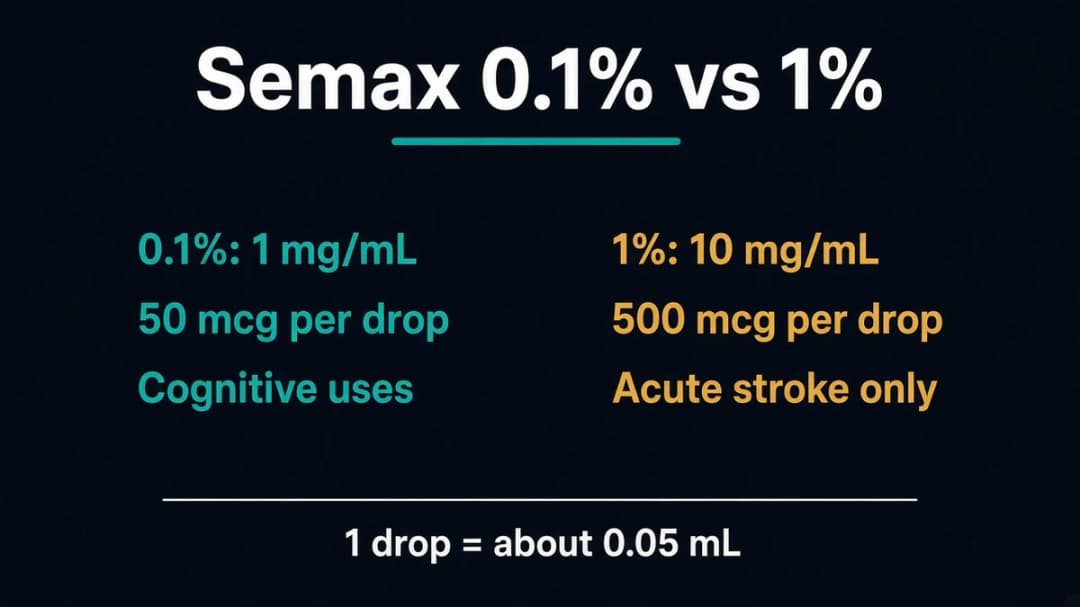
The 1% solution is ten times stronger than the 0.1% solution, and the two are registered for different uses. The 0.1% drops cover cognitive, neurological and eye indications. The 1% drops are registered only for the acute period of moderate to severe ischemic stroke, as part of combined therapy.
| Russian label (Vidal, registrations dated Mar 26, 2025 and Jun 18, 2025) | Semax 0.1% | Semax 1% |
|---|---|---|
| Concentration | 1 mg/mL | 10 mg/mL |
| Peptide per drop | 50 mcg | 500 mcg |
| Peptide per 3 mL bottle | 3 mg | 30 mg |
| Registered uses | Memory and attention disorders, TIA, post-stroke recovery, after brain injury or surgery, optic nerve disease, childhood ADHD (age 7+) | Acute moderate to severe ischemic stroke, with other therapy |
| Per instillation | Up to 2-3 drops per nostril | 2-3 drops per nostril (moderate stroke), 3-4 drops (severe stroke) |
| Daily range (examples) | 400-900 mcg (fatigue prevention) | 6,000-20,000 mcg |
| Minimum age | 7 years (18 in eye and neurosurgery use) | 18 years |
| Storage | 2-8 °C | 2-8 °C |
| Status | Prescription | Prescription |
Sources: Vidal 0.1%, Vidal 1%.
The per-drop numbers imply a drop of about 0.05 mL (1,000 mcg per mL ÷ 50 mcg per drop). The 1% label confirms it: 4 drops equal 0.2 mL and 2,000 mcg.
The label caps a single instillation at 2-3 drops per nostril and says larger doses should be given in rounds 10-15 minutes apart (Vidal 0.1%). Using a 1% bottle with 0.1% instructions gives ten times the intended amount, so check the strength first.
How does nasal administration get Semax to the brain?
Some of it is absorbed into the blood through the nasal lining, and some appears to reach the brain more directly along nerve pathways from the nose. The Russian label says up to 60-70% of the dose is absorbed from the nasal lining, that Semax crosses the blood-brain barrier, and that it is broken down quickly once in the blood (Vidal, Semax 0.1%).
Rat data summarized by FDA show why the nose is preferred: about 0.072% of a radiolabeled intranasal dose reached the brain versus about 0.005% of an intravenous dose, with a higher brain-to-blood ratio (0.67 vs 0.24). Intranasal peptides are thought to travel partly along olfactory nerve cells linking the nasal cavity to the brain (FDA briefing document).
These are rat numbers. FDA found no pharmacokinetic studies of Semax in humans by any route, so claims about how fast or how long it works in people are estimates.
How do you use Semax nasal spray?
The Russian product is a dropper bottle used at no more than 2-3 drops per nostril at a time (Vidal 0.1%). Spray bottles are a different device, so drop counts do not translate one to one. General nasal-dosing practice looks like this:
- Confirm the strength (0.1%, 1% or a custom mg/mL) before working out any dose.
- Clear the nose gently so the solution reaches the lining instead of mucus.
- Prime a new spray pump into the air until it gives an even mist. Priming uses up some solution.
- Spray into one nostril, then the other, head upright or slightly forward, breathing in gently. Hard sniffing sends liquid down the throat.
- Avoid nasal decongestant sprays around the same time. The label says vasoconstrictor nose sprays are "undesirable" with Semax (Vidal 1%).
The Russian regimens put 0.1% doses in the first half of the day for fatigue prevention. If you are considering Semax for any health reason, talk to a clinician first, especially if you take other medicines.
How many mcg are in one spray of Semax?
It depends on the concentration in mg/mL and the volume your pump delivers, which for many metered nasal pumps is about 0.1 mL. For example, a US fluticasone nasal spray label says each actuation delivers its dose "in 100 mg of formulation", roughly 0.1 mL (DailyMed fluticasone propionate nasal spray). Pumps vary, so check the rated volume of yours.
The formula is: mcg per spray = concentration (mg/mL) × 1,000 × spray volume (mL).
| Solution | Concentration | mcg per 0.1 mL spray | Same as |
|---|---|---|---|
| Russian 0.1% | 1 mg/mL | 100 mcg | 2 drops of 0.1% |
| 30 mg in 10 mL (a retail spray format FDA found marketed in the US) | 3 mg/mL | 300 mcg | 6 drops of 0.1% |
| 7,500 mcg/mL (strength proposed in the 2026 compounding nominations) | 7.5 mg/mL | 750 mcg | 1.5 drops of 1% |
| Russian 1% | 10 mg/mL | 1,000 mcg | 2 drops of 1% |
Sources: label strengths from Vidal; 30 mg/10 mL product and 7,500 mcg/mL nominated strength from the FDA briefing document, checked November 2026.
So "one spray" means very different amounts on different products. For how these line up with label regimens, see the Semax dosage chart.
How do you make Semax nasal spray from a 10 mg vial?
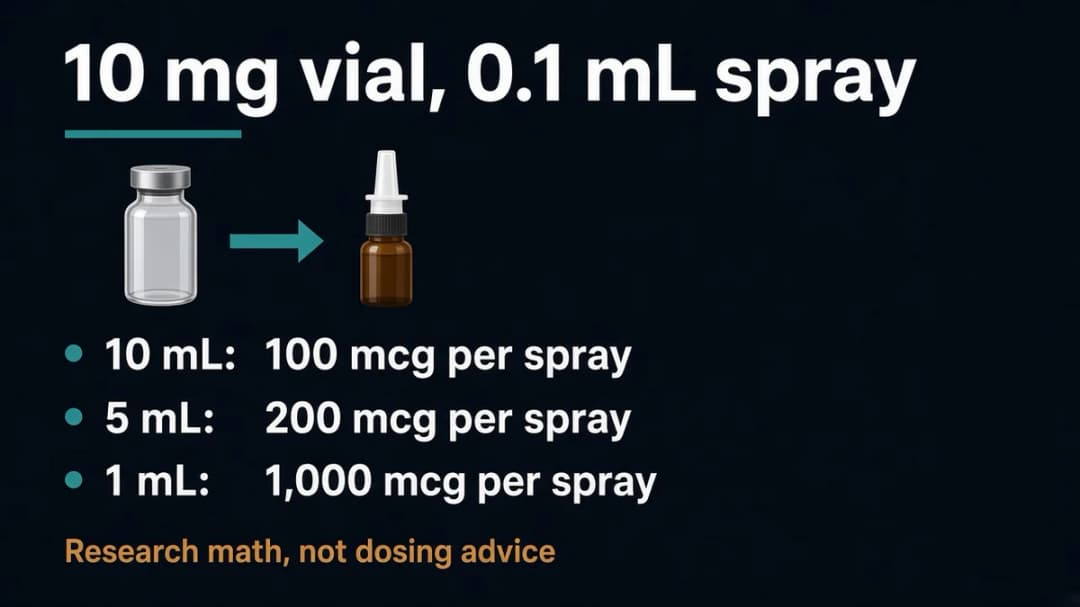
Research vials hold dry powder, and the final concentration is simply peptide mass divided by liquid volume. The math below is research-context arithmetic, not dosing advice; unapproved peptides of unknown purity carry risks no calculation removes.
| Liquid added to 10 mg | Concentration | Approx. strength | mcg per 0.1 mL spray | Sprays per 10 mg (before priming loss) |
|---|---|---|---|---|
| 10 mL | 1 mg/mL | 0.1% | 100 | 100 |
| 5 mL | 2 mg/mL | 0.2% | 200 | 50 |
| 3.3 mL | 3 mg/mL | 0.3% | 300 | 33 |
| 2 mL | 5 mg/mL | 0.5% | 500 | 20 |
| 1 mL | 10 mg/mL | 1% | 1,000 | 10 |
Worked example: 10 mg is 10,000 mcg. In 10 mL that is 1,000 mcg per mL, the same strength as the Russian 0.1% drops, so a 0.1 mL spray carries 100 mcg, equal to two label drops. Since 10 mL will not fit in most small vials, the powder is usually dissolved in less liquid, moved to the spray bottle and topped up. The peptide reconstitution calculator does this arithmetic for other vial sizes.
Which liquid? This is where research practice and the registered product differ:
- The Russian drops use purified water with 0.1% methylparaben as a preservative (Vidal 1%).
- Bacteriostatic water contains 0.9% or 1.1% benzyl alcohol and is labeled for diluting or dissolving drugs for injection, not for nasal use (DailyMed, Bacteriostatic Water for Injection).
- Sterile saline without a preservative has no protection against bacteria once a multi-use spray bottle is opened.
FDA also flagged the device: pump delivery, spray content uniformity and droplet size all affect how much peptide arrives, and nominators gave no information on any of them (FDA briefing document).
What is N-acetyl Semax amidate, and is it different?
N-acetyl Semax amidate is Semax with an acetyl group on the front end and an amide on the tail end. Sellers claim it is more stable and longer lasting, but it is not the registered Russian drug and we found no published human study of it.
The closest peer-reviewed work is a 2016 lab study of N-acetylated Semax (acetylation only, without the amide). It found that acetylation changed how the peptide binds copper. It also found the acetylated form did not protect nerve-like cells from copper toxicity, which the authors attributed to losing the free amino end (Magrì et al., 2016, PMID 27586814). That is a cell-culture result, not evidence of a stronger effect in people.
The label doses and research on this page apply to plain Semax. For its sister peptide from the same institute, see Semax vs Selank.
What does the research on Semax actually show?
The evidence is mostly Russian, small, and often in rats. FDA's 2026 review found human data on roughly 33-47 healthy adults, 69 adults with medical conditions and 451 children, partly from conference abstracts and often with Semax given alongside other treatments (FDA briefing document).
| Study | Who | Nasal dose | What it measured |
|---|---|---|---|
| Dolotov et al., 2006 (PMID 16996037) | Rats | 50 mcg/kg once | Hippocampal BDNF protein up 1.4-fold; trkB activation up 1.6-fold |
| Kaplan et al., 1996 (per FDA review) | 19 healthy men | 1 mg daily for 2 days, or 0.25 mg once | EEG and operator work-efficiency measures |
| Lebedeva et al., 2018 (PMID 30225715) | 24 healthy adults (14 Semax, 10 placebo) | 1% Semax, single dose | Resting-state fMRI 5 and 20 minutes after dosing |
| Gusev et al., 2018 (PMID 29798983) | 110 patients after ischemic stroke | 6,000 mcg/day, two 10-day courses 20 days apart | Plasma BDNF, motor scores, Barthel index |
The stroke study matters most for the 1% label, since 6,000 mcg/day is the low end of the moderate-stroke range. Patients given Semax had higher BDNF and faster gains in Barthel scores, a measure of daily-living independence. But the abstract describes no placebo group or blinding, and FDA did not count Russian-language studies like it because full English translations were not available.
FDA found "insufficient evidence of effectiveness" for cerebral ischemia, migraine and trigeminal neuralgia, and noted that stroke guidelines do not mention Semax and that approved treatments exist for each condition (FDA briefing document). No large Western randomized trial of Semax nasal spray has been published.
What are the side effects of Semax nasal spray?
The only side effect on the current Russian label is mild irritation of the nasal lining with prolonged use (Vidal 0.1%). Older Russian label text also listed agitation and insomnia (RLS, Semax 0.1% solution). Our Semax side effects page covers headaches and other user reports in more depth.
The label rules it out in acute psychotic states, anxiety disorders, a history of seizures, pregnancy and breastfeeding, allergy to any component, and children under 7 (0.1%) or under 18 (1%).
FDA raised further concerns: most human studies did not report side effects at all, one abstract suggested antithrombotic effects (a bleeding question for people on blood thinners), and in mice Semax increased amphetamine-triggered dopamine release. FDA's adverse event database held one report through December 3, 2025: a consumer who described eye pain and burning, with hospitalization, after using 0.1% drops bought online (FDA briefing document). Research-chemical sprays are also not tested to drug standards.
How should Semax nasal spray be stored?
The current Russian labels say to store both strengths at 2-8 °C, which is normal refrigerator temperature (Vidal 0.1%). Older label text said protect from light, keep below 10 °C, do not freeze, and gave a 2-year shelf life for unopened bottles (RLS).
For research powder, supplier data cited by FDA say lyophilized Semax free base is stable for 4 years at -20 °C, and reconstituted solution should be kept at about 4 °C for 2-7 days (FDA briefing document). That short window makes a large homemade batch a poor fit. FDA also warned that poorly stored peptides can aggregate, which can reduce activity and raise immune-reaction concerns.
Before buying any product sold as Semax, read our guide to Semax for sale for what to check on testing and labeling.
Frequently Asked Questions
Is Semax nasal spray FDA-approved?
No. Semax is not FDA-approved for any use and is sold in the US as a research chemical. An FDA advisory committee voted 8-5 in July 2026 to recommend allowing compounding, but the vote is not binding and no final rule existed as of November 4, 2026.
What is the difference between Semax 0.1% and 1%?
The 1% solution is ten times more concentrated: 500 mcg per drop versus 50 mcg per drop. In Russia, the 0.1% drops are registered for cognitive, neurological and optic nerve uses, while the 1% drops are registered only for acute ischemic stroke in adults as part of combined therapy.
How many mcg are in one spray of Semax?
Multiply the concentration in mg/mL by 1,000 and by the spray volume in mL. With a 0.1 mL pump, 0.1% solution gives 100 mcg per spray and 1% solution gives 1,000 mcg.
How many doses are in a 3 mL bottle of Semax drops?
At about 0.05 mL per drop, a 3 mL bottle holds roughly 60 drops: 3 mg of peptide at 0.1% or 30 mg at 1%. Spray bottles lose some solution to priming.
Can you use bacteriostatic water to make Semax nasal spray?
People do, but bacteriostatic water contains 0.9% or 1.1% benzyl alcohol and is labeled for diluting injectable drugs, not for nasal use. The registered Russian drops use purified water with 0.1% methylparaben instead.
Does Semax nasal spray need to be refrigerated?
Yes. The current Russian labels say 2-8 °C, and older labels add: protect from light and do not freeze. Supplier data cited by FDA suggest reconstituted research Semax be kept at about 4 °C for only 2-7 days.
Is N-acetyl Semax amidate stronger than Semax?
There is no published human evidence that it is, and it is not the registered Russian drug. The one relevant lab study found acetylation removed a cell-protective effect seen with plain Semax.
Can Semax be injected instead of used nasally?
The registered product is nasal only. FDA found no published safety data for injected Semax, every human study it reviewed was intranasal, and it flagged immune-reaction concerns for injected peptides of uncertain purity.
Sources
- FDA briefing document: Semax-related bulk drug substances, Pharmacy Compounding Advisory Committee, July 23-24, 2026
- FDA: Certain bulk drug substances for use in compounding that may present significant safety risks (current as of 04/22/2026)
- FDA: July 23-24, 2026 Pharmacy Compounding Advisory Committee meeting
- STAT News: FDA advisory panel vote on epitalon, semax and emideltide (July 24, 2026)
- Vidal: Semax 0.1% nasal drops, Russian label (registration LP-009449, Mar 26, 2025)
- Vidal: Semax 1% nasal drops, Russian label (registration LP-010596, Jun 18, 2025)
- RLS encyclopedia: Semax nasal drops 0.1% and 1%
- Dolotov et al., Brain Research, 2006 (PMID 16996037)
- Gusev et al., Zh Nevrol Psikhiatr Im S S Korsakova, 2018 (PMID 29798983)
- Lebedeva et al., Bull Exp Biol Med, 2018 (PMID 30225715)
- Magrì et al., J Inorg Biochem, 2016 (PMID 27586814)
- Asmarin et al., Zh Vyssh Nerv Deiat Im I P Pavlova, 1997 (PMID 9173745)
- DailyMed: fluticasone propionate nasal spray label
- DailyMed: Bacteriostatic Water for Injection, USP