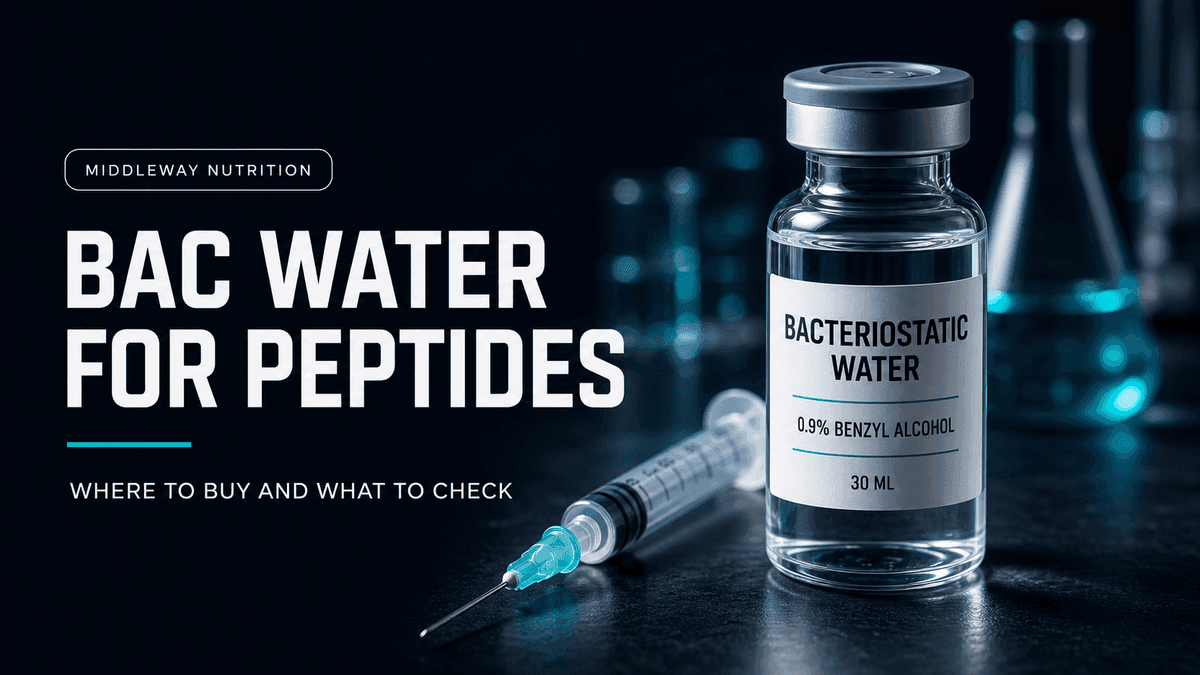
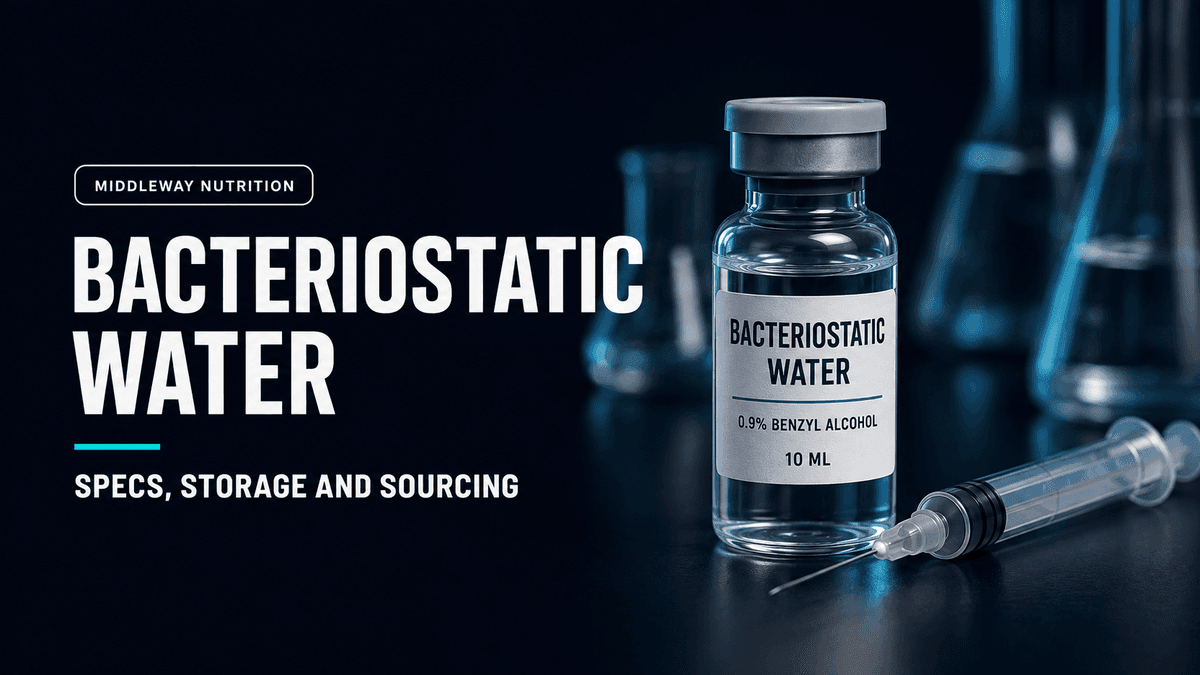
Bacteriostatic water is sterile water for injection with one thing added: 0.9% benzyl alcohol, about 9 mg per millilitre. That single preservative is the whole reason a vial can be punctured more than once. Everything else people argue about — brand, price, vial size — matters far less than whether the water in front of you actually meets that specification and can prove it.
Reconstitution is the step where a good peptide gets ruined. The compound arrives as a stable lyophilised powder; the moment solvent goes in, it becomes a solution that can be contaminated, degraded, or quietly diluted to the wrong concentration. The solvent is not a commodity in that process. It is the variable most people never check.
Key Takeaways
- Bacteriostatic water is USP Water for Injection plus 0.9% benzyl alcohol. Sterile water for injection has no preservative and is single-use only.
- The benzyl alcohol is bacteriostatic, not bactericidal. It suppresses growth of organisms introduced by a needle; it does not sterilise anything.
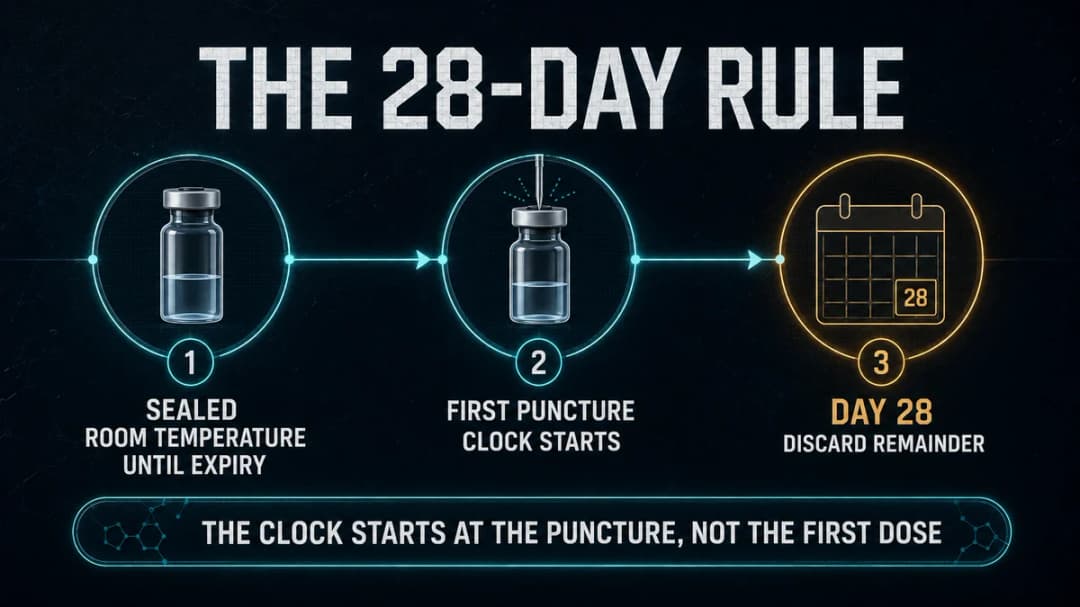
- An opened vial gets 28 days. That clock starts at the first puncture, not at the first dose.
- Benzyl alcohol is contraindicated in neonates and should not be used for intrathecal, epidural or ophthalmic routes.
- The specification is easy to state and hard to verify. A batch-specific certificate of analysis is the only thing that closes that gap.
What Bacteriostatic Water Actually Is
Two ingredients. USP-grade Water for Injection, and benzyl alcohol at 0.9% weight/volume. Nothing else — no buffer, no salt, no tonicity agent.
Benzyl alcohol is an aromatic alcohol that disrupts bacterial cell membranes at low concentrations. At 0.9% it is high enough to stop most common skin and airborne organisms from multiplying in the vial, and low enough that the volumes used in reconstitution stay well inside established safety margins for adults.
The word that does the work is bacteriostatic. It means growth-inhibiting. It does not mean germ-killing. If you introduce a genuinely contaminated needle into the vial, the preservative slows the problem down rather than solving it. This is why aseptic technique still matters even with a preserved solvent.
The Specification, Stated Plainly
| Property | What it should be |
|---|---|
| Water base | USP Water for Injection |
| Preservative | Benzyl alcohol, 0.9% w/v (9 mg/mL) |
| Appearance | Clear, colourless, no particulate |
| pH | Roughly 4.5 to 7.0 |
| Endotoxin limit | Below 0.25 EU/mL, the USP limit for Water for Injection |
| Sterility | No aerobic bacteria, anaerobic bacteria or fungi at release |
| Container | Sealed glass vial with a self-sealing elastomeric closure |
| In-use window | 28 days from first puncture |
Every line in that table is checkable. That is the point of reproducing it: it converts "is this good water?" into a list of specific questions a supplier either answers or does not.
Bacteriostatic Water Compared With the Alternatives
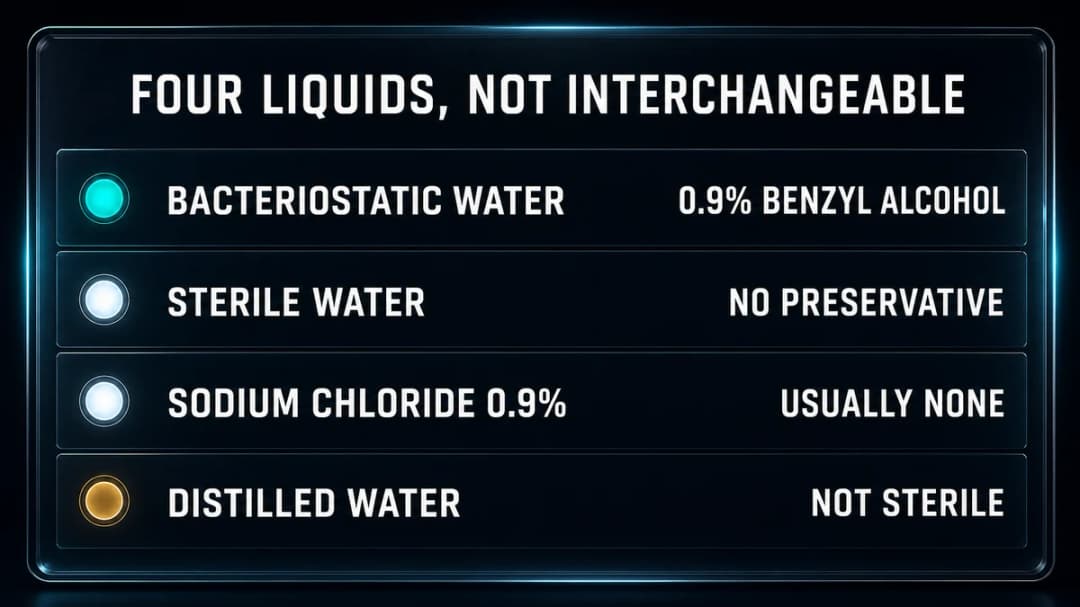
The four liquids people confuse most often are not interchangeable.
| Solvent | Preservative | Punctures | Typical use |
|---|---|---|---|
| Bacteriostatic water | 0.9% benzyl alcohol | Multiple, 28 days | Multi-dose reconstitution |
| Sterile water for injection | None | Single use, discard immediately | One-shot preparations |
| 0.9% sodium chloride | Usually none | Single use unless marked bacteriostatic | Isotonic dilution |
| Distilled water | None, and not sterile | Not for injection at all | Laboratory and household use |
Distilled water is the dangerous one, because it is cheap, widely sold, and sounds clinical. It is neither sterile nor pyrogen-free. It has no place anywhere near an injectable preparation.
Sterile water for injection is genuinely sterile and perfectly good — for exactly one draw. Without a preservative, anything the needle carries in gets an unopposed growth medium. If the protocol calls for a vial to be accessed repeatedly over weeks, bacteriostatic is the only one of the four that supports it.
Why the 28 Days Is a Real Number
The 28-day in-use window is not a marketing conservatism. It comes from how preservative efficacy is tested: a preserved multi-dose product is challenged with organisms and must demonstrate sustained suppression over a defined period. Twenty-eight days is the window that testing supports for this preservative at this concentration.
Two things people get wrong about it:
The clock starts at the first puncture. Not at the first dose, not when the peptide runs out. The moment the stopper is breached, the preservative starts doing its job and the countdown begins.
It is a ceiling, not a guarantee. Twenty-eight days assumes the vial has been stored properly and accessed cleanly. A vial left warm on a bathroom shelf and punctured with a reused needle does not get 28 days because the label says so.
How Much to Add
Reconstitution volume does not change the amount of peptide in the vial. It changes the concentration, and therefore the volume you draw. More water is not weaker medicine; it is the same medicine in a larger, easier-to-measure volume.
| Peptide in vial | Water added | Resulting concentration | Volume per 250 mcg |
|---|---|---|---|
| 5 mg | 2 mL | 2.5 mg/mL | 0.10 mL (10 units) |
| 5 mg | 5 mL | 1 mg/mL | 0.25 mL (25 units) |
| 10 mg | 2 mL | 5 mg/mL | 0.05 mL (5 units) |
| 10 mg | 5 mL | 2 mg/mL | 0.125 mL (12.5 units) |
The practical guidance is to choose a volume that puts your intended dose somewhere in the middle of the syringe barrel rather than at the very bottom of it. A dose that lands at one or two units on an insulin syringe is difficult to measure repeatably; the same dose at ten or fifteen units is not.
Add the water slowly, down the inside wall of the vial, aimed away from the powder. Do not inject it as a jet directly into the cake. Then swirl — never shake. Peptides are proteins, and mechanical agitation can denature them.
Where to Buy Bacteriostatic Water
| Source | Availability | Typical price | Verdict |
|---|---|---|---|
| Chain pharmacy | Behind the counter, often needs a prescription | $20 to $35 for 30 mL | Excellent product, awkward access, no batch paperwork for retail buyers |
| General online marketplaces | Listings restricted or removed | Varies wildly | Frequently mislabelled. Not worth the risk |
| Peptide suppliers | Sometimes stocked alongside vials | $14 to $16 for 10 mL | Convenient, but many do not stock it at all |
| Specialist bacteriostatic water sellers | Online | $8 to $20 for 10 mL | The best documentation, when certificates are actually published |
A note on the peptide-supplier route, because it is the assumption most buying guides make: plenty of well-known peptide vendors do not sell bacteriostatic water. It is worth checking the catalogue rather than assuming, and it is the reason a specialist is often the simpler answer. Our sister site runs the same checks against a wider vendor list in its bacteriostatic water guide.

The specialist we point to. PureBac sells two SKUs and nothing else, and publishes a certificate of analysis for every batch rather than supplying one on request.
Their per-lot testing covers seven points: USP Water for Injection purity, benzyl alcohol identity and concentration, net fill volume, heavy metals by ICP analysis, endotoxins by LAL against the 0.25 EU/mL limit, sterility, and batch-to-batch variance. That maps almost exactly onto the specification table above, which is the reason we point at them rather than at a generic listing.
Sizes: 10 mL at $14.99 for multi-dose work, 3 mL at $7.99 when a single reconstitution is all that is needed. Free shipping over $150.
Check the current batch certificate — affiliate link, we earn a commission at no extra cost to you.
Six Questions That Separate Good Suppliers From Listings
- Is there a batch-specific certificate of analysis? A generic PDF that never changes proves nothing about the vial in your hand. The lot number on the certificate should match the lot number on the label.
- Does the certificate name the testing laboratory? In-house testing is a self-assessment. An independent lab is a verification.
- Is the benzyl alcohol concentration stated and confirmed? 0.9% is the specification. Under-concentration is the most common defect in counterfeit product and is invisible in the vial.
- Is endotoxin testing included? Sterility and pyrogen-free are different claims. LAL testing against the 0.25 EU/mL limit is what covers the second one.
- Is the fill volume verified? A 10 mL vial containing 9 mL quietly changes every concentration you calculate from it.
- Is the vial glass with a proper self-sealing stopper? Plastic containers and thin closures do not survive repeated punctures cleanly.
Any supplier that answers all six is fine. Most cannot answer more than two.
Storage
Unopened vials keep at room temperature, away from direct light, until the printed expiry. Refrigeration is unnecessary before first use and does not extend anything.
Once punctured, refrigeration at 2–8°C is sensible if the reconstituted peptide requires it, which most do. The bacteriostatic water itself is stable at room temperature; the peptide dissolved in it usually is not.
Wipe the stopper with an alcohol swab before every single access, including the first. The stopper is not sterile just because the contents are.
When Not to Use It
This is the part most buying guides skip, and it is the part with actual consequences.
Neonates. Benzyl alcohol has been associated with gasping syndrome, a serious and sometimes fatal toxicity in newborns. Bacteriostatic water is contraindicated in neonates, and preservative-free sterile water is used instead.
Intrathecal, epidural and ophthalmic routes. Preservatives are neurotoxic in the intrathecal space and irritant to the eye. These routes require preservative-free solvent without exception.
Known benzyl alcohol sensitivity. Uncommon, but real, and the reaction is to the preservative rather than to the compound dissolved in it.
Large-volume administration. The safety margin on benzyl alcohol assumes the small volumes used in reconstitution. It does not extend to using bacteriostatic water as a bulk diluent.
Frequently Asked Questions
Is bacteriostatic water the same as sterile water? No. Both are sterile at release, but only bacteriostatic water contains a preservative. Sterile water for injection is single-use and must be discarded after one draw; bacteriostatic water supports repeated access for 28 days.
Can I make bacteriostatic water at home? No. It requires USP Water for Injection, pharmaceutical-grade benzyl alcohol at a verified concentration, aseptic filling and a sealed vial. Boiling water and adding anything to it produces neither sterility nor pyrogen-freedom.
Does bacteriostatic water expire? Unopened, it carries a printed expiry, typically two to three years out. Opened, the governing number is 28 days from first puncture regardless of how much is left.
What happens if I use it past 28 days? The preservative's demonstrated efficacy window has lapsed. It does not become instantly dangerous, but it is no longer a preserved product and there is no way to inspect a vial and tell.
Why does my vial say 30 mL when the peptide only needs 2 mL? Pharmacy-format vials are sized for clinical use. For home reconstitution a 10 mL vial is usually the practical size, and a 3 mL vial is enough for a single peptide vial.
Is a prescription required? In the United States bacteriostatic water is classified as a prescription drug product, which is why pharmacies keep it behind the counter. Online availability varies and sits in a grey area that buyers should be aware of.
Related Reading
- BAC Water for Peptides: Where to Buy It and What to Check — the sourcing-focused companion to this page
- How to Store Peptides So They Actually Last
- Peptide Reconstitution Calculator
- Bacteriostatic water on PeptideDeck — the vendor-by-vendor comparison
Medical disclaimer. This article describes laboratory and research handling practice. It is not medical advice and contains no dosing guidance for human use. Bacteriostatic water is a prescription drug product in the United States. Speak with a qualified clinician before using any injectable preparation.