A peptide reconstitution calculator does one piece of arithmetic: it divides the milligrams in your vial by the milliliters of bacteriostatic water you add, then converts that concentration into marks on a U-100 syringe. Everything else is bookkeeping.
Once you understand that division, you can sanity-check any number a vendor, a forum post, or a spreadsheet hands you. Below are the formula, reference tables for common vial sizes, and worked examples. What this page will not do is tell you what to inject. Doses belong to your prescription or research protocol, not a chart on the internet.
Key Takeaways
- The core formula is one line: milligrams in the vial divided by milliliters of bacteriostatic water equals milligrams per milliliter
- On a U-100 syringe, 100 units equals 1 mL, so 1 unit equals 0.01 mL. Units are volume marks, not peptide potency
- The shortcut worth memorizing: micrograms per unit equals vial mg times 10, divided by mL of water added
- Water volume never changes how much peptide is in the vial. It changes only how many units you draw for the same dose
- Most compounds sold as lyophilized powder are research chemicals, and label milligrams are nominal rather than verified
The Only Formula a Peptide Reconstitution Calculator Uses
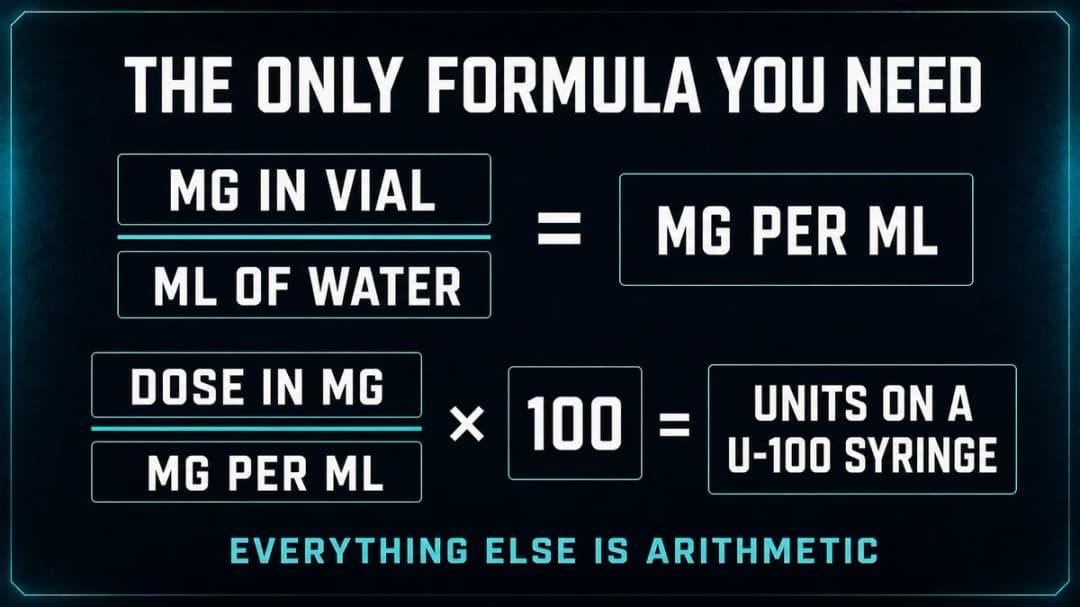
Every calculator and chart runs the same three steps.
Step 1: Find the concentration.
concentration (mg/mL) = vial contents (mg) / bacteriostatic water added (mL)
A 10 mg vial with 2 mL of bacteriostatic water gives 10 / 2 = 5 mg per mL.
Step 2: Find the volume that contains your dose.
volume (mL) = dose (mg) / concentration (mg/mL)
If your protocol calls for 0.5 mg from that 5 mg/mL solution, you need 0.5 / 5 = 0.1 mL.
Step 3: Convert volume to syringe units.
units = volume (mL) x 100
That is 10 units on a U-100 syringe.
Collapse all three and you get:
units = (dose in mg x mL of water x 100) / vial mg
That is the entire calculator. No hidden constants, no compound-specific coefficient, and the math is identical whether the vial holds a repair peptide or a compounded incretin.
How a Peptide Reconstitution Calculator Handles U-100 Syringes
The step that trips people up is not the division. It is the word "unit."
A U-100 syringe is calibrated so 100 units fill exactly 1 mL. That labeling exists because U-100 insulin holds 100 international units per milliliter, so for insulin the volume mark and the drug amount line up. For every other compound they do not. A unit mark is purely a volume: 0.01 mL, or 10 microliters. It tells you nothing about the peptide in that volume until you have done Step 1.
Three practical consequences:
- Barrel size changes resolution, not math. A 0.3 mL barrel holds 30 units and usually has a tick for every unit. A 1 mL barrel holds 100 units and is often ticked in 2-unit increments. Ten units is the same volume in both. The smaller barrel is just easier to read accurately.
- U-40 syringes will wreck your calculation. U-40 syringes, common in veterinary supply, put 40 units in 1 mL, so one unit is 0.025 mL. Run U-100 numbers on a U-40 barrel and you deliver 2.5 times what you intended.
- Units are not IU. Compounds dosed in international units, such as HCG or growth hormone, use a potency-based scale that has to be converted separately.
Concentration Reference Table for Common Vial Sizes
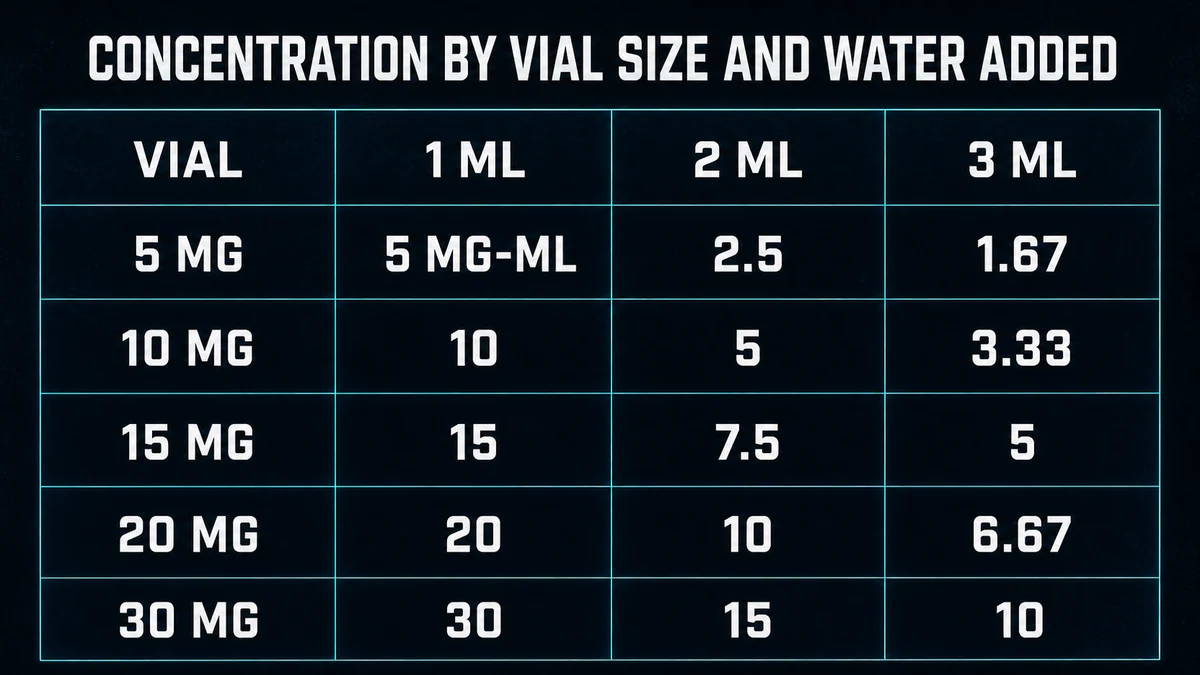
This is the Step 1 output for the vial sizes most peptides ship in, at the three dilution volumes people actually use.
| Vial size | 1 mL of BAC water | 2 mL of BAC water | 3 mL of BAC water |
|---|---|---|---|
| 5 mg | 5.0 mg/mL | 2.5 mg/mL | 1.67 mg/mL |
| 10 mg | 10.0 mg/mL | 5.0 mg/mL | 3.33 mg/mL |
| 15 mg | 15.0 mg/mL | 7.5 mg/mL | 5.0 mg/mL |
| 20 mg | 20.0 mg/mL | 10.0 mg/mL | 6.67 mg/mL |
| 30 mg | 30.0 mg/mL | 15.0 mg/mL | 10.0 mg/mL |
Concentration in mg/mL is correct but awkward, because most protocols in this space are written in micrograms. So convert once more.
Micrograms Per Unit: The Number Worth Memorizing
Since one unit is 0.01 mL, the peptide sitting in a single unit is one hundredth of the concentration. Expressed in micrograms, that reduces to a very clean shortcut:
mcg per unit = (vial mg x 10) / mL of water added
A 10 mg vial in 2 mL: (10 x 10) / 2 = 50 mcg per unit. Once you know that figure, every dose becomes a one-step division: dose in mcg divided by mcg per unit equals units to draw.
| Vial size | 1 mL | 2 mL | 3 mL |
|---|---|---|---|
| 5 mg | 50 mcg/unit | 25 mcg/unit | 16.7 mcg/unit |
| 10 mg | 100 mcg/unit | 50 mcg/unit | 33.3 mcg/unit |
| 15 mg | 150 mcg/unit | 75 mcg/unit | 50 mcg/unit |
| 20 mg | 200 mcg/unit | 100 mcg/unit | 66.7 mcg/unit |
| 30 mg | 300 mcg/unit | 150 mcg/unit | 100 mcg/unit |
A 5 mg vial in 1 mL and a 10 mg vial in 2 mL both land on 50 mcg per unit. Different vials, identical syringe reading. That is why you run the math instead of memorizing one chart.
Worked Examples
Example 1. A 10 mg vial, 2 mL of water, 250 mcg wanted. Concentration is 5 mg/mL, which is 50 mcg per unit. 250 / 50 = 5 units. Doubling the target to 500 mcg gives 10 units.
Example 2. A 5 mg vial, 3 mL of water, 300 mcg wanted. Concentration is 1.67 mg/mL, or 16.7 mcg per unit. 300 / 16.7 = 18 units. The long form confirms it: (0.3 x 3 x 100) / 5 = 18.
Example 3. A 30 mg vial, 3 mL of water, 2.5 mg wanted. Concentration is 10 mg/mL, or 100 mcg per unit. 2.5 mg is 2500 mcg, so 2500 / 100 = 25 units.
Example 4. Working backwards to pick your water volume. Suppose you want 20 units to equal 500 mcg, because 20 units sits in an easy-to-read part of the barrel. You need 25 mcg per unit. Rearranging the shortcut gives:
mL of water = (vial mg x 10) / target mcg per unit
For a 5 mg vial: (5 x 10) / 25 = 2 mL. A 10 mg vial would need 4 mL, which may exceed the vial's usable volume, so you would accept a different unit reading instead.
Choosing How Much Bacteriostatic Water to Add
There is no correct answer, only trade-offs. The peptide mass is fixed the moment the vial was filled. Water volume decides only how spread out it is.
Less water produces a concentrated solution and small unit readings, so a one-unit misread is a bigger proportional error. More water gives finer resolution and more forgiving readings, at the cost of a larger injection volume.
A useful heuristic: pick a volume that makes your usual dose land between roughly 10 and 50 units. Below 10, small reading errors matter too much. Above 50, you are drawing a large volume for a subcutaneous injection. Check the vial too, since most crimped peptide vials are 2 mL or 3 mL glass and headspace runs out faster than people expect. Then stay consistent, because if a 10 mg vial always gets 2 mL, 50 mcg per unit becomes muscle memory.
Units Needed for a Given Dose
Step 3 output, cross-referenced. Find your concentration on the left, read across to your dose.
| Concentration | 100 mcg | 250 mcg | 500 mcg | 1 mg | 2 mg | 2.5 mg |
|---|---|---|---|---|---|---|
| 25 mcg/unit | 4 u | 10 u | 20 u | 40 u | 80 u | 100 u |
| 50 mcg/unit | 2 u | 5 u | 10 u | 20 u | 40 u | 50 u |
| 100 mcg/unit | 1 u | 2.5 u | 5 u | 10 u | 20 u | 25 u |
| 150 mcg/unit | 0.7 u | 1.7 u | 3.3 u | 6.7 u | 13.3 u | 16.7 u |
| 200 mcg/unit | 0.5 u | 1.3 u | 2.5 u | 5 u | 10 u | 12.5 u |
| 300 mcg/unit | 0.3 u | 0.8 u | 1.7 u | 3.3 u | 6.7 u | 8.3 u |
The fractional readings in the bottom rows are the argument for adding more water. No syringe can be drawn to 1.7 units with confidence. If your arithmetic keeps producing ugly decimals, change the dilution volume until it produces whole numbers.
Where the Arithmetic Quietly Goes Wrong
The formula is trivial. The failure modes are not.
- Mixing mg and mcg. One milligram is 1000 micrograms. This slip is a factor-of-1000 error and by far the most common one.
- Trusting the label as an assay. Vial contents are nominal. Fill tolerance, overfill, and purity below 100 percent all mean true mass may differ from the printed number. Without a batch certificate of analysis you are calculating from an assumption.
- Ignoring residual volume. You will not recover every microliter, so doses per vial on paper is a ceiling, not a promise. The gap widens with removable-needle syringes that hold liquid in the hub.
- Forgetting powder displacement. The lyophilized cake occupies a little volume itself, so true concentration is marginally lower than calculated. Usually negligible, but a reason to treat every figure as an approximation.
- Reading the wrong part of the plunger. Measure to the leading edge of the rubber stopper, the flat face nearest the needle.
- Recalculating a vial you already mixed. Adding water to a reconstituted vial changes concentration again. Redo Step 1 from the new total volume.
Compound-Specific Charts
This arithmetic applies to any lyophilized vial. For numbers already worked out per compound:
- Retatrutide dosage calculator for vial mg, water volume, and unit conversions
- Retatrutide reconstitution chart for concentration and unit tables
- Semaglutide reconstitution chart for compounded semaglutide
- Tirzepatide dosing in units for mg to U-100 conversions
The physical side, meaning how to introduce water without shearing the peptide and how to store the vial afterward, is covered in how to reconstitute retatrutide, and those handling steps generalize to most powders. For peptides outside the incretin class, our BPC-157 guide shows how reported protocols, purity documentation, and regulatory status fit together for a compound with no approved human indication, and peptide capsules vs injectable covers the prior question of whether you need to reconstitute anything at all.
FAQ
Does adding more bacteriostatic water reduce my dose?
No. The vial holds a fixed mass of peptide regardless of what you do next. More water dilutes it, so the same dose occupies more volume and you draw more units. Less water, fewer units. The peptide delivered is identical as long as you recalculate.
How do I convert syringe units back to milligrams?
Reverse the last two steps: divide units by 100 for milliliters, then multiply by concentration in mg/mL. At 5 mg/mL, 12 units is 0.12 mL, or 0.6 mg. In shortcut form, units times mcg per unit gives the dose in micrograms.
Does the math change on a 0.3 mL or 0.5 mL syringe?
Not at all, provided the syringe is U-100. A 0.5 mL U-100 barrel is simply a 50-unit barrel, and its marks mean the same 0.01 mL they mean on a 100-unit barrel. Smaller barrels are easier to read because the ticks sit further apart.
Can I use sterile water instead of bacteriostatic water?
The calculation is unaffected, because volume is volume. What changes is storage. Bacteriostatic water contains benzyl alcohol as a preservative, which is why multi-dose vials are typically reconstituted with it. Sterile water has no preservative and is intended for single use.
Why do some calculators show a different number than mine?
Almost always an assumption you did not make: a different vial size, a different water volume, or a chart built around U-40 syringes. Recompute concentration first. If your mg/mL matches theirs and the units still differ, the discrepancy is in syringe calibration, not the peptide.