Most guides to the best peptide vendors are written by peptide vendors ranking themselves, and almost none of them say so. This one takes the opposite approach: a reliable peptide source and trusted peptide suppliers are things you verify document by document, not things a list asserts, so every claim below is tagged with how we know it.
Before writing this we read six of the most visible vendor ranking articles published for these searches. Five of the six were published by a company that appears inside its own ranking. One of the six disclosed a conflict of interest, and it still placed itself first. That is the bar this page is trying to clear.
So here is the deal up front. One of the vendors below pays us commission. It is named in the disclosure box that sits above the ranking rather than in a footer, and it has a documentation problem that we describe inside its own entry rather than hiding. The rest of the page is a five-step test you can run on any company in about five minutes, a field-by-field breakdown of what a real certificate of analysis actually contains, and a directory of 130 peptide brand names people search for, most of which we could not verify in either direction and label exactly that way.
Key Takeaways
- Peptide Partners is our top pick on documentation. It publishes the deepest public certificate library we were able to load for any vendor in this set, every row carrying a batch identifier and a link to the underlying file, attributed to four named laboratories
- Synthro Lab ranks third. It is the best current value on this page (bundle discounts of up to 25%, a free shipping threshold, tiered free gifts), and it still sits below two vendors with weaker promotions, because we could not find a single certificate issued under Synthro's own name. The certificates it publishes name other companies as the client, and we say so in its entry
- "Lab tested" is not a claim worth accepting. A usable certificate names the lab, names the vendor as the client, carries the lot number printed on your vial, and can be checked at the lab's own site rather than the vendor's
- About half of the searches this page answers are people asking whether one specific brand is legitimate. For most of those brands there is no public evidence in either direction. That is an information gap, not evidence of wrongdoing, and we do not dress it up as one
- Nothing here is medical advice. These compounds are sold for laboratory research use, they are not FDA-approved drugs, and no human dosing guidance appears anywhere on this page
Best Peptide Vendors: Our Ranked Picks
Two tags run through this page, and the difference between them is the whole point of it. Verified means we loaded the page or document ourselves and confirmed what it says. Vendor claim means it is the company's own marketing, repeated and attributed but not endorsed by us.
Affiliate disclosure, placed above the ranking on purpose
Middleway Nutrition earns a commission if you buy through the Synthro Lab links on this page. Those are the only monetised links here, and they sit at #3. The vendors at #1 and #2, and the two listed after the ranking, pay us nothing and carry no affiliate link of any kind. We also publish peptidedeck.com, which is an editorial review site rather than a vendor.
The commission does not change what we found, and you can see that in how the entries are written. Every factual claim about our affiliate partner is tagged Verified when we personally loaded the page or document and confirmed it, or Vendor claim when it is the company's own marketing claim repeated and attributed but not endorsed. Where it fails part of our own five-step test, the entry says so in plain language. The clearest evidence that the commission did not set the order is that our #3 pick fails two of the five steps this article teaches, its entry says exactly which two and why, and two vendors that pay us nothing are ranked above it.
How we ranked them
We ran the same procedure on every vendor we assessed. Load the certificate library. Open an actual certificate rather than the page advertising certificates. Check whether it carries a lot number, a named laboratory and a named client. Try to confirm the document at the laboratory's own domain instead of the vendor's. Read the refund, cancellation and shipping policies against the promises in the site banner. Then look for a footprint the vendor does not control: community forums, independent blind-testing services, review platforms.
How the order was decided. Positions 1 and 2 are ranked on documentation we could verify ourselves, strongest first: the deepest public certificate library we were able to load, then an independent blind-test record with no recorded failures, from a service that buys product anonymously. Position 3 is ranked on value, because value is the axis where that vendor genuinely leads and it is not the axis this article treats as decisive. A vendor with excellent promotions sits below vendors with verifiable certificates here, deliberately. If you weight price more heavily than paperwork, the evidence behind each entry is laid out so you can reorder them yourself.
Two limits are worth stating. First, we verified three Synthro certificates. A verified certificate is evidence about the batch it covers, not proof about a catalogue, and we do not imply otherwise. Second, Trustpilot blocks automated access and returned HTTP 403 for every profile we tried, so no Trustpilot rating appears anywhere on this page even though search snippets offered us numbers. Numbers we could not open are numbers we do not print.
#1 Peptide Partners: the deepest public certificate library we could load
Peptide Partners is unaffiliated. There is no commission link in this entry, or anywhere else on this page, and it ranks above a vendor that does pay us because its documentation is simply the better documentation.
It publishes the most substantive certificate library we were able to load for any brand in this set. The page at peptide.partners/independent-certifications/ renders certification tables covering purity, endotoxin, heavy metals and sterility, each row carrying a batch identifier and a link to the underlying file, attributed to four named laboratories. The vendor states that all certificates it provides can be validated on the third-party laboratory's website. Contact details shown are a phone number and a support email, with no street address or registered legal entity displayed. The caveat that matters: at least three live sites trade under this brand name, and only the one above showed us verifiable batch documentation. Confirm which site you are actually on before ordering.
#2 Cactus Peptides: independent blind-test data, from a thin sample
Cactus Peptides is also unaffiliated and also carries no commission link. It ranks second on the one form of evidence a vendor cannot curate: product bought anonymously and tested without the vendor's knowledge.
It has independent blind-test data, which almost nothing in this market does. Finnrick, a service that buys product anonymously and sends it to partner laboratories, reports 4 independent lab tests across 2 peptides with 4 passes and 0 failures against its purity standard, with recency-weighted ratings of 81% for both retatrutide and tirzepatide as of the latest tests in June 2026. The honest caveat, which the testing service itself makes, is that four tests is a very small sample, which is exactly why a perfect record still renders as 81% rather than near-100%. A clean thin record is not the same as a proven one. We did not open this vendor's own site, so we make no claim about whether it publishes its own certificates.
#3 Synthro Lab: the best current value here, ranked below the vendors whose evidence we could verify
Synthro Lab is our affiliate partner, it is the best current value on this page, and it ranks third. Those three facts belong in the same sentence. It sits below two vendors that pay us nothing because ranking on documentation is the entire premise of this article, and Synthro is the one vendor here whose certificates we could verify at the laboratory but could not tie to the vendor's own name. Promotions are worth something. They are not worth more than knowing whose material was tested. It is also the vendor with the clearest gap between what its banners promise and what its own policy pages say, so read the whole entry before deciding.
Why it ranks on value. Vendor claim Synthro advertises bundle discounts of up to 25%, specifically 15% on a three-pack and 25% on a six-pack, plus tiered free gifts at $150, $250, $500 and $750 order values. It states that discounts never combine and that checkout applies your single lowest price automatically. Vendor claim Listed pricing observed on 2026-07-28 ranged from $45.80 for GHK-Cu 50mg to $107.00 for GLP-3 RETA 10mg per vial. Prices drift, so treat those as a snapshot. Verified One warning about the promotion: the "ends in" countdown displayed next to the discount promotion is driven by a modulo of the current clock, so it has no end date and silently resets every 24 hours. Whatever the deal is worth, it is not expiring tonight, and nobody should buy on that timer.
The genuine strength. Verified The certificate index at synthrolab.com/coa/ loads and lists 13 products with purity figures. We opened three certificates in full, for BPC-157, GLP-3 and NAD+. All three are real laboratory certificates rather than marketing graphics. Each names the testing laboratory (Freedom Diagnostics), an accession number, a lot number and a signing chemist. Verified All three of the search codes Synthro publishes resolve inside that laboratory's own public certificate index, and downloading the BPC-157 certificate directly from the laboratory's storage returned a document identical to the one Synthro publishes. That is a real positive. A dead certificate link is common in this market, and Synthro does not have one.
The problem, stated plainly. Verified The client named on those certificates is never Synthro. The BPC-157 certificate names Uptime as the client. The GLP-3 and NAD+ certificates name Authentichain. Verified Synthro Lab holds zero certificates registered under its own name at that laboratory. Company-name searches returned 0 files for "Synthro", "Synthro Lab" and "Synthro Science", against 15 for Uptime and 35 for Authentichain. Verified We then checked the entire block of certificates whose search codes begin with the same four letters as Synthro's name: 167 certificates, of which all 166 retrievable ones were downloaded and had their client field extracted. None names Synthro. A full-text search for the word across all 166 returned zero hits, and control searches confirmed the method works rather than silently failing.
Verified What that establishes is narrow and we will not stretch it. No published certificate names Synthro as the client. Whether Uptime and Authentichain are Synthro's suppliers, affiliated entities, or unrelated parties is not established, we could not determine it, and we are not asserting a relationship in either direction. Verified The vials photographed on Synthro's certificates are unbranded. Vendor claim This sits in tension with Synthro's own About page claim that it manufactures domestically with no overseas sourcing, no dropshipping and no middlemen, and readers should weigh that tension themselves.
Verified Three further gaps in the documents themselves. No endotoxin result appears on any of the published certificates, and the endotoxin column on Synthro's own index page is blank for all 13 products. The same laboratory does issue much fuller panels for other clients, including endotoxin replicates, microbial analysis and elemental impurities, so the omission is in these documents rather than in the laboratory's capability. And two certificates do not match the product actually sold: the GLP-3 certificate is for a 30mg presentation while the listed product is 10mg, and the NAD+ certificate is for 1000mg while the listed product is 500mg.
The guarantee, and their side of it. Verified Every page carries a persistent bar reading "30-Day Money-Back Guarantee". The published refund policy states that all sales are final, that the company does not offer cash, credit card or digital asset refunds once an order has been processed and payment confirmed, and that returns cannot be accepted under any circumstances. Verified The strings "30-Day", "money-back" and "98%" appear zero times in the body of that refund policy, and no published terms for the guarantee exist anywhere on the site. Verified The banner promising the guarantee renders directly above the policy text that contradicts it.
Vendor claim In fairness, Synthro does describe a remedy path. Its homepage FAQ answers the question of what happens if a customer is not satisfied with "98%+ purity guaranteed or refunded", followed by "send us an independent test result and we'll make it right." That is their position and it deserves to be represented. It does not resolve the contradiction, because no 30-day terms exist anywhere on the site and the refund policy's no-refund language is blanket and unqualified. What it does tell you is the practical route: independent third-party test result first, then a conversation.
Verified Other terms to know before ordering: cancellation is limited to one hour after payment; damaged goods receive replacement only and never a refund, reported within 24 hours with photographs; the policy carries a strict no-dispute clause stating that any customer initiating a chargeback will be permanently banned; the shipping policy instructs buyers not to file a claim or missing mail search with their carrier; and lost package protection requires a paid add-on, without which the company states it is not liable.
Verified Three more inconsistencies worth knowing. The free shipping threshold is stated three different ways on the same site: the header bar says $250 and up, the on-page gift tiers say $250 for free express shipping, and the actual shipping policy says orders over $100 receive free express shipping. EU shipping is advertised on the homepage with warehouses claimed across the US, EU and Australia, while the shipping policy states the company ships within the United States and Australia and publishes rates for those two countries only. And "Same-Day Dispatch" in the header conflicts with the shipping policy's 24 to 72 hour dispatch window.
Verified On reviews: the homepage shows 4.98 out of 5 across 3,200+ reviews in the hero and 500+ reviews in a trust badge lower down the same page. We found no independent corroboration for either figure. A search of the Peptide Critic community returned 0 matches for Synthro, and no readable review-platform profile surfaced. Verified The homepage testimonials also do not withstand inspection: the same testimonial sentence appears twice, attributed once to a named doctor and once to an anonymous verified researcher. Verified The greater-than-99% HPLC purity badge is applied by template to every product card including reconstitution water, a nasal spray bottle, travel bags and a mini fridge, so it is a layout artifact rather than a per-product test result. Verified No physical address, legal entity registration or phone number is published on the homepage, About page, Contact page or policy pages; the footer names "Synthro Science" while the site brands itself Synthro Lab, and contact is a web form only.
Bottom line. Run our five-step test on Synthro and it passes step 1 and step 3 cleanly: a real certificate exists, it carries a lot number, and it verifies at the laboratory rather than the vendor. It fails step 2, because the certificate does not name the vendor as the client. It fails step 4, because the advertised guarantee and the published policy say opposite things. If you buy here, buy because the current promotional pricing is genuinely competitive, buy the smallest quantity that answers your question first, and assume you have no refund route beyond the independent-test path described above.
See Synthro Lab's current promotions and COA index (affiliate link).
Two more unaffiliated vendors worth knowing
Neither of these pays us anything either. They sit outside the numbered ranking because the evidence we could load about each one has a specific limit, stated with it.
Red Dirt Research has the cleanest identity of any unaffiliated vendor here. The site names Red Dirt Research LLC in its footer disclaimer, and a dedicated certificate section exists at /coas/, so documentation is not merely claimed. The limit is real though: that section sits behind a customer login, so we could not read a single certificate, batch number or laboratory name, and no physical address or third-party laboratory is disclosed publicly. If you want to audit purity documentation before you spend money, this vendor does not let you.
Red Fox has something rarer than a certificate library, which is a genuine independent user-discussion footprint. A forum thread we read in full ran from late May into mid-June 2026 across roughly a dozen distinct posters and 20-plus posts. The tone is ordinary product discussion covering tolerability, shipping and comparisons with other vendors, and it contains no allegation of fraud or counterfeiting. Users report that the vendor supplies certificates and one poster raised a question about the vendor using three different laboratories, to which another replied that multiple laboratories are not inherently suspicious provided the results agree. All of that is anecdotal self-reporting by pseudonymous users, and we did not load any of the certificates referenced, so treat it as a reputation signal rather than lab data.
How to Vet Any Peptide Vendor: A Five-Step Test
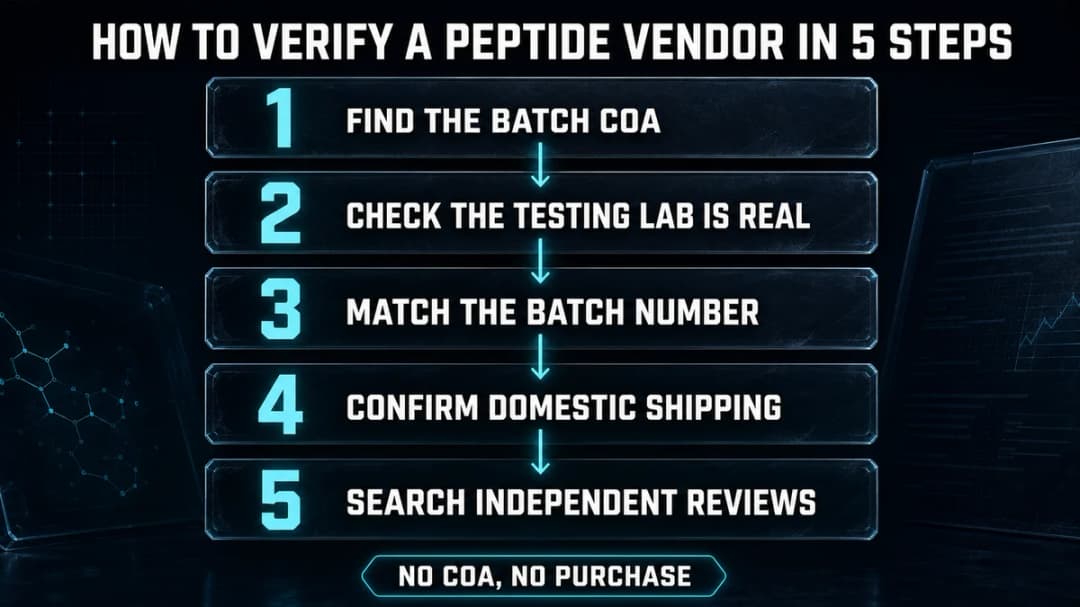
This is the part of the page that outlives any ranking. It takes about five minutes per vendor and it is the same procedure we ran above. If you only remember one section, remember this one, because it is what makes "we could not verify this brand" an honest answer rather than an evasion. It is also the answer to the most common question in this whole search cluster: how do I find a reliable peptide company, or a trusted peptide supplier, without simply believing a website.
Step 1: Find a batch-specific certificate, not a product-level one
A product-level certificate covers a product line. It might have been produced months ago on a completely different synthesis run, and some vendors reuse the same one indefinitely. A batch-specific certificate references the exact lot number printed on the vial you received. When your order arrives, the lot on the vial and the lot on the document should match. If the vendor cannot produce a document with a lot number on it, you do not have testing, you have a marketing sentence.
Practical version: search the vendor's site for a certificates page. Do not stop at the page that advertises testing. Open an actual file. If every link leads back to prose about how rigorously they test, that is your answer.
Step 2: Check that the certificate names both the laboratory and the vendor
This is the step almost nobody performs, and it is the step that separated the vendors on this page. A real certificate has a client field. That field should name the company you are buying from.
A certificate naming a different company is not automatically sinister. Supply chains have layers, and a vendor may be reselling material tested by whoever produced it. But it does mean the document is evidence about someone else's inventory, and you should know that before you treat it as proof about yours. If the client field is blank, cropped out of the image, or names a business you have never heard of, ask the vendor directly who that company is and what the relationship is. A vendor that answers clearly is telling you something useful. So is one that does not.
Step 3: Verify the document at the laboratory, not at the vendor
A PDF hosted on a vendor's own server proves only that the vendor uploaded a PDF. The check that matters is whether the issuing laboratory recognises the document.
Most laboratories that serve this market publish a lookup: you enter an accession number, a report number, or a search code printed on the certificate, and the laboratory returns its own copy of the record. Compare the numbers. Purity, net content, lot, date. They should match exactly. Some certificates also carry an access code, and a matching access code at the laboratory's domain is about as strong as this kind of verification gets. If the laboratory named on the certificate has no website, no lookup, and no findable existence, you have a document rather than a test result.
Step 4: Read the refund, cancellation and shipping policies before you read the banner
Banners are written by marketers. Policies are written by whoever will have to honour them, and in this market the two frequently disagree. Open the refund policy, the shipping policy and the terms page, and check each promise from the header against the corresponding paragraph. Specifically look for: whether all sales are final, how long the damage-reporting window is, how long the cancellation window is, whether chargebacks are prohibited, whether shipping insurance is included or a paid add-on, and which countries the policy actually names.
You are not looking for a generous policy. Strict policies are normal in this market and are not by themselves a warning sign. You are looking for whether the policy and the advertising agree. A vendor whose terms are strict but consistent is easier to deal with than one whose banner promises a guarantee its own policy page revokes two inches lower.
Step 5: Look for a footprint the vendor does not control, and check that it is current
Independent signal beats self-reported signal every time. In descending order of usefulness: independent blind-testing services that buy product anonymously and publish pass and fail counts; community forums and subreddits where discussion is not moderated by the vendor; review platforms that verify purchases; Better Business Bureau records; and consumer review aggregators such as SiteJabber. Vendor-hosted testimonials sit at the bottom, below even nothing, because a testimonial you cannot trace is a design element.
Two cautions. First, some community sites in this niche are themselves monetised through shopping links and coupon codes for the vendors being discussed. That does not make them worthless, but it does make them interested parties, and you should read them as such. Second, and this is the one people miss most often: purity data and order fulfilment are different things. A vendor can have an excellent blind-test record and still have a bad month on shipping, communication or refunds. Purity certificates say nothing about whether a parcel arrives. When searching for vendor feedback, try the vendor name with search terms like "reviews", "complaints" and "scam"; a single negative post does not establish a pattern, but repeated complaints about the same unresolved issue are worth taking seriously. Always check the most recent community discussion, not just the aggregate rating, before sending money to any vendor including the ones on this page.
How to Verify a COA and Read a Purity Report
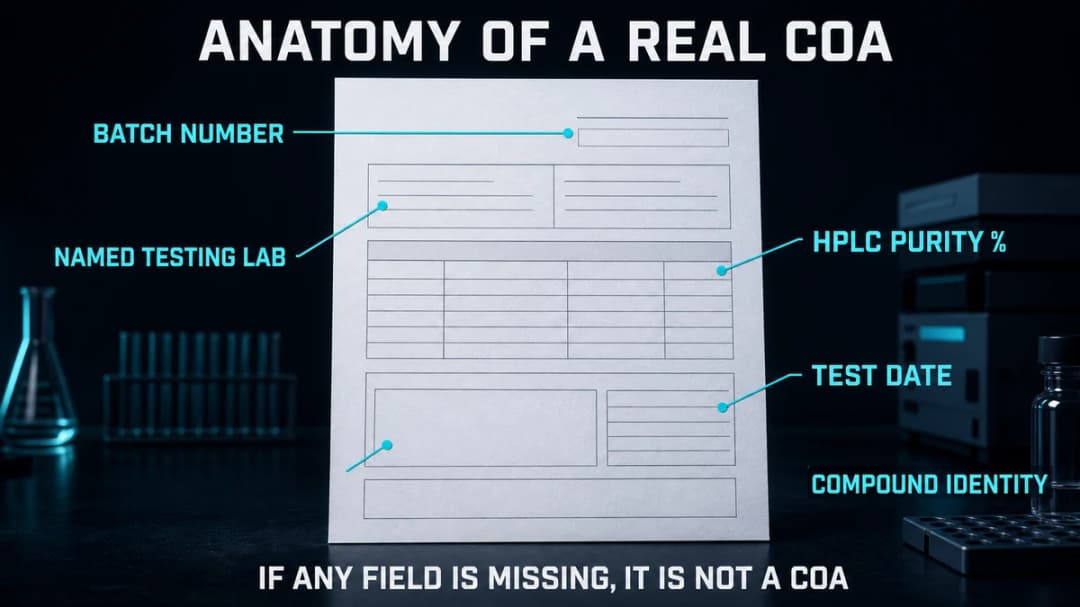
Step 3 above tells you where to check. This section tells you what you are looking at, field by field, so you can tell a complete document from a thin one before you have spent money on either.
What a complete certificate actually contains
A complete certificate carries all of the following, and every field below does a specific job:
- Identity of the document. A report number, a named testing laboratory, a client name, and a signature from a named laboratory director.
- Identity of the material. The compound name, the CAS registry number, the lot number, and on the better documents even the vial's cap and crimp colours, so the physical product can be matched to the paperwork.
- Purity against a stated specification. A measured percentage sitting next to the specification it was measured against. A percentage with no specification next to it is half a result.
- The method. A named technique, for example RP-HPLC on a C18 column with diode array detection at a stated wavelength. A purity figure without a method is a number, not a measurement.
- Identity confirmation by mass spectrometry. LC-MS confirming the material is the compound named on the label. This matters because HPLC can report high purity for the wrong compound. Purity tells you how much of one thing is in the vial; mass spectrometry tells you which thing.
- Net peptide content. The measured milligrams in the vial against the milligrams on the label. This is the figure that tells you whether the vial is actually filled to label claim, and it is routinely omitted by vendors who only publish purity.
- Contamination screens. An endotoxin result against a stated limit, a microbial sterility result, and heavy metals: arsenic, cadmium, lead and mercury.
- A verification route. An accession number, report number or access code you can enter at the laboratory's own site and have it return the same record.
What a thin certificate looks like
Compare that with the certificates our #3 pick publishes, which are also real documents from a real laboratory, and which we describe as thin rather than fake because that is what the evidence supports. They carry purity, identity and net content, and they stop there. No endotoxin result appears on any of them. The client field names a different company. Two of the thirteen do not match the strength of the product being sold, listing 30mg where the product is 10mg and 1000mg where the product is 500mg.
None of that means the material is bad. It means the documents answer fewer questions than they appear to. When a vendor advertises that most compounds include up to three certificates covering purity, content and endotoxin levels, and the endotoxin column on its own index page is blank for every product, the gap between the claim and the document is the finding.
The checks that catch most problems
- Does the lot number on the certificate match the lot printed on your vial?
- Is there a stated specification next to the purity figure, or just a number?
- Is there a method line, and does it name a technique rather than the phrase "third-party tested"?
- Is there a net content figure, or only purity?
- Is there a date, and is it plausibly recent relative to your order?
- Does the laboratory exist independently of the vendor, with its own domain and its own lookup?
- Does the certificate name the vendor you are buying from?
A certificate that fails one of these is worth a question. A certificate that fails four is worth walking away from.
Price, Shipping, Stock and Cold Chain
What the vendor we examined most closely actually charges
Verified Synthro publishes shipping rates for the United States and Australia only, quotes a 24 to 72 hour dispatch window in its policy, and states its free shipping threshold three different ways in three different places on the same site, so treat whichever number appears in your cart as the operative one. Vendor claim Synthro's observed vial pricing on 2026-07-28 ran from about $45.80 to about $107.00 depending on compound and size.
Why price is a weak quality signal in both directions
Peptide synthesis has real costs and third-party testing has real costs, so a price far below the market usually means something was skipped, and testing is the cheapest thing to skip. That is the familiar half of the argument. The less familiar half is that a high price proves nothing either. Marketing spend, affiliate commissions and packaging all raise prices without raising purity, and several of the most expensive listings in this market carry the thinnest documentation. Price belongs at the bottom of your decision stack, under documentation and under policy clarity.
Out of stock, and what it usually means
"Out of stock in the USA" is a recurring search for a reason. Domestic inventory in this market is lumpy: vendors hold limited quantities, popular compounds sell out, and restock timing is rarely published. A vendor that shows honest stock status is doing you a favour compared with one that accepts the order and then goes quiet. If a compound is unavailable everywhere you look at once, that is usually a supply event upstream rather than anything about the individual vendor.
Two behaviours to avoid when a product is out of stock. Do not switch to an unfamiliar vendor purely on availability, because availability is the one signal that correlates with nothing. And do not accept a substitution offer for a different compound or a different strength without a certificate for what you are actually being sent.
Cold chain and cold shipping
Lyophilized peptide powder is comparatively tolerant of ambient temperature for the short transit windows involved in domestic shipping, which is why most vendors in this market ship it without cold packs and why that is not by itself a red flag. Once reconstituted, storage matters a great deal more than shipping did.
No vendor we examined publishes a cold-chain guarantee that we could find, and we want to be precise: we did not find one, which is not the same as saying none exists. If cold shipping matters for your application, ask before ordering and get the answer in writing rather than inferring it from a product page. Vendors that do offer cold packs generally charge for them.
Red Flags: How Peptide Vendor Scams Actually Present
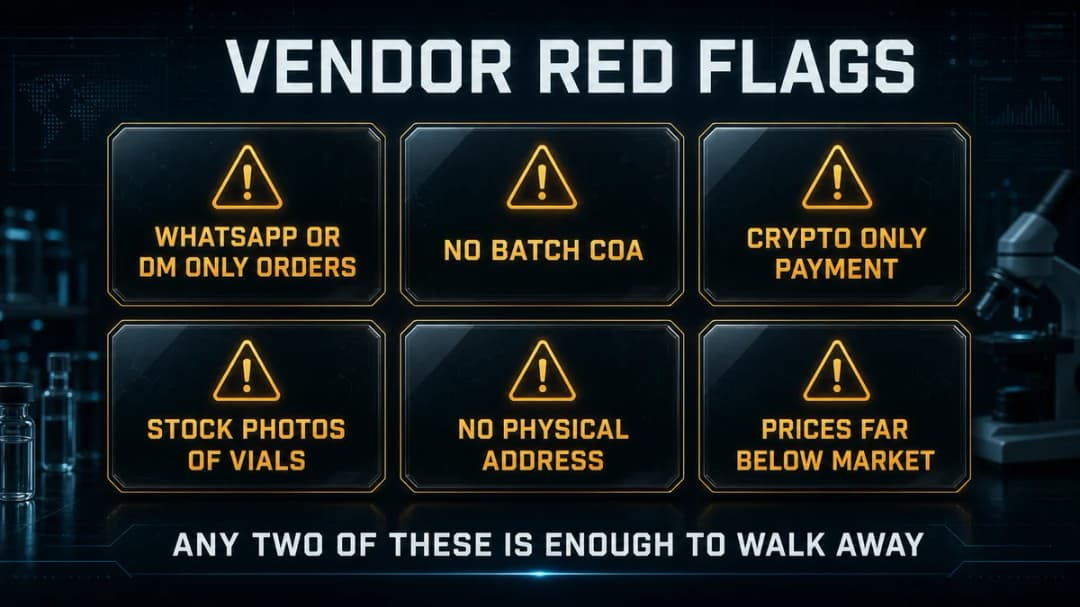
Most bad experiences in this market do not begin with an obvious fraud. They begin with a site that looks professional and whose claims quietly do not survive being checked. Here is what that looks like in practice, with examples drawn from things we personally verified while researching this page.
Manufactured urgency
A countdown timer next to a promotion is worth ten seconds of inspection. On one site we examined, the timer is computed as a modulo of the current clock, meaning it has no end date at all and resets every 24 hours forever. The offer may be perfectly real. The deadline is not. Any purchase decision that depends on a timer is a decision the timer made for you.
Purity badges applied by template
If a greater-than-99% HPLC purity badge appears on a product card for reconstitution water, a nasal spray bottle, travel bags and a mini fridge, that badge is a layout element rather than a test result. We verified exactly that on one site. Badges are cheap. Documents are not.
A guarantee the policy page revokes
Check the banner against the policy. We found one vendor whose site-wide bar promises a 30-day money-back guarantee, whose refund policy states all sales are final and that returns cannot be accepted under any circumstances, and where the banner renders on the very page carrying that policy. Neither the phrase "30-Day" nor "money-back" appears anywhere in the policy body, and no terms for the guarantee are published anywhere on the site.
Self-reported review counts that contradict themselves
A homepage showing 3,200+ reviews in the hero and 500+ reviews in a badge lower down the same page is telling you the numbers are decorative. So is the same testimonial sentence appearing twice under two different names. Neither of those requires any special expertise to catch; it requires reading the page instead of scanning it.
Recycled and mismatched certificates
Product-level certificates reused across batches, certificates with the lot number cropped out, certificates dated well before your order, and certificates for a different strength than the product being sold. We found the last of those on two documents from a single vendor: a certificate for a 30mg presentation attached to a 10mg product, and one for 1000mg attached to a 500mg product.
No published address, entity or phone number
A contact form alone is a thin basis for a commercial relationship. If a vendor publishes no physical address, no registered legal entity, and no telephone number anywhere on its site, your only recourse if something goes wrong is an email address. That is worth knowing before you order rather than after.
Vendors selling through WhatsApp, Telegram and direct messages
This one deserves its own treatment, because there is real search demand asking whether it is safe, and because the recruitment approach is now a routine sight in comment sections, forum replies and unsolicited direct messages. The pattern is consistent: a friendly personal framing, a claim of access to research-grade material sourced abroad, and an invitation to continue the conversation inside a messaging app. We are not reproducing any of those pitches here, but you will recognise one when it arrives.
Treat messaging-app selling as a category, not as individual cases, and understand what you give up structurally:
- No published policy. There is no refund policy, no shipping policy and no terms page, because there is no site. Every term is whatever the person says it is in the moment, and it can change after payment.
- No verifiable certificate chain. A certificate image sent in a chat cannot be traced to a lot you received, and images are trivially reused across buyers. The step 3 check, verifying at the laboratory, is usually impossible because there is no accession number to check.
- No identity. You do not know the seller's legal name, country, or whether the same account will exist next month. Accounts in this space are frequently renamed or abandoned.
- No payment recourse. These sales are typically crypto or peer-to-peer transfer, both of which are final. There is no chargeback and no intermediary.
- No accountability for repeat business. A vendor with a public storefront has a reputation to protect. A messaging account has nothing at stake.
None of this asserts that any particular person messaging you is dishonest. It says that the structural protections you have with a storefront, thin as they already are in this market, are entirely absent here, and that you are relying on a stranger's goodwill for every part of the transaction. If you want the compound, buy it from somewhere that publishes a policy you can hold them to.
Buying Peptides Outside the US: UK, EU, Australia, China and Hong Kong
A large share of this cluster comes from outside the United States, and it deserves a straight answer rather than a US-centric one.
The honest position on our own picks
Verified Our #3 pick publishes shipping rates for the United States and Australia and states in its shipping policy that it ships to those two countries, while its homepage advertises warehouses and two-day delivery across the US, EU and Australia. If you are in the EU and considering that vendor, the published policy does not currently support the advertised EU service, and you should confirm before ordering rather than after.
For the UK and EU specifically, we did not verify a vendor to the standard applied to our top picks, so we are not naming one. That is the honest state of our evidence, and a recommendation we cannot support would be worth less than nothing to you.
What changes when you buy across a border
Three things, and none of them are about the vendor.
You become the importer. Rules on importing unapproved substances vary widely by country and are enforced unevenly, and personal imports are routinely detained or returned at customs in several jurisdictions. Check your own country's rules before you order, not after a parcel goes missing. Nothing on this page is legal advice, and jurisdictions differ enough that generalisations are useless.
Recourse shrinks. A domestic vendor with a strict policy is still easier to resolve a problem with than an overseas one with a generous policy. Distance, time zones and payment method all reduce your practical options.
Transit time lengthens, which changes storage. A parcel that spends three weeks in transit is a different proposition from one that spends three days, particularly for anything you intend to reconstitute on arrival.
China and Hong Kong suppliers
A very large share of the world's research peptide supply originates from contract manufacturers in mainland China and Hong Kong, and this is one of the most searched sub-topics in the whole cluster: whether a given Chinese peptide company is legitimate, which Chinese suppliers are best rated, and whether Hong Kong research laboratories are safe to order from. The honest framing is that "Chinese manufacturer" describes the largest and most heterogeneous category in the market rather than a quality tier. It contains genuine large-scale synthesis operations that supply Western brands, and it contains resellers with no synthesis capability at all.
What changes when you buy direct rather than through a Western reseller is that you take on everything the reseller was doing: importing, verifying, and testing. Ask for exactly the same documents you would ask a domestic vendor for, applying all five steps above. In particular, ask for a certificate from a laboratory with an independent public lookup rather than an in-house certificate on company letterhead, because an in-house document from a manufacturer verifies nothing you could not have assumed.
Two specific queries in this cluster are worth answering directly. Requests for a "scammer list" of Chinese vendors are asking for something we will not publish, because we have no independently verified evidence supporting a fraud allegation against any specific named company, and publishing an unverified list of company names as scammers would be both wrong and defamatory. What we will do instead is give you the test in the five-step section, which works on any company in any country. And searches for southeast Asian suppliers who sell through direct messages belong under the messaging-app section above, not here.
Australia, France, India and Japan
The pattern is the same everywhere. Availability varies, the number of domestic vendors is small, and most buyers end up either importing or using a regional reseller who imports on their behalf. Regional resellers are a legitimate model, but they are exactly the case where step 2 matters most: ask whose name is on the certificate, because a reseller's certificate frequently belongs to whoever synthesised the material rather than to the reseller.
Bulk, Wholesale and Peptide Manufacturers
There are four different kinds of company in this market and searchers regularly conflate them, which is why "peptide manufacturers USA" and "peptide supplier USA" return such different sets of results.
Retail research vendors are what most of this page is about. They sell single vials to individual researchers, they hold their own inventory, and they typically do not synthesise anything themselves.
Distributors and wholesalers sell in quantity to other businesses. Several retail vendors run a wholesale tier alongside the storefront, and the thresholds are frequently unpublished, so you would need to ask.
Contract manufacturers, often called CDMOs, actually synthesise peptides at scale. Companies such as Bachem, PolyPeptide Group, AmbioPharm and CordenPharma are in this category. They are real and they are large, and they are also not an option for an individual buyer: they work on institutional contracts with minimum order quantities and qualification requirements that have nothing to do with buying a 10mg vial. Ranking them alongside retail vendors, as one competitor guide does, produces a list that cannot actually be acted on.
Dropshippers hold no inventory and forward your order to whoever does. This model is not inherently dishonest, but it has a documentation consequence you should understand: a dropshipper's certificates generally belong to the company that holds the stock, which is precisely the pattern step 2 of our test is designed to surface.
How to tell which one you are dealing with
Ask three questions. Who is named as the client on your certificates? Where is the material synthesised, and can you name the facility? What is the minimum order quantity for a wholesale account, and what are the tiers? A retail vendor with a genuine wholesale programme can answer the third question immediately. A dropshipper usually cannot answer the first two.
If you are sourcing bulk lyophilized powder for an institutional buyer rather than vials for a bench, you are in a different market with different rules, and the correct route is a qualified CDMO with a quality agreement rather than any of the storefronts discussed here.
Peptide Vendor Directory: Brand-by-Brand Index
This is the part of the page that answers the single most common question in this whole search cluster, which is not "who is best" but "is this specific company legitimate". Below are the brands people actually search for.
The question arrives in a lot of shapes: which peptide shops are legit, the safest peptide sources, unbiased reviews of peptide suppliers, which peptide websites carry the most customer reviews, and how to separate the honest dealers from the rest. They all reduce to the same thing, and this directory plus the five-step test above is our answer to it.
Read the two tiers correctly, because the distinction is the whole point. Tier 1 means we found evidence we could load and read ourselves. Tier 2 means we could not, and that is a statement about our evidence rather than about the company. A blank record in this market usually means a small business with no independent web footprint, which is the normal condition for most vendors here. We do not treat absence of evidence as evidence of guilt, and neither should you.
Tier 1: brands where we found evidence we could open
Peptide Partners. A research peptide vendor whose site at peptide.partners publishes certification tables covering purity, endotoxin, heavy metals and sterility, with batch identifiers and file links, attributed to four named laboratories. No street address or registered legal entity is displayed. Note that at least three live sites trade under this brand name and only one of them showed us verifiable batch documentation, so confirm which domain you are on. Third-party coverage of this brand is dominated by affiliate-style review sites, which we do not treat as independent. Evidence: peptide.partners/independent-certifications/, loaded 2026-07-28.
Certified Peptides. The one independent source we could actually read is a Reviews.io profile for certified-pep.com showing an aggregate 4.9 across 1,443 reviews with 97% of reviewers recommending and individual entries carrying a verified-buyer badge. Both poles are represented and recent. Positive reviews cluster on delivery timing, products matching description, and pricing; the most substantive critical review describes a buyer who received a vial that looked clumped rather than powdery, offered to return it at their own expense, was refused, and took their business elsewhere. We are deliberately not quoting individual reviewers, because two fetches of the same page returned different wordings for the same review and we will not put quotation marks around a paraphrase. The vendor's own lab-testing page refused our request, so its claims of accredited third-party testing are unverified by us: we saw no certificate, batch number or laboratory name first-hand. At least five distinct domains use variations of this brand name, so confirm which site you are actually on. Evidence: reviews.io/company-reviews/store/certified-pep.com, loaded 2026-07-28.
Chimera Peptides. A research peptide vendor for which independent blind-test data has been published. Finnrick, which buys product anonymously and sends it to partner laboratories, reports 20 independent lab tests across 2 peptides with 19 passes and 1 failure against its purity standard, and recency-weighted per-compound ratings of 89% for retatrutide across 11 tests and 83% for tirzepatide across 9 tests, as of 25 July 2026. Finnrick does not name the individual laboratories and says nothing about whether this vendor publishes its own certificates; we did not open the vendor's own site, so we make no claim either way on that. Evidence: finnrick.com/vendors/chimera-peptides, loaded 2026-07-28.
Cactus Peptides. Independent blind-test data exists: 4 tests across 2 peptides, 4 passes and 0 failures, with recency-weighted ratings of 81% for both retatrutide and tirzepatide, latest tests 15 June 2026. Four tests is a very small sample and the testing service's own methodology pulls sparse-history vendors toward a peer baseline for exactly that reason, which is why a perfect record renders as 81%. We did not open the vendor's own site and found no forum or review-platform footprint. A separate site with an adjacent name also exists; we take no position on any relationship between them. Evidence: finnrick.com/vendors/cactus-peptides, loaded 2026-07-28.
Red Dirt Research. Names Red Dirt Research LLC in its site footer, and maintains a dedicated certificate section at /coas/, so per-batch documentation is not merely claimed. That section sits behind a customer login, so we could not read a single certificate, batch number or laboratory name, and no physical address or third-party laboratory is publicly disclosed. A Trustpilot profile exists under the vendor's own domain, but Trustpilot blocked our access so we assert nothing about its rating or sentiment. Evidence: rdrpeptides.com/research/ and /coas/, loaded 2026-07-28.
Red Fox. Has a genuine, readable user-discussion footprint on an independent bodybuilding forum, running from late May into mid-June 2026 across roughly a dozen posters and more than 20 posts. The discussion is ordinary product talk covering tolerability, shipping and vendor comparisons, and contains no allegation of fraud or counterfeiting. Users report the vendor supplies certificates from three different laboratories; we did not load any of them. Anecdotal self-reporting, not lab data. Evidence: canadianbrawn.com/threads/redfox-peptides-lab-review.17733/, loaded 2026-07-28.
Ravens Nest. Two verified facts. The independent testing service Finnrick lists this vendor in its directory of tracked vendors but states plainly that it has not yet published independent lab test results for it, and is explicit that a directory listing is not evidence of product quality or a safety endorsement. Separately, and this is also what searches for "Ravensclass" appear to be reaching, a Skool community page describes RNS-Ravens Nest as a free-to-join peptide education community with 6,900 members, calendar events and classroom categories; that page does not mention group buys or certificates at all. A related domain refused our access, so we could not verify how, or whether, product is sold, and we withdraw any characterisation of the commercial model. Evidence: finnrick.com/vendors/raven-nest and skool.com/rns-ravensnest/about, both loaded 2026-07-28.
Peptides America. The most useful disambiguation in this directory, and it is verified first-hand: this is not a research-peptide vial vendor. The site identifies its operator as an Estonian company at a Tallinn address and describes itself as a supplier of Russian peptides in the USA. The catalogue is Khavinson-style oral bioregulator products organised by organ system, including Endoluten, Cerluten, Bonomarlot, Bonothyrk and Cartalax, and the site references the Saint Petersburg Institute of Bioregulation and Gerontology. That is a different product category with a different evidence base and different expectations. We found no certificate page on the homepage we loaded, which is consistent with the category, since bioregulator capsule vendors do not typically publish HPLC batch certificates. If you arrived at this brand expecting a tirzepatide or BPC-157 vial supplier, you are looking at the wrong kind of company. Evidence: peptidesamerica.com, loaded 2026-07-28.
Tier 2: brands we could not independently verify
Twelve of the twenty brands we researched individually could not be assessed, and it is worth saying why in each case, because the reasons are informative and several of them are name collisions that will save you an ordering mistake.
Superfolia. No independent evidence in either direction. The apex domain did not resolve when we tried it on 2026-07-28. The only footprint located was a pair of Facebook video posts we did not open, using longevity-supplement phrasing, which do not establish a corporate identity or a product line. Searchers spell this several ways, including "superfolio", and it may refer to a consumer longevity powder rather than a research-peptide vendor at all. No assessment.
Sterile Labs. No company identified, including at the sterile-labs.com spelling searchers use. Four separate searches returned no vendor site, no review profile, no forum thread and no social account under this name; every result was a different business with a superficially similar name. This is a plausible case of searchers describing a product attribute rather than naming a brand. No assessment.
Unyx. The site at unyxpeptides.com loads, but everything past the entry point sits behind a researcher-verification gate, so we saw no catalogue, no certificate section, no batch numbers, no named laboratory, no legal entity and no address. The name is also one character from "Onyx", and searches return two unrelated Onyx-branded companies. No independent evidence in either direction. No assessment.
Verified Vials. A genuine UK-based storefront that states it supplies high-purity research peptides for laboratory use and that it provides certificates of analysis for applicable products which may include identity, purity, batch details and testing data. Those are the vendor's own words. We could not find an actual certificate library or document, any batch or lot number, any named third-party laboratory, a registered legal entity, or a physical address. This name is also routinely confused with Verified Peptides, an entirely separate and much more visible company, and most searches for one return the other. We found no independent source of any kind for this brand. No assessment.
Silverline Labs. Names a legal entity, Silverline Labs LLC registered in Oregon, which is a checkable claim and the only concrete fact we have. The site states each product is accompanied by a batch-specific certificate where available, and that qualifier is the vendor's own rather than ours, and we could not locate an actual certificate, batch number or named laboratory. No independent evidence in either direction. Searches surfaced only unrelated companies with adjacent names. No assessment.
Halo. Identity unresolvable. At least four separate live sites trade as Halo Peptides, and the search queries give no signal about which one a searcher means. We loaded one of them, whose catalogue banner claims a certificate for every batch and batch-specific verification, but that page displayed no batch numbers, no certificate documents, no named laboratory, and no legal entity or address. We found no independent source for any of the four domains. Assessing one of four same-named companies and presenting it as "Halo" would be guessing at an identity. No assessment.
Zen Peptides. Identity unresolvable, despite good data existing for a company of this name. At least three distinct entities are in play, and the testing service that holds data does not disclose a website domain, so its results cannot be mapped to any of them. Attributed strictly to the entity that service calls Zen Peptides: 23 independent lab tests of 4 peptides, 15 passes and 8 failures, with recency-weighted ratings of 91% for GHK-Cu, 79% for tirzepatide, 75% for retatrutide and 42% for tesamorelin, as of 25 July 2026. That record cannot be attached to a specific domain. No assessment of any company.
Source 307. A storefront exists but refused our request with HTTP 403, so we verified nothing on it and describe nothing from it. Two searches produced no independent source of any kind. Both search queries for this brand are review-seeking, which tells us searchers want exactly the information that does not appear to exist publicly. No assessment.
Alpine. Identity unresolvable. At least four distinct domains surfaced under the Alpine peptide name, plus unrelated Alpine-branded health companies. The only search query is the bare brand name, which carries no signal about which one is meant. We opened none of them: one failed DNS resolution on 2026-07-28 and the rest we did not fetch, so we assert nothing about any of their testing practices, certificates or shipping. No assessment.
Proxiva. One narrow first-hand observation: when we attempted to load proxivalabs.com on 2026-07-28, DNS resolution failed. We report that as a reachability observation at a single point in time and nothing more, since DNS failures can be transient, geographic or a resolver artifact. Because the site would not load, we assert nothing about its purity claims, testing practices or certificates. Social listings exist which we did not open. We found no independent source at all. The only search query for this brand is a searcher's question, and we want to be explicit that we found nothing supporting it and nothing refuting it. No assessment.
Limitless Biotech. This brand plainly operates and has a review-platform profile, but that platform blocks automated access, we opened nothing, and we have zero first-hand verification: no certificate, batch number, laboratory name, legal entity or address. Independent testing services returned no entry for it. Nearly all remaining coverage comes from affiliate-style review sites and, in one case, a competing vendor's "alternative to" page, none of which we treat as independent. Worth flagging: the queried name is Limitless Biotech while the storefront domain reads as Limitless Life Nootropics. No assessment.
Pepvida. The vendor FAQ states that products are tested by independent third-party laboratories to verify identity, purity and quality, and that testing documentation may be available in a lab results section or on request. That hedge is the vendor's, not ours. On the page we loaded there was no named laboratory, no batch or lot reference, no legal entity and no location. The brand also splits across domains, with the storefront on one and the third-party profiles on another, and we did not confirm these are one company. A young vendor with a thin public record is not a criticism, it is an absence of information. No assessment.
Tier 2 index: every other brand people search for
Almost every cell below reads "Not independently verified", and where a cell says something else, it states exactly what we found and whether we could verify it. That is the truth of it: we did not research these brands individually, and a blank cell is a statement about our work rather than about the company. Use the five-step framework above on any of them. If you want one of these researched properly, the framework is the same one we ran on the vendors at the top of this page.
Top Vendors
Ranked by purity, third-party testing, COA availability, and price.
If a peptide company you are researching is not in this directory, that is not a verdict either. It means the brand did not appear in the search data this page was built from. Run the five-step test on it yourself.
Frequently Asked Questions
How do I know if an online peptide distributor is legit?
Run the five-step test. Open an actual certificate rather than the page advertising certificates, confirm it carries the lot number printed on your vial, check that it names both the testing laboratory and the vendor as the client, verify the document at the laboratory's own site rather than the vendor's, read the refund and shipping policies against the promises in the site banner, and look for a footprint the vendor does not control such as a forum, a blind-testing service or a verified-purchase review platform. A company that clears all five is not guaranteed, but it is a materially different proposition from one that clears none.
Which peptide vendors publish batch COAs?
Of the vendors we examined directly, Peptide Partners publishes certification tables with batch identifiers attributed to four named laboratories. Red Dirt Research maintains a certificate section but gates it behind a customer login. Synthro Lab publishes 13 per-product certificates that resolve at the issuing laboratory, though the client named on them is another company. For every other brand in our directory the honest answer is that we did not verify it either way, which is not the same as saying they do not publish.
Are WhatsApp peptide vendors safe?
Structurally, no, and that is a statement about the channel rather than about any individual. Selling through WhatsApp, Telegram or direct messages means there is no published refund policy, no shipping policy, no terms page, no verifiable certificate chain, no legal identity, and usually crypto or peer-to-peer payment with no chargeback route. A certificate image sent in a chat cannot be traced to the lot you received. If someone approaches you in a comment section or a direct message offering lab-grade material from overseas, you are being recruited into a transaction with none of the protections a storefront gives you, thin as those already are in this market.
What is the most reliable peptide source in 2026?
There is no company we can hand you as a permanent answer, and any page that gives you one is telling you about its own writing process rather than about the market. "Most reliable" is not a fixed property of a business, and the useful version of this question is which vendor's documentation you can verify today for the batch you are actually being sent: a certificate that names the laboratory and names the vendor as the client, carries the lot printed on your vial, and confirms at the laboratory's own site rather than the vendor's. That is the check the five-step framework exists to give you, and it survives any change in who is ranked where.
Do any independent services actually test peptide vendors?
Yes, though coverage is thin. Blind-testing services buy product anonymously and send it to partner laboratories, then publish pass and fail counts per vendor. In our research, published independent lab data existed for only a handful of the brands people search for. Where it exists it is the strongest signal available, because the vendor has no opportunity to select the sample. Where it does not exist, you are back to the vendor's own certificates and to community discussion, both of which are weaker and should be treated as such.
Is it safe to buy peptides from China or Hong Kong?
A very large share of the world's research peptide supply originates from contract manufacturers in that region, so "Chinese supplier" describes the biggest and most varied category in the market rather than a quality tier. Buying direct means you take on the roles a Western reseller would otherwise perform: importing, verifying and testing. Ask for the same documentation you would ask any vendor for, and insist on a certificate from a laboratory with an independent public lookup rather than an in-house document on company letterhead. We do not publish scam lists of named foreign companies, because we have no independently verified evidence supporting a fraud allegation against any specific one.
Can I buy peptides in the UK, EU or Australia?
Availability varies sharply by country and the domestic vendor pool is small in most of them. The vendor at #3 publishes shipping rates for the United States and Australia only, despite advertising EU service on its homepage. For the UK and EU we did not verify a vendor to the standard we applied to our top picks, so we are not naming one. Buying across a border also makes you the importer, and rules on importing unapproved substances vary widely and are enforced unevenly.
Why does this page list so many brands as "not independently verified"?
Because that is what we found, and inventing a verdict would defeat the purpose of the page. Most peptide brands are small businesses with no independent web footprint at all: no forum thread, no blind-test data, no review-platform profile, sometimes not even a reachable site. When we could not verify a company we say so, and we do not convert that gap into an accusation. Absence of evidence is not evidence of wrongdoing, and any guide that treats it as such is telling you about its own writing process rather than about the company.
What is the difference between a peptide vendor, a distributor and a manufacturer?
A retail research vendor sells single vials to individual researchers and typically holds inventory it did not synthesise. A distributor or wholesaler sells in quantity to other businesses, and several retail vendors run a wholesale tier alongside their storefront. A contract manufacturer, or CDMO, actually synthesises peptides at scale on institutional contracts with minimum order quantities, and companies in that category do not sell single vials to individuals. A dropshipper holds no inventory and forwards your order to whoever does, which usually shows up as certificates naming a company other than the one you bought from.
How much should peptides cost from a reputable vendor?
Less than you would expect from marketing and more than the cheapest listing you can find. Among the vendors we examined, observed per-vial pricing ran from roughly $45 to roughly $107 depending on compound and size as of July 2026, and shipping was free above a threshold that one vendor stated three different ways on the same site. Price is a weak signal in both directions: unusually cheap usually means testing was skipped, while expensive proves nothing, since marketing spend and affiliate commissions raise prices without raising purity. Put documentation first, policy clarity second, price last.
The Bottom Line
The peptide market does not have a trust problem that a ranking can fix. It has a verification problem, and the only durable answer is being able to check a company yourself in five minutes: open a real certificate, confirm it names both the laboratory and the vendor, verify it at the laboratory, read the policy against the banner, and look for a footprint the vendor does not control.
Our first two picks are there on documentation we could open and read ourselves, and neither of them pays us anything. Our third pick, Synthro Lab, is there for current value: its certificates are real documents that resolve at the issuing laboratory, and its entry tells you exactly which two steps of our own test it does not pass and why. It is the only vendor on this page that pays us a commission, and it still ranks below two vendors that pay us nothing, which is the order the evidence produced rather than the order the commission would have produced.
If you want to see the same verification approach applied to one compound rather than to vendors in general, our retatrutide buying guide and BPC-157 buying guide walk through it in more detail.
Medical Disclaimer: The information in this article is for informational purposes only and does not constitute medical, legal or purchasing advice. The peptides discussed are sold for laboratory research use, are not FDA-approved drugs, and are not intended to diagnose, treat, cure or prevent any disease. No human dosing guidance is provided anywhere on this page. Vendor findings describe what we were able to load and verify on specific dates in July 2026 and may change without notice; verify current documentation, policies and pricing yourself before ordering. Where we state that something was not independently verified, that describes the limits of our research and is not an assertion about any company's conduct. Always consult a qualified healthcare provider before beginning any new compound or protocol, and check the import and possession rules that apply in your own jurisdiction.