BPC-157 is one of the most searched-for research peptides in the recovery and gut-health world, which means it is also one of the most counterfeited. The compound is real. A large share of what gets sold under its name is underdosed, untested, or simply not what the label claims.
If you have been searching for where to buy BPC-157, this guide gives you the version most affiliate pages leave out: who actually publishes batch testing, what a real certificate of analysis looks like, what fair pricing is in 2026, and the red flags that separate a clean vendor from a repackaged scam. BPC-157 is sold as a research peptide, not an FDA-approved drug, so vendor quality is the entire game.
Key Takeaways
- BPC-157 is NOT FDA-approved for human use. It is sold legally as a research peptide and is not a controlled substance, but there is no pharmacy or insurance pathway
- Ascension Peptides is our top-rated vendor: every batch third-party tested, a >98% HPLC purity pass mark, and 85 batch-specific certificates in a public library
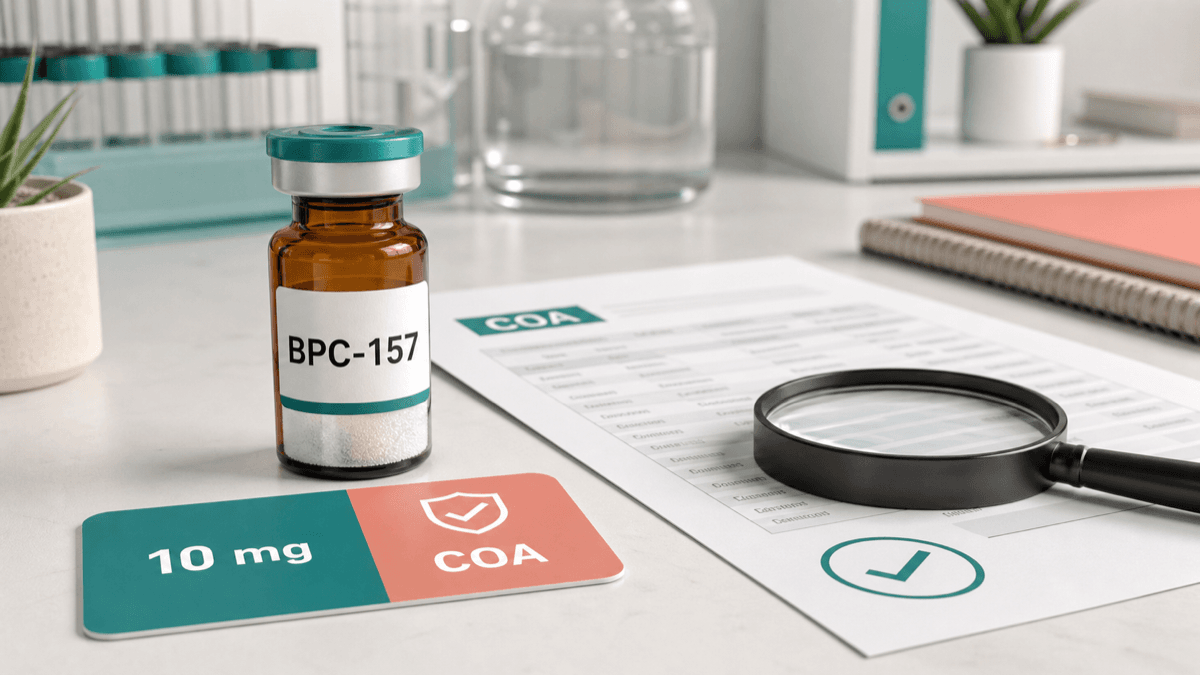
- Always demand a batch-specific COA tied to the lot on your vial, with HPLC purity of 98% or higher. A generic product certificate means nothing
- Fair 2026 pricing runs roughly $35–$80 for a 10mg vial. Anything under about $3 per mg should make you suspicious, not excited
- Buy lyophilized (freeze-dried) powder, not pre-mixed solution. Pre-mixed product degrades and hides quality problems
What BPC-157 Actually Is
BPC-157 (Body Protection Compound-157) is a synthetic pentadecapeptide, a chain of 15 amino acids based on a sequence found in human gastric juice protein. In research settings it is studied for tissue repair, tendon and ligament healing, and gastrointestinal protection. The mechanisms most often described in the literature involve angiogenesis (new blood vessel formation), upregulation of growth factors, and modulation of nitric oxide signaling.
Here is the honest part most sales pages skip. The bulk of BPC-157 evidence comes from animal models, much of it from Predrag Sikiric and colleagues, who have published the foundational work on the peptide since the 1990s. Human data is still very thin, limited to a handful of small case series and early safety work. So when a vendor markets BPC-157 with confident claims about curing injuries in people, they are getting ahead of the science. It is a promising research compound, not an approved therapy. If your interest is gut-specific, our BPC-157 for gut healing overview covers what the research does and does not support.
Where to Buy BPC-157 in 2026
There is no pharmacy counter for BPC-157, no insurance coverage, and no standard prescription on demand. Realistically you are choosing between two lanes, and every listing you see advertised as BPC-157 for sale sits in one of them.
Research Peptide Vendors (Where Most People Buy)
This is the main channel. Online peptide companies sell BPC-157 as lyophilized powder for research use, no prescription required. The catch is that quality ranges from genuinely excellent to outright fraudulent, and the price tag tells you almost nothing about which you are getting. Two vials at the same price can differ wildly in actual purity and milligram content. Everything comes down to whether the vendor publishes real third-party testing.
Compounding Pharmacies (Restricted)
In 2023 the FDA placed BPC-157 in its Category 2 list of bulk drug substances, which effectively restricted licensed compounding pharmacies from preparing it for human use. Its compounding status has remained a subject of ongoing FDA review since, so availability through telehealth and compounding channels has been inconsistent and depends on the regulatory posture at the time you read this. If you do find a compounded prescription option, expect to pay a premium plus consultation fees, and still ask for the same sourcing and testing documentation you would demand from any vendor.
FDA's position moved again in 2026, and not in the direction vendors imply. On the agency's category 2 page, content current as of April 22, 2026, BPC-157 no longer appears in the active category 2 table. It sits in the separate list of bulk substances nominated but withdrawn, which covers substances "previously in category 2" whose nominators pulled the nomination, not substances FDA cleared (FDA). The safety language FDA published alongside it still stands: compounded BPC-157 "may pose risk for immunogenicity for certain routes of administration," carries complexities around peptide-related impurities and active pharmaceutical ingredient characterization, and has "no, or only limited, safety-related information" for the proposed routes of administration. A withdrawn nomination is not an approval, and it does not reopen a pharmacy lane.
For most buyers, a reputable research peptide vendor is the practical answer. Which makes vendor selection the part that actually matters. The compounding route changed again in 2026, and the rules around where to buy BPC-157 legally are worth reading in full before you assume a pharmacy can supply you.
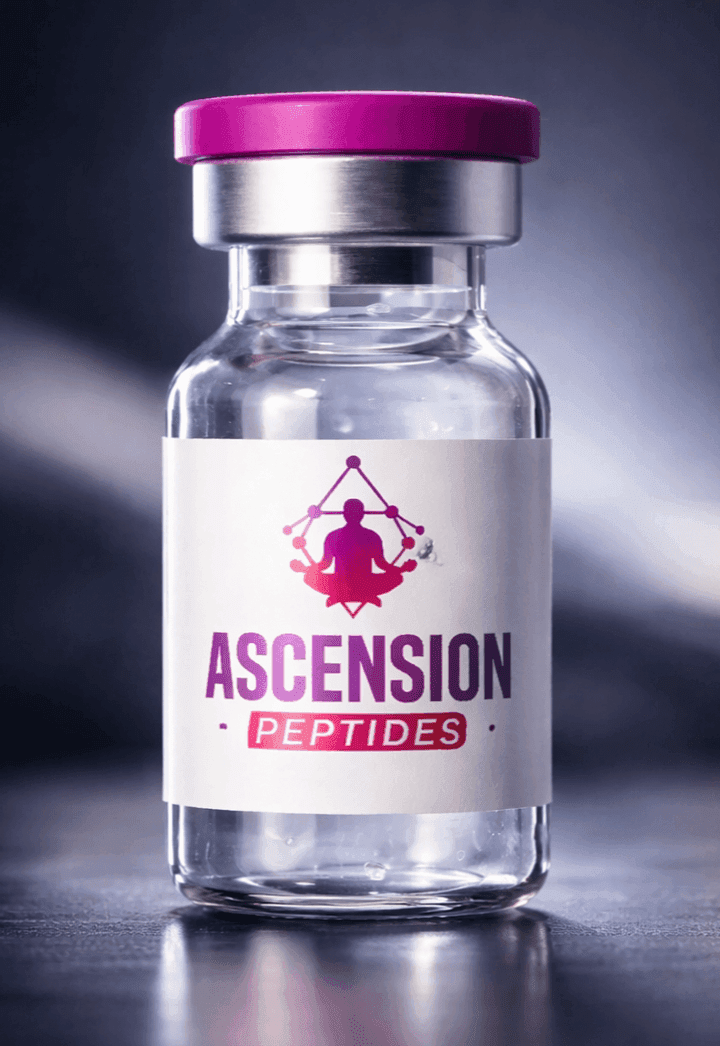
Best Place to Buy BPC-157: Ascension Peptides
Ascension Peptides is the vendor we recommend, and not because of commission rates. It is because they handle the boring, expensive part of this business, quality verification, the right way.
Why Ascension Stands Out
Batch certificates you can actually check. Ascension publishes 85 batch-specific certificates of analysis in a public library, not a recycled document from a synthesis run six months ago. You can match the lot on your vial to the lot on the document. We checked one Kovera Labs report (KVR-2026-410047, for DSIP) against the lab's own records, and it matched.
Purity that holds up. Every batch is independently tested by a third-party lab, currently Kovera Labs, and the certificate pass mark is >98% by HPLC; recent batches have tested between 98.9% and 99.9%. That precision matters for accurate research dosing, where a 90–95% product quietly throws off every calculation you make.
Testing that goes past a purity number. The certificates also cover LC-MS identity, net content (mg per vial), endotoxin, a rapid sterility screen and heavy metals, so you see identity and contamination data rather than one headline figure with nothing behind it.
Clear shipping terms, no refund promises. Ascension ships within the United States only, with free shipping over $250. All sales are final, though damaged or incorrect items are replaced if reported quickly.
You can check current pricing and stock for their 10mg vial directly at Ascension Peptides. It lists at $49.00 USD, and new customers get 50% off with code PEPTIDEDECK.
How to Verify BPC-157 Quality: Reading a COA
"Look for third-party testing" is advice everyone repeats and almost no one explains. Here is what actually separates a legitimate certificate from decoration.
Batch-Specific vs. Generic COAs
A product-level COA is a single certificate slapped on an entire product line. It may have been generated on a different lot entirely. Some vendors reuse the same PDF indefinitely.
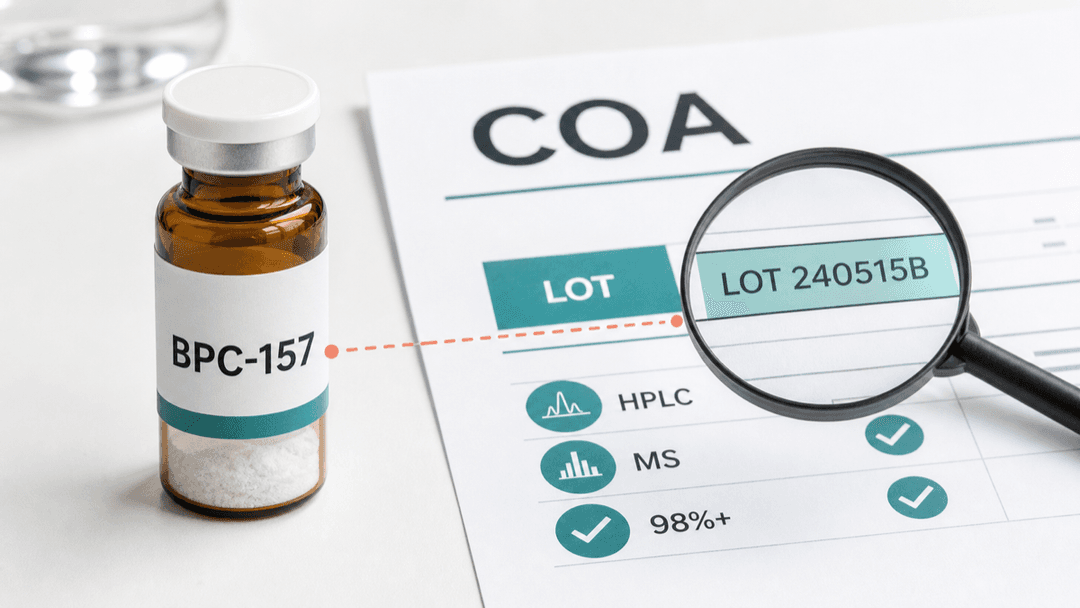
A batch-specific COA references the exact lot number printed on your vial, with a testing date and results that correspond to what shipped to you. That is the only kind worth trusting. When your vial arrives, the lot numbers should match. If a vendor cannot produce that, treat the sale as unverified.
HPLC and Mass Spectrometry
HPLC measures purity, the percentage of the sample that is actually BPC-157. Look for 98% or higher. Around 95% is borderline; lower is a red flag.
Mass spectrometry confirms identity by checking that the molecular weight matches BPC-157. Ideally a vendor runs both, because a sample can be highly pure and still be the wrong compound.
Labs like Janoshik, Colmaric Analyticals, and MZ Biolabs actively test peptides and have verifiable certificate IDs you can often cross-reference. If the "lab" on a COA has no online footprint, that document is worthless.
What BPC-157 Costs in 2026
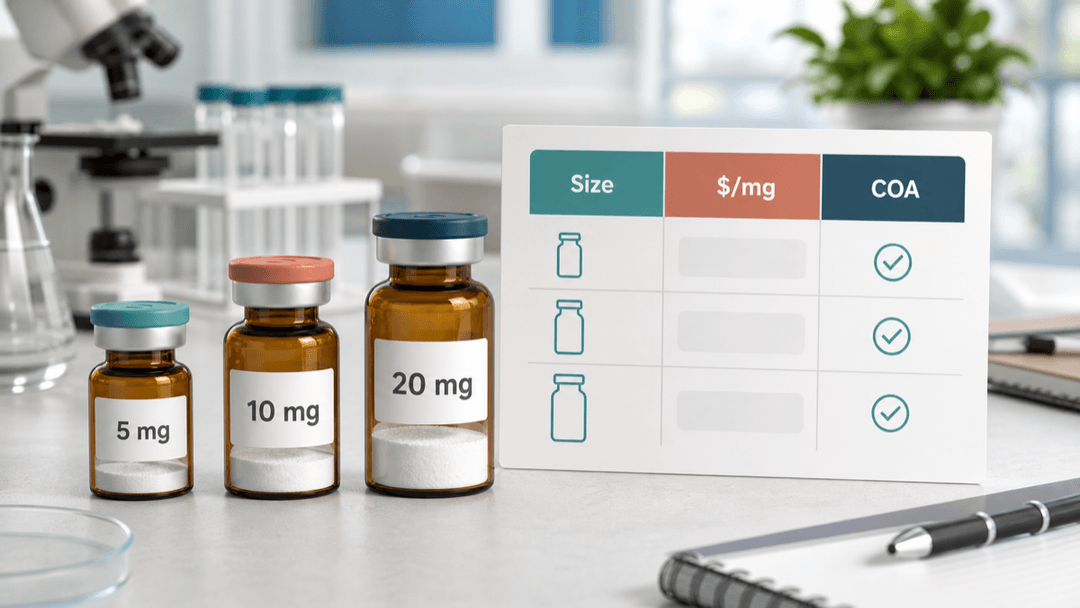
Pricing is mostly a function of vial size and vendor quality tier.
- 5mg vials: roughly $25–$55. The bottom of that range often signals testing shortcuts.
- 10mg vials: roughly $35–$80. This is the most common purchase. A fully documented vial with real COAs lands comfortably in this band.
- 20mg vials: roughly $75–$140. Better value per milligram for longer research protocols, but only if the batch testing is genuine.
A useful rule from the market: below about $3 per milligram, quality becomes a real concern. Synthesis and proper third-party testing cost money. A 10mg vial at $15 with free shipping did not pay for HPLC verification, and it may not contain what the label says. Spend the extra $20 and get the COA. It is the cheapest insurance in this entire process.
Red Flags to Avoid
The BPC-157 market is crowded with bad actors. Watch for these:
- No COA, or generic COA only. No batch-specific certificate means no sale. Full stop.
- Pre-mixed solutions sold as a convenience. Lyophilized powder is the stable format. Pre-mixed vials degrade and conveniently hide purity problems.
- Prices that are too good. A $12 "10mg" vial cut a corner somewhere, usually testing, sometimes the synthesis itself.
- Medical claims. Any vendor telling you how to dose BPC-157 "to heal your injury" while also calling it a research chemical is talking out of both sides of its mouth.
- Zero reputation. Check community boards like r/Peptides. Vendors with no track record, good or bad, deserve caution.
- Fake scarcity. Countdown timers and "today only" pressure from unknown sellers correlate with low-quality operations.
How to Get BPC-157
If you have decided a research peptide vendor is your route, the process is straightforward.
- Pick a vendor with published batch COAs. This is 90% of the decision. Start with a vendor like Ascension that documents every batch.
- Order the right vial size. A 10mg vial is the standard. Match size to how long you intend your research protocol to run.
- Pay with a credit card when you can. Card purchases carry chargeback protection if a fraudulent product shows up. Crypto offers privacy but no recourse.
- Verify the COA on arrival. Match the lot number on the vial to the certificate before anything else.
- Reconstitute and store correctly. BPC-157 ships as lyophilized powder and is mixed with bacteriostatic water, not plain sterile water. Keep the unreconstituted vial refrigerated; once reconstituted, store at 2–8°C, protect from light, and use within about four weeks.
No prescription is required for research-use purchases, and reputable vendors ship in discreet, unmarked packaging, typically within a few business days for US domestic orders. If you are researching BPC-157 alongside TB-500, our guide on what the Wolverine stack is and the Wolverine stack dosage breakdown cover that pairing in detail. Prefer the non-injectable route? See our look at BPC-157 capsules and oral vs capsules.
Vendor Comparison Table
Top Vendors
Ranked by purity, third-party testing, COA availability, and price.
>98% HPLC pass mark · Kovera Labs, every batch · Free over $250; US only
≥99% claimed · Published COA · Free over $200
≥98% HPLC · MZ Biolabs · US domestic
99% claimed · Claimed · US shipping
99% claimed · Third-party claimed · US/international
"Lab tested" · Unverified · Varies
Prices are approximate and change frequently. Always confirm current pricing and COA availability before buying.
Related Buying Guides
Use these next if you are comparing adjacent research-peptide sourcing decisions:
- Where to buy TB-500
- Where to buy Wolverine Stack
- Where to buy GLOW peptide stack
- Where to buy KPV
- Where to buy ARA-290
Frequently Asked Questions
Where can I buy BPC-157?
BPC-157 is sold by online research peptide vendors as a lyophilized powder, with no prescription required. The differentiator is documentation: buy only from a vendor that publishes batch-specific third-party COAs showing ≥98% HPLC purity. Ascension Peptides is our top recommendation for that combination of verified third-party testing and a public library of batch-specific certificates.
Is BPC-157 legal to buy?
BPC-157 is not a controlled substance and is sold legally as a research peptide in the United States. It is not FDA-approved for human use, and in 2023 the FDA restricted compounding pharmacies from preparing it for people by placing it on its Category 2 bulk substance list. Buying it for research from a domestic vendor carries low practical legal risk, but you are operating outside the standard pharmaceutical approval system. It is also banned in competition by the World Anti-Doping Agency.
How much does BPC-157 cost?
Expect roughly $25–$55 for a 5mg vial, $35–$80 for a 10mg vial, and $75–$140 for a 20mg vial from quality vendors in 2026. Pricing below about $3 per milligram should raise a flag rather than excitement, since legitimate synthesis and third-party testing both cost money.
How do I know my BPC-157 is real and high purity?
Demand a batch-specific COA whose lot number matches the vial you received. Confirm purity is listed at 98% or higher by HPLC, ideally with mass spectrometry confirming identity. Verify the testing lab is a real, searchable organization such as Janoshik, Colmaric, or MZ Biolabs. If there is no lot number or the lab cannot be found online, treat the product as unverified.
Do I need a prescription for BPC-157?
No prescription is needed to buy BPC-157 as a research peptide from an online vendor. Prescription access through compounding pharmacies has been restricted by the FDA and remains inconsistent, so the research vendor channel is how most people obtain it.
Is BPC-157 for sale through a pharmacy?
No. Under section 503A of the Federal Food, Drug, and Cosmetic Act, a compounding pharmacy may only use a bulk drug substance that complies with a USP or NF monograph, is a component of an FDA-approved drug product, or appears on FDA's 503A bulks list (FDA). That list, codified at 21 CFR 216.23, currently holds six substances: Brilliant Blue G, cantharidin, diphenylcyclopropenone, N-acetyl-D-glucosamine, squaric acid dibutyl ester, and thymol iodide. BPC-157 is not among them. So the listings you find advertised as BPC-157 for sale come from research peptide sellers, not pharmacies, which is why the batch COA rather than a pharmacy label is the only quality control in the transaction.
What is the difference between BPC-157 acetate and arginate?
The acetate salt is the standard injectable research form and is water-soluble. The arginate salt is a more stable variant marketed for oral or sublingual use, since it is designed to better survive the digestive environment. For research focused on gut tissue, oral forms are common; our oral vs capsules guide explains the trade-offs.
The Bottom Line on Where to Buy BPC-157
If you came here to figure out where to buy BPC-157, the framework is simple: COA first, reputation second, price last. The compound is genuinely interesting in research, but the market around it is full of vendors who lean on the name and skip the testing that makes a vial worth buying.
Ascension Peptides clears all three bars: batch-specific certificates from an independent lab published in a public library, a >98% HPLC purity pass mark, and pricing that is competitive without being suspiciously cheap. If you are ready to order, that is where I would start, and code PEPTIDEDECK takes 50% off for new customers.
Medical Disclaimer: This article is for informational purposes only and does not constitute medical advice. BPC-157 is not FDA-approved and is not intended to diagnose, treat, cure, or prevent any disease. Research peptides are sold for laboratory research use only. Always consult a qualified healthcare provider before considering any new compound, and understand that the purchase and use of research peptides carries legal and health risks that vary by jurisdiction and individual circumstances.