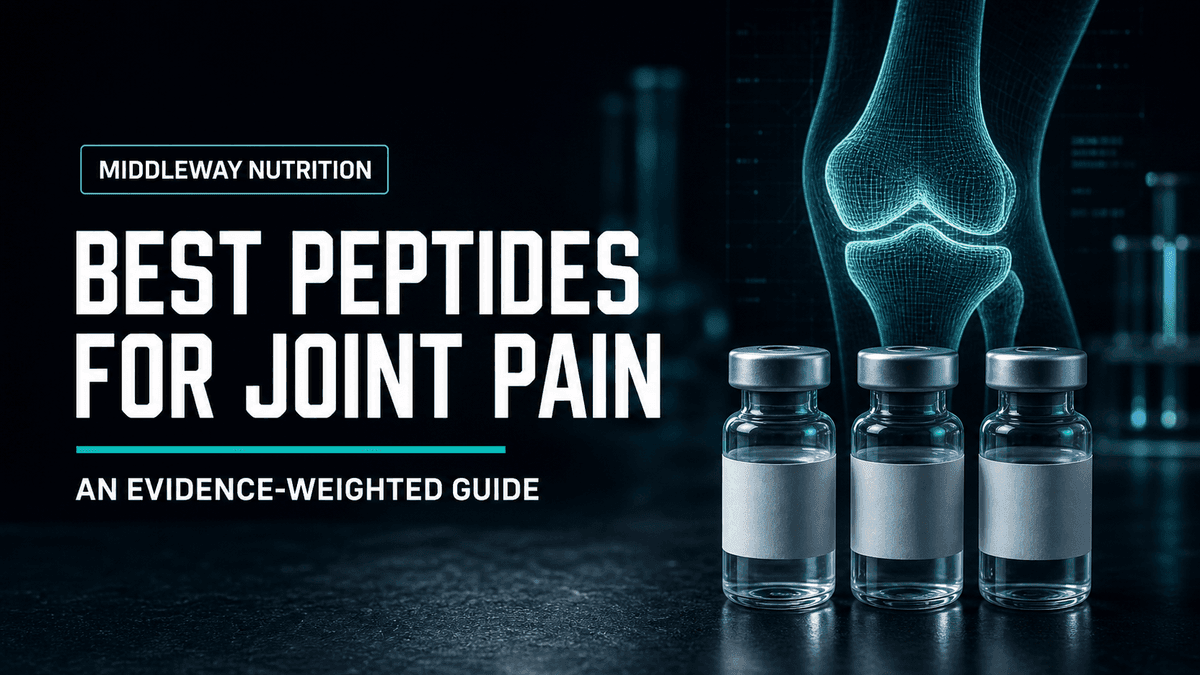
The best peptides for joint pain, in terms of how much support each has, are BPC-157 first, TB-500 second, then GHK-Cu and KPV for the inflammatory component. The important qualifier is that the evidence behind all of them is animal research and clinical experience rather than controlled human trials, so this is a ranking within a category where nothing has been properly proven.
Search results for the best peptides for joint pain tend to be written with a confidence the underlying data does not support. This page keeps the compounds and the reported doses, but is explicit about where the ground is solid and where it thins out, because that distinction is the useful part.
Why Joints Are Hard to Repair
The tissues that hurt in a painful joint are among the slowest healing in the body, and the reason is blood supply.
| Tissue | Blood supply | Typical healing timescale |
|---|---|---|
| Cartilage | None, avascular | Months to years, often incomplete |
| Tendon | Poor | Weeks to months |
| Ligament | Moderate | Weeks to months |
| Synovial membrane | Good | Days to weeks |
| Bone | Excellent | Weeks |
Cartilage has no vessels at all and relies on diffusion from synovial fluid for everything. That single fact explains why joint problems persist, why anti-inflammatories manage symptoms without changing the trajectory, and why the argument for compounds that promote new vessel formation nearby is at least coherent.
It also explains why timelines here are long. Anything promising joint repair in two weeks is describing a reduction in inflammation, not structural change.
BPC-157
BPC-157 is a synthetic fifteen amino acid peptide based on a sequence found in gastric juice protein. It is the most used compound in this space and has the largest body of preclinical work behind it, most of it in rodents.
The reported mechanisms are angiogenesis through VEGF signalling, upregulation of growth factor activity, and effects on tendon fibroblast migration. In animal models it accelerates healing across tendon, ligament, muscle and bone, which is unusually broad for a single compound and is the basis of its reputation.
What is missing is human trial data. There are no large controlled trials showing BPC-157 improves joint pain in people. What exists is a substantial animal literature, a long record of use, and consistent user reports. That is enough to make it the reasonable first choice within the category and not enough to make claims about it with confidence.
Reported research doses cluster around 250 to 500 mcg daily, sometimes split, often injected near the affected area on the theory of local concentration, though systemic effects are also reported. Courses typically run four to eight weeks. Our BPC-157 guide covers the detail.
TB-500
TB-500 is a fragment of thymosin beta-4, and the mechanism differs from BPC-157 in a way that matters. It binds actin and supports cell migration, which is how repair cells reach damaged tissue. It also distributes systemically rather than acting mainly where it is injected.
That systemic distribution is the practical argument for choosing it when the problem is diffuse: multiple joints, a general osteoarthritic picture, rather than one specific tendon. It is also why equine practice adopted it early for tendon and ligament injury, giving it a longer track record in animals than in people.
Reported doses are usually in the range of 2 to 5 mg per week during a loading period, dropping to a lower maintenance frequency. The human evidence is thinner than for BPC-157.
Because the two act through different mechanisms, running them together is the most common combination in this space. That is a defensible rationale for stacking rather than the usual "more is better" reasoning, though it does mean two variables at once on a first attempt.
GHK-Cu
GHK-Cu is a copper-binding tripeptide with a well-documented role in collagen synthesis and wound remodelling. Most of its human evidence is dermatological and topical, where it is one of the better-supported cosmetic actives.
The joint argument is an extrapolation: cartilage is a collagen matrix, GHK-Cu promotes collagen synthesis and influences the enzymes that degrade it, therefore it may help cartilage. The mechanism is plausible and the human joint data does not exist. Treat it as a supporting compound rather than a primary one.
KPV
KPV is a three amino acid fragment of alpha-MSH with anti-inflammatory activity. It does not repair tissue; it dampens the inflammatory signalling that makes a damaged joint painful and that drives further degradation.
For a joint where the dominant symptom is inflammatory, swelling, heat, morning stiffness, it has a clearer rationale than for a mechanically worn one. It is also frequently included in blends, which is where most people encounter it.
Best Peptides for Joint Pain Compared
| Peptide | Primary role | Evidence strength | Reported dose range | Common side effects |
|---|---|---|---|---|
| BPC-157 | Tissue repair, angiogenesis | Strongest in the category, still animal-dominated | 250 to 500 mcg daily | Injection site reactions |
| TB-500 | Cell migration, systemic distribution | Moderate, mostly animal and equine | 2 to 5 mg weekly loading | Injection site reactions, occasional fatigue |
| GHK-Cu | Collagen synthesis | Good topically, extrapolated for joints | 1 to 2 mg daily reported | Local irritation, staining |
| KPV | Anti-inflammatory | Limited, mechanism well described | 250 to 500 mcg daily | Minimal reported |
Doses are figures reported in research and common practice, not recommendations.
Side Effects and the One Real Caution
Across this group, the commonly reported effects are local: redness, a small lump, transient soreness at the injection site. Systemic complaints are uncommon in user reports.
The caution that deserves proper weight is angiogenesis. BPC-157 and TB-500 both promote new blood vessel formation, which is precisely how they are supposed to help a poorly vascularised tendon. A tumour also depends on new blood vessels. There is no evidence that either peptide causes cancer, and there is a reasonable case for avoiding them with an active or suspected malignancy. This is worth raising with a clinician rather than deciding alone.
The second caution is less dramatic and more common. These compounds may reduce pain before the tissue has recovered, and people then train through an injury that is still healing. Pain is information. Losing it early is not automatically a good outcome.
What to Do Before Reaching for a Vial
Get a diagnosis. "Joint pain" covers osteoarthritis, tendinopathy, bursitis, referred pain, inflammatory arthritis and mechanical instability, and those have genuinely different treatments. Inflammatory arthritis in particular has effective medical therapy, and delaying it while trying research compounds is a bad trade.
Then do the loading work. For tendinopathy specifically, progressive loading protocols have real trial evidence, which is more than anything on this page can claim. A peptide alongside a structured rehab programme is a reasonable experiment. A peptide instead of one is a worse plan than doing nothing.
Our peptides for recovery piece goes further into where this literature runs out.
A Realistic Timeline
Weeks one to two: little or nothing. Some people report reduced ache early, which is likely inflammatory rather than structural.
Weeks three to six: this is where reports of improved function cluster, if they appear at all.
Weeks six to eight: the point at which to make a decision. If a structured course alongside rehab has produced no measurable change in pain or function, extending it is unlikely to help.
Track something specific. "Feels a bit better" is not usable. Pain on a numeric scale at a defined activity, or a range of motion measurement, gives you something to compare.
FAQ
Which peptide is best for knee pain?
BPC-157 is the most commonly used and has the largest preclinical base, so it is the usual starting point. Whether it addresses your knee depends entirely on the cause, since osteoarthritis, a meniscal problem and patellar tendinopathy are different conditions with different prospects. Getting the diagnosis first matters more than the choice of compound.
Can peptides regrow cartilage?
There is no human evidence that any of these compounds regrows cartilage. Cartilage has no blood supply and repairs poorly under any intervention. The plausible claim is improved function and reduced pain in surrounding structures, not regeneration, and anyone promising the latter is well ahead of the evidence.
How long should a joint peptide course run?
Reported protocols commonly run four to eight weeks, followed by a break and a reassessment. Continuous long-term use is not well studied for any of these compounds, and running one indefinitely because it might be helping is how people spend a lot of money on an unanswered question.
Are peptides better than cortisone injections for joints?
They are different interventions and have not been compared in a trial. Corticosteroid injections reliably reduce inflammation for a period and have known downsides with repetition, including effects on cartilage and tendon. Peptides have a repair-oriented rationale and no controlled human evidence. Neither statement makes one better than the other.
Do peptides for joint pain show up on a drug test?
For tested athletes, yes, this is a real risk. Growth factors and repair peptides fall under prohibited categories in anti-doping rules, and BPC-157 has been specifically addressed by WADA. Anyone subject to testing should check the current prohibited list rather than assume a research compound is unlisted.