BPC-157 peptide benefits rest almost entirely on animal data, the side effects reported so far are mild and mostly local, and dosage in the literature clusters around a few hundred micrograms per day. That is the honest summary of a compound usually described in far grander terms, and it is the frame for this page.
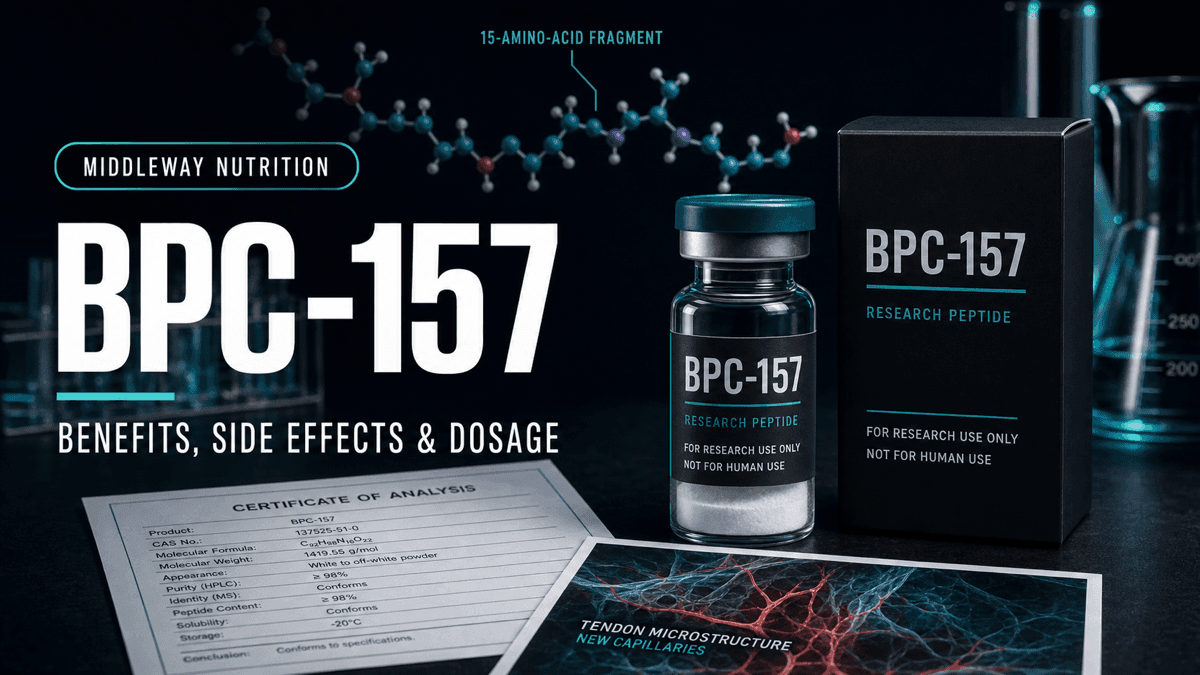
- BPC-157 is a synthetic 15 amino acid fragment (a pentadecapeptide) of a larger protective protein isolated from human gastric juice. Sequence: Gly-Glu-Pro-Pro-Pro-Gly-Lys-Pro-Ala-Asp-Asp-Ala-Gly-Leu-Val.
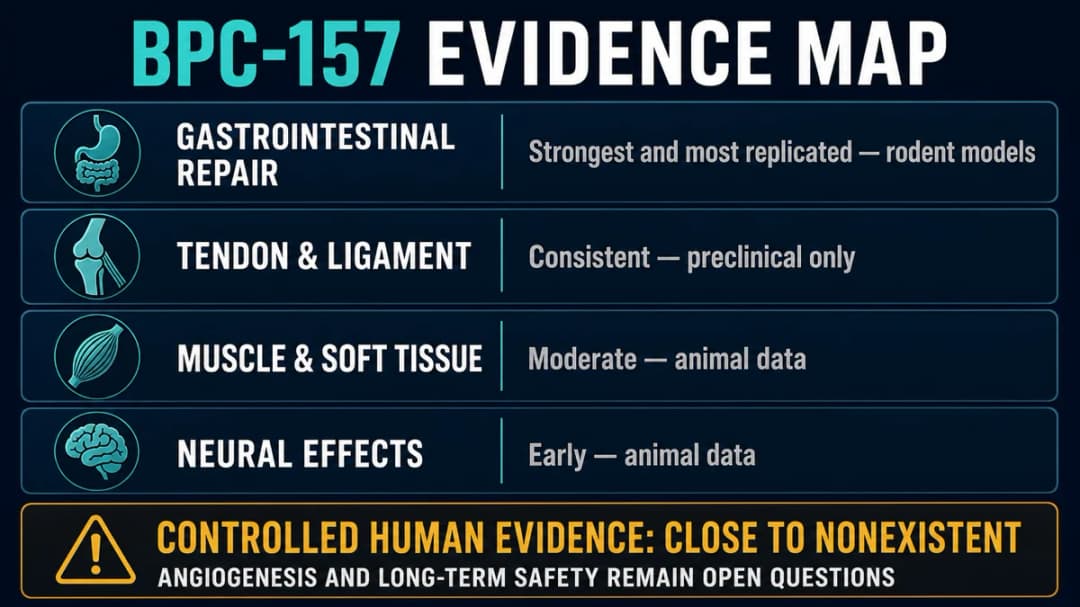
- The best replicated findings are gastrointestinal: protection and repair of stomach and intestinal lining in rodent models of NSAID, alcohol, and stress damage.
- Connective tissue findings (Achilles tendon, transected muscle, ligament) are consistent across labs but remain preclinical. Human trial evidence is close to nonexistent.
- Doses reported in vendor and community use sit between roughly 200 and 500 mcg per administration, once or twice daily, in cycles of about four to eight weeks.
- Documented adverse effects are limited to injection site irritation, occasional nausea, and rare mild dizziness. Sold for laboratory research use only, not approved by the FDA, and prohibited in tested sport as a non-approved substance.
What BPC-157 Actually Is
Strip away the marketing and BPC-157 is a short, unusually rugged chain of fifteen amino acids. The parent molecule, Body Protection Compound, occurs naturally in human gastric juice, where it appears to help the stomach tolerate its own acid. Researchers in the 1990s identified an active fragment of that protein and synthesized it. Everything sold today is that fragment, usually a lyophilized white powder in a 5 mg or 10 mg glass vial.
The property that makes it interesting is stability. Most peptides are torn apart by gastric acid within minutes, which is why they have to be injected. BPC-157 holds its structure in acidic conditions, unsurprising given where the parent protein lives. That single trait is why oral administration is even discussed for this compound and almost never for others in its category.
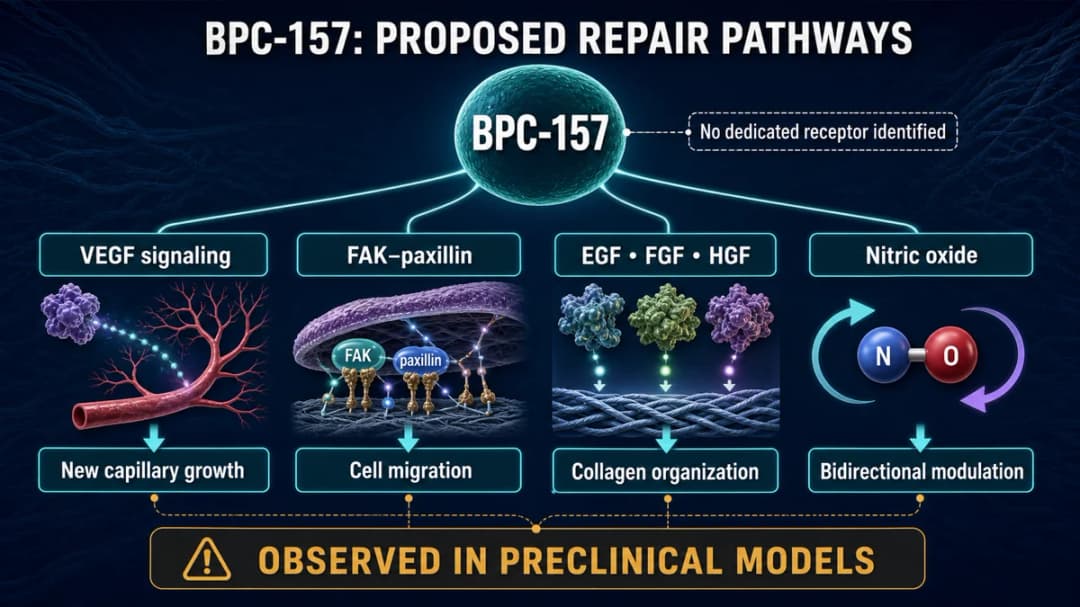
Mechanistically, it does not appear to act through one dedicated receptor. No specific BPC-157 receptor has been identified. Instead the literature describes several overlapping effects:
- Angiogenesis through VEGF upregulation. New capillary growth into damaged tissue is the most frequently cited mechanism, and it plausibly explains why poorly perfused structures like tendon respond in animal models.
- Growth factor signaling. EGF, FGF, and HGF activity all shift in BPC-157 studies, which maps onto epithelial repair, fibroblast activity, and collagen organization.
- Bidirectional nitric oxide modulation. This is the subtle one. BPC-157 counteracts both NO synthesis blockade and NO excess, behaving more like a regulator restoring balance than a simple donor or inhibitor.
- FAK-paxillin pathway interaction. Focal adhesion kinase governs cell migration into a wound bed, and this pathway has been implicated in BPC-157's repair effects.
- Dopaminergic interaction at D1 and D2 receptors, which is how the gut-brain and neuroprotective observations are usually rationalized.
- Local cytokine suppression without the broad immunosuppression associated with corticosteroids.
All of that is preclinical characterization. BPC-157 is not an approved drug anywhere, it sits on the FDA's list of substances flagged for evaluation under Section 503A compounding rules, and research vendors sell it labeled for laboratory use only. Treat every mechanism here as what has been observed in models, not a promise about what it does in a person.
BPC-157 Benefits
Grading matters more than listing here, so each category below comes with the strength of the evidence behind it rather than a flat bullet.
Gastrointestinal repair (strongest evidence). This is where the research is deepest and most replicated. Rodent models show reduced ulcer formation and faster healing where the damage came from NSAIDs including aspirin, indomethacin, and diclofenac. Similar protection appears against alcohol-induced gastric lesions, stress ulcers, and cysteamine-induced duodenal ulcers. Colitis models (TNBS, DSS, acetic acid) show lower inflammation scores and better mucosal healing, and fistula healing has been observed in Crohn's-relevant models. Oral dosing works in these studies, consistent with the peptide's acid stability.
Tendon and ligament healing (consistent but preclinical). Accelerated Achilles tendon repair is among the most cited findings, alongside faster recovery in ligament models. The mechanistic story is coherent: tendon heals slowly largely because it is poorly vascularized, and the primary reported effect of BPC-157 is building vasculature. Human evidence here is anecdotal. If you see a percentage improvement quoted for human tendon healing, it is not coming from a controlled trial.
Muscle and soft tissue recovery (moderate, animal). Crushed and transected muscle regenerated faster than controls in animal studies. In practice this is hard to separate from ordinary recovery, and it is the category where anecdotal reports and placebo are hardest to untangle.
Neural and neuroprotective effects (early, animal only). Peripheral nerve crush recovery, protection of dopaminergic neurons in MPTP models, and improved outcomes after experimental brain injury have all been reported. Interesting results, and a long way from clinical validation.
Gut-brain and mood effects (weak, mechanistic). Anxiolytic and antidepressant-like behavior appears in stress-based rodent models. The proposed route is the gut-brain axis plus dopaminergic interaction. Anyone presenting this as a treatment for anxiety is well ahead of the data.
For a fair comparison of how this profile stacks against other repair compounds, the TB-500 peptide guide covers a peptide with a systemic, migration-driven mechanism, while the KPV peptide guide covers a much smaller anti-inflammatory tripeptide with overlapping gut applications.
BPC-157 Side Effects
The safety picture looks favorable, but it matters why. Most of the reassurance comes from animal toxicity work and a large volume of uncontrolled self-reporting, not from monitored human trials. Absence of documented harm is not demonstrated safety.
Documented and commonly reported:
- Injection site reactions. Redness, mild stinging, or a small welt. The most frequent complaint by a wide margin, and generally short lived.
- Nausea. Reported more often with oral administration, particularly at the higher end of the oral range.
- Mild dizziness. Uncommon, and mostly noted at higher doses.
- Transient fatigue. Occasionally reported in the first days of a protocol, poorly characterized.
What the toxicity literature shows: animal work has generally failed to establish a lethal dose even at large multiples of typical research amounts, and extended dosing studies have not described organ toxicity. That is genuinely reassuring as far as it goes. What does not exist is a monitored human safety dataset of any real size, so the human side of the picture rests on self-reporting rather than measurement.
Where the data is genuinely thin, and worth stating plainly:
- Long-term use. There is no meaningful human data past a few weeks. Multi-month or repeated annual use is entirely uncharacterized.
- Angiogenesis and cancer. Promoting new blood vessel growth is the central mechanism, and tumors also require blood vessels. No case reports link BPC-157 to tumor progression, and the interaction has not been studied. Anyone with a current or prior malignancy should treat that gap as disqualifying until a specialist says otherwise.
- Drug interactions. Nitric oxide modulation and dopaminergic activity make interactions with nitrates, certain blood pressure medications, and dopaminergic drugs theoretically plausible. There is essentially no data.
- Pregnancy, breastfeeding, and pediatric exposure. No data at all.
- Product quality as a safety variable. With an unregulated research chemical, the most likely cause of a bad experience is not the peptide but what else is in the vial.
BPC-157 Dosage Chart
The flat microgram figures in the chart below are community and vendor convention, not published research protocols: the animal papers dose per kilogram of body weight (for example 10 ug/kg and 10 ng/kg in rats; see the BPC-157 dosage chart for the verified PMIDs), and no one has converted those into a validated human dose. The chart describes what people report using, not a protocol for you to follow. There is no established human dose for BPC-157, because no dose-finding trial has been run.
| Research context | Reported range | Route | Frequency | Typical cycle |
|---|---|---|---|---|
| General GI protection | 250 to 500 mcg | Oral | Once or twice daily | 4 to 6 weeks |
| Ulcer healing models | 250 to 500 mcg | Oral or subcutaneous | Twice daily | 4 to 6 weeks |
| IBD-focused protocols | 500 mcg | Oral | Once or twice daily | 4 to 8 weeks |
| Tendon and ligament repair | 250 mcg | Subcutaneous | Twice daily | 6 to 8 weeks |
| Muscle strain and tear | 250 mcg | Subcutaneous | Twice daily | 4 to 6 weeks |
| Post-operative repair models | 250 mcg | Subcutaneous | Twice daily | 4 to 8 weeks |
| Acute or severe injury, short term | 500 mcg | Subcutaneous | Twice daily | 2 to 4 weeks |
| Low-dose maintenance | 250 mcg | Subcutaneous | Once daily | 4 weeks on, 2 to 4 weeks off |
Three things worth knowing about how these numbers behave.
First, the community figures are flat rather than weight-based. The reported ranges are the same for a 60 kg subject and a 100 kg one, which is a convention and not something a study has shown; the animal research doses per kilogram. The idea that the signaling pathways saturate at low concentrations, so that extra peptide is simply excreted, is an unverified explanation and we found no source for it.
Second, the oral range sits at the higher end of the same band rather than far above it. Oral absorption is less efficient than subcutaneous, but for GI applications the target tissue is the gut lining itself, so the route delivers the compound exactly where it is meant to act.
Third, tendon protocols run long. Six to eight weeks is a common community length (not a studied standard), and stubborn structures like the Achilles or rotator cuff are often run to ten or twelve. Some users blame short cycles when a protocol produces nothing, but no source shows cycle length is the usual reason.
Reconstitution and Storage
BPC-157 ships as a lyophilized powder and has to be reconstituted with bacteriostatic water before any injectable use. Two common vial sizes, with the arithmetic laid out:
| Vial | Bacteriostatic water added | Resulting concentration | 250 mcg equals | 500 mcg equals |
|---|---|---|---|---|
| 5 mg | 2 mL | 2,500 mcg/mL | 0.1 mL (10 units) | 0.2 mL (20 units) |
| 5 mg | 1 mL | 5,000 mcg/mL | 0.05 mL (5 units) | 0.1 mL (10 units) |
| 10 mg | 2 mL | 5,000 mcg/mL | 0.05 mL (5 units) | 0.1 mL (10 units) |
| 10 mg | 1 mL | 10,000 mcg/mL | 0.025 mL (2.5 units) | 0.05 mL (5 units) |
Units refer to markings on a standard 100 unit insulin syringe. A 5 mg vial yields twenty 250 mcg doses regardless of how much water you add, since dilution changes the volume drawn, not the total peptide.
Add the water slowly down the inside wall of the vial rather than onto the powder, and swirl instead of shaking. Sealed lyophilized vials are the most stable form, and the unmixed powder can be frozen for long-term storage. Once reconstituted, keep the vial at 2 to 8 degrees Celsius, use it within roughly three to four weeks, and do not freeze the solution. Pre-mixed liquid sold as ready to use is a red flag, since it tells you nothing about how long it sat that way.
Stacking
Only one combination has a real documented rationale. BPC-157 with TB-500 is common in research protocols because the mechanisms are complementary rather than redundant: BPC-157 drives vascular supply into the damaged area, TB-500 acts on actin regulation and cell migration to move repair cells there. Reported protocols load TB-500 at 2 to 2.5 mg twice weekly alongside daily BPC-157 at 250 to 500 mcg, then taper TB-500 to about 2 mg weekly. No adverse interaction between the two is described in the literature.
Blended products extend that base with GHK-Cu, typically reported around 1 to 3 mg twice weekly and aimed at skin and collagen remodeling, and KPV at roughly 250 to 500 mcg daily for its anti-inflammatory profile. These blends are marketed as broader coverage; the honest read is that the combined evidence is thinner than for either single compound, because nobody has studied the mixtures.
How to Verify What You Buy
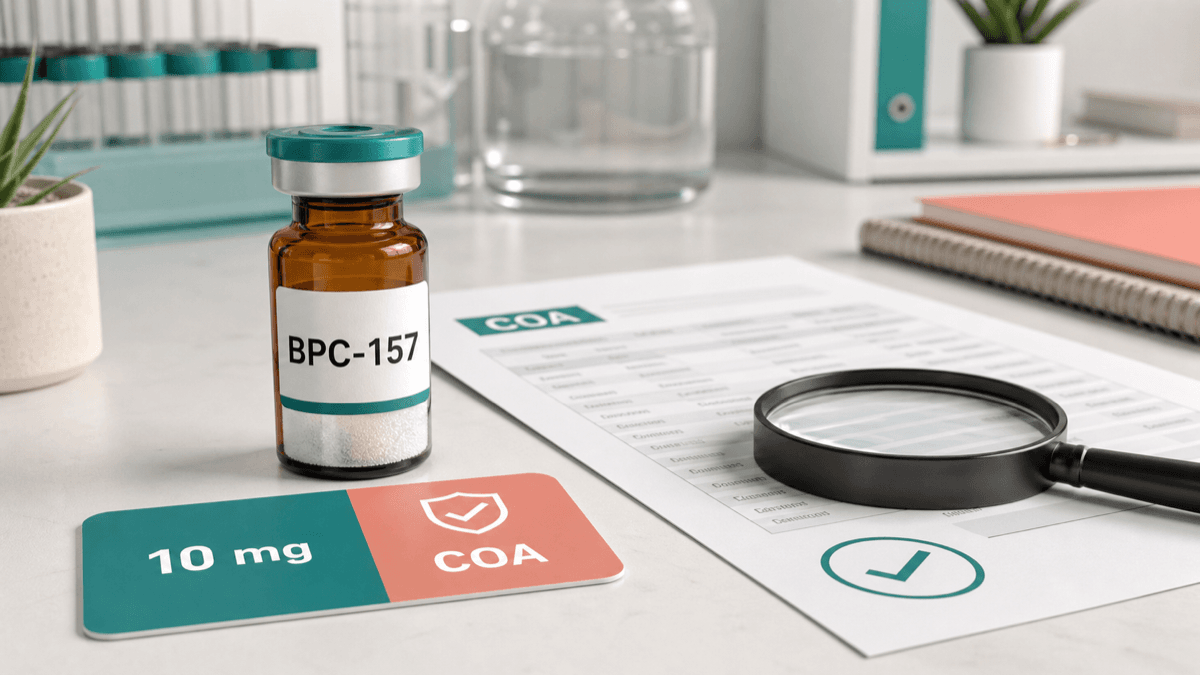
Because BPC-157 sits outside pharmaceutical regulation, the vial is only as good as the vendor's testing, so ask for a recent third-party certificate of analysis with HPLC purity and mass spectrometry identity confirmation rather than an in-house document. Match the mass on the report against the expected molecular weight of the pentadecapeptide, and be skeptical of any listing that shows no independent testing at all. Our where to buy BPC-157 page walks through which suppliers publish verifiable documentation, and the BPC-157 for sale page tracks current pricing per milligram so you can spot listings that are suspiciously cheap.
Looking for the numbers behind this guide? Our BPC-157 dosage chart sets label and trial doses beside what Reddit users report taking.
Frequently Asked Questions
What does BPC-157 actually do?
In research models it accelerates tissue repair, most reliably in the gastrointestinal tract and most visibly in poorly vascularized structures like tendon. The proposed mechanism is a combination of new blood vessel formation, growth factor upregulation, nitric oxide regulation, and local reduction of inflammatory signaling. In humans, controlled evidence for any of these outcomes is not yet available.
Is BPC-157 safe?
Animal toxicity work has been reassuring, with no lethal dose established at large multiples of typical amounts and no organ toxicity described, and adverse effects in practice are minor and mostly local. But the human record is essentially uncontrolled self-reporting rather than monitored study. The pro-angiogenic mechanism is an open question for anyone with a cancer history, and long-term effects are unstudied.
How much BPC-157 do people use?
Reported research ranges concentrate between 250 and 500 mcg per administration, once or twice daily, over cycles of four to eight weeks, with the same figures used regardless of body weight. Those are community and vendor figures, not published protocols or a recommendation, and no regulator has established a human dose.
Is BPC-157 legal?
Possession is legal in the United States and the compound is sold openly as a research chemical, but it is not an FDA-approved drug and it cannot lawfully be marketed for human use or as a dietary supplement. It has been flagged for further evaluation under Section 503A compounding rules, which has made pharmacy access inconsistent. Athletes should note that it appears on the WADA Prohibited List as a non-approved substance, so any competitive testing exposure makes it off limits regardless of national law.