VIP nasal spray is a compounded prescription spray of vasoactive intestinal peptide, usually 50 mcg per spray, used as the final step of the Shoemaker protocol for chronic inflammatory response syndrome (CIRS), the condition many patients call mould illness. The case for VIP nasal spray in CIRS rests mainly on one open-label study of 20 patients, published in 2013 by the protocol's own author, with no placebo group. The results were striking, but the evidence behind them is thin.
This page covers the CIRS-specific use. For VIP's general pharmacology and non-CIRS uses, see our VIP peptide overview. This is not medical advice. VIP for CIRS is off-label and belongs under a prescriber who can run the monitoring labs.
What VIP Nasal Spray Is and Why CIRS Clinics Use It
Vasoactive intestinal peptide is a 28-amino-acid neuropeptide made in the gut, lungs and brain, including the hypothalamus. It relaxes smooth muscle in blood vessels and airways and dampens several inflammatory pathways. Its half-life in plasma is very short, one reason it is given as frequent nasal doses.
In Shoemaker's model, chronic exposure to the inside of a water-damaged building sets off an innate immune response that never switches off in genetically susceptible people. That inflammation is said to disrupt hypothalamic signalling and lower regulatory hormones, VIP and MSH (alpha-melanocyte-stimulating hormone) among them. The protocol literature claims low VIP appears in 98% of CIRS patients and fewer than 10% of controls. Those figures come from Shoemaker's own clinic, not independent cohorts. Whether intranasal VIP reaches the brain in meaningful amounts has not been measured in humans.
Compounded spray versus research vials
VIP circulates in two forms: the compounded spray, made by a licensed pharmacy to a prescription, and lyophilised research-grade powder sold "not for human use", which some people mix with bacteriostatic water and load into their own atomiser. The protocol assumes the first form, with a known concentration and lab monitoring. A home-made spray has no assurance of dose, sterility or stability. Our guide to sourcing and COA checks for research-grade VIP covers that market separately.
Is CIRS a Real Diagnosis? The Evidence Problem
CIRS is a contested diagnosis. It has no ICD-10 code of its own (treating clinicians typically bill under Z77.120, contact with and suspected exposure to mould), and mainstream medical bodies have not adopted it.
In a December 26, 2025 column, UCLA Health physicians Eve Glazier and Elizabeth Ko wrote that "CIRS is not widely seen as an established medical diagnosis. Almost everything about it remains the subject of research and ongoing debate." Their practical worry was that "a focus on CIRS may delay other diagnoses", such as endocrine disorders, vitamin deficiencies, sleep disorders, autoimmune disease or Lyme disease.
What is established and what is not
Damp, mouldy buildings are associated with respiratory symptoms and asthma. The WHO's 2009 indoor air guidelines on dampness and mould say so. The contested step is the claim that building exposure causes a distinct multi-system illness, with fatigue, cognitive problems and pain, that a particular lab panel can identify and a particular drug sequence can reverse.
The case criteria come largely from one clinician and his collaborators. They combine a symptom roster (13 symptom clusters, with 8 or more said to be consistent with biotoxin illness), exposure history, a visual contrast sensitivity (VCS) test, HLA genotyping and biomarkers such as C4a, TGF-beta1, MMP-9, MSH and VIP. Several of these markers rise in many inflammatory states and are not specific to anything.
The controlled evidence is very small
The protocol's randomised evidence is for cholestyramine, the binder used in step 2, not for VIP. In that 2006 crossover trial (Shoemaker and House, Neurotoxicology and Teratology, PMID 17010568), 13 participants entered the double-blind phase: 7 took cholestyramine for two weeks and 6 took placebo. Symptoms and VCS scores improved only in the drug group, and the placebo group improved once switched over. It is a genuine controlled result, but from 13 people at one clinic over two weeks.
None of this means CIRS patients are imagining their illness. It means the label, and the logic of a sequenced protocol ending in VIP, has not been independently validated. Ordinary causes of fatigue and brain fog should be ruled out first. Our review of what the evidence supports for energy and fatigue comes at that problem from another angle.
Where VIP Sits in the Shoemaker Protocol
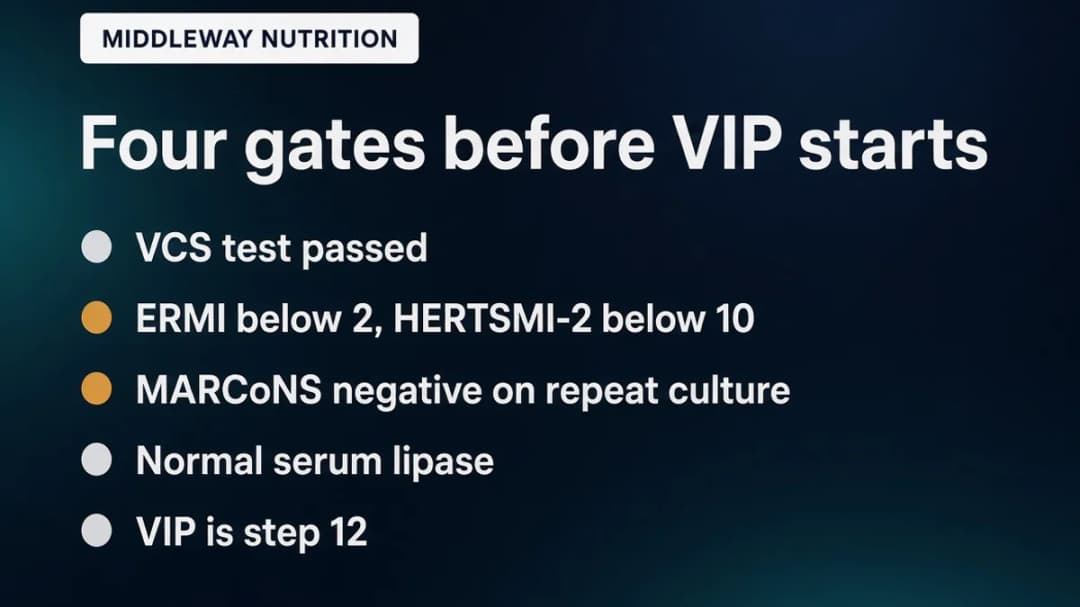
The Shoemaker protocol has 12 steps, done in order, and VIP is step 12. In short: remove from exposure; take binders (cholestyramine or colesevelam); clear MARCoNS (multiply antibiotic-resistant coagulase-negative staphylococci in the deep nasal passages) with a compounded antibiotic-EDTA spray; drop gluten if anti-gliadin antibodies are positive; correct androgens, checking testosterone and estradiol; correct ADH and osmolality; then work down MMP-9, VEGF, C3a, C4a and TGF-beta1. Only then does VIP start.
Some telehealth services now compress this into three phases and prescribe before labs or while the patient still lives in the building, which departs from the original protocol.
The preconditions before the first spray
Protocol summaries agree on four gates:
- VCS test passed, as a rough marker that neurotoxic effects have settled.
- No ongoing exposure: the home or workplace tests at ERMI below 2 or HERTSMI-2 below 10.
- MARCoNS negative on a repeat deep nasal culture.
- Normal serum lipase, because VIP stimulates pancreatic secretion.
The 2013 study used the same logic. It excluded patients with depressed VCS, an ERMI above 2 or MARCoNS, because benefit in earlier use "was not observed to be universal" when any of these were present. That is coherent within the model, but it also means the trial population was screened in a way that probably favoured responders.
Proponents say VIP goes last because it fails while the inflammatory drive is still running. Critics would add that after many months on steps 1 to 11, time and regression to the mean explain a lot of apparent improvement.
What the 2013 VIP Study Actually Showed
The key paper is Shoemaker RC, House D and Ryan JC, "Vasoactive intestinal polypeptide (VIP) corrects chronic inflammatory response syndrome (CIRS) acquired following exposure to water-damaged buildings", Health, 2013, 5(3): 396-401. We read the full text.
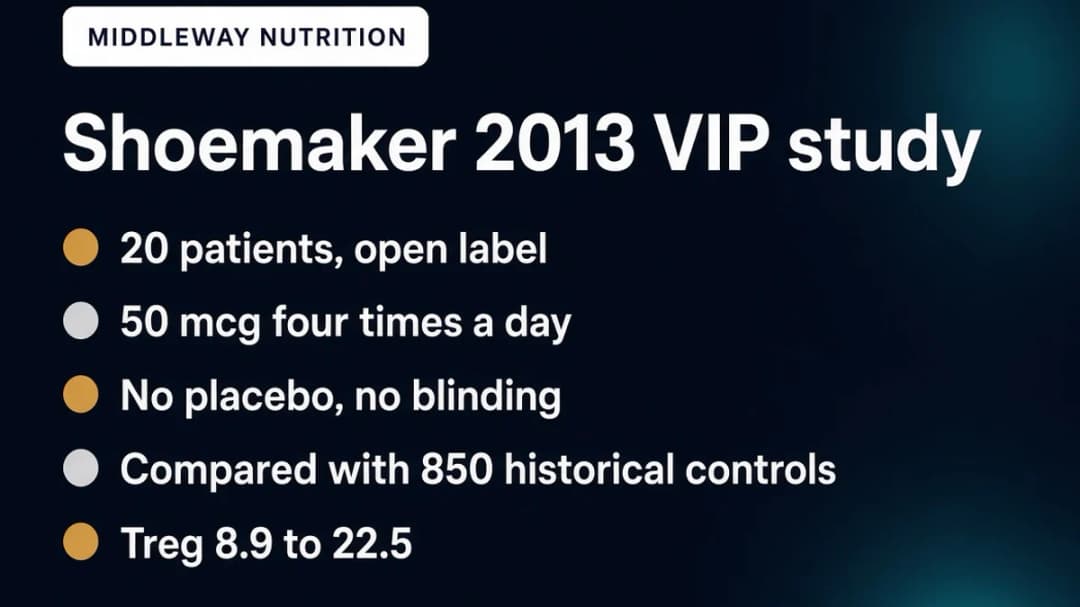
It enrolled 20 patients: 11 women (mean age 51.1) and 9 men (mean age 48.2), all with CIRS that had not resolved after steps 1 to 10, after a 36 month mean duration of prior treatment. All had an abnormal rise in pulmonary artery systolic pressure (PASP) on exercise echo, more than 8 mmHg above rest. They self-administered 50 mcg of VIP four times a day by nasal spray for at least 18 months. The dose was titrated down to find the minimum effective level, then back up. By the end, 8 patients used it three or four times a day, 4 once or twice a day, 3 only before strenuous activity, and 5 had stopped after their symptoms resolved.
| Measure | Reported result |
|---|---|
| Symptoms | Nearly 23 at baseline, reduced to control levels in all patients |
| C4a, TGF-beta1, MMP-9, VEGF | Not significantly different from controls by the end |
| VIP and MSH levels | Rose, but stayed significantly below controls |
| Estradiol and testosterone (men) | High estradiol and low testosterone corrected to control levels |
| 25-OH vitamin D | Corrected, which the authors called unexpected |
| CD4+CD25+ T-regulatory cells | Rose from a mean of 8.9 to 22.5 |
| Exercise PASP | Under 8 mmHg in all subjects within two months (data not shown) |
| Quality of life | Enhanced in 100% of patients |
| Safety | No dropouts for adverse effects; one transient lipase rise without abdominal pain |
Limitations the numbers don't show
- No placebo, no blinding. Everyone knew who was on VIP. Symptom counts, the headline outcome, are especially prone to expectation effects.
- Historical controls. "Equal to controls" means compared with 850 healthy people tested earlier at the same clinic.
- On-drug analysis only. For the 5 who stopped, only data collected while they were using VIP was analysed.
- Missing baselines and data. Treg cells were not measured before any treatment, the paper gives no units for them, and the PASP data is not shown.
- An internal inconsistency. The results report one transient lipase rise; the discussion says "lipase levels did not rise in this cohort".
- Author and venue. The lead author developed the protocol and runs the clinic, and no conflicts are declared. We could not find the paper in PubMed or Europe PMC.
The paper said a double-blind, placebo-controlled trial "has begun". We found no published result. A later uncontrolled Shoemaker paper in Internal Medicine Review (2017) reported that more than 6 doses a day over more than 12 weeks restored grey matter volumes on NeuroQuant MRI. It is not indexed in Europe PMC either.
Evidence grade: low. One small open-label cohort plus clinic experience (the authors cite over 600 patients), with no independent replication.
VIP Nasal Spray Dosing: How the Spray Is Used
A typical compounded spray delivers 50 mcg per 0.1 mL actuation, which is 500 mcg/mL. Regimens vary more than most summaries admit:
| Source | Starting regimen | Adjustment | Duration |
|---|---|---|---|
| Shoemaker 2013 trial | 50 mcg four times a day | Titrated down to minimum dose, then up | At least 18 months |
| 12-step protocol summary | First 50 mcg dose in clinic, labs before and 15 minutes after | 50 mcg twice daily for 30 days, then once daily for 30 days, then stop | About 3 months minimum |
| Compounding pharmacy label | 1 spray (50 mcg) four times daily, alternating nostrils | Up to 2 sprays (100 mcg) four times daily in month two | Per prescriber |
| Some clinics | 50 mcg in each nostril four times daily (400 mcg a day) | 4 to 6 week trial first | Varies |
| Grey matter protocol (2017) | More than 6 doses a day | Guided by repeat MRI | More than 12 weeks |
The common core is 50 mcg, four times a day, alternating nostrils. The main disagreement is whether a "dose" is one spray in one nostril or one in each, which doubles the daily amount, so read the prescription wording.
The first dose and the taper
The protocol gives the first spray in the clinic. Blood is drawn for VIP, MSH, C4a, TGF-beta1, MMP-9, VEGF and lipase; one 50 mcg spray is given; TGF-beta1 and lipase are rechecked 15 minutes later. If things are stable and improved at 30 days, the dose steps down. Some patients stay on it far longer, as a subset of the 2013 cohort did.
Storage
Pharmacy instructions call for refrigeration at 2°C to 8°C, never frozen, protected from light and kept upright. Patient guides warn that a bottle left warm for hours loses potency.
VIP Nasal Spray Side Effects and Lab Monitoring
VIP is a potent vasodilator, and most of its side effects follow from that. Pharmacy monographs and clinic consent forms list:
- Common: nasal irritation, headache, flushing or warmth, mild early fatigue
- Less common: dizziness, low blood pressure, stomach discomfort, nausea, loose stools
- Rare: allergic reactions, shortness of breath, low mood
Nasal irritation from frequent dosing affects intranasal peptides generally. The fixes are similar to those in our write-up on nasal irritation and other Semax side effects. People with low blood pressure should have it checked before and during treatment.
Why lipase matters
The hard stop is pancreatic. If a patient develops abdominal pain and lipase rises above the reference range, VIP stops. So lipase must be normal before the first dose and is rechecked at 15 minutes, 30 days, during the taper and at six months. Serious pancreatic problems appear uncommon, but no monitored cohort of meaningful size has published a rate.
Estradiol and testosterone
The protocol frames CIRS as excess aromatase activity, with testosterone converted to estradiol, and claims VIP corrects it. The 2013 study reported high estradiol and low testosterone in men at baseline, both corrected by 18 months. Protocols following this model check testosterone and estradiol before VIP and during treatment, often with 25-OH vitamin D.
| When | What is checked (per protocol summaries) |
|---|---|
| Before first dose | VIP, MSH, C4a, TGF-beta1, MMP-9, VEGF, lipase; often testosterone, estradiol, vitamin D |
| 15 minutes after first spray | TGF-beta1, lipase, symptoms |
| Day 30 | Exercise echo (PASP), lipase, C4a, TGF-beta1, VCS, blood pressure |
| During taper | Abdominal pain, lipase, VCS |
| 6 months | Exercise echo, lipase, VCS |
Who should not use it
Consent forms exclude allergy to the formulation, untreated infections, and pregnancy or breastfeeding without specialist input. Pharmacy guidance adds caution with uncontrolled blood pressure and other vasodilators.
Getting VIP Nasal Spray: Prescription, Compounding Pharmacies and Cost
Is it legal and FDA approved?
VIP nasal spray is not FDA approved for anything. In the US it is legal only as a compounded medication dispensed to a prescription. On the FDA's list of bulk drug substances nominated for 503A compounding, updated May 14, 2026, vasoactive intestinal peptide is in Category 1, "bulk drug substances under evaluation". That lets 503A pharmacies keep compounding it while the FDA decides. It is an interim policy, not an approval. Our explainer on whether peptides are legal covers how the categories work and how rules differ outside the US.
How patients get a prescription
- A CIRS-trained physician who follows the protocol and runs the prerequisite testing (ERMI or HERTSMI-2, VCS, MARCoNS culture, biomarker panel). Slowest and most expensive, and the most faithful to the evidence.
- Telehealth mould-illness services. Some follow the full sequence; others prescribe with optional labs, skipping the preconditions the 2013 study used.
- General peptide telehealth clinics, which sometimes sell VIP as an "anti-inflammatory" spray after a video consult with no CIRS workup.
Not every compounding pharmacy makes it; some that make the other protocol drugs say plainly that they do not compound VIP.
What VIP nasal spray costs
Insurance almost never covers it.
| Item | Price found | Notes |
|---|---|---|
| 10 mL spray at 500 mcg/mL, US telehealth listing (2026) | $209/month on subscription, $229 one-off | About 100 sprays of 50 mcg, roughly 25 days at four a day |
| 120-dose spray, patient guide (January 2015) | $190 plus $40 shipping | Older price, shown for trend |
| Prerequisite testing (building test, VCS, nasal culture, biomarkers, exercise echo) | Varies widely | Often more than the spray itself |
The 50 mcg-per-nostril or grey matter regimens double or triple the drug cost, before the workup and follow-up labs.
Other Research Uses of VIP
Outside CIRS, VIP has a small, more conventional record, mostly by inhalation:
- Pulmonary hypertension. In Leuchte and colleagues' 2008 study (European Respiratory Journal, PMID 18978135), 20 patients inhaled a single 100 mcg dose of aviptadil during right-heart catheterisation. Six had a fall in pulmonary vascular resistance of more than 20%, and the authors called the effect "modest and short-lived".
- Sarcoidosis. In Prasse and colleagues' 2010 open phase II study (American Journal of Respiratory and Critical Care Medicine, PMID 20442436), 20 patients with active sarcoidosis inhaled nebulised VIP for 4 weeks. TNF-alpha from lung lavage cells fell and regulatory T cells rose.
- COVID-19 and ME/CFS. Aviptadil was trialled in COVID-19 respiratory failure with mixed results, covered in our general VIP guide. Some clinics promote VIP for ME/CFS by analogy with CIRS, with no controlled trials.
Clinics using VIP for immune regulation often discuss it alongside thymosin alpha-1 and its immune-modulating evidence, which has a larger trial base, though for different conditions.
FAQ
How long does VIP nasal spray take to work for CIRS?
In the 2013 study, the exercise pulmonary pressure change was reported within two months, and labs and symptoms were tracked to 18 months. Clinic guides describe air hunger easing over 2 to 4 weeks and cognition over longer. These timelines are clinical experience, not controlled data.
What is the standard VIP nasal spray dose?
The usual regimen is 50 mcg per spray, four times a day, alternating nostrils, as in Shoemaker's 2013 study. Some prescriptions double it to 50 mcg per nostril. The protocol then tapers to twice daily, then once daily, before stopping.
Why must MARCoNS be negative before starting VIP?
In Shoemaker's model, MARCoNS in the deep nasal passages keeps MSH low and sustains inflammation, and VIP given alongside it worked less well in early use. The 2013 study excluded MARCoNS-positive patients for that reason. No independent controlled evidence tests this sequencing.
Can I use VIP nasal spray while still living in a mouldy home?
The original protocol says no. ERMI below 2 or HERTSMI-2 below 10 is a precondition, and ongoing exposure is described as making VIP ineffective. Services that prescribe before remediation are departing from the protocol the evidence came from.
Is VIP nasal spray FDA approved?
No. It is a compounded prescription medication. As of the FDA's May 14, 2026 update, VIP is in Category 1 (under evaluation) for 503A compounding, which permits compounding in the interim but is not approval.
Does insurance cover VIP nasal spray?
Almost never. The spray and most of the specialised CIRS labs are paid out of pocket. Recent telehealth pricing is $209 to $229 for a roughly month-long vial, before consultation and lab costs.