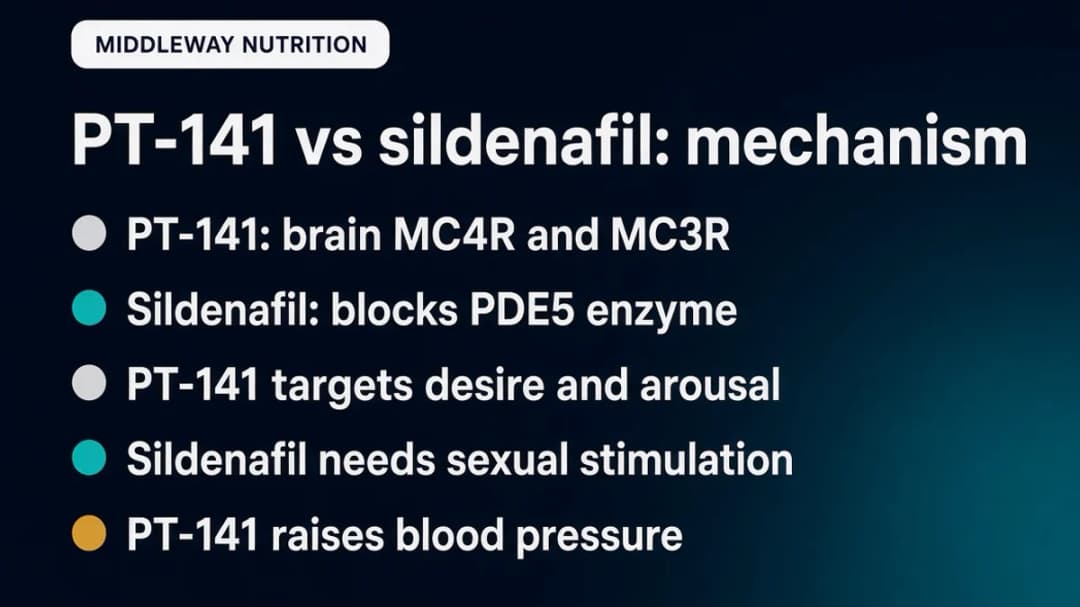
The core difference in PT-141 vs Viagra is where each one acts. PT-141 (bremelanotide) switches on melanocortin receptors in the brain that feed into sexual desire and arousal, while Viagra (sildenafil) works in the blood vessels of the penis, helping an erection happen and hold once arousal is already under way. One targets the wanting, the other targets the plumbing, and that decides who each is for.
The comparison gets muddled online because the two drugs have very different evidence bases. Sildenafil has been approved for erectile dysfunction since 1998 and has large randomised trials in thousands of men. Bremelanotide is approved only for low sexual desire in premenopausal women, and its data in men comes from a handful of small studies from the mid-2000s. Searches for "bremelanotide vs sildenafil" surface plenty of claims the trials do not support, so this page sticks to the labels and published studies.
This article is for information only and is not medical advice. Research-grade PT-141 is not approved for human use.
PT-141 vs Viagra at a glance
| PT-141 (bremelanotide) | Viagra (sildenafil) | |
|---|---|---|
| Where it acts | Brain: MC4R and MC3R melanocortin receptors | Penile blood vessels: blocks the PDE5 enzyme |
| Main target | Desire and arousal | Erection quality once aroused |
| Needs sexual stimulation? | No for erections in male lab studies; desire effect is the point | Yes, it does nothing without arousal |
| Approved use | Low sexual desire (HSDD) in premenopausal women | Erectile dysfunction in men |
| Approved dose | 1.75 mg subcutaneous injection | 50 mg tablet (25 to 100 mg) |
| Timing on label | At least 45 minutes before sex | About 1 hour before (30 minutes to 4 hours) |
| Peak blood level | About 1 hour | 30 to 120 minutes (median 60), fasted |
| Half-life | About 2.7 hours | About 4 hours |
| Blood pressure | Rises (up to 6 mmHg systolic) | Falls (about 8 mmHg systolic) |
| Most common side effect | Nausea (40% in trials) | Headache (16% to 28% by dose) |
| Nitrate interaction | Not listed | Contraindicated |
| Evidence in men | Small lab studies, one trial under an expression of concern | Large phase 3 trials |
Figures come from the US prescribing information for Vyleesi (bremelanotide) and Viagra. The side-effect percentages come from different populations, so treat them as a guide, not a head-to-head result.
How PT-141 works: melanocortin signalling in the brain
MC4R and MC3R, not blood vessels
PT-141 is a cyclic seven-amino-acid peptide based on alpha-melanocyte-stimulating hormone (alpha-MSH), and a close chemical relative of melanotan II, the tanning peptide it grew out of. It binds melanocortin receptors, chiefly MC4R and MC3R, which are concentrated in the hypothalamus and connected brain regions involved in appetite, energy balance and sexual behaviour.
Animal work suggests that activating MC4R in these areas increases dopamine release in circuits linked to sexual motivation, which is the leading explanation for why a drug injected under the skin changes how much someone wants sex. That dopamine link is well supported in rats and still largely inferred in humans.
Why it also produced erections in men
Because the signal starts in the brain, PT-141 can trigger an erection without any change to blood vessel chemistry at the penis. In a 2004 study of intranasal PT-141, healthy men were monitored with a RigiScan device without any sexual stimulation, and doses above 7 mg produced statistically significant erections compared with placebo, with the first erection arriving in about 30 minutes (Diamond et al., 2004). That is a genuine difference from sildenafil, which needs arousal to have anything to act on.
So the common line that "PT-141 is not an erection drug" is only half right. It was developed for erectile dysfunction first. It just gets there through the brain rather than the blood supply.
How Viagra works: PDE5 and blood flow
The nitric oxide chain
When a man is sexually aroused, nerve endings in the penis release nitric oxide. That raises levels of a messenger molecule called cGMP inside the smooth muscle of the erectile tissue, the muscle relaxes, blood flows in and an erection follows. An enzyme called phosphodiesterase type 5 (PDE5) breaks cGMP down, which is how the erection normally subsides.
Sildenafil blocks PDE5, so cGMP lingers and the erectile response is stronger and lasts longer. The key word is response. With no arousal there is no nitric oxide release, no cGMP to protect and no effect. The Viagra label says so plainly: it helps a man get and keep an erection only when he is sexually stimulated.
What it does not do
Sildenafil has no direct effect on desire. Several ranking pages claim Viagra "works regardless of mental state". The label and the mechanism both say otherwise.
Sildenafil also weakly inhibits PDE6, an enzyme in the retina, which is why a colour tinge to vision turns up as a side effect at higher doses.
Desire or erection: which problem does each solve?
When a PDE5 inhibitor is the logical choice
If desire is intact but erections are hard to get or keep, the problem is usually vascular, nerve-related or a mix, and a PDE5 inhibitor such as sildenafil or tadalafil is the best-evidenced option by a wide margin. That includes most age-related, diabetic and cardiovascular erectile dysfunction. Erectile problems can also be an early sign of heart disease, which is a good reason to see a clinician rather than self-treat.
When desire is the real issue
If the interest itself has faded, a drug that improves blood flow has nothing to work with. Low desire is the only indication PT-141 is approved for, and only in premenopausal women. In men, low libido has other causes worth ruling out first, including low testosterone, depression, relationship problems and medications such as SSRIs, and none of those have been studied as a PT-141 indication in a proper trial.
So which is better?
Neither is better in general. For a man whose only complaint is erection quality, sildenafil has decades of randomised data behind it, costs little as a generic, comes as a pill and has a well-characterised safety profile. PT-141 in men is an off-label, lightly studied option that some clinicians try when PDE5 inhibitors have failed or when desire is part of the picture. For women with low desire, the comparison barely exists, because sildenafil has not shown benefit there (see below). For PT-141 against the injectable erection drug, see our alprostadil vs PT-141 comparison.
Onset and duration compared
Sildenafil
The label advises taking sildenafil about an hour before sex, with a window of 30 minutes to 4 hours. Peak blood levels arrive 30 to 120 minutes after an empty-stomach dose, with a median of 60 minutes. A high-fat meal delays the peak by a mean of 60 minutes and cuts the peak level by 29%, one common reason a first attempt disappoints. The half-life is about 4 hours, and in the label's lab testing the erectile effect was still present at 4 hours, though weaker than at 2 hours.
Tadalafil (Cialis) is the long-acting alternative in the same class. Its half-life is 17.5 hours and its label reports improved erectile function for up to 36 hours after a dose. If you are comparing PT-141 with Cialis rather than Viagra, duration is the main thing that changes.
PT-141
The Vyleesi label says to inject at least 45 minutes before anticipated sexual activity. Blood levels peak at about 1 hour and the half-life is about 2.7 hours. Importantly, the label also states that the duration of efficacy after each dose is unknown and the best dosing window has not been fully characterised.
Pages quoting PT-141 effects of 6 to 12 hours, or even 24 to 72 hours, are relying on user reports and clinic marketing, not trials. What is measured is that the blood pressure rise peaks 2 to 4 hours after a dose and usually returns to baseline within 12 hours, and that trial nausea started within an hour and lasted about two. Our PT-141 results timeline covers what users describe hour by hour.
What the evidence shows in men
Sildenafil: large, consistent trials
The pivotal sildenafil paper in the New England Journal of Medicine ran two studies: a 24-week dose-response study in 532 men and a 12-week flexible-dose study in 329 different men with erectile dysfunction of physical, psychological and mixed causes (Goldstein et al., 1998). In the last four weeks of the flexible-dose study, 69% of intercourse attempts were successful on sildenafil against 22% on placebo. Many later trials and nearly three decades of use have broadly confirmed that picture.
PT-141: small lab studies and one problematic trial
The published male data for bremelanotide is thin:
- Intranasal, 2004. Healthy men and men with mild-to-moderate erectile dysfunction who already responded to Viagra. Doses above 7 mg produced significant erections on RigiScan compared with placebo, with onset in about 30 minutes. Flushing and nausea were the most common side effects (Diamond et al., 2004).
- Subcutaneous, 2004. Healthy men responded at doses above 1.0 mg. A second group of men who had an inadequate response to 100 mg Viagra (erections good enough for penetration half the time or less) were given 4 mg or 6 mg, and both doses produced significant erections under visual sexual stimulation (Rosen et al., 2004).
- Intranasal, 2008. The largest male trial: 342 men who had not responded to sildenafil were given 10 mg intranasal bremelanotide or placebo before sex at home. Positive results were reported in 33.5% on bremelanotide against 8.5% on placebo (Safarinejad and Hosseini, 2008). In 2023 the Journal of Urology published an expression of concern about this paper, so its figures should be treated with real caution.
The first two are short clinic studies of erections, not real-world sexual function over months: proof of mechanism and little more.
Why men never got an approval
Palatin, the developer, originally pursued PT-141 as an intranasal spray for erectile dysfunction. That programme was halted around 2008 after blood pressure increases raised concern with the FDA, and development moved to subcutaneous injection for women. In 2023 Palatin announced a new programme combining bremelanotide with a PDE5 inhibitor for men who do not respond to PDE5 inhibitors alone. As of this review we have not found peer-reviewed results from it. We also found no completed randomised trial of bremelanotide for low desire in men, although a 2026 commentary in the Journal of Clinical Psychopharmacology openly asks whether it should be considered for that use.
What the evidence shows in women
PT-141: the RECONNECT trials
Bremelanotide's approval rests on two identical phase 3 trials, known as RECONNECT (studies 301 and 302). They randomised 1,267 premenopausal women with acquired, generalised hypoactive sexual desire disorder to 1.75 mg bremelanotide or placebo, self-injected as needed for 24 weeks. The women had a mean age of 39 (Kingsberg et al., 2019).
Compared with placebo, bremelanotide improved the desire score by 0.30 points in study 301 and 0.42 points in study 302, and reduced distress about low desire by 0.37 and 0.29 points. In raw terms from the label, average desire scores rose by 0.5 to 0.6 points on a 1.2 to 6.0 scale, against 0.2 on placebo. There was no significant difference in the number of satisfying sexual events, a secondary endpoint.
Those are real, replicated effects, but modest ones, and the label explicitly excludes men and postmenopausal women.
Sildenafil in women: a negative result
Sildenafil was also tested for female sexual arousal disorder. The largest trial randomised 577 women with normal oestrogen levels and 204 oestrogen-deficient women to 10 to 100 mg sildenafil or placebo, and found no significant difference on any patient or partner measure (Basson et al., 2002). The Viagra label states it is not indicated for use in females.
Side effects: nausea and blood pressure rise vs headache and vision
PT-141's side effects come from melanocortin receptors elsewhere in the body; sildenafil's come from widening blood vessels.
| Side effect | PT-141 1.75 mg (vs placebo) | Sildenafil 25 / 50 / 100 mg (vs placebo) |
|---|---|---|
| Nausea | 40.0% (1.3%) | 2% / 3% / 3% (1%) |
| Flushing | 20.3% (0.3%) | 10% / 19% / 18% (2%) |
| Headache | 11.3% (1.9%) | 16% / 21% / 28% (7%) |
| Vomiting | 4.8% (0.2%) | Not listed |
| Injection site reactions | 13.2% (8.4%) | Not applicable |
| Indigestion | Not listed | 3% / 9% / 17% (2%) |
| Abnormal vision | Not listed | 1% / 2% / 11% (1%) |
| Nasal congestion | 2.1% (0.5%) | 4% / 4% / 9% (2%) |
Source: Vyleesi and Viagra US prescribing information. PT-141 figures are from 627 women with low desire; sildenafil figures are from fixed-dose trials in men with erectile dysfunction.
PT-141: nausea, blood pressure and pigmentation
Nausea is the defining problem. In the phase 3 trials it hit 40% of women, 13% needed an anti-nausea drug and 8% dropped out because of it. It was most common after the first dose (21%) and fell to about 3% with later doses.
Bremelanotide raises blood pressure, by up to 6 mmHg systolic and 3 mmHg diastolic, peaking 2 to 4 hours after a dose, with heart rate dropping by up to 5 beats per minute. It is contraindicated in uncontrolled high blood pressure and known cardiovascular disease. An ambulatory monitoring study in 397 women found the increases were small and transient (White et al., 2017), but for someone with heart disease, a drug that raises blood pressure before sex is not trivial.
Focal darkening of the skin, gums or breasts affected 1% of women using up to 8 doses a month, and 38% in a separate study where it was given daily for 8 days. It also reduces the absorption of oral naltrexone and may slow stomach emptying. Our full breakdown of PT-141 side effects covers frequency, duration and who should avoid it.
Sildenafil: headache, flushing and vision
Headache, flushing and indigestion rise with dose. Visual changes, mostly a colour tinge, reached 11% at 100 mg. A single 100 mg dose lowered sitting blood pressure by an average maximum of 8.3/5.3 mmHg, most noticeable 1 to 2 hours after dosing.
Sildenafil is contraindicated with nitrates (such as glyceryl trinitrate for angina) and with riociguat, because the blood pressure drop can be dangerous. The label also warns about erections lasting more than 4 hours, sudden vision loss that can signal an optic nerve problem called NAION, and sudden hearing loss.
Can you take PT-141 and Viagra together?
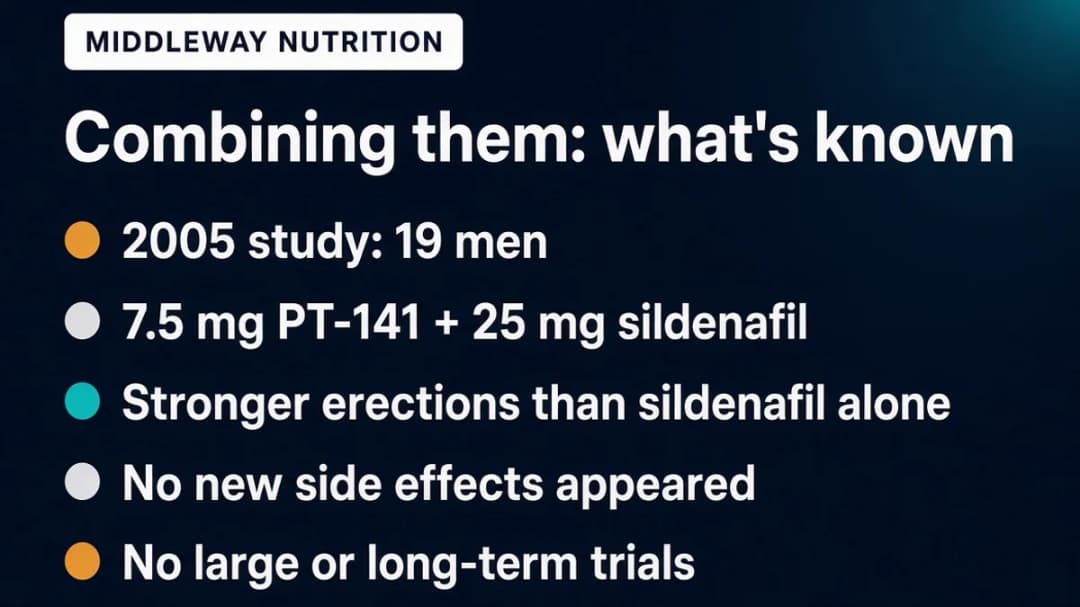
Some clinics prescribe both, one for desire and one for erection mechanics. The evidence is one small published study.
What the combination study found
In 2005, 19 men with erectile dysfunction who responded to Viagra or Levitra were given three treatments in random order: 25 mg sildenafil plus 7.5 mg intranasal PT-141, 25 mg sildenafil plus a placebo spray, and placebo alone. Erections measured on RigiScan during visual sexual stimulation were significantly stronger with the combination than with sildenafil alone, and no new or worse side effects appeared (Diamond et al., 2005). The doses were deliberately low, and it was a single-session lab study.
What is not known
There are no large or long-term trials of the combination, and none using today's standard subcutaneous bremelanotide dose alongside full-dose sildenafil or tadalafil. The two drugs push blood pressure in opposite directions, and nobody has properly measured the net effect across a range of patients, including those on blood pressure medication. Flushing and headache are common to both and could add up. The Vyleesi label also notes it may slow gastric emptying and affect the absorption of oral drugs taken at the same time, which could in principle delay a sildenafil tablet.
The combination is plausible but unestablished, and cardiovascular history is the deciding factor, which makes it a clinician's call. For PT-141 dosing itself, see our PT-141 dosing and reconstitution guide.
Legal and prescription status
PT-141
Bremelanotide was first approved in the US in 2019, as Vyleesi, for premenopausal women with acquired, generalised hypoactive sexual desire disorder. It is prescription-only, and the label states it is not indicated for men or postmenopausal women, so any prescription for a man is off-label. Palatin sold worldwide rights to Vyleesi to Cosette Pharmaceuticals under an agreement signed in December 2023. It has no marketing authorisation in the UK or EU.
Outside that route, PT-141 is widely sold online as a "research use only" peptide in vials. Those products are not approved for human use, are not made to pharmaceutical standards and vary in purity and dose. Our overview of the legal status of research peptides explains how that grey market works.
Viagra
Sildenafil is prescription-only for erectile dysfunction in the US, where cheap generics have been available for years. In the UK, a 50 mg product (Viagra Connect) can be bought from pharmacies without a prescription after a consultation with the pharmacist. For a wider look at compounds marketed for libido and function, see our guide to peptides for sexual health and what the evidence supports.
FAQ
Is PT-141 stronger than Viagra?
They are not measured on the same scale, so "stronger" does not really apply. Sildenafil reliably improves erections in men with erectile dysfunction, backed by large trials. PT-141's approved effect is a modest increase in desire in premenopausal women, and its male erection data comes from small lab studies.
Does PT-141 work for erectile dysfunction?
Small 2004 studies showed PT-141 produced erections in healthy men and in men who responded poorly to 100 mg Viagra. The largest male trial now carries an expression of concern, and it is not approved for erectile dysfunction anywhere.
Does Viagra increase libido?
Not directly. Sildenafil only strengthens the erectile response to arousal that is already happening. Some men feel more interested once erections become reliable, but that is a psychological knock-on, not an effect on desire circuits.
How long does PT-141 last compared with Viagra?
Sildenafil works for about 4 hours, and tadalafil for up to 36 hours. The Vyleesi label says the duration of PT-141's effect is unknown; its half-life is about 2.7 hours, and its blood pressure effect usually clears within 12 hours. Longer figures quoted online come from user reports rather than trials.
Is it safe to take PT-141 with Viagra or Cialis?
One 2005 study in 19 men found low doses of both together gave stronger erections with no new side effects, but it was a single-session lab study. The two push blood pressure in opposite directions and have not been tested together in larger trials, so medical oversight is needed.
Can women take Viagra instead of PT-141?
Sildenafil is not indicated for women, and the largest trial in women with arousal disorder, involving 781 women, found no benefit over placebo. PT-141 (as Vyleesi) is the one of the two with approval for low desire in premenopausal women.
Is PT-141 legal?
As Vyleesi it is a legal prescription drug in the US for premenopausal women with low sexual desire. The research-grade vials sold online are labelled not for human use, and PT-141 has no approval in the UK or EU.