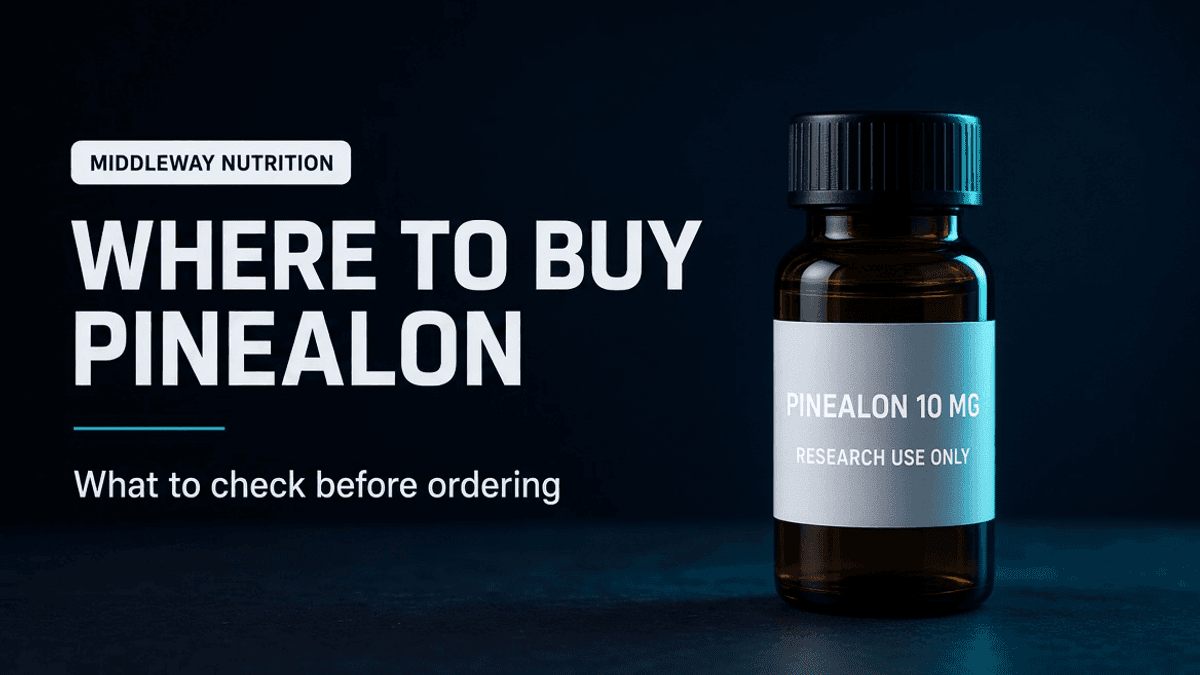
If you are working out where to buy Pinealon, the realistic answer is an online research-peptide vendor that publishes a batch-matched certificate of analysis with both HPLC purity and a mass spectrometry result. Pinealon has no prescription or pharmacy route anywhere in the West. Our pick is Synthro Lab, which lists a 10mg vial at A$71.88 (about US$51) with content, purity and endotoxin testing on every batch.
A tripeptide is cheap and easy to make, so the risk isn't failed chemistry. The risk is a vial that holds less peptide than the label says, or holds something else. This guide covers how to check the paperwork, what the market charges per milligram, why the oral capsules and the vials are different products, and where the compound stands legally.
Where to Buy Pinealon in 2026
Pinealon turns up in two places, and they sell different things.
Research-peptide vendors. These sell lyophilised powder in sealed vials, labelled for laboratory research use only. For Western buyers this is the main channel, and the vendors differ mostly in testing and documentation. The compound itself is identical across all of them.
Bioregulator capsule sellers. The oral Cytogen-line capsules made under the St Petersburg Institute of Bioregulation and Gerontology name are resold by import shops and marketplaces. They're a different product with a different label, covered in the oral versus injectable section below.
There is no prescription channel. Pinealon is not an approved medicine in the US, UK, EU or Australia, and we found no licensed clinic or pharmacy that lists it. A local shop or clinic claiming to stock it is reselling one of the channels above, with a mark-up.
Pinealon in Brief: What You Are Actually Buying
Pinealon is the tripeptide glutamic acid, aspartic acid, arginine (Glu-Asp-Arg, often written EDR). Its formula is C15H26N6O8 and its molecular weight is about 418.4 daltons. It came out of Vladimir Khavinson's bioregulator programme in St Petersburg, which identified it within Cortexin, a cattle cerebral cortex preparation. Despite the name, it is not the pineal peptide. Our full Pinealon research overview covers the origin, the proposed mechanism and the reported dose ranges in depth, so here is only what matters for a purchase.
The evidence is thin and mostly comes from one research network, so a buyer should know how it grades before spending money:
- Cell work. Khavinson and colleagues reported in 2011 that Pinealon restricted reactive oxygen species build-up in rat cerebellar granule cells, neutrophils and PC12 cells in a dose-dependent way, and reduced necrotic cell death (Khavinson et al., 2011, PMID 21978084).
- Animal work. In a 2012 rat study, Pinealon given to pregnant rats fed a methionine-loading diet improved spatial orientation and learning in the offspring (Arutjunyan et al., 2012, PMID 22567179).
- Human work. A 2015 Russian-language study gave Pinealon and Vesugen to 32 people aged 41 to 83 with polymorbidity and organic brain syndrome. The authors reported an anabolic effect but also found prooxidant activity, and Vesugen outperformed Pinealon (Meshchaninov et al., 2015, PMID 26390612). That is small, uncontrolled as reported, and hard to retrieve in full.
- Independent work. The only study we found from outside the originating network is a 2026 preprint that screened five longevity interventions in mice over 8 weeks. Pinealon showed "a trend toward improved working memory without detectable adverse effects" (Marín-Jerez et al., 2026, Research Square preprint). A trend in a small mouse screen, not yet peer reviewed.
The mechanism claims on vendor pages, such as the idea that EDR enters the cell nucleus and binds histone proteins to adjust gene expression, come from reviews by the same group (Khavinson et al., 2020, PMID 33396470). They are hypotheses, not established pharmacology.
One more buyer-relevant point: people regularly order Pinealon when they meant Epithalon, or the reverse, because both are Khavinson peptides and the names suggest the wrong tissues. Epithalon is the four-residue pineal peptide (Ala-Glu-Asp-Gly). If that's the one you want, our Epithalon buying guide covers it separately.
Best Place to Buy Pinealon: Synthro Lab
Synthro Lab is the vendor we recommend for Pinealon. It sells one format, a 10mg lyophilised vial, listed at A$71.88 (about US$51) and in stock when we checked on 26 September 2026.
Why Synthro gets the pick
- Three kinds of testing, not one. Synthro publishes content tests, purity tests and endotoxin tests. For Pinealon the content test matters most, because it answers the underfilling question that HPLC purity can't.
- Batch-matched paperwork. The certificate shown is for the lot currently shipping, matched by batch number, and the QR code on the vial resolves to that batch's certificate.
- Purity standard. Synthro lists a purity figure of 99% or higher by HPLC and confirms identity by mass spectrometry.
- Logistics. Same-day dispatch before the daily cutoff, tracked delivery to the US, Europe and Australia, free shipping over a threshold, and a 30-day money-back guarantee.
Two honest caveats
First, Synthro's store prices in Australian dollars. A$71.88 for 10mg is about US$50.50 at the 25 September 2026 exchange rate, or roughly US$5.05 per mg. That puts it in the upper half of the price survey below: cheaper than the other 10mg listing, but well above the cheapest 20mg vials at around US$2 to US$3 per mg. Check the currency your checkout shows before comparing. Either way, part of what you pay for is the content and endotoxin testing that most cheaper listings don't show.
Second, Synthro's product description repeats the common line that Pinealon is "pineal gland-derived". Nearly every vendor says this, and the published record points to a cortex preparation instead. It doesn't change what is in the vial, but treat any vendor's biology text as marketing rather than evidence.
How to Check a Pinealon Certificate of Analysis
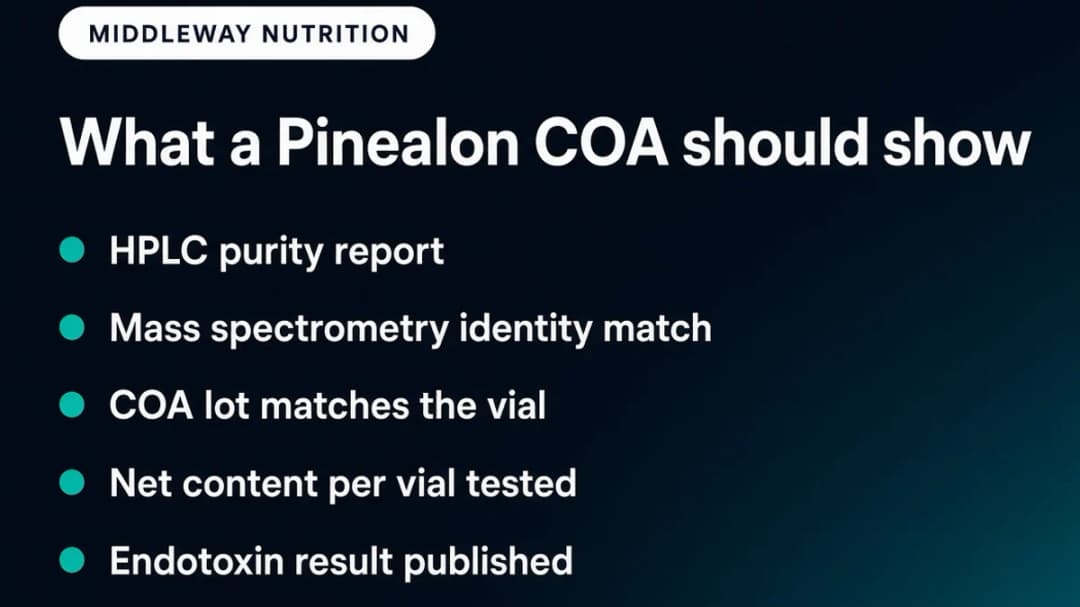
For a peptide this small, three checks on the certificate of analysis (COA) do most of the work.
1. Mass spectrometry: is it EDR?
HPLC shows how pure a sample is. It doesn't show what the sample is. Mass spectrometry does. For Pinealon:
- Average molecular weight is about 418.4 g/mol, the figure most product pages print.
- Monoisotopic mass is about 418.18 Da.
- In electrospray MS, the most common method, the main peak usually appears as the protonated ion at about 419.2 (the mass plus one proton).
A certificate showing 419.2 is therefore consistent with EDR, not a mismatch. A certificate with no mass data at all, or a mass that matches none of these figures, is a failed identity check. Scrambled versions of the same three amino acids (Asp-Glu-Arg, for example) have the same mass. MS can't tell them apart, but a sequence scramble from a real synthesis house is unlikely. The realistic fraud is a different, cheaper powder, and MS catches that.
2. HPLC purity: necessary, not sufficient
Look for 98% or higher. With only three residues there are few ways for the synthesis to go wrong, so high HPLC purity is easy to reach and on its own says little. A vendor that leads with "99% pure" and shows nothing else has told you the powder in the test sample was clean. That's all it tells you.
3. Content: is there really 10mg?
This is the check buyers skip and the one that matters most for a cheap peptide. Lyophilised peptide powder isn't 100% peptide. It also holds counter-ions left over from purification and some residual water, so "10mg" on the label can mean 10mg of powder or 10mg of peptide. A content or quantity test tells you which. Underfilling is the standard way to cut cost on an inexpensive compound, and purity testing can't detect it.
Also worth checking
- Lot number match. The lot on the certificate should match the lot on your vial. A certificate with no lot number is a product-level document and proves nothing about your batch.
- Who ran the test. An independent laboratory, named, ideally with a lookup code or QR you can verify on the lab's own site. A PDF with the vendor's own logo as the testing body is self-certification.
- Endotoxin. Relevant if the material will ever be used in anything injectable. Few Pinealon listings show it.
What Pinealon Should Cost: Price per mg
We checked eight vendor listings on 26 September 2026. Prices change often, and several were sale prices, so read this as a snapshot of the range rather than a quote.
Top Vendors
Ranked by purity, third-party testing, COA availability, and price.
Content, purity and endotoxin; batch COA, QR on vial
HPLC; COA on request
HPLC; COA on request
LC and MS on COA
HPLC and MS, lot-matched COA, endotoxin
HPLC
HPLC-UV/MS
UHPLC-MS, named labs, endotoxin
Synthro's price is as listed in its store feed, which quotes Australian dollars. The others are US listings.
What the table shows:
- 20mg vials are the norm in the US market, and they are far cheaper per mg than 10mg vials. Most listings land between about $2 and $4.25 per mg.
- Per-mg price only matters if the mg is really there. A $2.10/mg vial that is 30% underfilled costs more per real milligram than an honestly filled vial at $3. That's why the content test in the previous section is worth paying for.
- The testing column varies more than the price column. At these prices, the gap between HPLC-only and HPLC plus MS plus endotoxin is worth more than a dollar or two per mg.
How many vials a course takes
Reported community ranges for injectable Pinealon disagree by roughly ten-fold, from about 1 mg to about 10 mg per day on short courses of 10 to 20 days. So a single 10mg vial could last anywhere from one day to around ten. None of those figures is an established dose, because no human dose-finding study exists. The peptide reconstitution calculator handles the concentration maths for any vial size.
Oral Pinealon vs Injectable Vials: Which Are You Buying?
Search results mix two products under one name, and they aren't interchangeable.
| Oral capsules | Lyophilised vials | |
|---|---|---|
| What it is | Cytogen-line capsule, labelled "peptide complex AC-5 (arginine, glutamic acid, aspartic acid)" | Synthetic Glu-Asp-Arg powder |
| Amount per unit | 0.2 g capsule; peptide amount not disclosed on the listings we checked | 10mg or 20mg per vial |
| Other ingredients | Microcrystalline cellulose, lactose, gelatin or starch and similar excipients | Usually none listed |
| Labelled use | 1 to 2 capsules, 1 to 2 times daily, for 10 to 30 days, repeated in 4 to 6 months | Research use only; no labelled use |
| Typical price | $45 for 20 capsules; about $94 to $109 for 60 | $42 to $85 per vial |
| Testing you can see | Rarely a batch COA | Varies; batch COA from better vendors |
The absorption question
Pinealon from the originating group was described with oral use, so capsules aren't a vendor invention. What's missing is human pharmacokinetic data. Several sites quote precise oral bioavailability figures for Pinealon, such as 5 to 15%, or claim it crosses the gut wall through a specific peptide transporter. We couldn't find a published study behind any of those numbers. Unmodified short peptides are generally broken down by digestive enzymes. Whether enough intact EDR survives to matter is an open question, and anyone quoting a percentage is guessing.
What that means for buying
Because capsule labels don't state how much Pinealon each one contains, and capsule sellers rarely publish batch testing, you can neither compare their price to a vial's nor verify them. If you want a defined, testable quantity of EDR, the vial is the only format that lets you check what you have. Capsules are a Russian supplement-style product with an undisclosed peptide dose.
For the broader context of how these short peptides were developed and marketed as a family, see our piece on the wider bioregulator family.
Is Pinealon Legal to Buy?
United States
Pinealon isn't an FDA-approved drug and isn't a controlled substance. It's sold as a research chemical, labelled not for human consumption, and buying it on those terms carries low practical legal risk for an individual. What vendors can't lawfully do is market it for human use, as a treatment, or as a dietary supplement. When a vial listing gives injection instructions or promises better memory, that seller is outside the research-use framing.
The oral capsules sold in the US carry the standard supplement disclaimer. That label is the seller's own classification, not an FDA determination that Pinealon is a permitted dietary ingredient.
Elsewhere
In Russia the capsules are sold as a supplement-type bioregulator product, which isn't equivalent to drug approval anywhere else. In the UK, EU and Australia it has no approval, and rules on importing research peptides differ by country and change often. Check local rules before ordering across a border. Our guide to how peptide legality works more generally sets out the main frameworks.
Athletes
Pinealon isn't named on the WADA Prohibited List. However, section S0 covers any pharmacological substance without current approval from a government health authority for human therapeutic use. Pinealon has no such approval, so tested athletes should treat it as prohibited.
This page is buying guidance for a research compound, not medical advice, and nothing here is a recommendation for personal use.
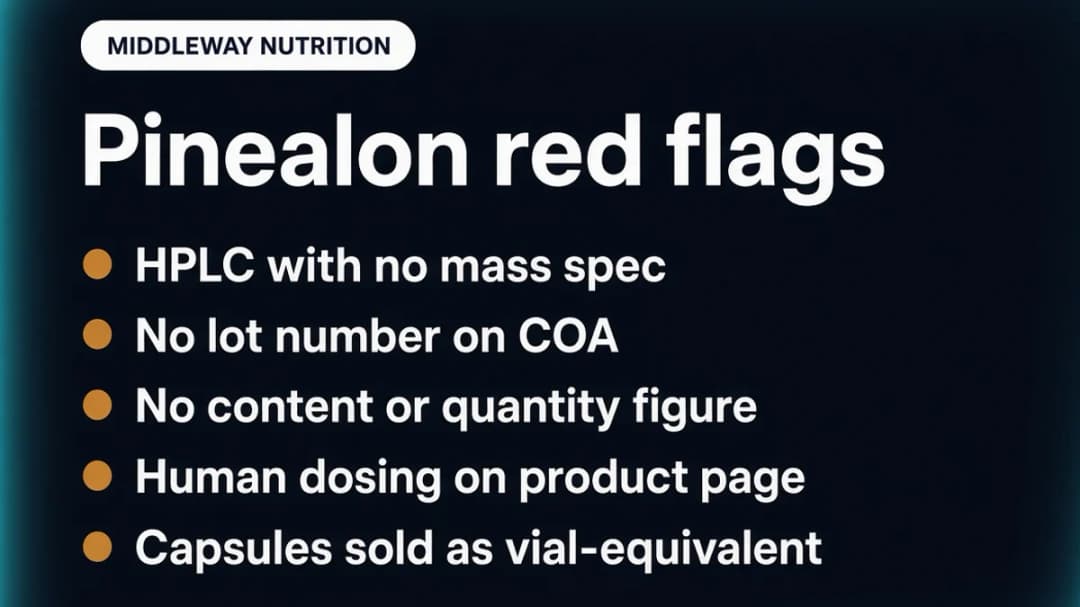
Red Flags When Buying Pinealon
- HPLC with no mass spectrometry. Purity without identity is the most common gap on Pinealon listings. The mass should be consistent with 418.4 g/mol, or appear as about 419.2 for the protonated ion.
- No lot number on the certificate. A product-level COA can be years old and from a different synthesis run.
- No content or quantity figure. On a cheap tripeptide, underfilling is the likeliest way to lose money.
- Human dosing or cognition claims on the product page. A vendor that sells "research use only" while explaining how to inject it for memory is contradicting its own label.
- Prices far below the market. Most 20mg vials sit between about $42 and $85. A listing well below that with no testing is saving money somewhere.
- Capsules sold as equivalent to a 10mg vial. Capsule labels don't state their peptide content, so no equivalence can be claimed.
After the Vial Arrives
Pinealon ships as a dry, lyophilised powder. Unopened, it keeps best frozen and away from light, which is what most vendor labels specify. Our guide to storing lyophilised peptides covers powder, solution and travel in detail.
For research use the powder is reconstituted with bacteriostatic water, added slowly down the inside wall of the vial and swirled rather than shaken. Once reconstituted it goes in the fridge and is used within a few weeks. Photograph the lot number on arrival and keep the matching certificate; a vendor's guarantee depends on that record.
If Pinealon is one part of a wider interest in Russian-developed neuropeptides, the same checks apply when sourcing Selank, which has a larger published record than EDR.
FAQ
Where can I buy Pinealon?
Online, from research-peptide vendors that sell it as lyophilised powder for laboratory use. Our recommendation is Synthro Lab, which sells a 10mg vial at A$71.88 (about US$51) with content, purity and endotoxin testing on each batch. There is no pharmacy or prescription route in the US, UK, EU or Australia.
How much does Pinealon cost?
In our survey of eight listings, 20mg vials ranged from $41.98 to $85.00 and 10mg vials from US$50.50 (Synthro's A$71.88) to $55.00, or roughly $2 to $4.25 per mg for 20mg vials. Oral capsules cost $45 for 20, but their peptide content isn't disclosed, so they can't be compared per mg.
Is Pinealon legal?
In the US it isn't FDA-approved and isn't a controlled substance, and it's sold legally as a research chemical not for human consumption. Vendors can't lawfully market it for human use. Other countries set their own import rules. Athletes should treat it as prohibited under WADA's S0 category for non-approved substances.
Is oral Pinealon as good as the injectable form?
Nobody knows. The originating group described oral use, but no published human study measures how much intact Pinealon survives digestion, and the bioavailability percentages quoted online have no source we could find. Capsules also don't state their peptide content, so like-for-like comparison isn't possible.
How do I know my Pinealon is real?
Get a batch-specific certificate whose lot number matches your vial. It should show HPLC purity of 98% or more and a mass spectrometry result consistent with EDR: about 418.4 g/mol average weight, or about 419.2 for the protonated ion. A content test confirming the milligrams in the vial is the third piece most buyers overlook.
Is Pinealon the same as Epithalon?
No. Pinealon is the three-residue Glu-Asp-Arg peptide traced to a brain cortex preparation. Epithalon is the four-residue Ala-Glu-Asp-Gly peptide linked to the pineal gland. They come from the same research programme and are often confused because of the names, so check the sequence on the label before you order.
Do I need a prescription for Pinealon?
No, because there is no approved Pinealon medicine to prescribe. Research vendors sell it under a research-use label, which also means nobody checks what you buy except you.