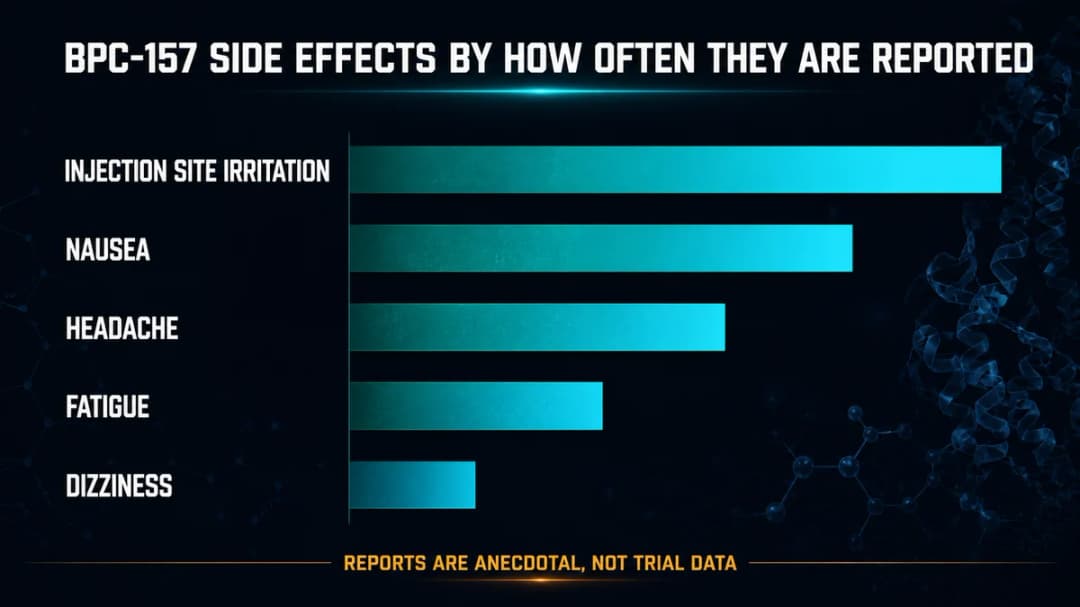
Most reported BPC-157 side effects are mild, dose-related and local: soreness at the injection site, occasional nausea above roughly 500 mcg per day, and brief light-headedness shortly after dosing. The reason that reassuring list should be read carefully is that BPC-157 side effects have never been catalogued in a controlled human safety study, so what circulates is self-report from people who bought a research chemical and were not being monitored by anyone. A short list can mean a benign compound. It can also mean nobody is collecting the data.
BPC-157 is not an approved medicine. Nothing below is a protocol or medical advice.
BPC-157 Side Effects: what people report, in order of frequency
| Effect | How often reported | Typical severity and duration | What people say helps |
|---|---|---|---|
| Injection site soreness or redness | Very common, especially early | Mild, a few hours | Rotating sites, injecting slowly, fine 29 to 31 gauge needle |
| Nausea | Uncommon at moderate doses, more likely above 500 mcg daily | Queasiness rather than vomiting, 30 to 60 minutes after dosing | Reducing the dose, dosing with food |
| Light-headedness | Uncommon | Brief, minutes | Injecting seated, waiting before standing |
| Fatigue or feeling flat | Uncommon | First few days, then settles | Usually resolves; if not, pausing |
| Vivid dreams or disturbed sleep | Occasionally reported | Not harmful, noticeable | Moving the dose to the morning |
| Transient warmth or flushing | Rare | Brief | Nothing needed |
Two patterns are worth extracting. Almost everything is dose-dependent, which makes it testable: reduce and see whether it follows. And almost everything appears in the first two weeks, so someone who has been at a stable dose for a fortnight without trouble is unlikely to develop a new problem at that dose.
Much of what sits at the top of that table is not really about BPC-157 at all. Injection site soreness and post-injection light-headedness are properties of subcutaneous injection, and they show up with almost any compound and improve with technique.
Dose and reported risk
| Daily dose | Reported side effect risk | Notes |
|---|---|---|
| 200 to 300 mcg | Very low | Where most people start; usually uneventful |
| 300 to 500 mcg | Low | The commonly cited range; occasional mild nausea |
| 500 to 1,000 mcg | Moderate | Nausea more frequent, with no demonstrated added benefit |
| Above 1,000 mcg | Higher | No evidence supports it |
These are reported research ranges, not recommendations. There is no published human dose-finding study for BPC-157, so the idea that more is better rests on nothing, and the idea that 500 mcg is a meaningful ceiling rests on community convention rather than on data.
The angiogenesis and cancer question
This is the concern that deserves the most serious treatment and gets the least.
BPC-157 promotes new blood vessel formation. That is not a side effect, it is the proposed mechanism, and it is why the compound is of interest in poorly vascularised tissue like tendon. Solid tumours also depend on recruiting new blood supply to grow beyond a small size.
Nothing in the published literature shows that BPC-157 causes cancer, and no case reports establish that it has worsened one. But no study has been designed to detect either, and there is no registry collecting outcomes from people using it. The honest position is that this is an unresolved theoretical risk with a plausible mechanism and no data on either side.
The practical conclusion most people reach is the right one: an active malignancy or recent cancer treatment is a reason not to use it, and that decision belongs with an oncologist rather than a forum.
Interactions nobody has properly studied
Human interaction data does not exist. What follows is mechanistic reasoning and community caution.
Anticoagulants. Animal work has described effects on clotting and vascular behaviour. Anyone on warfarin, a direct oral anticoagulant, or antiplatelet therapy should treat this as a genuine unknown and involve their prescriber.
NSAIDs. Much of the animal literature involves BPC-157 protecting against NSAID-induced gastric damage rather than interacting badly with it. No specific concern has been described, but "no concern described" is a weaker statement than it sounds.
Other peptides. Combinations such as BPC-157 with TB-500 are extremely common and no interaction problems are reported. Again, absence of reports reflects an absence of monitoring.
Anything else you are prescribed. The correct default with a compound that has no human pharmacology is to assume interactions are possible and unknown rather than absent.
Warning signs that need medical attention
Stop and seek care for any of the following. Most relate to injection rather than to the peptide, which does not make them less serious.
- Spreading redness, warmth or swelling at an injection site, particularly with fever, which suggests infection
- Hives, facial or throat swelling, or difficulty breathing
- Severe or persistent nausea or vomiting
- Chest pain, palpitations or shortness of breath
- Any symptom that is escalating rather than settling

Who should not use BPC-157
Anyone with an active or recent cancer. Anyone pregnant or breastfeeding, where the safety data is not thin but absent. Anyone on anticoagulant therapy without their prescriber's involvement. Anyone with a significant medical condition they have not discussed with a clinician. And athletes in tested sport, where BPC-157 is prohibited.
The unknowns that matter more than the symptom list
No long-term human data. Protocols run four to twelve weeks because that is the window animal studies used, not because anyone established that longer is unsafe or that this length is safe. Nothing published follows a person for a year.
No pharmacokinetics in humans. Nobody has published what happens to injected BPC-157 in a person: how fast it clears, what it becomes, where it goes. Doses in circulation were not derived from human data.
Product quality as a confounder. In an unregulated market, some adverse experiences are caused by what else is in the vial rather than by the peptide: solvent residue, synthesis byproducts, endotoxin, or a different compound entirely. A reaction that seems out of proportion to the dose is a reason to suspect the source. Third-party certificates of analysis from a named lab, matched to your lot number, are the only practical defence. Our BPC-157 vendor comparison covers which suppliers publish lot-matched certificates.
Under-reporting. People who have a bad experience with a grey-market compound often stop and say nothing. The visible reports are skewed toward those who continued.
Reducing the odds of a problem
Start at the low end and hold for a week before changing anything. Rotate injection sites across abdomen, flank and outer thigh. Inject slowly, which does more for local irritation than anything else. Move the dose to the morning if sleep is disrupted. Change one variable at a time so that a reaction can be traced. And do not exceed commonly cited ranges on the assumption that more will work faster, because nothing supports that.
For background see our BPC-157 guide, and for the oral route the oral versus capsule comparison.
FAQ
Is BPC-157 safe long-term?
Unknown. There is no human study of continuous use beyond short cycles, so the common four to twelve week convention is a habit rather than a finding. Animal work has not turned up clear organ toxicity, but rodent studies of a few weeks cannot answer a question about years in people.
Why does BPC-157 make some people nauseous?
Nausea is the most consistently dose-related reported effect and is most common above roughly 500 mcg per day. Reducing the dose usually resolves it, and dosing alongside food is the other adjustment people describe. Persistent nausea at any dose is a reason to stop.
Can you become dependent on BPC-157?
No dependence or withdrawal has been described. People sometimes notice that the pain or gut symptoms they were managing return after stopping, which is the underlying problem re-emerging rather than a withdrawal effect.
Does BPC-157 affect hormones?
It is not a hormone and does not act on androgen, oestrogen or corticosteroid receptors, and no suppression of the hypothalamic-pituitary axis has been described. Nothing resembling post-cycle therapy applies.
Are oral BPC-157 capsules safer than injections?
They remove the injection-related risks, which account for a large share of what people report, including local reactions and infection. They do not remove the compound's own unknowns, and oral absorption is poor for anything other than a gut target.
What if I inject more than intended?
Animal toxicity data suggests an accidental higher dose is unlikely to be an emergency, but pronounced nausea, dizziness and general unwellness are plausible. If you feel genuinely unwell after a mistake, get medical attention rather than waiting it out.