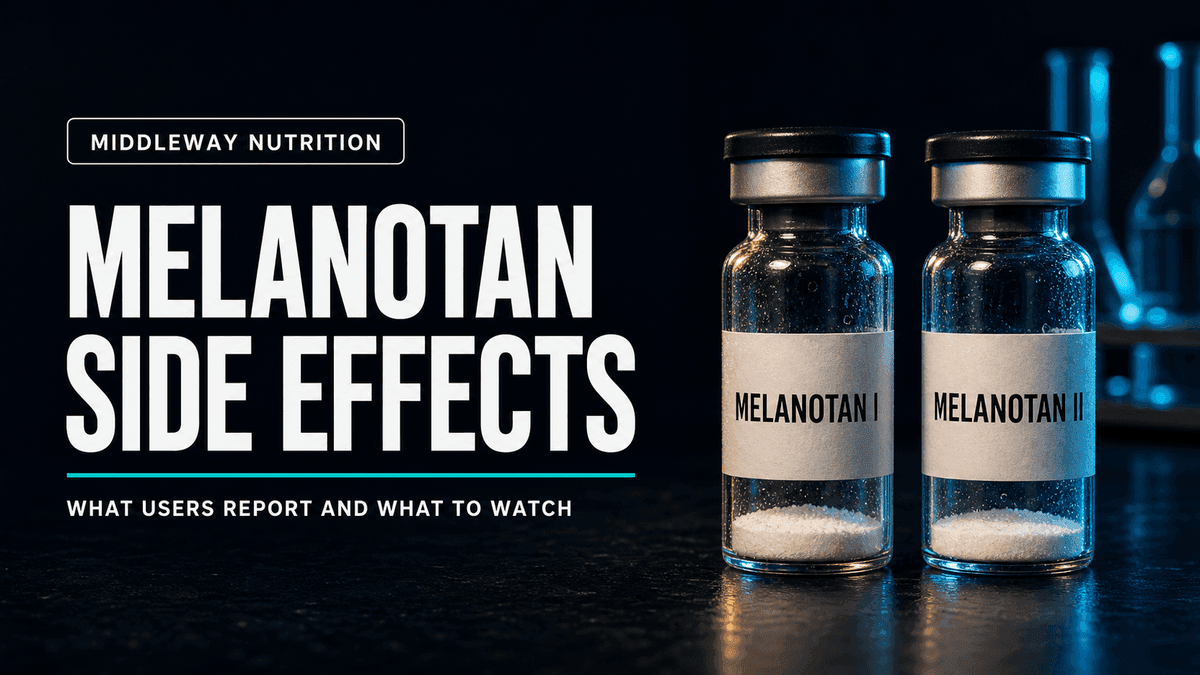
Melanotan side effects fall into two very different categories, and most articles blur them. The predictable ones, nausea, flushing, yawning, appetite loss and spontaneous erections in men, are dose related, unpleasant and harmless. The Melanotan side effects worth taking seriously are what happens to pigmented skin, because this compound stimulates pigment cells everywhere and the protocol requires deliberate ultraviolet exposure on top of that.
Melanotan II is not approved anywhere and is sold as a research compound. That is relevant to everything below, because there is no adverse event reporting system behind any of it.
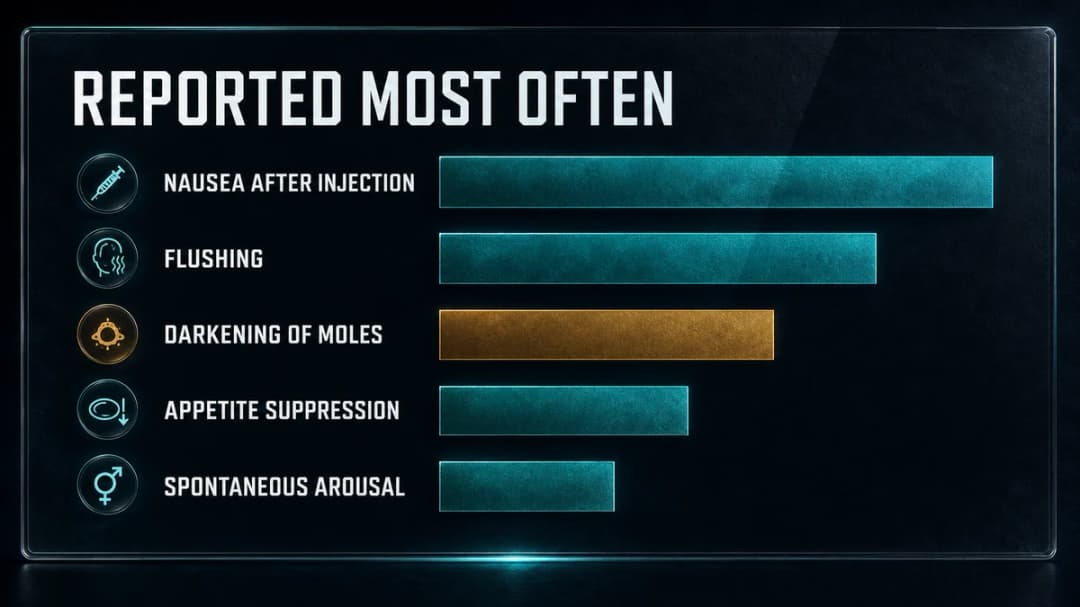
Melanotan Side Effects Reported Most Often
Nausea
The most common complaint and the main reason people abandon it. It is dose related, worst on the first few injections, and typically arrives one to three hours after a dose and lasts a few hours.
It improves substantially after the first week or two. The two things that reduce it are starting at 0.25 mg rather than jumping to a working dose, and injecting in the evening so the worst of it happens during sleep. Some users take an over-the-counter anti-sickness medicine in the first week.
Facial flushing and warmth
Near universal early on. Warm, reddened skin across the face and chest, typically for half an hour to an hour and a half after the injection. It eases as the body adapts and it is not dangerous.
Worth distinguishing from an allergic reaction: flushing is warmth and redness. An allergic reaction adds raised welts, itching, and potentially throat tightness or difficulty breathing, which is an emergency.
Spontaneous erections in men
A direct pharmacological effect rather than a quirk. Melanotan II binds MC4R, which sits in sexual arousal pathways, and the same receptor is the target of PT-141, a related compound developed specifically for that purpose.
It peaks one to two hours after dosing, which is another argument for evening injections. It becomes less pronounced over weeks but generally does not disappear at active doses. Melanotan I, which is more selective for the pigment receptor, produces far less of this.
Increased libido
Common in both men and women, same receptor, same explanation. Most people do not classify it as a side effect, but it is worth knowing about in advance.
Yawning and fatigue
Frequently reported in the hour or two after injection. Mild, and another reason evening dosing suits most protocols.
Darkening of existing moles
Universal enough to be considered an expected effect rather than a side effect. This is covered in its own section below because it is the one that matters.
Headache
Occasional, usually dose related, usually improved by drinking more.
Melanotan I Compared With Melanotan II
| Effect | Melanotan I | Melanotan II |
|---|---|---|
| Nausea | Mild | Moderate to strong |
| Flushing | Mild | Moderate |
| Spontaneous erections in men | Minimal | Common |
| Libido increase | Mild | Noticeable |
| Appetite suppression | Minimal | Reported |
| Mole darkening | Yes | Yes |
| Speed of tanning | Slower | Faster |
The pattern is entirely explained by receptor selectivity. Melanotan I is relatively specific to MC1R on pigment cells. Melanotan II hits several melanocortin receptors, which is why it works faster and produces more effects that have nothing to do with skin colour. See our Melanotan I and II comparison.
Note that pigment cell stimulation is common to both, so the skin question below is not solved by choosing the milder compound.
The Skin Question, Handled Properly
This is the section that determines whether the rest of the page matters.
What is known. Melanotan stimulates melanocytes throughout the skin, not selectively in the areas someone wants tanned. Existing moles darken, and new pigmented lesions are commonly reported by users. Published case reports describe changes in melanocytic naevi in melanotan users, and there are case reports of melanoma diagnosed in people who have used it.
What is not known. Whether melanotan causes melanoma. No trial has been run, no trial is likely to be run, and case reports cannot establish causation. Melanoma occurs in people who have never touched the compound.
Why the uncertainty still argues against it. Three factors stack. The compound drives pigment cell activity. The protocol requires deliberate ultraviolet exposure, which is the established cause of melanoma. And the population most drawn to it, fair-skinned people who tan poorly, is the population at highest baseline risk. Several national medicines regulators have issued warnings against unlicensed melanotan products, and dermatology bodies advise against use.
What this means practically. Anyone using it should know their skin, photograph their moles, and have anything that changes shape, develops an irregular border, or starts behaving differently from its neighbours looked at by a dermatologist rather than assessed on a forum. Darkening alone is expected. Changing is not.
Anyone with atypical moles, a large number of moles, or a personal or family history of melanoma is in the group where the risk calculation is worst.
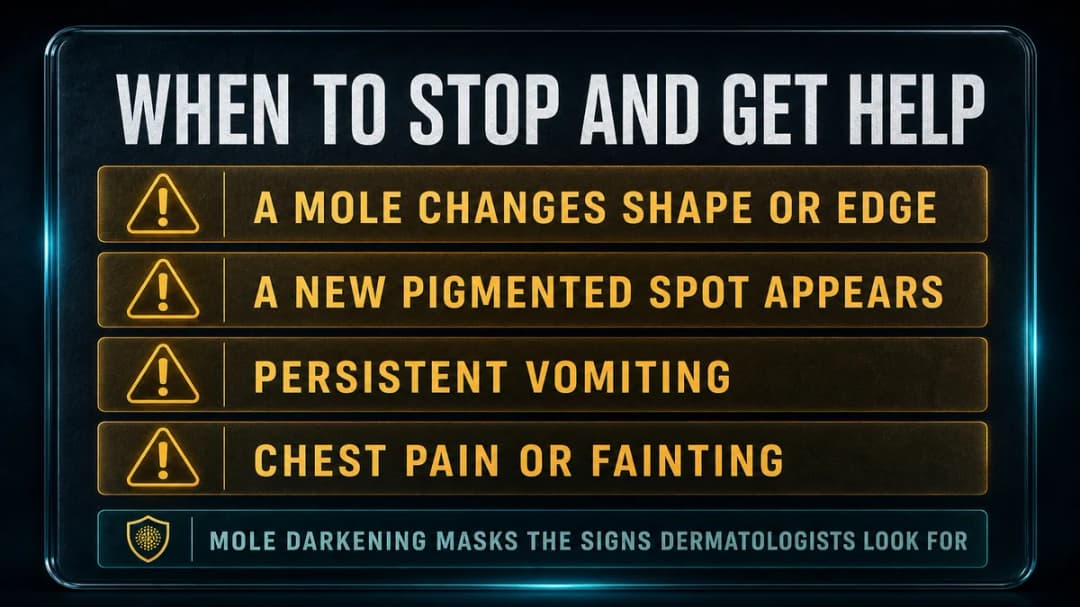
When to Stop and Get Help
- Any mole changing shape, size, colour distribution or border. Not a wait-and-see situation
- A painful erection lasting more than four hours. This is priapism and it is an emergency, because prolonged ischaemia damages tissue permanently
- Vomiting that does not settle, particularly if fluids cannot be kept down
- Hives, swelling of the face or lips, or difficulty breathing. Emergency care
Reducing the Predictable Ones
- Start at 0.25 mg, or lower for fair skin. This does more for nausea than anything else
- Inject in the evening, which covers both the nausea window and the erectile effect
- Increase slowly, and do not move to 1 mg without having tolerated 0.5 mg
- Stay hydrated, which reduces headache and flushing severity
- Rotate injection sites
See our Melanotan dosage guide for the reported ranges and reconstitution detail.
FAQ
Does Melanotan cause cancer?
No study has demonstrated it, and no study has ruled it out. There are published case reports of mole changes and of melanoma in users. Combined with the ultraviolet exposure the protocol requires, that uncertainty is why dermatology bodies and several regulators advise against it.
Do Melanotan side effects improve over time?
The predictable ones do. Nausea, flushing and yawning all decrease substantially over the first week or two as the body adapts. The erectile effect in men reduces but generally does not disappear at active doses.
Why does Melanotan II cause erections?
Because it binds MC4R, a melanocortin receptor in sexual arousal pathways. It is the same mechanism that a related compound, PT-141, was developed to exploit deliberately. Melanotan I is more selective and produces much less of this.
How do you tell flushing from an allergic reaction?
Flushing is warmth and redness, mainly on the face and chest, lasting under two hours. An allergic reaction adds hives, itching, and possibly throat tightness or breathing difficulty. Anything involving the throat or breathing is an emergency.
Is Melanotan safe for fair skin?
Fair-skinned people often see the most dramatic colour change, which is the appeal. They are also the group at highest baseline melanoma risk and the group that reports the strongest nausea. That combination is a reason for more caution, not less.
Will Melanotan show up on a drug test?
Melanotan II is on the World Anti-Doping Agency prohibited list, so anyone competing in tested sport should not use it.