Any honest IGF-1 LR3 dosage, cycle length & side effects guide has to lead with the same warning: this compound is measured in micrograms, it lowers blood glucose, and a decimal point in the wrong place is a medical emergency rather than a wasted dose. The reported ranges in this IGF-1 LR3 dosage, cycle length and side effects guide come from community protocols and animal work, not from human dose-finding trials, because none exist.
IGF-1 LR3 is a research chemical. It is not approved for human use anywhere and it is prohibited in tested sport. Nothing here is a protocol to follow.
IGF-1 LR3 Dosage, Cycle Length & Side Effects Guide: reported ranges
| Experience level | Reported daily amount | Usual timing | Usual cycle |
|---|---|---|---|
| Starting point | 20 mcg | After training | 4 weeks |
| Common | 40 mcg | After training | 4 to 6 weeks |
| Upper end | 50 to 100 mcg | After training | 4 to 6 weeks maximum |
| Women | 10 to 20 mcg | After training | 4 weeks |
The range most protocols converge on is 20 to 50 mcg per day. Above that, hypoglycaemia becomes harder to manage and the theoretical concerns about unwanted tissue growth get less theoretical, without any evidence that results improve proportionally.
Two points about these numbers. First, they were arrived at by trial and error in the bodybuilding community, not by a dose-ranging study, so the apparent precision is misleading. Second, the difference between 20 mcg and 100 mcg is a fivefold difference in a compound with insulin-like activity, which is not a small decision.
The reconstitution arithmetic
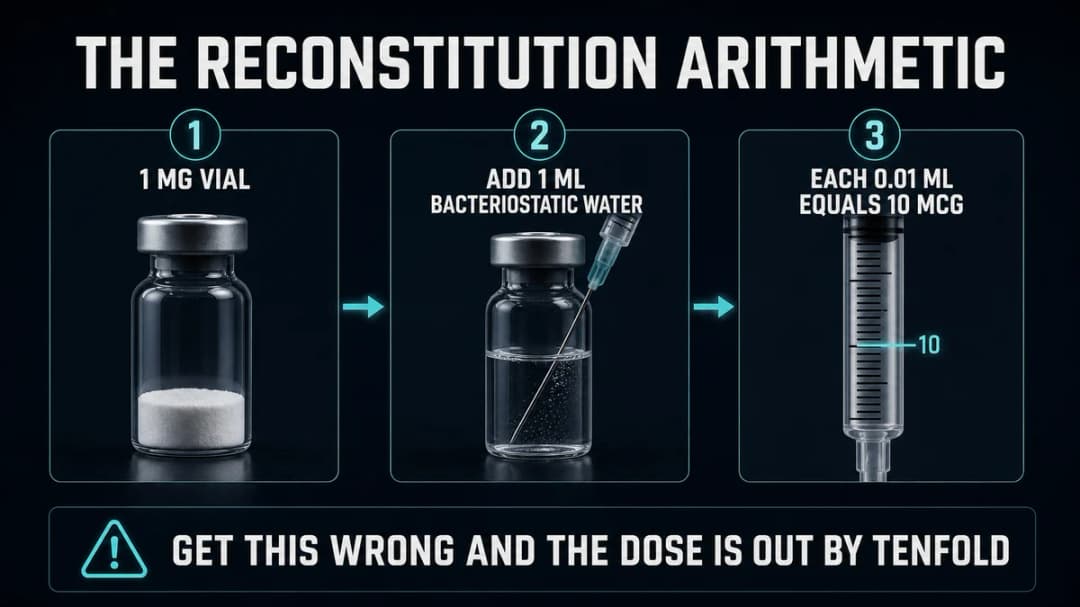
This is where people get hurt, so it is worth doing slowly. IGF-1 LR3 usually arrives as lyophilised powder in a 1 mg vial, which is 1,000 mcg in total.
Adding 1 mL of bacteriostatic water gives 1,000 mcg per mL, which is 10 mcg per unit on a 100-unit insulin syringe. A 20 mcg dose is 2 units.
Adding 2 mL gives 500 mcg per mL, which is 5 mcg per unit. A 20 mcg dose is 4 units.
The 2 mL dilution is the safer choice for small doses, because 4 units is easier to draw accurately than 2. Getting this wrong by a factor of ten is the realistic failure mode, and the consequence is not a wasted vial. Our reconstitution calculator handles the arithmetic if you would rather not do it by hand.
Practical handling: add the water slowly down the inside wall of the vial rather than directly onto the powder, swirl rather than shake, refrigerate immediately, and do not freeze. Reconstituted solution is generally treated as usable for around three to four weeks refrigerated.
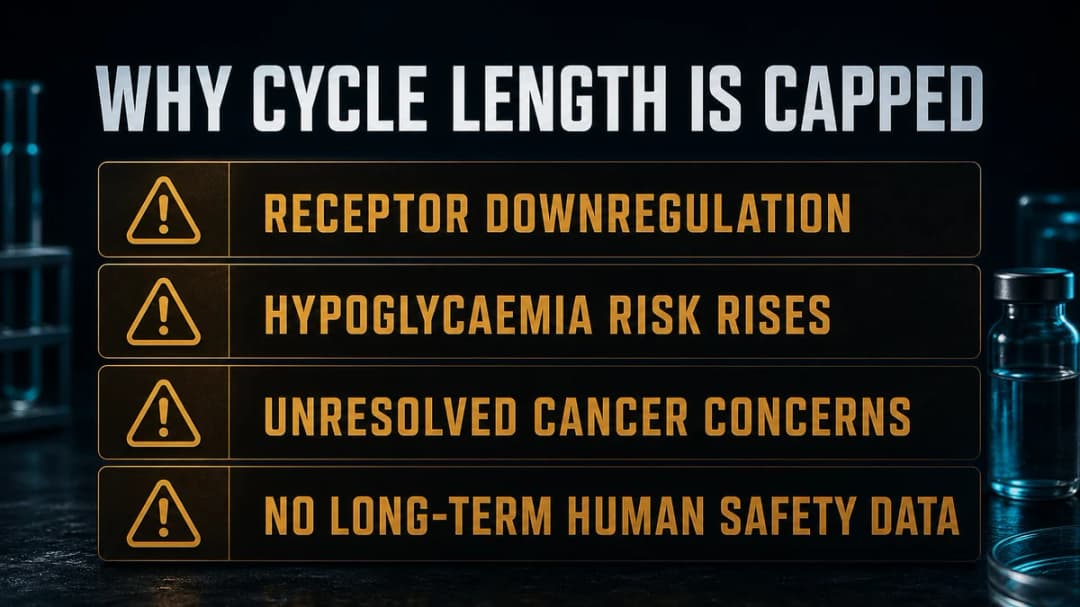
Cycle length and why it is capped
Four to six weeks on, with at least an equal period off, is the near-universal convention.
The stated reason is receptor downregulation. Sustained high-level IGF-1 receptor signalling is expected to reduce receptor responsiveness, so a long run produces diminishing returns while the side effect risk stays constant or grows. Four weeks on and four off is the most common pattern.
It is worth being clear that this is reasoning rather than a measured finding in humans. Nobody has published a study showing where the desensitisation curve turns, or that a four-week break restores anything. The convention is sensible and it is not evidence.
Timing and injection
After training, with food. This is the one rule with both a performance rationale and a safety rationale, and the safety half matters more. Training raises blood glucose and you are about to eat, which buffers the drop that IGF-1 LR3 causes. Carbohydrate and protein within about 30 minutes of injecting is treated as mandatory in every serious protocol.
Never fasted, and never before bed. Hypoglycaemia while asleep is the scenario nobody wakes up to manage.
Subcutaneous or intramuscular. The argument for injecting into the muscle just trained rests on MGF-style local action. The counter-argument is that a compound with a 20 to 30 hour half-life circulates systemically regardless of where the needle went. The evidence for a meaningful local advantage is weak. Subcutaneous injection into the abdomen is simpler and lower risk, and remains a defensible choice.
Side effects
Hypoglycaemia, the one that matters
IGF-1 LR3 has insulin-like activity on glucose uptake and lowers blood glucose reliably. Symptoms are shakiness, sweating, sudden hunger, confusion, blurred vision and, at the severe end, loss of consciousness or seizure.
The mitigations are unglamorous and they work: start at 20 mcg, inject only after training, eat carbohydrate within half an hour every single time, keep glucose tablets or juice physically within reach for the first hours, and never combine with insulin. That last one is not a caution, it is a hard line. The hypoglycaemic effects add together unpredictably and this combination has killed people.
Acromegalic changes
Chronic supraphysiological IGF-1 exposure produces the changes seen in acromegaly: growth of the jaw and brow, enlargement of hands and feet, and organ growth that is not visible from outside. This is a real risk at very high doses over extended periods, which is one reason the cycle cap exists. At 20 to 50 mcg for four to six weeks it is considered unlikely, though "considered" is doing work in that sentence, because nobody has followed a cohort to find out.
Cancer risk
IGF-1 drives cell proliferation. Epidemiological work has associated elevated IGF-1 with increased risk of several cancers, though causality in those studies is genuinely contested. What cannot be waved away is that deliberately raising IGF-1 receptor signalling for weeks at a time is not a neutral intervention, and that nobody has quantified what a cycle does to that risk. A personal or family history of a hormone-sensitive cancer is a strong reason to leave this compound alone.
The milder ones
Water retention, usually mild and resolving within days of stopping. Lethargy, often tracking blood glucose swings. Headaches, most common in the first week and usually responsive to hydration and eating properly. Injection site reactions, as with any subcutaneous compound.
Stacking, briefly
The common combinations pair IGF-1 LR3 with growth hormone secretagogues such as CJC-1295 and ipamorelin, which act upstream on the pituitary while IGF-1 LR3 acts downstream at the receptor. The secretagogues can run longer than the IGF-1 LR3 portion.
For injury contexts it is combined with BPC-157 and TB-500, on the reasoning that those address structural repair while IGF-1 LR3 preserves muscle during a layoff.
What not to combine: pharmaceutical growth hormone, which already drives endogenous IGF-1 production and makes total exposure impossible to control, and insulin, for the reasons above.
Sourcing matters more here than usual
IGF-1 LR3 is more sensitive to heat and handling than most research peptides, and it is expensive enough to make counterfeiting worthwhile. Look for a batch-specific certificate of analysis with identity confirmation, not just a purity percentage, lyophilised powder rather than a pre-mixed solution, and a vendor with a stated policy on shipping and damaged deliveries. Our where to buy IGF-1 LR3 page covers the checks in detail.
FAQ
How much IGF-1 LR3 is typically used?
Reported protocols cluster at 20 to 50 mcg per day, with 20 mcg as the usual starting point and 10 to 20 mcg cited for women. Higher amounts increase hypoglycaemia risk without evidence of proportionally better results. None of these figures comes from a human trial.
How long should a cycle be?
Four to six weeks, followed by at least an equal break, is the standard convention. The reasoning is IGF-1 receptor downregulation with sustained exposure. The convention is widely followed but has not been tested in humans.
When should IGF-1 LR3 be injected?
After training, followed by carbohydrate and protein within about 30 minutes. Never fasted and never before sleep, since hypoglycaemia during the night is the most dangerous version of the main side effect.
How serious is the hypoglycaemia risk?
Serious enough to define how the compound is used. It is the most commonly reported effect and the only one that can become an emergency within an hour. It is also almost entirely preventable through timing, food and starting low.
Can IGF-1 LR3 be combined with insulin?
No. Both lower blood glucose and the combined effect is unpredictable. There is no protocol that makes this acceptable and it has caused deaths.
Is IGF-1 LR3 legal?
It is sold as a research chemical rather than a medicine and is not approved for human use. It is not a controlled substance in the US but is prohibited by anti-doping authorities. Rules vary by country, so check your own jurisdiction.