
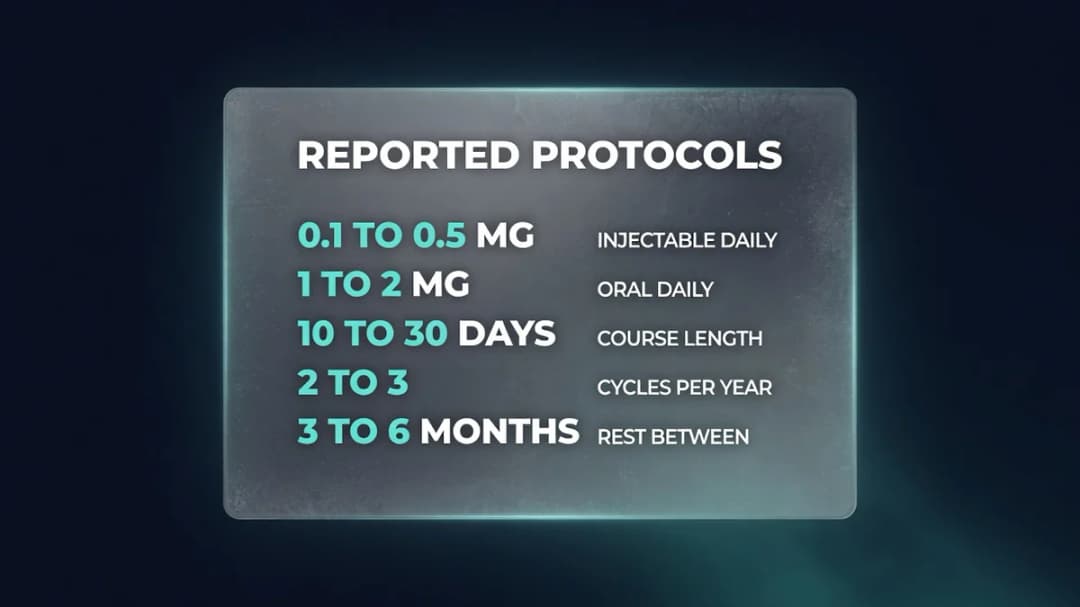
Bronchogen is a short peptide from the Khavinson bioregulator family, directed at bronchopulmonary tissue. This Bronchogen peptide complete guide covers the reported dosage of 0.1 to 0.5 mg per subcutaneous injection or 1 to 2 mg orally, run in short courses of ten to thirty days and repeated two or three times a year rather than taken continuously.
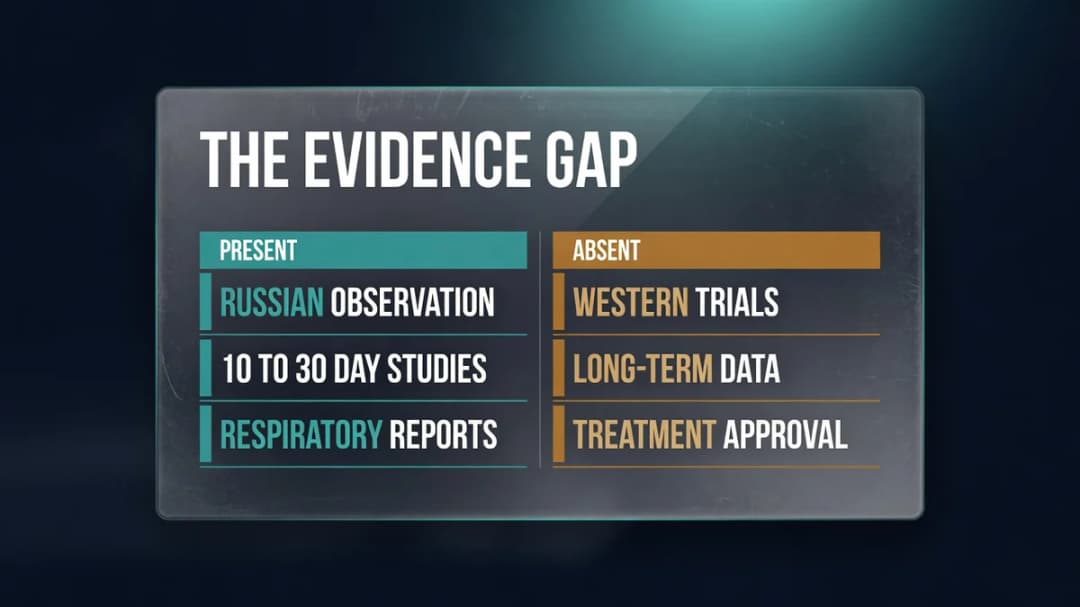
Any Bronchogen peptide complete guide has to be straightforward about one thing at the outset: the evidence base is Russian clinical and observational literature, not Western randomised trials. That does not make it worthless, and it does mean the confidence level here is different from what you would expect for an approved medicine.
Bronchogen Peptide Complete Guide: What It Is
Bronchogen belongs to the peptide bioregulator family developed under Vladimir Khavinson's programme at the St Petersburg Institute of Bioregulation and Gerontology. The organising idea behind that programme is that very short peptides derived from a given organ act preferentially on that organ's tissue, functioning as regulatory signals rather than as drugs in the conventional sense.
Bronchogen is the bronchopulmonary member of that family, usually described as a tetrapeptide. Others in the same family are directed at cartilage, the pineal gland, blood vessels and the thymus. Our bioregulator peptides overview covers the wider group and the theory behind it.
Bronchogen Peptide Dosage
Two routes are used, with different figures.
| Route | Dose per day | Cycle length | Cycles per year |
|---|---|---|---|
| Subcutaneous injection | 0.1 to 0.5 mg | 10 to 20 days | 2 to 3 |
| Oral capsule | 1 to 2 mg | 20 to 30 days | 2 to 3 |
Two features of that table are worth noticing, because they distinguish bioregulators from most of the peptide world.
The doses are tiny. A tenth of a milligram is a fraction of what a repair peptide uses. The theory behind bioregulators treats them as signals rather than as substrates, and the dosing reflects that.
They are pulse-dosed, not continuous. The Khavinson protocols are explicit about short courses with long rests, typically three to six months between cycles. Running a bioregulator daily and indefinitely is not a more aggressive version of the protocol; it is a different thing that the source literature does not describe.
Oral doses are higher than injectable ones because absorption is much lower, which is the usual pattern. Enteric coating is generally used to improve survival through the stomach.
Reconstitution
The dose is small enough that dilution matters. A 10 mg vial reconstituted with 2 mL of bacteriostatic water gives 5 mg per mL, at which 0.5 mg is 10 units and 0.1 mg is 2 units, which is too small to read accurately. Adding more water is the fix: at 5 mL, 0.1 mg becomes 5 units. Our peptide reconstitution calculator will run the numbers.
Refrigerate after reconstitution and treat the vial as a two to four week item.
What the Evidence Actually Shows
The research base is largely Russian, spans several decades, and is dominated by clinical observation rather than randomised placebo-controlled design. Reported studies are typically short, on the order of ten to thirty days, which matches the cycle structure but limits what can be said about longer-term effects.
Reported findings relate to respiratory function and bronchopulmonary tissue in older adults and in chronic respiratory conditions. Whether those findings would survive replication under Western trial standards is unknown, because that replication has not happened.
The honest position: there is a coherent body of work behind this compound, it is not fabricated, and it is also not the kind of evidence that would support a treatment claim. Anyone presenting Bronchogen as an established therapy for a lung condition is going considerably beyond what exists.
What It Is Used For
In practice, people use Bronchogen for general respiratory support, particularly in the context of ageing, and sometimes alongside conventional treatment for chronic respiratory conditions.
That last scenario is where the important caution lives. Asthma and COPD have effective, evidence-based treatments, and both can deteriorate quickly. A research peptide is not a substitute for an inhaler, and delaying or reducing established treatment in favour of one is a genuinely bad idea rather than a cautious-sounding disclaimer.
Safety and Side Effects
Reported side effects across the bioregulator family are minimal, dominated by injection site reactions. Given the microgram-scale doses, that is not surprising.
The caveats are the ones that apply to the whole category:
- No controlled long-term human safety data outside the Russian literature
- No interaction studies, so combinations with prescription medication are unstudied
- Nothing known about use in pregnancy or breastfeeding
- Product quality entirely dependent on vendor testing, since no regulator is checking
Because bioregulators are dosed in such small amounts, verifying that a vial contains what it claims is arguably more important here than for compounds where an underdose would be noticeable.
Practical Guidance If You Run It
Follow the cycle structure rather than improvising a continuous protocol, since the entire reported evidence base uses cycles.
Choose one route. Running oral and injectable together doubles cost and makes the exposure unclear.
Track something specific. For a respiratory compound that might be a peak flow reading, breathlessness on a defined activity, or the number of days a month a symptom occurs. Subjective impressions over a twenty day course are unreliable.
Do not change any prescribed respiratory medication. If you want to know whether Bronchogen is doing anything, the only interpretable way to find out is with everything else held constant.
FAQ
What is Bronchogen used for?
It is a bronchopulmonary bioregulator, used for general respiratory support and studied in Russian research in the context of ageing and chronic respiratory conditions. It is not an approved treatment for any condition outside that literature.
What is the standard Bronchogen dosage?
Reported protocols use 0.1 to 0.5 mg per day subcutaneously for ten to twenty days, or 1 to 2 mg per day orally for twenty to thirty days, repeated two or three times per year. There is no approved dose, because the compound is not an approved medicine.
Should Bronchogen be taken continuously?
No. The Khavinson protocols are explicitly cyclical, with short courses and rest periods of three to six months. Continuous dosing is not what the underlying research describes and there is no evidence supporting it.
Is oral or injectable Bronchogen better?
Injectable delivers a more predictable dose, which is why the reported injectable amounts are lower. Oral is easier and cheaper and relies on enteric coating to survive the stomach. The research literature includes both, and there is no head-to-head comparison establishing one as superior.
Is Bronchogen safe with asthma or COPD medication?
No interaction studies exist, so the honest answer is that nobody knows. Neither asthma nor COPD is a condition to experiment on, and no prescribed respiratory treatment should be reduced or delayed in favour of a research compound. Discuss it with the clinician managing your condition.