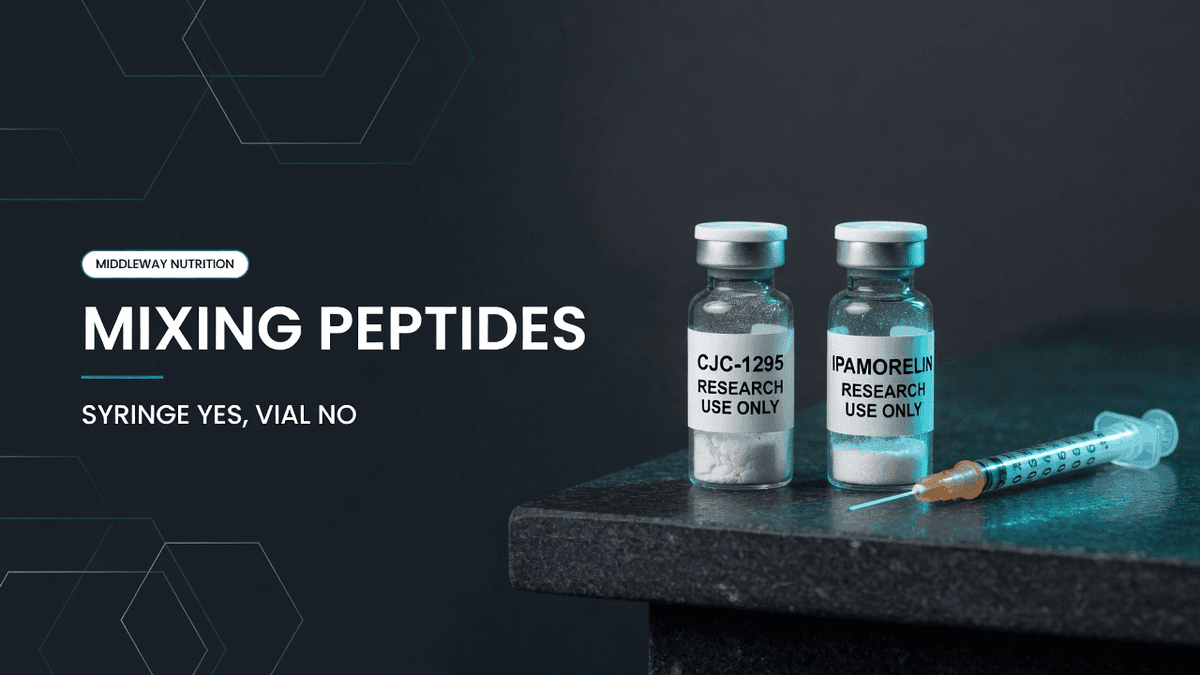
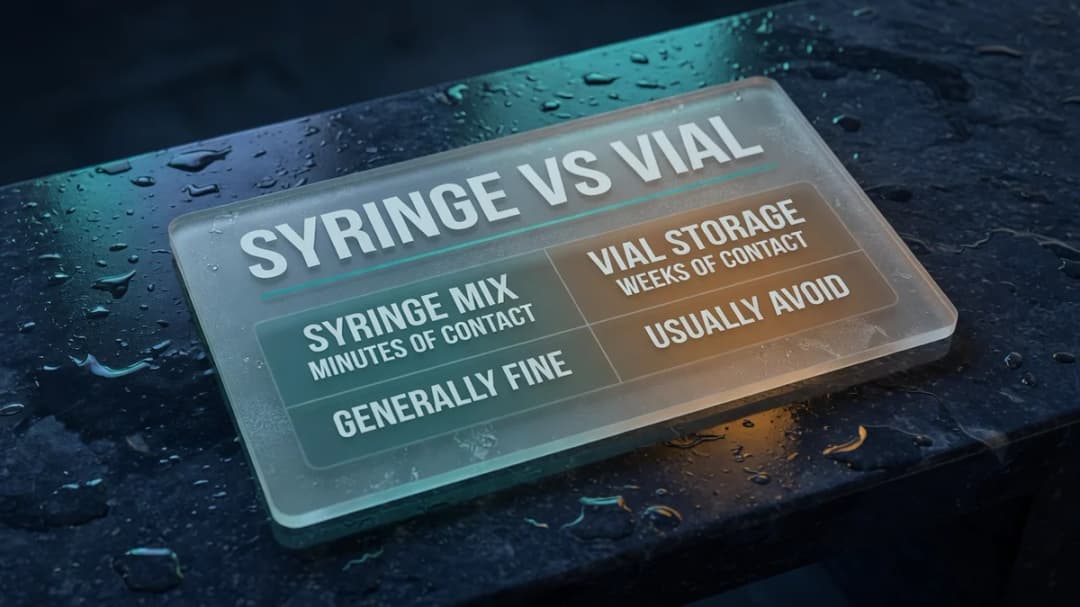
Can you mix peptides together? For a single injection, usually yes. Drawing two reconstituted peptides into the same syringe and injecting them at once is routine practice and is generally fine. Mixing two peptides in one vial and storing them that way is a different question, and the answer there is usually no.
The distinction between those two situations is what most discussions of whether you can mix peptides together skip over, and it is the whole practical point. A few minutes together in a syringe barrel exposes the compounds to each other briefly. Weeks together in a vial at fridge temperature is a stability experiment you have no way to check.
Can You Mix Peptides Together? The Syringe Answer
Combining two reconstituted peptides in one insulin syringe immediately before injection is common and, for the pairings people actually use, uncontroversial.
The combinations most often drawn together:
| Combination | Why they are paired | Mixing in one syringe |
|---|---|---|
| CJC-1295 and ipamorelin | Different receptors, same GH outcome, same timing | Routine |
| BPC-157 and TB-500 | Complementary repair mechanisms | Routine |
| Sermorelin and ipamorelin | GHRH plus secretagogue | Routine |
| GHK-Cu with anything | Copper complex, more likely to interact | Better injected separately |
The reason this works is exposure time. Whatever chemistry two peptides might do to each other, they have a minute or two to do it before the solution is out of the syringe and into subcutaneous tissue, where it is diluted into the body's own environment.
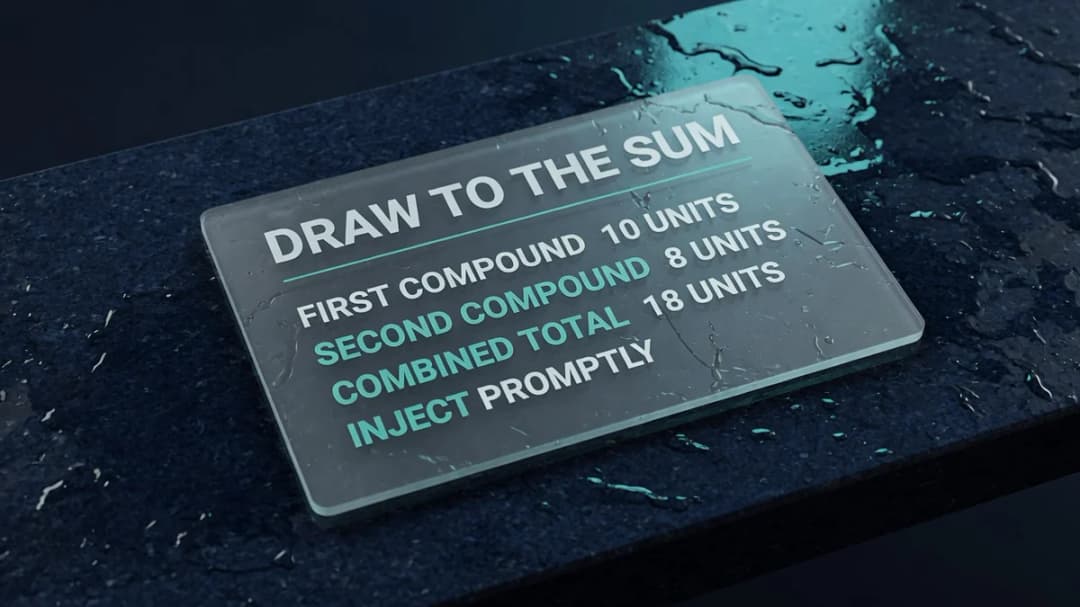
How to do it properly. Draw the first compound to its calculated unit mark, then draw the second so the plunger reaches the combined total. If compound A needs 10 units and compound B needs 8, draw to 10, then continue to 18. Use a fresh needle for each vial if you can, or at minimum swab both stoppers first. Inject promptly rather than letting the loaded syringe sit.
Mixing in the Vial: Usually a Bad Idea
Reconstituting two peptides into a single vial, or combining two reconstituted solutions into one for storage, is where the problems are.
Stability differs. One compound might hold four weeks refrigerated while its partner holds two. Stored together, you have no way to know when the shorter-lived one stopped being reliable, and no way to observe it. Degradation is invisible.
pH requirements differ. Peptides are stable across different pH ranges. Two solutions with different optimal ranges will settle at some intermediate value that suits neither. This is the mechanism people usually mean when they say two peptides are "incompatible", and it acts over days rather than minutes.
Ratios become fixed. Once combined, you cannot change one dose without changing the other. If one compound causes a side effect, your only lever is to reduce both.
Aggregation. Some sequences interact and form aggregates or precipitate out. Visible cloudiness is a clear sign, but not all aggregation is visible.
The exception is a commercial blend, where the manufacturer has combined the compounds as a lyophilised powder and, in principle, established that the formulation is stable. That is not the same as you combining two solutions in your fridge, though it does carry the same fixed-ratio limitation.
Practical Compatibility Guidance
The honest position is that formal compatibility data for research peptide combinations does not exist in the way it does for hospital IV drugs. What follows is practice, not published stability testing.
Generally combined without reported issues: GHRH analogues with growth hormone secretagogues, and the two main repair peptides with each other. These are the most used pairings by a wide margin, which is the main reason they are considered safe to combine.
Handled separately by preference: GHK-Cu, because a copper-bound peptide is chemically more reactive than most, and because it can stain and irritate more than others.
Never combined in one syringe: anything you have not reconstituted yourself and cannot identify, and any solution that has changed appearance.
The universal test: if a mixture turns cloudy, develops strands, changes colour or forms visible particles at any point, discard it. That is a chemical reaction you cannot characterise, and injecting the result is not worth the saved vial.
Mixing Is Not the Same as Stacking
Two separate questions get tangled here, and separating them makes both easier.
Physical mixing is about chemistry: can these two solutions share a barrel without degrading. That is what this page is mostly about.
Stacking is about whether the two compounds should be used together at all: do they act through different mechanisms, does each add something, can you attribute effects. Two peptides can be perfectly compatible in a syringe and a completely pointless combination pharmacologically. Our best peptide stacks guide covers that side.
The convenience of one injection is a poor reason to add a compound to a protocol.
Timing Instead of Mixing
Sometimes the better answer to "can these be mixed" is that they should not be given at the same time at all.
Growth hormone secretagogues are dosed fasted and usually before bed, because insulin blunts GH release. Repair peptides have no such constraint and can be dosed whenever is convenient. Combining them into one bedtime injection is possible, but if it makes you skip a second daily repair dose, you have optimised for convenience over the protocol.
Separating administration also preserves attribution. Injecting two compounds at different times of day means an injection site reaction tells you which one caused it.
A Short Checklist
- Mixing in a syringe immediately before injection: acceptable for common pairings
- Mixing in a vial for storage: avoid
- Reconstituting two powders in one vial: avoid
- Combining anything that has changed appearance: never
- Drawing to a combined unit total: draw the first, then continue to the sum
- Any cloudiness, strands or precipitate: discard the syringe and start again
FAQ
Can you mix BPC-157 and TB-500 in the same syringe?
Yes, this is one of the most commonly combined pairings and is routinely drawn into a single syringe immediately before injection. What should not be done is reconstituting them into the same vial for ongoing storage, since their stability profiles differ.
Can you reconstitute two peptides in one vial?
It is possible and generally inadvisable. You lose the ability to adjust either dose independently, the shorter-lived compound sets the usable life of the whole vial, and any pH mismatch acts on the solution for weeks. Commercial blends are formulated and tested as blends, which is not the same thing.
Does mixing peptides reduce their effectiveness?
For a brief period in a syringe, there is no reason to expect meaningful loss for compatible compounds. Stored mixed in a vial over weeks, loss is plausible and undetectable without testing. That asymmetry is why the syringe is fine and the vial is not.
How do you calculate the dose when mixing two peptides?
Calculate each dose separately using its own vial concentration, then draw cumulatively. If one needs 12 units and the other 6, draw to 12, then continue to 18. The concentrations are independent, so combining does not change either calculation. Our peptide reconstitution calculator handles each one.
What happens if a peptide mixture turns cloudy?
Discard it. Cloudiness means aggregation, precipitation or contamination, and none of those are recoverable. It is also a signal to stop combining those two compounds in future rather than to try again more carefully.