The best peptide stacks for muscle, fat loss & recovery are the ones where the two compounds act through genuinely different mechanisms aimed at the same outcome. A GHRH analogue paired with a ghrelin receptor agonist is the clearest example. Stacking two compounds that do the same thing adds cost and side effects without adding effect.
Most guides to the best peptide stacks for muscle, fat loss and recovery list combinations without explaining why any of them belong together. That is the part that decides whether a stack is worth running, so this page organises around the rationale first and the protocol second.
One thing to be clear about at the outset: peptide stacking has not been evaluated in controlled human trials. Every combination below rests on the mechanisms of the individual compounds, not on evidence that the pairing outperforms either one alone.
Best Peptide Stacks for Muscle, Fat Loss & Recovery: What Makes One Sensible
Three questions separate a reasoned stack from a shopping list.
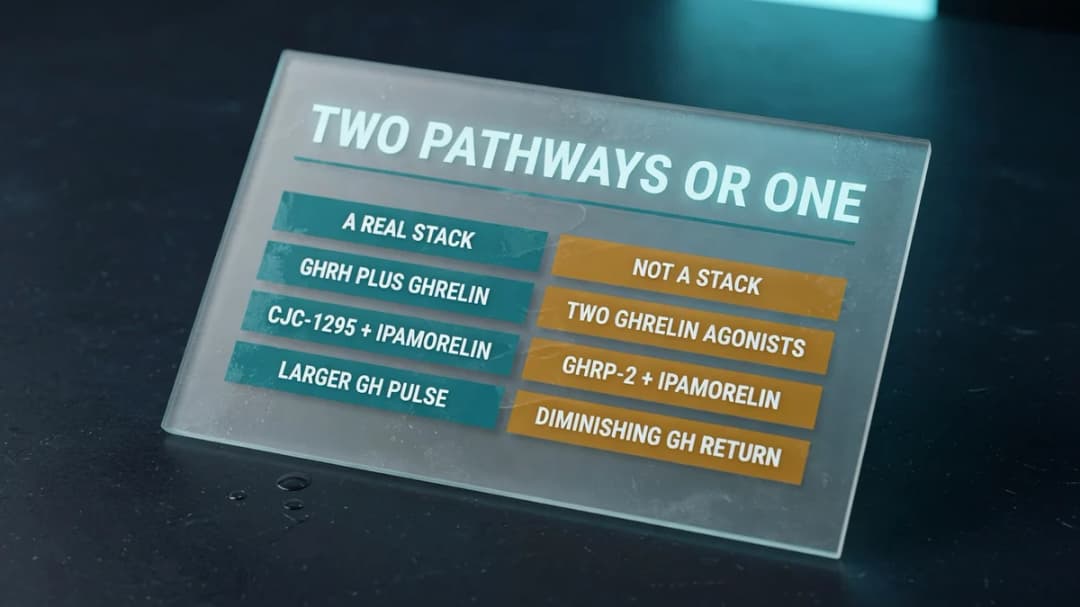
Do the compounds act through different pathways? Ipamorelin acts on the ghrelin receptor. CJC-1295 acts on the GHRH receptor. Both raise growth hormone, by different routes, which is the classic case for combining. Stacking ipamorelin with GHRP-2 does not do that, because they act on the same receptor and mostly duplicate each other.
Does each part earn its place? If you cannot say what the second compound adds that the first does not, it is not adding anything.
Can you tell them apart? Starting two compounds together means any effect, good or bad, is unattributable. Run the primary compound alone for two to four weeks first, then add the second.
Muscle and Body Composition
The foundational pairing here is a GHRH analogue plus a growth hormone secretagogue.
| Compound | Reported dose | Timing | Role |
|---|---|---|---|
| CJC-1295 without DAC | 100 to 200 mcg | Before bed, fasted | GHRH receptor, raises the size of the GH pulse |
| Ipamorelin | 100 to 300 mcg | Same injection | Ghrelin receptor, triggers the pulse |
Timing matters more here than in most stacks. Growth hormone release is blunted by insulin, so this pairing is dosed on an empty stomach, generally two hours after eating and thirty to sixty minutes before eating again. Dosing before bed lines it up with the body's own largest GH pulse.
MK-677 is the oral alternative to the injectable secretagogue side. It is convenient and has a much longer duration, which is also its problem: the hunger and fluid retention are persistent rather than pulse-shaped. Our MK-677 guide covers the trade-off.
What to expect is modest. This class supports recovery, sleep and lean mass retention. It does not build muscle the way people sometimes imply, and nothing in it substitutes for training and protein intake.
Fat Loss
The honest ranking here is uncomfortable for the research peptide category: the compounds with real fat loss evidence are the incretin drugs, and they are prescription medicines rather than research vials.
| Approach | Components | Rationale | Evidence |
|---|---|---|---|
| Incretin plus GH support | A prescribed GLP-1 medicine with CJC-1295 and ipamorelin | Appetite reduction from one side, lean mass support from the other | Strong for the medicine, weak for the pairing |
| Tesamorelin plus a secretagogue | Tesamorelin with ipamorelin | Tesamorelin has clinical data for visceral fat | Moderate, in a specific population |
| GH fragments | AOD-9604, HGH fragment 176-191 | Isolated lipolytic portion of growth hormone without growth effects | Weak. Human trials have been unimpressive |
The GH fragment row deserves particular scepticism. AOD-9604 was developed specifically as a fat loss compound and its human results did not support the promise, which is why it never reached approval for that use. It is still widely sold. Our AOD-9604 guide covers what the trials actually showed.
The muscle-sparing argument for adding a GH secretagogue to a GLP-1 medicine is reasonable in principle, since lean mass loss during rapid weight loss is a real problem. It is also unproven, and the glucose interaction between the two directions of effect is a genuine reason to involve a clinician rather than improvise. Our can you build muscle on GLP-1 page covers the underlying issue.
Recovery and Repair
| Compound | Reported dose | Frequency | Role |
|---|---|---|---|
| BPC-157 | 250 to 500 mcg | Once or twice daily | Angiogenesis, growth factor signalling |
| TB-500 | 2 to 2.5 mg | Twice weekly loading, then weekly | Cell migration, systemic distribution |
This is the most popular pairing in the category and one of the few with a defensible reason for existing. The mechanisms are genuinely different: one works largely on signalling and local vessel formation, the other on getting repair cells to where they are needed, and it distributes systemically regardless of where you inject.
Some people add GHK-Cu for the collagen synthesis angle, particularly where skin or superficial wound healing is part of the picture. That is a reasonable third component and the point at which the stack stops being simple.
Both BPC-157 and TB-500 promote new blood vessel formation. That is the mechanism, and it is also the reason to avoid them with an active or suspected malignancy. Discuss it with a clinician rather than deciding alone.
Combinations Worth Avoiding
Two compounds acting on the same receptor. GHRP-2 plus GHRP-6 plus ipamorelin gives you diminishing returns on GH and compounding side effects on appetite and cortisol.
Four or five compounds at once on a first attempt. Every addition multiplies the number of explanations for anything that happens, and the cost.
Anything metabolic without monitoring. GH secretagogues raise fasting glucose while GLP-1 medicines lower it. Running both without checking numbers means guessing about the net effect on something that matters.
A stack instead of a diagnosis. If a joint has been painful for six months, the useful next step is imaging and a rehab plan, not a third vial.
Cycling
Cycling practice in this space is convention rather than evidence, which is worth saying plainly.
| Stack type | Common cycle | Common break |
|---|---|---|
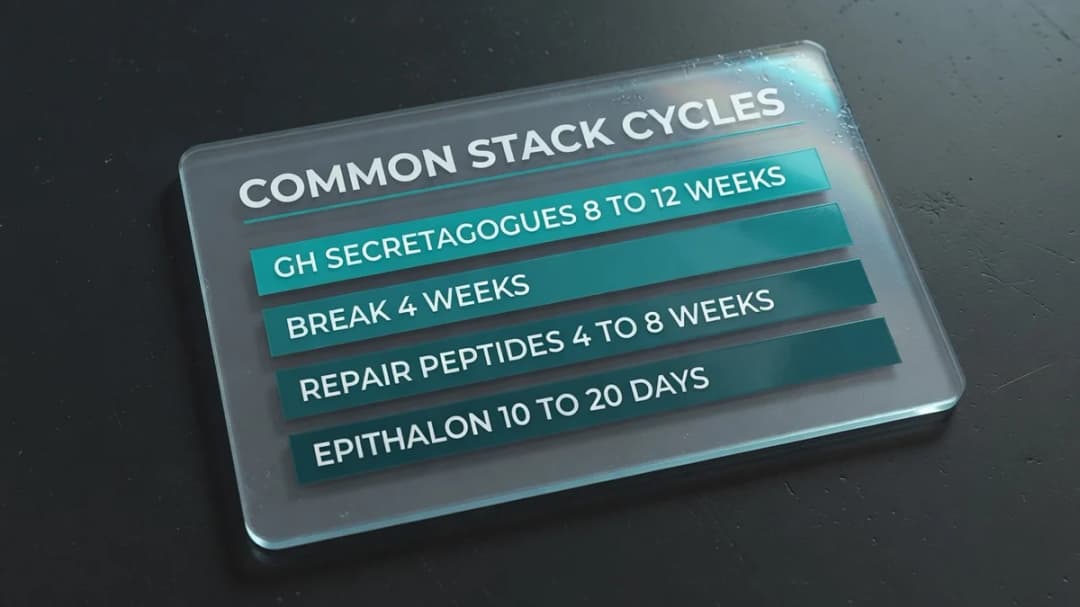
| GH secretagogues | 8 to 12 weeks | 4 weeks |
| Repair peptides | 4 to 8 weeks | Until the next injury |
| Epithalon | 10 to 20 days | Several months |
The reasoning for cycling GH secretagogues is receptor desensitisation, which is a real phenomenon in principle. How quickly it happens at these doses in humans is not well established, so the specific numbers above are custom rather than science.
How to Build a Stack Properly
- Write down the single outcome you want and how you will measure it.
- Run the compound most likely to deliver that outcome, alone, for two to four weeks.
- If it is working and tolerated, add the second compound and wait another two weeks before judging.
- Keep a log of dose, timing and effect. Memory is unreliable over an eight week cycle.
- Set the end date in advance, and evaluate against the measure you wrote down at step one rather than against how you feel on the day.
Most people skip step one, which is why so many stack reports end in "I think it helped".
FAQ
Can peptides be mixed in the same syringe?
Commonly used pairings such as CJC-1295 with ipamorelin, or BPC-157 with TB-500, are routinely drawn into one syringe. The practical rule is to only combine compounds already reconstituted and known to be compatible, and to inject separately if you are unsure. Mixing does not change the dose maths, since each is drawn to its own volume.
What is the best stack for a beginner?
For growth hormone support, CJC-1295 without DAC plus ipamorelin is the standard entry point and the best tolerated. For recovery, start with BPC-157 alone rather than pairing it immediately. The general principle is to master one compound before combining, which is dull advice and correct.
How long before a stack does anything?
Sleep changes from GH secretagogues can appear within days. Body composition changes take at least eight to twelve weeks and are modest. Recovery stacks are usually assessed at four to six weeks. Anything faster is likely to be inflammation or fluid rather than tissue change.
Do peptide stacks work better than single peptides?
There is no controlled human evidence that they do. The mechanistic argument for combining compounds with different pathways is reasonable, and it remains an argument rather than a finding. A well-run single compound with proper tracking often teaches you more than a four compound stack.
Are these stacks legal?
The individual compounds are sold legally as research chemicals rather than approved medicines, which leaves human use unaddressed. Prescription components such as GLP-1 medicines require a prescriber. Tested athletes should assume the entire category is prohibited. Our are peptides legal page covers this properly.