Enclomiphene vs Clomid comes down to one ingredient. Clomid (clomiphene citrate) is a mixture in which 30% to 50% is zuclomiphene, a weakly estrogenic isomer with a half-life of about 30 days, and the rest is enclomiphene, which clears in about 10 hours. In a 2024 Baylor review of 66 men who switched from clomiphene to enclomiphene, recorded side effects fell from 47% to 13.8% and median estradiol dropped 5.92 pg/mL, but a 2023 Miami review found estradiol rose more on enclomiphene. No randomized trial has compared the two drugs directly.
This page covers what is in each pill, how zuclomiphene builds up on long-term clomiphene, what the two retrospective comparisons measured and why their estradiol results disagree, how each drug is approved and sold, and which men the literature suggests might switch.
Key Takeaways
- The Clomid label describes clomiphene as a mix of two isomers containing 30% to 50% of the cis form (zuclomiphene); enclomiphene is the trans form sold on its own
- In 15 men on clomiphene 25 mg daily for a median 25.9 months, blood zuclomiphene outnumbered enclomiphene by about 20 to 1 (44.0 vs 2.2 ng/mL)
- Baylor switch study (66 men): testosterone rose a median 98 ng/dL on clomiphene and 166 ng/dL on enclomiphene (not significant); estradiol changed +17.5 vs -5.92 pg/mL and side effects fell from 47% to 13.8%
- Miami study (46 men on enclomiphene, 32 on clomiphene): median estradiol went from 29.5 to 67 pg/mL on enclomiphene and from 31 to 37.6 pg/mL on clomiphene
- Clomid has been FDA-approved since 1967, but only for ovulatory dysfunction in women; enclomiphene has no approval anywhere and reaches US patients as a compounded prescription
What Clomid is made of: enclomiphene plus zuclomiphene
Clomiphene citrate is one formula that exists as two geometric isomers. The current Clomid prescribing label on DailyMed describes the drug as a mixture of the cis isomer (zuclomiphene) and the trans isomer (enclomiphene), with 30% to 50% cis. So a 50 mg tablet holds roughly 25 to 35 mg of enclomiphene. The 62% to 38% split often quoted online, which Wikipedia describes as a typical synthesis ratio, sits inside that range; the label gives only the range.
The two isomers do different jobs. Enclomiphene blocks estrogen receptors in the hypothalamus and pituitary, so the brain reads estrogen as low and releases more LH and FSH, which drive testosterone and sperm production. Zuclomiphene behaves more like a weak estrogen; the label says only that some data suggest it is the more estrogenic isomer. A 2016 review by Rodriguez, Pastuszak and Lipshultz in Expert Opinion on Pharmacotherapy goes further, describing zuclomiphene as an estrogen receptor agonist linked to the estrogenic side effects reported with clomiphene.
The same review gives enclomiphene a half-life of about 10 hours and zuclomiphene about 30 days, and the label notes zuclomiphene was still detectable more than a month after a single dose. For the basics, see our explainer on what enclomiphene is.
Zuclomiphene accumulation: the 20 to 1 blood ratio
A 30-day half-life means a daily dose keeps stacking up for months. Helo and colleagues (BJU International, 2017) measured both isomers once in 15 men taking clomiphene 25 mg daily for secondary hypogonadism, for a median of 25.9 months.
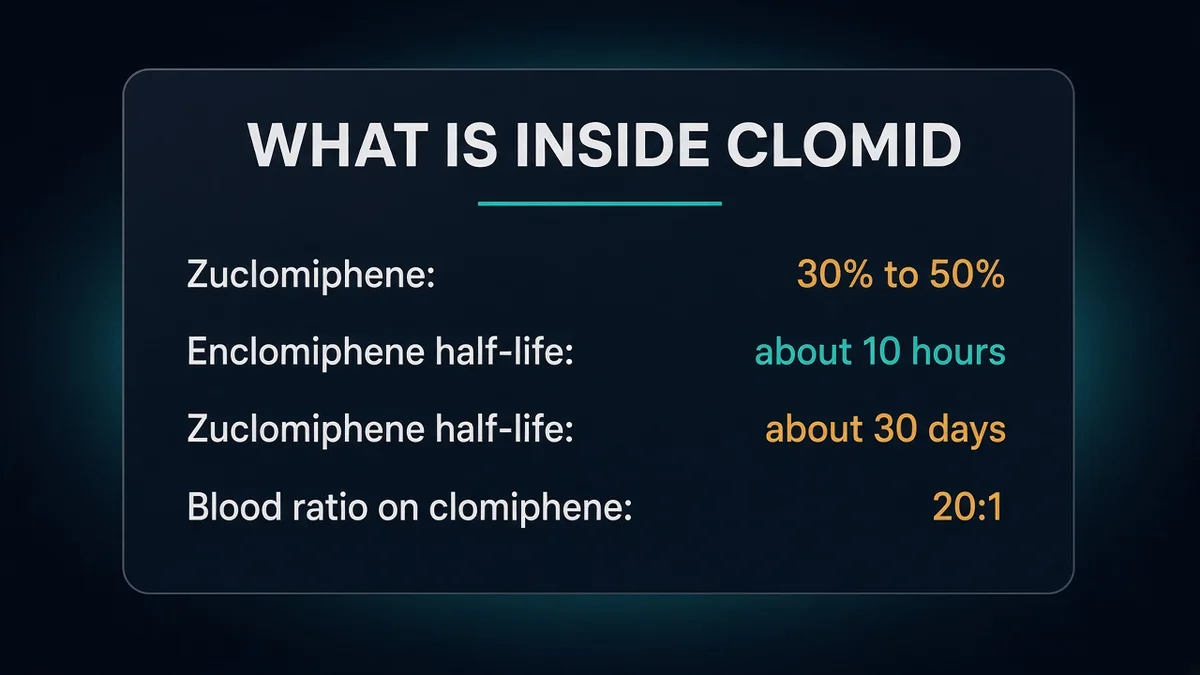
Median enclomiphene was 2.2 ng/mL and median zuclomiphene 44.0 ng/mL, about 20 to 1. The minority isomer in the tablet becomes the majority in the blood. Age, BMI and treatment length did not predict either level. The drug still worked: median testosterone went from 205 to 488 ng/dL and LH from 4.0 to 6.1 mIU/mL, while estradiol doubled from 17.0 to 34.0 pg/mL. The authors argued for a pure antagonist for men.
Fifteen men in one blood draw is a small base, and a high zuclomiphene level does not by itself prove harm. It does show that a man on long-term clomiphene is mostly exposed to the isomer that does not raise LH.
The long tail matters for drug testing. In a 2019 Journal of Clinical Endocrinology and Metabolism study, 12 healthy men took clomiphene 50 mg daily for 30 days; zuclomiphene stayed detectable in urine for 121 to more than 261 days. WADA lists clomifene as a hormone and metabolic modulator, and enclomiphene is one of its isomers, so tested athletes should treat both as prohibited.
Saffati 2024: what happened when 66 men switched from Clomid to enclomiphene
The most cited comparison is a Baylor College of Medicine chart review by Saffati and colleagues in Translational Andrology and Urology. It covered men seen from January 2021 to December 2022 who took clomiphene and later switched to enclomiphene, excluding anyone with prior testosterone or hCG. All had two testosterone readings below 300 ng/dL plus symptoms; mean age was 38.5 and 78% had secondary hypogonadism. Each man served as his own control, with labs before clomiphene, on clomiphene, and on enclomiphene.
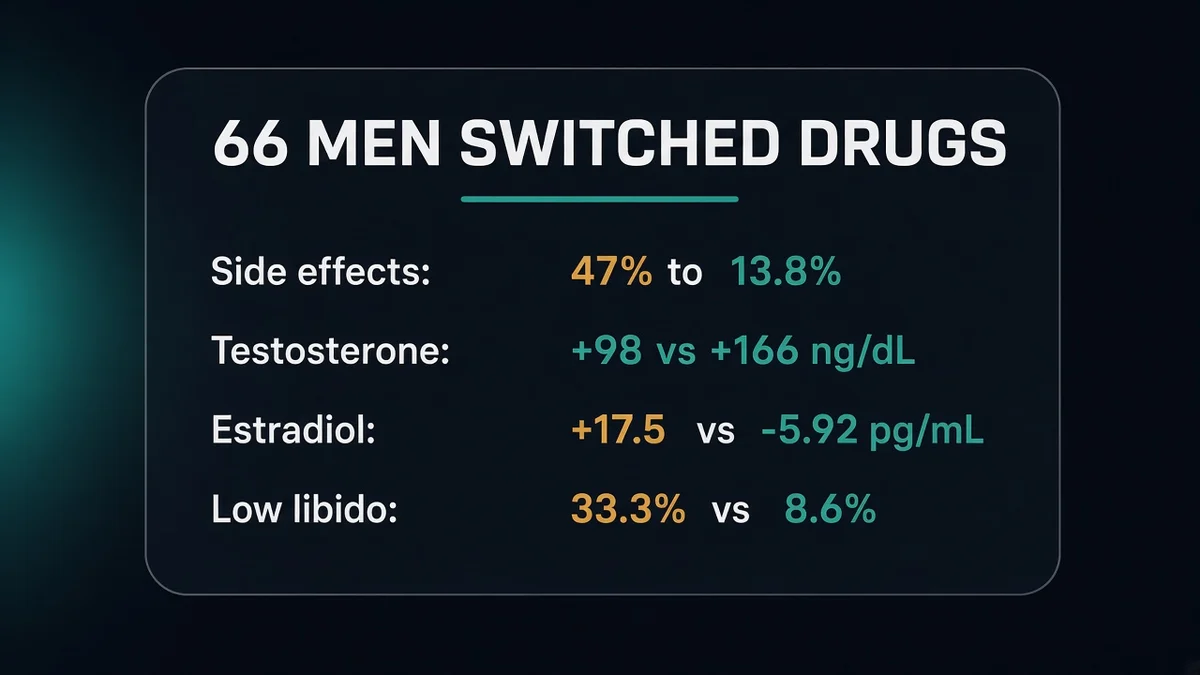
Same 66 men, three checkpoints (Saffati et al., 2024)
| Before clomiphene | On clomiphene | On enclomiphene | |
|---|---|---|---|
| Total testosterone | 306 ng/dL | 436 ng/dL | 499 ng/dL |
| Estradiol | 23.4 pg/mL | 30 pg/mL | 29 pg/mL |
| Hematocrit | 45.6% | 45.5% | 47.0% |
| Any side effect recorded | Not applicable | 47% (31 men) | 13.8% (8 men) |
| Decreased libido | Not applicable | 33.3% | 8.6% |
| Mood changes | Not applicable | 9.1% | 0% |
| Median time on drug | Not applicable | 18.7 months | 8.9 months |
The estradiol result is smaller than the headline. Each man's own change had a median of minus 5.92 pg/mL, but the group median barely moved, from 30 to 29 pg/mL. Testosterone kept climbing after the switch, and the gap in the size of the rise was not significant.
The side-effect gap is the stronger finding, with significant drops in decreased libido, decreased energy (16.7% to 5.2%) and mood changes. Erectile dysfunction fell from 18.2% to 8.6%, not significant (P = 0.12). The odds ratio for any adverse event on enclomiphene was 0.18.
The authors list most of the design problems:
- Order. Everyone took clomiphene first, and men usually switch because something bothered them, which weights the group toward poor clomiphene responders.
- No washout. Zuclomiphene from the clomiphene phase was still circulating early in the enclomiphene phase.
- Starting points. Enclomiphene started from levels clomiphene had already raised.
- Counting. Side effects came from coded clinic notes, and the enclomiphene percentages imply 58 men rather than 66, unexplained in the paper.
- Doses. None are reported.
The full safety record is on our enclomiphene side effects page.
Thomas 2023: the Miami study that found the opposite on estradiol
The only other direct comparison is a 2023 University of Miami chart review by Thomas and colleagues in Cureus. It compared two separate groups treated for at least three months: 46 men on enclomiphene and 32 on clomiphene, most seen for infertility. On enclomiphene, 14 men took 12.5 mg daily and 32 took 25 mg daily; everyone on clomiphene took 50 mg every other day. Six enclomiphene patients had earlier stopped clomiphene over side effects, most often weight gain.
| Median value, before and after at least 3 months | Enclomiphene | Clomiphene |
|---|---|---|
| Total testosterone, ng/dL | 390 to 581 (n = 31) | 244 to 470 (n = 29) |
| LH, mIU/mL | 3.1 to 5.5, significant | 4.8 to 6.3, not significant |
| FSH, mIU/mL | 4.4 to 7.4, significant | 6.9 to 13, not significant |
| Estradiol, pg/mL | 29.5 to 67 (n = 18, P = 0.003) | 31 to 37.6 (n = 11, P = 0.074) |
| Total motile sperm count, millions | 0.73 to 4.01, significant | 1.2 to 8, not significant |
| Reached testosterone above 300 ng/dL | 87.1% | 88.9% |
Here estradiol rose sharply on enclomiphene and the testosterone to estradiol ratio fell from 13.2 to 8.7, while on clomiphene it improved from 7.9 to 12.5. Yet between groups, no change differed significantly, estradiol included (+61.18 vs +25.01 pg/mL, P = 0.164).
Estradiol was measured in only 18 and 11 men, and the groups started from different testosterone levels. A 2026 position statement from the British Society for Sexual Medicine adds that the doses compared were not equivalent.
Enclomiphene vs clomiphene on estradiol: why the two studies disagree
Both results can be true, because estradiol in men mostly comes from testosterone. Aromatase converts part of whatever testosterone the testes make into estradiol, so any drug that raises testosterone tends to raise estradiol. Removing zuclomiphene does not switch that off.
The trial record agrees. A randomized phase 2 trial by Wiehle and colleagues (Fertility and Sterility, 2014) reported that enclomiphene raised morning testosterone and estradiol by amounts similar to topical testosterone gel, while also raising LH. A 2025 meta-analysis by Hohl and colleagues in Archives of Endocrinology and Metabolism pooled 10 randomized trials with 819 men and found that clomiphene and enclomiphene together raised estradiol by 33.99 pg/mL more than placebo.
A plausible but untested reading is that zuclomiphene's estrogen-like effects happen at the receptor and do not show on a blood estradiol test, so a man could feel better on enclomiphene with the same or a higher estradiol number. How prescribers handle high estradiol, and why adding an aromatase inhibitor is disputed, is covered on our page on enclomiphene and anastrozole.
The baboon study behind the stronger-isomer claim
As summarized in the Rodriguez review, Repros Therapeutics gave male baboons 1.5 mg/kg/day of zuclomiphene, enclomiphene or clomiphene for 12 days. Testosterone rose from 170 to 1,144 ng/dL on enclomiphene and from 170 to 559 ng/dL on clomiphene, both significant, while zuclomiphene produced no significant rise. Zuclomiphene raised cholesterol 22%; enclomiphene lowered it 8%. No group showed a significant LH or FSH rise.
This is where the line that enclomiphene is twice as strong as Clomid comes from. The review cites it to a company abstract and patent filings, not a peer-reviewed paper, and gives no animal count. In men, neither comparison found a significant difference in testosterone rise.
Claims about Clomid vs enclomiphene that the papers do not support
Pages ranking for this search repeat several claims the primary sources contradict:
- Claim: a 2014 trial found 73% normalized on enclomiphene against 41% on Clomid. The 2014 phase 2 trial (NCT01270841) compared enclomiphene with topical testosterone gel. It had no clomiphene arm.
- Claim: enclomiphene does not raise estrogen. Wiehle 2014 and the Miami review both found it does.
- Claim: enclomiphene's half-life is measured in days. It is about 10 hours.
- Claim: enclomiphene causes 85% fewer side effects. No study reports that figure; the only side-effect comparison is the Saffati switch study.
Approval and labelling: Clomid is approved, just not for men
Clomid was approved by the FDA on February 1, 1967, for one use: ovulatory dysfunction in women trying to conceive. The label says no adequate, well-controlled studies show it works for male infertility, and notes that "testicular tumors and gynecomastia have been reported in males." Prescribing it to men is off-label, legal and common; the Saffati paper and the BSSM statement both cite American Urological Association guidance naming it as an option for men who want to preserve fertility. The label also warns that visual symptoms can occur and, rarely, persist.
Enclomiphene has no approval. Repros received an FDA Complete Response Letter at the end of 2015 and the European Medicines Agency refused it in 2018. US 503A pharmacies compound it for named patients under an interim FDA policy that still listed it in Category 1 on May 14, 2026; the record is on our page asking is enclomiphene FDA approved. The BSSM calls it promising but wants it kept to specialist or research settings until long-term data exist.
Long-term data favour clomiphene. A 2019 retrospective study by Krzastek and colleagues in the Journal of Urology followed 400 men for a mean of 25.5 months. Of the 120 treated more than three years, 88% reached normal testosterone and 8% reported side effects, most often mood changes (5 men) and blurred vision (3). Nothing comparable exists for enclomiphene.
Enclomiphene vs Clomid at a glance
| Enclomiphene | Clomid (clomiphene citrate) | |
|---|---|---|
| Contents | Trans isomer only | Enclomiphene plus 30% to 50% zuclomiphene |
| Half-life | About 10 hours | Zuclomiphene about 30 days; 20:1 blood ratio on long-term use |
| FDA status | Not approved; Complete Response Letter 2015 | Approved 1967 for women; off-label in men |
| US access | Compounded prescription, mostly via telehealth | Generic tablet at retail pharmacies |
| Estradiol in men | Rises in trials; fell after switching in one review, rose more in another | Rises; doubled in the 15-man blood-level study |
| Side-effect comparison | 13.8% after switching (Saffati) | 47% in the same men; label warns on vision |
| Sperm data | Preserved in phase 2 and 3 trials; motile count rose in Miami review | Widely used for male infertility, mixed semen results |
| Long-term data | Little beyond 12 months | 120 men treated over 3 years in one series |
Cost and access: generic tablet against compounded capsule
Clomiphene is cheaper and easier to get: any doctor can prescribe the generic tablet and any retail pharmacy can fill it. When we checked for our enclomiphene cost guide, 30 tablets of 50 mg cost $129.84 with a discount card, while telehealth enclomiphene plans ran $99 to $199 a month and compounding pharmacies quoted roughly $40 to $150 for a month of 12.5 mg capsules before prescriber fees. The Rodriguez review flagged the same trade-off in 2016, asking whether a possible side-effect advantage justified enclomiphene's higher price. The prescription routes for enclomiphene are compared in our guide to an enclomiphene prescription online.
Which men the literature suggests might switch
No guideline sets switching criteria, so these are patterns in the published series, not rules:
- Men with side effects on clomiphene. This is the group the Saffati data describe, and 6 of the 46 Miami enclomiphene patients had dropped clomiphene for that reason.
- Men doing well on clomiphene. Neither comparison found a bigger testosterone rise on enclomiphene, so good labs and no complaints give little published reason to pay more.
- Men focused on fertility. Both drugs work by raising LH and FSH, where testosterone suppresses them. The Miami motile-count rise was significant only on enclomiphene, but not between groups.
- Men with primary hypogonadism. If the testes are failing and LH is already high, neither drug has much to work with. How enclomiphene compares with testosterone itself is covered on our enclomiphene vs TRT page. Either way, the literature monitors total and free testosterone, LH, FSH, estradiol and hematocrit, plus a semen analysis when fertility matters, and the decision belongs with a clinician who has seen those results.
Frequently Asked Questions
Is enclomiphene better than Clomid?
For testosterone, the evidence says they are about equal: neither retrospective comparison found a significant difference. Enclomiphene had far fewer recorded side effects in the Baylor switch study, but every man took clomiphene first and there was no washout.
What is the difference between enclomiphene and clomiphene?
Clomiphene is a mixture of two isomers, and enclomiphene is the one that blocks estrogen feedback and raises LH and FSH. The other, zuclomiphene, makes up 30% to 50% of clomiphene, acts more like an estrogen and has a half-life of about 30 days against about 10 hours.
Clomid vs enclomiphene: which raises estrogen less?
The data conflict. In the Baylor switch study, median estradiol rose 17.5 pg/mL on clomiphene and fell 5.92 pg/mL after the switch. In the Miami study it rose more on enclomiphene. Both drugs raise testosterone, and estradiol tends to follow.
How long does zuclomiphene stay in the body after Clomid?
Its half-life is about 30 days. In a 2019 study of men who took clomiphene for 30 days, zuclomiphene stayed detectable in urine for 121 to more than 261 days.
Can you switch from Clomid to enclomiphene?
Prescribers do, and the Baylor study records men moving straight from one to the other without a washout. Zuclomiphene lingers for weeks after the last Clomid dose. How and when to switch is a clinical decision based on repeat labs.
Why is Clomid cheaper than enclomiphene?
Clomid is an approved drug with generic versions at retail pharmacies. Enclomiphene exists in the US only as a compounded prescription or a research chemical, and compounding and telehealth fees push its monthly price higher.
Weighing the two, and the research-capsule option
Removing zuclomiphene gets rid of a long-lived, estrogen-like isomer that reaches about 20 times enclomiphene's blood level on long-term Clomid. One small switch study suggests that matters for how men feel, but estradiol does not reliably improve and no randomized trial has settled it. Clomiphene has decades of approved use and far more long-term data; enclomiphene has a cleaner mechanism and a thinner evidence base.
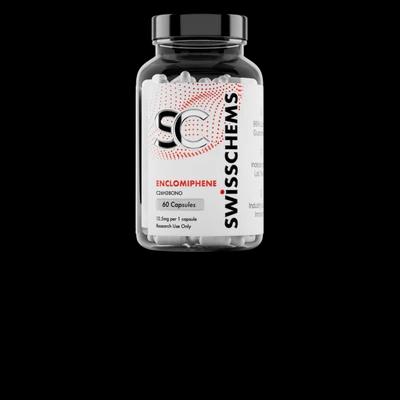
For laboratory work, Swiss Chems enclomiphene 12.5 mg capsules come 60 to a bottle with batch lab reports on the product page, and code jqrlsday takes 10% off at checkout. They are sold labelled for research use only, not for human consumption, and are not a pharmacy product; batch-testing details are on our enclomiphene for sale page. For treatment, the route is a clinician, baseline labs and a prescription.
Medical Disclaimer: Enclomiphene is not approved by the FDA or the EMA for any condition. Clomiphene citrate is FDA-approved only for ovulatory dysfunction in women, and its use in men is off-label. Research-labelled enclomiphene is sold for laboratory research use only and is not intended for human or veterinary consumption. This article is educational and is not medical advice, a dosing protocol or a recommendation for personal use. Consult a qualified healthcare professional about low testosterone, fertility or any other health concern.