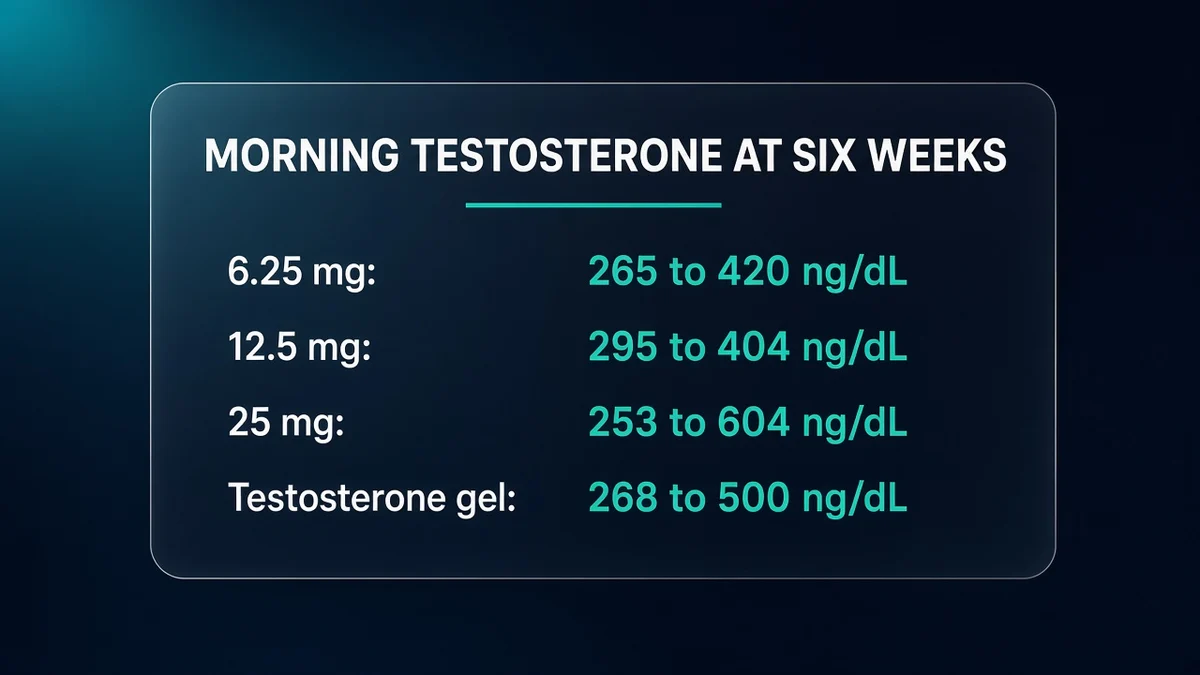
Every controlled trial of enclomiphene citrate gave it once a day by mouth, at 6.25, 12.5 or 25 mg. In the one study that tested all three side by side (six weeks, men with secondary hypogonadism), mean morning testosterone went from 265 to 420 ng/dL on 6.25 mg, 295 to 404 on 12.5 mg and 253 to 604 on 25 mg. Doubling from 12.5 to 25 mg roughly doubled LH but lifted 24-hour average testosterone far less (27%, by the authors' count), and a longer trial found the 12.5 mg arm ending higher.
This page sets out the enclomiphene dosage evidence arm by arm, the little that exists on 50 mg, the half-life data, and what published prescribers did about daily versus every-other-day use. It reports what studies gave and measured. It is not a regimen.
Key Takeaways
- In Wiehle 2013, all 12 men on 25 mg had a 24-hour average testosterone above 400 ng/dL at week 6, against 3 of 7 on 12.5 mg and 5 of 12 on 6.25 mg
- Morning LH on 25 mg reached 13.3 IU/L, about double the 6.7 seen on 12.5 mg, while testosterone rose much less than LH did
- In the 48-week ZA-205 trial, fixed doses of 12.5 and 25 mg added 174 and 237 ng/dL, against 43 ng/dL on placebo
- The only 50 mg efficacy data come from a 14-day developer study; day-14 peak drug levels were 12.09 ng/mL on 50 mg versus 10.63 on 25 mg
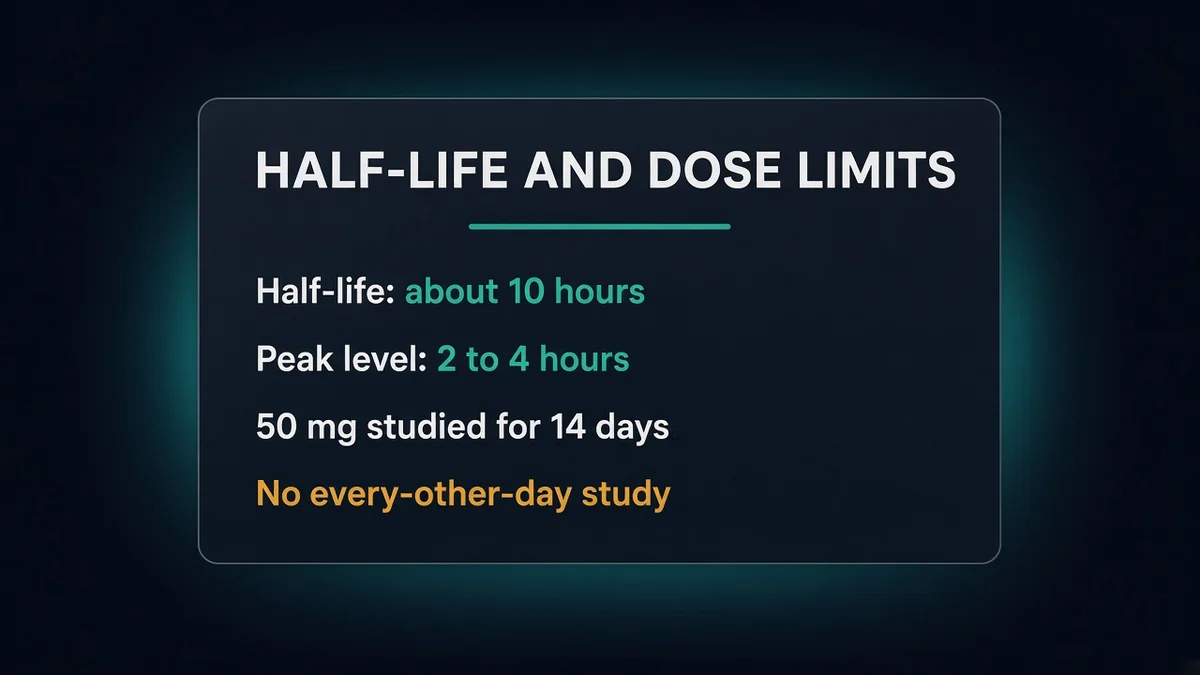
- Measured half-life ran 6.5 to 10.7 hours, with peak levels 2 to 4 hours after a dose
- No published study has tested enclomiphene every other day; every trial and prescriber series we found dosed daily
Enclomiphene dosage chart: every fixed-dose arm
Three randomized studies assigned men to one enclomiphene dose and kept them on it, which makes them the only data that isolate the effect of dose. All enrolled men with secondary hypogonadism (low testosterone with low or normal LH), most of them overweight. For how the drug works, see our guide to what enclomiphene is.
Enclomiphene dosage chart: fixed-dose trial arms, mean total testosterone and LH
| Study, length | Daily dose | Men | Testosterone, ng/dL | LH |
|---|---|---|---|---|
| Wiehle 2013, 6 weeks | 6.25 mg | 12 | 265 to 420 | 3.7 to 5.7 IU/L |
| Wiehle 2013, 6 weeks | 12.5 mg | 7 | 295 to 404 | 3.9 to 6.7 IU/L |
| Wiehle 2013, 6 weeks | 25 mg | 12 | 253 to 604 | 4.5 to 13.3 IU/L |
| Wiehle 2013, 6 weeks | Testosterone gel 5 g | 13 | 268 to 500 | 3.6 to 1.3 IU/L |
| ZA-203 (Wiehle 2014), 3 months | 12.5 mg | 73 finished, all arms | 217.2 to 471.9 | Rose (value not given) |
| ZA-203 (Wiehle 2014), 3 months | 25 mg | (see above) | 209.8 to 405.8 | 5.3 to 11.9 mIU/mL |
| ZA-203 (Wiehle 2014), 3 months | Topical testosterone | (see above) | 210 to 462.6 | 3.9 to 1.4 mIU/mL |
| ZA-205, 48 weeks | 12.5 mg | 18 | 243.6, change +173.8 | 3.93, change +2.40 mIU/mL |
| ZA-205, 48 weeks | 25 mg | 17 | 218.2, change +237.2 | 3.41, change +3.01 mIU/mL |
| ZA-205, 48 weeks | Placebo | 15 | 223.5, change +43.3 | 3.51, change +0.83 mIU/mL |
Wiehle et al., BJU International, 2013. This randomized, single-blind phase 2 study ran at two US sites in 2011. Men aged 18 to 65 with morning testosterone at or below 350 ng/dL took one capsule between 7 and 10 a.m. daily for six weeks, then stopped for a week. Blood was drawn hourly for 24 hours on day 1 and day 42, so this study says more about dose than any other.
ZA-203 (Wiehle and colleagues, 2014). A three-month phase 2b trial: 124 men enrolled, 73 finished. I could not open the full paper, so its numbers come from the 2016 review by Rodriguez, Pastuszak and Lipshultz in Expert Opinion on Pharmacotherapy. Here the lower dose ended higher.
ZA-205, completed May 2017. Repros Therapeutics, the developer, randomized 50 obese men to 12.5 mg, 25 mg or placebo for 48 weeks alongside a diet plan and a personal trainer. Results are on the ClinicalTrials.gov record, not in a journal. It is the longest fixed-dose comparison, with 15 to 18 men per arm.
Enclomiphene 12.5 mg vs 25 mg: what doubling the dose changed
Across the three studies, 25 mg beat 12.5 mg on testosterone twice (Wiehle 2013, ZA-205) and lost once (ZA-203), in arms too small to settle it. Where 25 mg pulled clearly ahead was LH, FSH and consistency.
Enclomiphene citrate 12.5 mg in the trials
At 12.5 mg in Wiehle 2013, the 24-hour average testosterone went from 280 to 426 ng/dL. The arm had just seven men in the per-protocol analysis, and the paper's arm sizes do not fully reconcile between text and tables. The authors judged that 12.5 mg added little over 6.25 mg on average but gave a more dependable response, and they took 12.5 and 25 mg forward, which is why later trials dropped 6.25 mg. On day 42, 26% of hourly samples on 12.5 mg still fell below 300 ng/dL, against 46% on 6.25 mg.
Enclomiphene citrate 25mg in the trials
At 25 mg, the 24-hour average went from 300 to 586 ng/dL, and none of 272 hourly samples on day 42 fell below 300. Two (1%) went above 1,000. The gel arm had 16.4% of samples below 300 and 6% above 1,000. FSH at week 4 was significantly higher on 25 mg than on 12.5 mg (P = 0.010).
The authors calculated that the step from 12.5 to 25 mg raised 24-hour average testosterone by only 27%, while LH roughly doubled. (The per-protocol means in their table, 426 and 586 ng/dL, imply closer to 38%; either way it is far short of double.) They read this as a limit on what the testes' Leydig cells can make, and as a sign the drug does not push testosterone above normal. Drug exposure was uneven too: the area under the curve on 25 mg was about 4.5 times that on 12.5 mg.
Men with a 24-hour average testosterone above 400 ng/dL after 6 weeks (Wiehle 2013)
ZA-205 adds an estradiol signal. Over 48 weeks, mean estradiol changed by -3.00 pg/mL on 12.5 mg, +13.03 on 25 mg and -11.46 on placebo, which fits more testosterone being available for conversion. Our enclomiphene side effects page covers what else the trials recorded.
Why the phase 3 results at 12.5 and 25 mg are not a dose comparison
The phase 3 program is often described as 12.5 mg against 25 mg, but the European Medicines Agency's assessment report for EnCyzix (EMA/88321/2018) explains that in ZA-304 and ZA-305, the trials pooled by Kim and colleagues in BJU International in 2016, every man started on 12.5 mg and moved to 25 mg at week 4 only if morning testosterone was below 450 ng/dL. In ZA-301 and ZA-302 the trigger was below 300 ng/dL at week 6. The 25 mg group in those trials is the men who responded least to 12.5 mg.
The numbers show that selection:
| Study | How dose was set | Result |
|---|---|---|
| ZA-304, 16 weeks | 12.5 mg, raised at week 4 if T below 450 | 24-hour mean T on 25 mg was 298.0 ng/dL at the end, just under normal; the 12.5 mg group was within range |
| ZA-301, 12 weeks | 12.5 mg, raised at week 6 if T below 300 | 89 of 113 men (78.8%) reached a normal 24-hour average; only 21 needed 25 mg, and 14 of them reached normal |
The EMA made the same point about safety: because men were not randomized between strengths, it found the two doses hard to compare.
The EU application carried a proposed label: 8.5 mg once daily, raised to 17 mg if testosterone stayed below 450 ng/dL after four to six weeks. Those are the same capsules expressed as enclomiphene base rather than citrate salt; by my arithmetic from the molecular weights, 12.5 mg of the citrate holds about 8.5 mg of enclomiphene. The EMA refused the application in 2018, and the FDA has not approved enclomiphene, so that label never applied anywhere.
Enclomiphene 50mg: what has and has not been studied
Compounding pharmacies list 50 mg capsules. I found one human efficacy study that gave 50 mg a day, and it lasted two weeks.
ZA-001. The EMA report and a Repros patent (US 9,161,940) describe 52 men with low or borderline-low testosterone randomized to 12.5, 25 or 50 mg of enclomiphene, placebo, or AndroGel 1% for 14 days. The EMA lists 50 mg as once daily; the patent describes 12.5 mg capsules given once, twice or four times per day, so the two sources differ on how it was taken. Testosterone rose at all three doses, by less than the increase in dose would predict, per the EMA. Peak drug levels on day 14 averaged 2.68 ng/mL on 12.5 mg, 10.63 on 25 mg and 12.09 on 50 mg, and the EMA read the flat step above 25 mg as possible saturation.
ZA-003. The patent says this six-month trial of 194 men also had a 50 mg arm, but the EMA reports results only for 12.5 and 25 mg, and I found no published 50 mg results.
Safety-only doses. Two heart-rhythm studies gave healthy men 100 mg or 250 mg daily for three days. At 100 mg the QT interval was not prolonged; at 250 mg mean QTcF prolongation peaked at 12.18 msec.
Since then. A 2026 British Society for Sexual Medicine position statement (World Journal of Men's Health) mentions 50 mg as a step after 25 mg when response falls short, without citing a 50 mg study. A 2026 Cureus case report describes a 46-year-old with a repaired mitral valve whose atrial flutter was found soon after he took 50 mg a day instead of 25 mg by mistake; the authors rated the link as only possible, given his existing heart scarring.
So for enclomiphene 50mg: two weeks of developer data, little added drug exposure above 25 mg, and no published long-term efficacy or safety data.
Enclomiphene half life and what it means for daily dosing
The usual figure is about 10 hours, from the Rodriguez review; the Repros patent gives about 10.5 hours, which is where telehealth pages get that number. The measured values vary with dose and day:
- ZA-001, day 1: 7.91 hours on 12.5 mg, 8.08 on 25 mg, 6.53 on 50 mg
- ZA-001, day 14: 9.31, 10.73 and 9.69 hours
- Wiehle 2013: the authors cited about 7 hours from an older clomiphene study rather than measuring it
Peak levels came 2 to 3 hours after a dose in Wiehle 2013; ZA-001 put the median at 4.0 hours on 12.5 mg and 2.0 hours on the higher doses. A 12-man food study found exposure was higher when the dose was taken with a meal.
Two findings explain why once daily works. The drug accumulates: exposure on day 14 of ZA-001 was 2.5 to 2.8 times day 1, and in Wiehle 2013 serum levels had not returned to baseline 24 hours after a dose. And the hormonal effect outlasts the drug. Seven days after the last dose in Wiehle 2013, testosterone and LH had not fallen significantly, and the 25 mg arm still sat above the 12.5 mg arm (P = 0.012). That fades: in a 12-man open-label study (Kaminetsky et al., Journal of Sexual Medicine, 2013), testosterone was back to pre-treatment levels a month after stopping. Our enclomiphene before and after page follows that timeline.
Clomiphene is about 62% enclomiphene and 38% zuclomiphene, per Wiehle 2013. Rodriguez gives zuclomiphene a half-life of about 30 days, and a 1986 single-dose study of clomiphene in 24 women still detected it a month later. The enclomiphene vs Clomid page compares the two. The EMA also noted that moderate or severe kidney impairment raised exposure about 2.1 to 2.5 times after a single 25 mg dose.
Daily versus every other day: what prescriber series actually did
Every controlled trial dosed daily, in the morning. Every-other-day schedules appear on clinic blogs, but as of 2026-11-29 I found no published trial or case series of enclomiphene on alternate days. The real-world series:
- University of Miami, 2023 (Thomas et al., Cureus). A chart review of 46 men on enclomiphene and 32 on clomiphene for at least three months. Enclomiphene was daily (14 men on 12.5 mg, 32 on 25 mg); clomiphene was 50 mg every other day. Median testosterone on enclomiphene went from 390 to 581 ng/dL (31 men) and estradiol from 29.5 to 67 pg/mL (18 men), not split by dose.
- Baylor, 2024 (Saffati et al., Translational Andrology and Urology). 66 men switched from clomiphene to enclomiphene. Doses were not reported.
- A 2026 Cureus series (Warren) of 15 men on a compounded sublingual liquid with 25 mg enclomiphene plus boron, vitamin C and spermidine. Mean testosterone rose from 347 to 805 ng/dL at 60 days, with no control group and no LH data.
The only academic source for intermittent use is a line in Wiehle 2013: the week-long persistence "could lead to an eventual intermittent dosing regimen." Nobody has published a test. And 25 mg every other day is not 12.5 mg daily in disguise: the weekly milligrams match, but given the uneven exposure between those doses, blood levels would not.
How published prescribers describe choosing a dose
The literature leaves dose to a clinician working from blood tests. The BSSM statement describes adjusting the dose in steps according to response, a scheme that no trial has tested, and the same statement says the evidence rests on small, short studies, that the society does not recommend routine use outside specialist settings, and that prescribing should ideally sit within research frameworks.
What the trials did support is how to measure response. In Wiehle 2013, a single morning testosterone tracked the 24-hour average closely on enclomiphene (correlation 0.93 on 25 mg, slope near 1), far better than on gel (0.56).
Labs that trial protocols and reviews describe monitoring, as information:
- Morning total and free testosterone
- LH and FSH, which separate secondary from primary hypogonadism
- Estradiol
- Hematocrit (the phase 3 trials excluded men above 54%)
- Semen analysis where fertility matters
Who the evidence covers is set out on our enclomiphene for low testosterone page.
Frequently Asked Questions
What is the usual enclomiphene dosage in studies?
Controlled trials gave 6.25, 12.5 or 25 mg once daily in the morning. The phase 3 trials started everyone at 12.5 mg and moved poor responders to 25 mg after four to six weeks. A 2023 Miami chart review found clinicians prescribing 12.5 or 25 mg daily.
Is enclomiphene 25 mg better than 12.5 mg?
For LH and FSH, yes: 25 mg roughly doubled the LH rise in Wiehle 2013. For testosterone it is mixed. 25 mg ended higher in Wiehle 2013 (604 versus 404 ng/dL) and ZA-205 (+237 versus +174), but lower in ZA-203 (405.8 versus 471.9). Estradiol rose on 25 mg in ZA-205 and not on 12.5 mg.
Has anyone studied enclomiphene 50 mg?
Only for two weeks. The developer's ZA-001 study gave 50 mg daily for 14 days, and peak drug levels were barely higher than on 25 mg. A six-month trial reportedly had a 50 mg arm, but those results were never published.
What is the half-life of enclomiphene?
About 10 hours. Measured values in the developer's 14-day study ranged from 6.53 to 10.73 hours depending on dose and day, with peak levels 2 to 4 hours after a dose. Zuclomiphene, the other half of clomiphene, lasts about 30 days.
Can enclomiphene be taken every other day?
No published study has tested it. All trials dosed daily, and the Miami series used every-other-day dosing only for clomiphene. The 2013 trial authors floated intermittent dosing as an idea because testosterone held for a week after stopping, but it remains untested.
Where dose decisions actually get made
Trials used 12.5 or 25 mg daily, 25 mg pushed LH much harder than testosterone, and nothing above 25 mg has been studied for more than two weeks. Choosing a strength is a clinician's call made from repeat morning testosterone, LH, FSH and estradiol. Our page on getting an enclomiphene prescription online explains how that route works through telehealth and compounding pharmacies. If you are comparing sources, price and batch-testing details are on our enclomiphene for sale page.
Medical Disclaimer: Enclomiphene citrate is not approved by the FDA or the EMA for any condition. This article summarizes the doses given in published studies for education only. It is not medical advice, a dosing recommendation or a treatment protocol, and the right dose, if any, can only be set by a qualified clinician using your own laboratory results. Research-labelled enclomiphene is not intended for human or veterinary use. Speak with a healthcare professional before starting, changing or stopping any treatment.