In the trials, the enclomiphene before and after picture shows up in blood work first. LH roughly doubled within two weeks (4.82 to 8.60 mIU/mL on 12.5 mg in one phase 2 study), testosterone rose significantly by week 2 and averaged above 400 ng/dL by week 4, and it did not climb further between weeks 4 and 6. By week 12, 78.8% and 81.3% of men in two phase 3 trials had a 24-hour average testosterone in the normal range. Within about a month of stopping, testosterone fell back toward where it started.
This page follows the trial data in time order, from the first blood test to a month after the last dose, then covers what no trial measured, including anything a photo would show.
Key Takeaways
- In the ZA-204 trial, morning LH on 12.5 mg went from 4.82 to 8.60 mIU/mL after 2 weeks; on testosterone gel it fell from 3.57 to 2.00
- Testosterone had risen significantly by week 2 in every arm and averaged above 400 ng/dL by week 4, with no significant change from week 4 to week 6
- At 12 weeks, 78.8% (ZA-301) and 81.3% (ZA-302) of enclomiphene-treated men had a 24-hour average testosterone of 300 to 1,040 ng/dL, so about one in five did not
- In two 16-week phase 3 trials, sperm concentration went from 98.3 to 102.9 and from 79.0 to 88.6 million/mL on enclomiphene, against 78.9 to 32.7 and 75.1 to 44.0 on testosterone gel
- Seven days after the last dose, testosterone and LH had not fallen significantly; one month after stopping, testosterone was back to pretreatment levels in a small phase 2b study
- No enclomiphene trial measured symptoms with validated questionnaires, and the only 48-week body composition trial found no lean-mass gain beyond placebo
How the trials measured "before" and "after"
Every number here comes from men with secondary hypogonadism: repeatedly low morning testosterone (below 300 or 350 ng/dL, depending on the study) with LH that was low or normal. Most were overweight, and men with high LH were screened out. Our explainer on what enclomiphene is covers why that matters.
"Before" was usually two morning testosterone readings taken days apart. "After" was a morning reading, and in some trials a 24-hour average from blood drawn across a full day. The developer, Repros Therapeutics, ran almost all of these studies, and several are known mainly from ClinicalTrials.gov results and the European Medicines Agency's review rather than full papers.
One finding from the 2013 phase 2 study by Wiehle and colleagues in BJU International helps when reading any before-and-after lab report. After six weeks on 25 mg, a single morning testosterone value tracked the 24-hour average closely (correlation 0.93). On testosterone gel the correlation was only 0.56. A morning draw on enclomiphene is a fair snapshot of the whole day; on gel it is not.
Weeks 0 to 2: how long enclomiphene takes to work on blood tests
People who search "enclomiphene how long to work" want a number of days or weeks. In the 2013 study the drug peaked in blood 2 to 3 hours after a dose and had not returned to baseline 24 hours later. The 2016 review by Rodriguez, Pastuszak and Lipshultz gives a half-life of about 10 hours; the 2013 paper cites roughly 7 hours from older clomiphene data. Either way it clears within a day or two, unlike zuclomiphene, the other clomiphene isomer, at around 30 days.
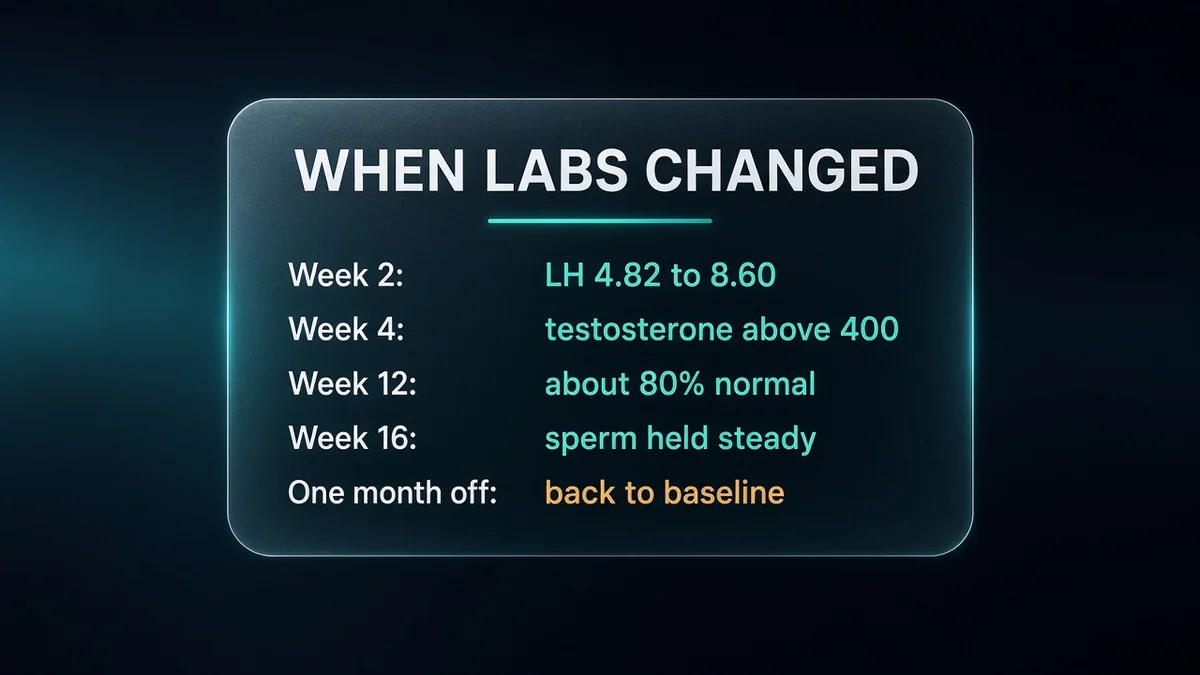
The hormone response is slower than the drug. The registry record for the same phase 2 trial (ZA-204 on ClinicalTrials.gov) reports morning LH at weeks 2, 4 and 6:
| Morning LH (mIU/mL) | Start | Week 2 | Week 4 | Week 6 |
|---|---|---|---|---|
| Enclomiphene 6.25 mg (n=15) | 3.63 | 5.49 | 6.92 | 6.1 |
| Enclomiphene 12.5 mg (n=13) | 4.82 | 8.60 | 7.20 | 8.2 |
| Enclomiphene 25 mg (n=16) | 4.98 | 9.64 | 11.78 | 14.5 |
| Testosterone gel 5 g (n=14) | 3.57 | 2.00 | 1.88 | 2.2 |
FSH followed the same pattern, rising from 6.31 to 11.41 mIU/mL by week 2 on 25 mg and falling from 6.38 to 3.80 on gel. Testosterone had risen significantly in all groups by week 2, with the 25 mg and gel arms ahead of 6.25 mg; the paper graphs those values without listing them, so I have not quoted numbers.
So the earliest measured time point, two weeks, already showed the change, and not only at the higher dose: on 12.5 mg, LH had nearly doubled by the first visit. No study reports values between the first dose and day 14, so how fast the change builds inside those two weeks is unknown.
Weeks 4 to 6: the plateau
The authors of the 2013 study defined a steady state as mean testosterone above 400 ng/dL and reported reaching it after four weeks on both enclomiphene and gel. There were no significant changes in testosterone or LH between weeks 2 and 4, or between weeks 4 and 6, in any group.
At day 42, mean morning testosterone (per-protocol) had gone from 265 to 420 ng/dL on 6.25 mg (12 men), 295 to 404 on 12.5 mg (7 men), and 253 to 604 on 25 mg (12 men), against 268 to 500 on gel (13 men). Every man on 12.5 or 25 mg had some increase, but not every man reached a target: in the 12.5 mg arm, 5 of 7 had a 24-hour average above 300 ng/dL, while all 12 on 25 mg did. Arm-by-arm comparisons are on our enclomiphene for low testosterone page, and dose questions on our enclomiphene dosage page.
Enclomiphene timeline: what the trials measured, and when
| When | What the data show | Study |
|---|---|---|
| 2 to 3 hours | Peak drug level in blood; not back to baseline at 24 hours | Wiehle 2013 (ZA-204) |
| Week 2 | Testosterone up significantly in all arms; LH 4.82 to 8.60 mIU/mL on 12.5 mg | Wiehle 2013 (ZA-204) |
| Week 4 to 6 | Mean testosterone above 400 ng/dL; no significant change from week 4 to 6 | Wiehle 2013 (ZA-204) |
| 1 week off | Testosterone and LH had not fallen significantly | Wiehle 2013 (ZA-204) |
| Week 12 | About 4 in 5 men with a normal 24-hour average testosterone | ZA-301, ZA-302 (phase 3) |
| Week 16 | Sperm concentration held; on gel it fell by 33% to 57% on average | ZA-304, ZA-305 (phase 3) |
| Week 26 to 48 | Testosterone still raised; no lean-mass gain beyond placebo at 48 weeks | ZA-300, ZA-205 |
| 1 month off | Testosterone back to pretreatment levels; LH and FSH back near baseline | Kaminetsky 2013 (ZA-201), ZA-301 extension |
Enclomiphene results at 12 and 16 weeks
Three months, phase 2b. The ZA-203 trial, published by Wiehle and colleagues in Fertility and Sterility in 2014, randomized 124 men to placebo, testosterone gel or enclomiphene 12.5 or 25 mg; 73 finished. Per the Rodriguez review, testosterone went from 217.2 to 471.9 ng/dL on 12.5 mg, 209.8 to 405.8 on 25 mg and 210 to 462.6 on gel. The registry adds the placebo arm, which changed by -16.9 ng/dL: low testosterone did not drift up on its own over three months.
Twelve weeks, phase 3. In ZA-301 and ZA-302, men started on 12.5 mg and were moved to 25 mg at week 6 if their morning testosterone was still under 300 ng/dL. At week 12, 89 of 113 enclomiphene-treated men (78.8%) in ZA-301 and 81.3% of 134 in ZA-302 had a 24-hour average between 300 and 1,040 ng/dL. Roughly one man in five did not, even with the option of a higher dose.
Sixteen weeks, phase 3. ZA-304 and ZA-305, published by Kim and colleagues in BJU International in 2016, added testosterone gel 1.62% and placebo arms. Men moved up to 25 mg at week 4 if morning testosterone was below 450 ng/dL. The EMA's assessment report gives the share with normal testosterone at the end: 63.4% on enclomiphene against 44.2% on gel in ZA-304, and 68.2% against 52.4% in ZA-305. On the combined goal of normal testosterone plus a sperm concentration of at least 10 million/mL, enclomiphene succeeded in 61.0% and 65.9% of men, gel in 16.3% in both trials, and placebo in 4.4% and 7.3%.
One detail tempers this. In ZA-304, the men who needed the step up to 25 mg ended with a mean 24-hour testosterone of 298.0 ng/dL, just under 300. A weak response in the first month tended to stay weak.
Mean morning testosterone before and after, by length of treatment (ng/dL)
Before After
Six months to a year: does the effect hold?
The largest dataset is ZA-300, an open-label study of 499 overweight men who started on 12.5 mg and moved to 25 mg at week 6 or 16 if morning testosterone was below 450 ng/dL. The EMA reports mean testosterone in the normal range from week 6 through week 26. The 216 men who never needed the higher dose went from 225 to 484 ng/dL; the 283 who were moved up went from 201 to 406.
ZA-205, a 48-week placebo-controlled trial in 50 obese men who also dieted and trained with a personal trainer, ended with mean gains of 174 ng/dL on 12.5 mg and 237 on 25 mg, against 43 on placebo. The change in LH at 48 weeks was no longer significantly different from placebo (P = 0.30 and 0.27), though testosterone still was.
Long-term data are thin. The EMA counted 1,403 men dosed across the program; 482 took the drug for more than six months and only 116 for twelve months or longer. In clinic use, the 2024 Baylor retrospective by Saffati and colleagues followed 66 men for a median of 8.9 months on enclomiphene after they switched from clomiphene. Median testosterone was 436 ng/dL before the switch and 499 after, with estradiol essentially flat (30 and 29 pg/mL).
Sperm counts before and after enclomiphene
Here the contrast with testosterone therapy is sharpest, because sperm production depends on FSH and testosterone made inside the testes, and gel suppresses both.
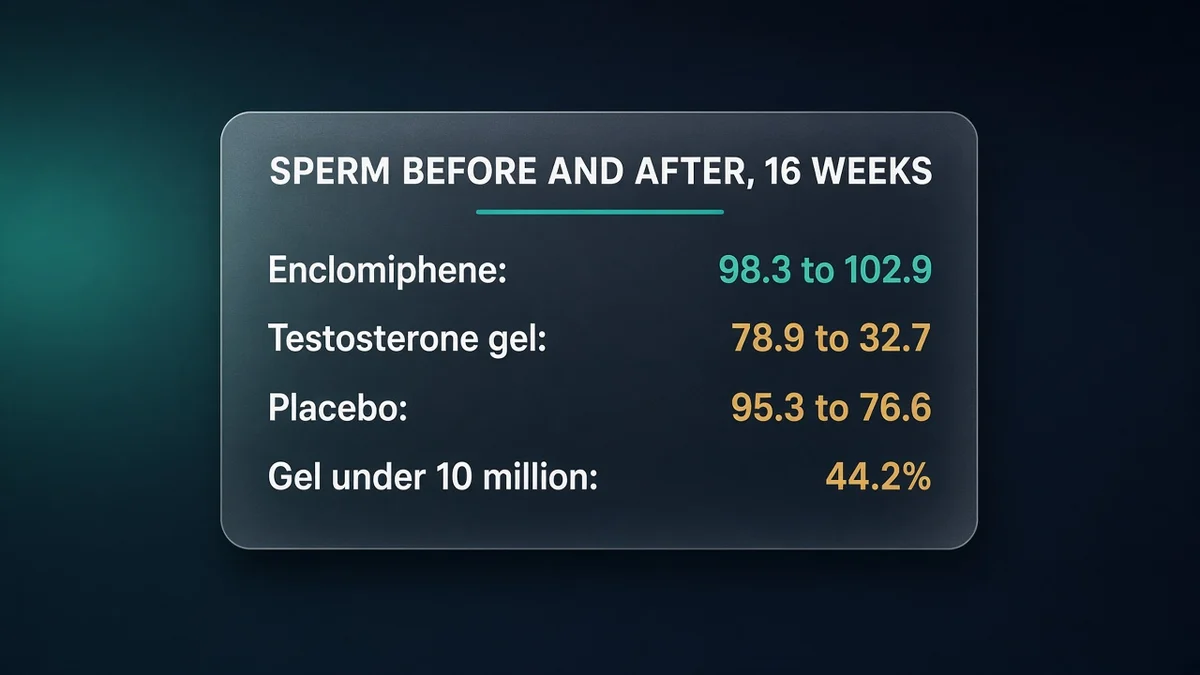
| Study, length | Enclomiphene: before to after | Testosterone gel: before to after | Placebo: before to after |
|---|---|---|---|
| ZA-304, 16 weeks | 98.3 to 102.9 million/mL | 78.9 to 32.7 | 95.3 to 76.6 |
| ZA-305, 16 weeks | 79.0 to 88.6 | 75.1 to 44.0 | 80.5 to 72.9 |
| ZA-201, 6 months, then 1 month off | 72.8, then 182.6 at 3 months, 168.5 at 6 months, 164.0 one month off | 0.54, then 3.00, 23.14, 21.03 | none |
At the end of ZA-304, 44.2% of men on gel had a sperm concentration below 10 million/mL, against one man (2.4%) on enclomiphene. In ZA-305 the figures were 23.8% and 2.3%. The ZA-201 row comes from the registry entry for the open-label study published by Kaminetsky and colleagues in 2013; its groups had only 5 and 6 men and very different starting counts, so compare each group with itself.
The data are not all reassuring. In the 12-week ZA-301 and ZA-302 trials, 14.2% of enclomiphene-treated men had their sperm concentration fall by half or more, against 2.6% and 4.3% on placebo. The EMA accepted ZA-301 as showing non-inferiority to placebo in the full analysis but noted it failed that test in the per-protocol group. Only a semen analysis before and after shows what happened in a given man.
After stopping: what the washout data show
- One week off (Wiehle 2013). Seven days after stopping, testosterone in the enclomiphene arms had not changed significantly, and LH stayed above baseline. Men on 25 mg were higher than men on 12.5 mg (P = 0.012), and the 12.5 mg arm was higher than the gel arm (P = 0.003). LH on gel climbed back to about its starting level that week.
- One month off (Kaminetsky 2013). In men treated for six months, testosterone fell back to pretreatment values one month after treatment ended. The registry shows LH in the enclomiphene group at 2.47 mIU/mL a month after stopping, against 2.92 at the start and 6.12 at month 6. Sperm concentration was still 164.0 million/mL.
- One month off (ZA-301 extension). After six more months of treatment, testosterone a month after stopping was significantly lower than at the extension's start, and below the normal range in men who had needed 25 mg.
The effect outlasts the drug by days, not weeks. That fits a drug that turns up the pituitary signal while it is present rather than correcting whatever lowered it in the first place.
What did not change, or was never measured
As of the 2016 Rodriguez review, not one enclomiphene trial had scored symptoms or quality of life on a validated questionnaire, and I could not find a controlled study since then that did. The trials describe lab results, not whether libido, energy, mood or sleep changed.
Some things were measured and did not improve:
- Lean mass and strength. ZA-205, a 48-week trial run alongside diet and exercise, was the only one to measure this. Both enclomiphene arms gained somewhat more lean mass than placebo, but the gap was not statistically significant in either, and strength gains did not separate. The numbers are on our enclomiphene for low testosterone page.
- IGF-1. In the 2013 study it fell on enclomiphene, from 94 to 50 µg/L on 12.5 mg, more than on gel.
The Baylor retrospective recorded fewer low-libido complaints after the switch (8.6% against 33.3% on clomiphene), but that counts side effects charted by doctors, not improvement. Hematocrit, estradiol and the rare clot signal are covered on our enclomiphene side effects page.
What enclomiphene before and after photos can and cannot show
Search results for "enclomiphene citrate before and after" are full of photos. No trial took any. A photo shows weight, muscle definition, lighting and posture, and the ZA-205 placebo group shows how much diet and training alone can change a body: those men lost 14.51 kg, against 4.36 and 6.15 kg on enclomiphene. Testosterone cannot be seen in a photo.
Nor does a photo show what else changed: training, calories, other compounds, or what was really in an unregulated capsule. And a 2018 EMA table offers a caution about placebo: in a one-year extension of an early trial, 10 of 13 placebo completers (76.9%) had testosterone in the normal range, a higher share than on enclomiphene 12.5 mg (8 of 11). Small groups of completers produce striking numbers in either direction.
The before-and-after that means something is a pair of lab reports drawn the same way, in the morning. Themes from user threads, checked against the trials, are on our enclomiphene Reddit page.
Frequently Asked Questions
How long does enclomiphene take to work?
In the trials, LH and testosterone had already risen at the first visit, two weeks in. Mean testosterone passed 400 ng/dL by week 4 in the 2013 phase 2 study and did not rise significantly after that. When symptoms change, if they do, has not been measured.
What are typical enclomiphene results after 3 months?
In the three-month phase 2b trial, mean testosterone went from 217.2 to 471.9 ng/dL on 12.5 mg and from 209.8 to 405.8 on 25 mg. In two 12-week phase 3 trials, 78.8% and 81.3% of men reached a normal 24-hour average.
Does enclomiphene keep working after 6 months?
In the 499-man ZA-300 study, mean testosterone stayed in the normal range from week 6 to week 26, and at 48 weeks in ZA-205 it was still 174 to 237 ng/dL above baseline. Only 116 men in the program took it for a year or more.
What happens to testosterone when you stop enclomiphene?
It held for about a week, then fell. One month after stopping, testosterone was back at pretreatment levels in the Kaminetsky study, and LH was near its starting value.
Does enclomiphene affect sperm count?
On average it preserved sperm concentration in the 16-week phase 3 trials, while gel cut mean counts by 32.8% and 56.6%. Individual results varied: in the 12-week trials, 14.2% of men saw a drop of half or more.
Can you see enclomiphene results in before and after photos?
Not reliably. No trial used photos, and the only 48-week body composition trial found no lean-mass gain beyond placebo. Visible changes usually reflect diet, training and weight.
Reading your own numbers, and where the capsules fit
The labs the trials relied on are two morning testosterone readings and LH before treatment, then morning testosterone with LH, FSH, estradiol and hematocrit afterwards, plus a semen analysis where fertility matters. A clinician ordering those tests is the route the evidence supports; our page on getting an enclomiphene prescription online explains how telehealth services and compounding pharmacies handle it.
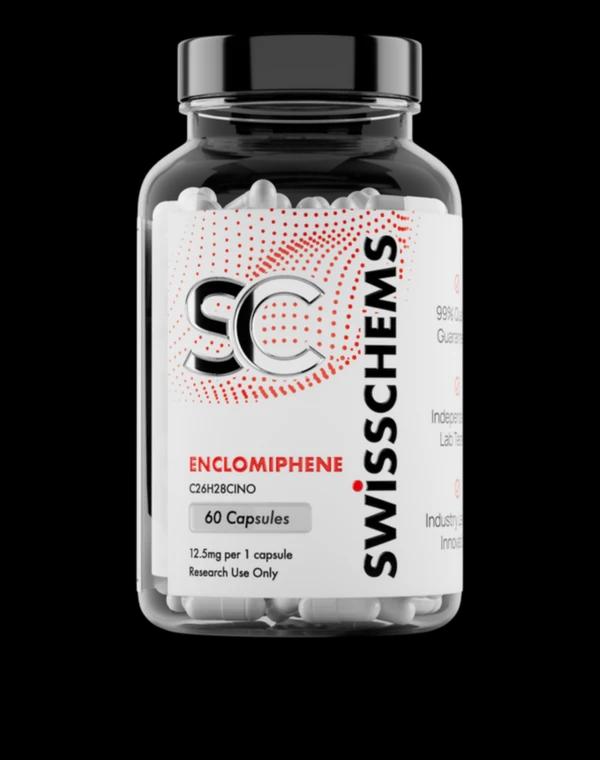
Enclomiphene is also sold outside pharmacies, for example as Swiss Chems enclomiphene 12.5 mg capsules. They are labelled for research use only, not for human consumption, and they are not a pharmacy product, so no prescriber, lab order or follow-up comes with them. The code jqrlsday takes 10% off at checkout. Batch testing and what the seller's lab reports do and do not prove are covered on our enclomiphene for sale page.
Medical Disclaimer: Enclomiphene citrate is not approved by the FDA or the EMA for any condition. Research-labelled enclomiphene is not intended for human or veterinary consumption. This article summarizes published trial data for education only and is not medical advice, a dosing protocol or a recommendation for personal use. Lab changes reported in trials may not match an individual's results, so talk with a qualified healthcare professional before starting, stopping or changing any treatment.