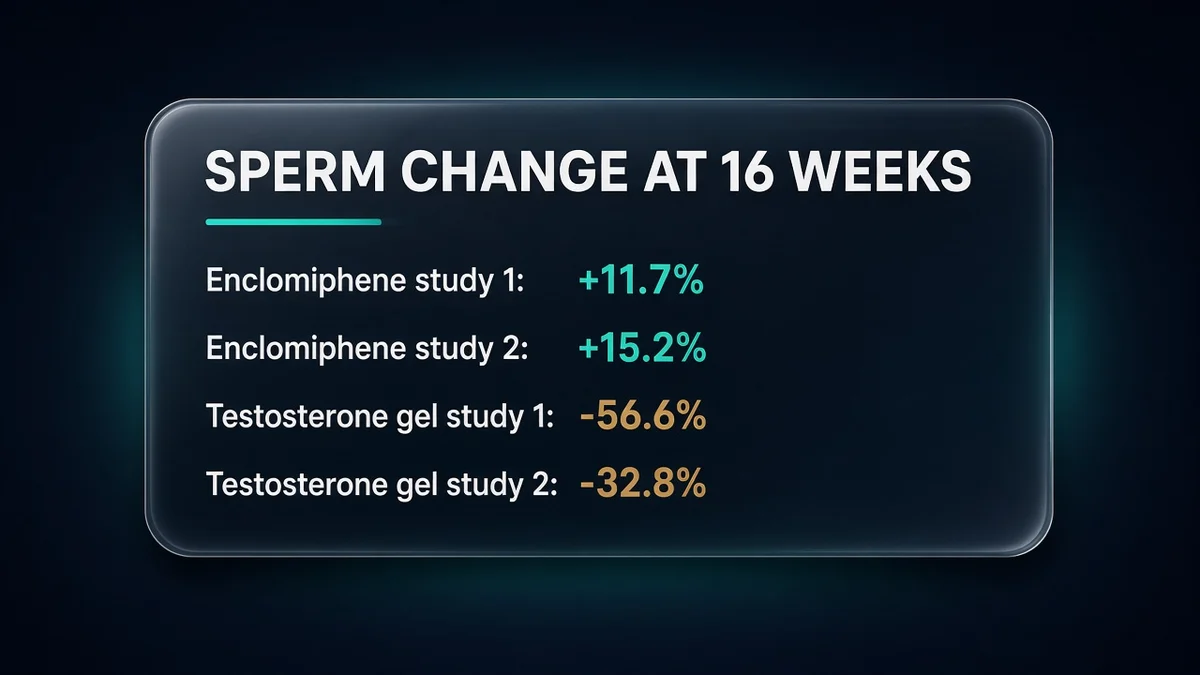
Enclomiphene is the trans isomer of clomiphene, an oral drug that blocks estrogen receptors in the hypothalamus and pituitary so that the body releases more LH and FSH and makes more of its own testosterone. In a 2013 phase 2 trial, the 25 mg arm went from a mean morning testosterone of 253 to 604 ng/dL in six weeks, and in two pooled phase 3 trials sperm concentration rose 11.7% and 15.2% on enclomiphene while it fell 56.6% and 32.8% on testosterone gel. It is not FDA-approved for any use; in the US it reaches men as a compounded prescription.
This page is the starting point for our enclomiphene series. It explains what the molecule is, how it differs from the other half of clomiphene, which men it is used for, what the trials measured, what they never measured, and where it stands with regulators. Each subtopic gets a short treatment here and a link to the page that covers it in depth.
Key Takeaways
- Clomiphene is a mixture of two isomers. The 2013 Wiehle paper describes it as 62% enclomiphene and 38% zuclomiphene, while the FDA Clomid label allows 30% to 50% zuclomiphene
- Enclomiphene has a half-life of about 10 hours; zuclomiphene, the estrogen-like isomer, stays detectable for more than a month after a single dose
- In Wiehle 2013, 24-hour mean LH rose from 4.9 to 13.1 IU/L on 25 mg enclomiphene and fell from 3.7 to 1.5 IU/L on testosterone gel over six weeks
- A 2024 Baylor retrospective of 66 men found any adverse event in 13.8% on enclomiphene versus 47% on clomiphene, though every man took clomiphene first
- FDA sent a Complete Response Letter in late 2015, the EMA refused it in April 2018, and FDA's compounding list still placed it in Category 1 on May 14, 2026
- A 2026 British Society of Sexual Medicine position statement does not recommend routine use outside specialist settings
What is enclomiphene citrate?
Enclomiphene citrate is the citrate salt of enclomiphene, a nonsteroidal selective estrogen receptor modulator (SERM) from the triphenylethylene family, the same chemical group as clomiphene and tamoxifen. It is not a hormone, not a steroid and not a form of testosterone. It does nothing to the testes directly. It works one level up, by changing what the brain thinks the estrogen level is.
Clomiphene citrate, sold as Clomid, was approved in 1967 to induce ovulation in women, and urologists began using it off label in men because it raised both testosterone and sperm counts. Clomiphene, though, is two geometric isomers: the same atoms, arranged differently around one double bond, with different effects. Repros Therapeutics, a Texas company, isolated the trans form, enclomiphene, and took it through phase 2 and phase 3 trials as a treatment for men, under the proposed US brand Androxal and the European name EnCyzix. Neither was approved, and the full regulatory record is on our page asking is enclomiphene FDA approved.
So the practical answer to "what is enclomiphene" is this: the half of clomiphene that does the work men want, without the half suspected of causing many of the side effects, and with a much thinner evidence base than either clomiphene or testosterone. That is the frame for everything written about enclomiphene citrate for men.
How enclomiphene works on the HPG axis
Testosterone production runs on the hypothalamic-pituitary-gonadal (HPG) axis. The hypothalamus releases GnRH, which tells the pituitary to release luteinizing hormone (LH), the signal for the testes to make testosterone, and follicle-stimulating hormone (FSH), which supports sperm production. Some testosterone is converted to estradiol, and estradiol acting in the hypothalamus and pituitary tells the system to ease off.
Enclomiphene blocks those estrogen receptors. The brain reads the block as low estrogen, so more GnRH, LH and FSH follow, and the testes make more testosterone while continuing to make sperm. A 2016 review by Rodriguez, Pastuszak and Lipshultz (Expert Opinion on Pharmacotherapy) describes it as competing with estrogen for receptor binding, which limits the feedback that suppresses gonadotropins.
Testosterone therapy does the opposite. Gel or injections add testosterone from outside, LH and FSH fall, and the testosterone inside the testes that sperm production depends on falls with them. That difference is why enclomiphene exists as a separate drug.
The 2013 phase 2 study by Wiehle and colleagues (BJU International) shows it in the numbers. Over six weeks, 24-hour mean LH went from 3.6 to 6.9 IU/L on 12.5 mg and from 4.9 to 13.1 IU/L on 25 mg, while on 5 g of testosterone gel it fell from 3.7 to 1.5 IU/L. The authors wrote that enclomiphene raised LH and FSH above the normal range, while testosterone itself landed inside it.
Two pharmacokinetic details matter. Blood levels of the drug peaked 2 to 3 hours after a dose and had not returned to baseline by 24 hours, and the Rodriguez review gives a half-life of about 10 hours. Yet the hormone effect outlasted the drug: seven days after the last dose, testosterone in the enclomiphene arms had not fallen significantly. The enclomiphene dosage page sets out what each trial arm did.
Enclomiphene vs zuclomiphene: the two halves of clomiphene
Clomiphene contains a cis isomer, zuclomiphene, and a trans isomer, enclomiphene. The proportions are usually quoted as 62% and 38%, which is the figure the Wiehle paper gives. The FDA Clomid label is looser: it describes a mixture containing between 30% and 50% of the cis isomer.
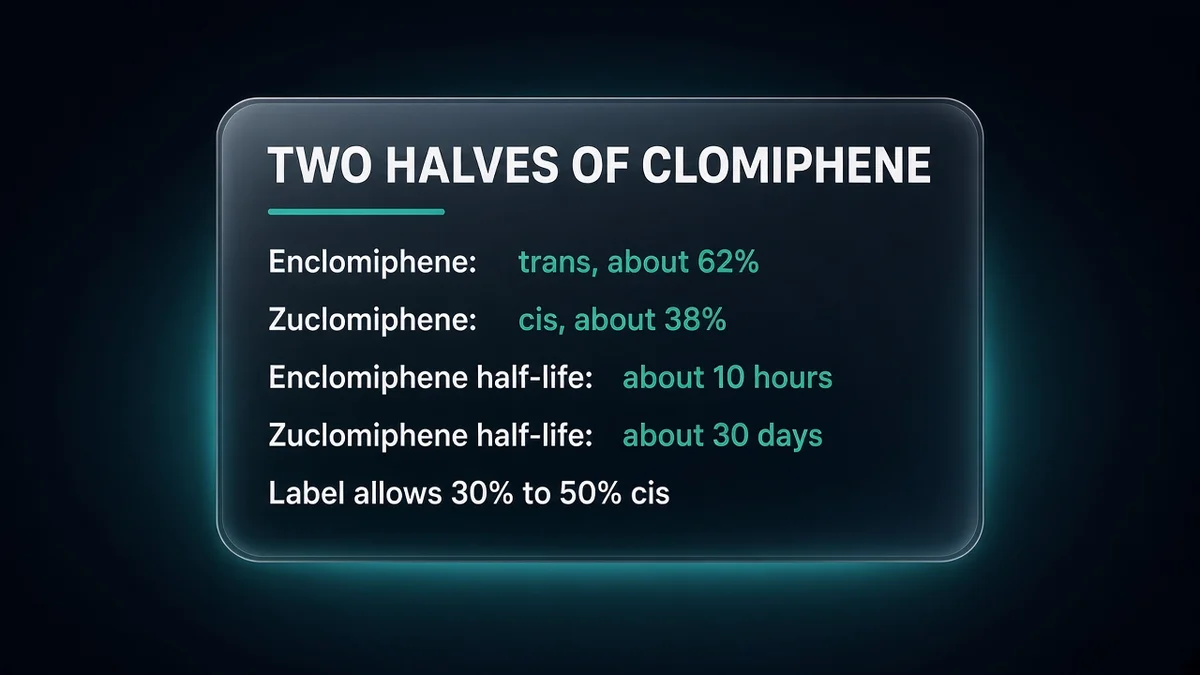
The two isomers do not act alike. Enclomiphene is the antagonist that lifts LH and FSH. Zuclomiphene behaves more like an estrogen, and the Clomid label notes that some data suggest it has greater estrogenic activity. It also lingers. In single-dose studies cited on the label, zuclomiphene stayed detectable for longer than a month, and the Rodriguez review puts its half-life at about 30 days. Taken daily, it builds up.
Enclomiphene, zuclomiphene and clomiphene compared
| Enclomiphene | Zuclomiphene | Clomiphene (Clomid) | |
|---|---|---|---|
| Isomer | Trans | Cis | Mixture of both |
| Share of clomiphene | About 62% (Wiehle); 50% to 70% by the label range | About 38% (Wiehle); 30% to 50% on the label | 100% |
| Action at the estrogen receptor | Antagonist; raises LH and FSH | Behaves more like an estrogen | Net antagonist with an estrogenic share |
| Persistence | Half-life about 10 hours | About 30 days; detectable over a month | Zuclomiphene share accumulates |
| Baboon testosterone, 12 days | 170 to 1,144 ng/dL | No significant rise | 170 to 559 ng/dL |
| US status | Not approved; compounded on prescription | Not developed as a drug | Approved 1967 for women; off label in men |
The Repros baboon study in the table gave the first hint that the isomers split the work. It was an animal study and found no significant LH or FSH rise, so it is a pointer rather than proof.
In men, the best comparison is the 2024 Baylor retrospective by Saffati and colleagues (Translational Andrology and Urology). It followed 66 men who took clomiphene for a median 18.7 months and then switched to enclomiphene. Median testosterone rose 98 ng/dL on clomiphene and 166 ng/dL on enclomiphene, a difference that was not significant (P = 0.20). Median estradiol rose 17.5 pg/mL on clomiphene and fell 5.92 pg/mL on enclomiphene (P = 0.001). The full comparison, and what this design cannot prove, is on our enclomiphene vs Clomid page.
Enclomiphene uses: which men it is prescribed for
Enclomiphene for men is used in four overlapping situations. All of them depend on the same condition: a pituitary that can still respond and testes that can still produce.
Secondary hypogonadism
This is the use the drug was developed for: testosterone is low because the brain's signal is weak, and LH is low or inappropriately normal, often alongside obesity or type 2 diabetes. Every trial enrolled this group: Wiehle 2013 required two morning testosterone readings below 350 ng/dL and LH under 12 IU/L, and the phase 3 trials required testosterone at or below 300 ng/dL and LH under 9.4 IU/L. The trial-by-trial testosterone gains are covered on our enclomiphene for low testosterone page.
Keeping fertility while treating low testosterone
For a man who wants children, testosterone therapy is a poor fit because it suppresses sperm production. Enclomiphene raises FSH along with LH, and sperm concentration held up in the trials. hCG, the other common approach, mimics LH but does not raise FSH; our hCG guide explains how it works.
An alternative to testosterone therapy
A 2026 British Society of Sexual Medicine (BSSM) position statement lists needle aversion, intolerance of topical products and a wish for future fertility as the situations where enclomiphene may suit. The direct comparison with testosterone is on enclomiphene vs TRT. Some clinics also add a SERM to ongoing testosterone, which is a different question with much less data.
Coming off testosterone or anabolic steroids
The only enclomiphene trial in men leaving testosterone therapy is the small phase 2b study by Kaminetsky and colleagues (Journal of Sexual Medicine, 2013). Twelve men stopped topical testosterone, fell to an average morning testosterone of 165 ng/dL, and were randomized to gel or enclomiphene. For recovery after anabolic steroid use, I found no enclomiphene trial at all. A 2014 Fertility and Sterility review of steroid-induced hypogonadism by Rahnema and colleagues set out to be a meta-analysis and found no studies of sufficient quality to include.
Who enclomiphene therapy does not fit
Men with primary hypogonadism, where the testes themselves are failing and LH is already high, were screened out of every trial, so there is no evidence that more LH helps them. The Wiehle paper also states that enclomiphene is not proposed for secondary hypogonadism caused by pituitary tumours, craniopharyngioma, haemochromatosis or congenital GnRH deficiency. Those causes need their own work-up, which is one reason a clinician measures LH and FSH before treating.
What the enclomiphene trials showed
The human evidence is a handful of small, developer-funded trials plus retrospective clinic series. Values below are group means unless marked.
| Study | Design and men | Length | Headline result |
|---|---|---|---|
| Wiehle 2013, BJU Int | Phase 2, single-blind; 44 per protocol | 6 weeks | Morning T 253 to 604 ng/dL on 25 mg; 268 to 500 on gel |
| Kaminetsky 2013, J Sex Med | Phase 2b, open label; 12 men off gel | 6 months | T 525 ng/dL on enclomiphene, 545 on gel; sperm kept up only on enclomiphene |
| Wiehle 2014, Fertil Steril | Phase 2b; 124 enrolled, 73 finished | 3 months | T 217 to 472 ng/dL on 12.5 mg; 210 to 406 on 25 mg |
| Kim 2016, BJU Int | Two phase 3 RCTs; 265 overweight men | 16 weeks | T restored to normal range, LH and FSH up; sperm held on enclomiphene, fell on gel |
| Saffati 2024, Transl Androl Urol | Retrospective switch; 66 men | Median 8.9 months | Median T +166 ng/dL; estradiol -5.92 pg/mL |
Wiehle 2014 values and the phase 3 sperm figures (Kim et al., BJU International 2016) come from the Rodriguez review's tables, because both papers are paywalled and the Kim abstract gives no per-arm testosterone values.
Two patterns stand out. A higher dose did not reliably mean higher testosterone: 25 mg ended highest in 2013, but 12.5 mg ended above 25 mg in 2014. And enclomiphene arms mostly landed between about 400 and 600 ng/dL, with the 2013 25 mg result not significantly different from gel (P = 0.23).
Change in sperm concentration over 16 weeks, phase 3 trials ZA-304 and ZA-305
Kaminetsky's small study points the same way. Enclomiphene raised sperm counts in seven of seven men at 3 months and six of six at 6 months, with concentrations in the 75 to 334 million/mL range, while gel failed to lift counts above 20 million/mL in any of its five men at 3 months. (The abstract prints testosterone in pg/dL, which reads as a typo for ng/dL.)
A 2025 meta-analysis of 10 randomized trials by Hohl and colleagues (Archives of Endocrinology and Metabolism) pooled clomiphene and enclomiphene together and found total testosterone 273.76 ng/dL higher than placebo, with no significant testosterone difference against gel. That pooling means it is not an enclomiphene-only estimate. For week-by-week timing, see enclomiphene before and after.
What enclomiphene treatment has not shown
The trials above measured blood and semen numbers, not symptoms. Rodriguez and colleagues wrote in 2016 that the drug's effect on hypogonadal symptoms remained unknown, which limited their ability to recommend it, and I found no controlled trial since that measured libido, energy or mood with a validated tool.
Regulators made the same point: FDA's 2015 letter said the phase 3 design could no longer show clinical benefit, and the EMA declined to accept testosterone alone as evidence that men were better off.
The effect also fades after stopping. Testosterone held for a week after the last dose in the 2013 study, but in Kaminetsky's study it was back at pretreatment values one month after treatment ended. Nothing in the trials suggests enclomiphene treatment repairs the underlying cause.
Enclomiphene side effects in brief
The largest safety dataset is the European Medicines Agency's assessment of EnCyzix, which pooled 1,403 men from phase 2 and 3 trials. The events most often judged drug-related were headache (1.6%), hot flushes (1.1%) and nausea (1.0%). In the placebo-controlled pool, headache ran at almost the placebo rate. The concern that shaped the refusal was rarer: four venous thromboembolism or stroke events among enclomiphene-treated men, none on testosterone or placebo, all in men with other risk factors.
Estradiol usually rises, because more testosterone gives the aromatase enzyme more to convert. In the EMA's core trial pool, 55.6% of enclomiphene patients moved from a normal to a high estradiol reading, against 10.1% on placebo. Whether that needs action, and the disputed case for adding an aromatase inhibitor, is covered on enclomiphene and anastrozole.
The Clomid label tells patients with blurring, spots or flashes to stop and get an eye examination; nobody has shown that removing zuclomiphene removes that risk. A 2026 Cureus case report of atrial flutter after an accidental dose increase rated the link only as possible. The full tables, including hematocrit, PSA and hair loss, are on our enclomiphene side effects page.
Is enclomiphene legal? Approval, compounding and research labels
Enclomiphene has no approval from FDA or the EMA. Repros received a Complete Response Letter on its Androxal application at the end of November 2015. The EMA's committee gave a negative opinion on EnCyzix on 25 January 2018, and the EMA refused the authorisation on 6 April 2018.
In the US, men get it through 503A compounding pharmacies on a prescription. On June 8, 2022, FDA's Pharmacy Compounding Advisory Committee voted 8 to 4 against adding enclomiphene citrate to the 503A bulks list, according to the approved minutes. That vote was advice, not a rule, and FDA's category list dated May 14, 2026 still placed it in Category 1, the group FDA does not intend to act against while it decides. Telehealth and pharmacy options are compared on enclomiphene prescription online, and what each route costs per month is on enclomiphene cost.
It is not over the counter and cannot legally be sold as a dietary supplement. Research suppliers sell it labelled not for human consumption, with no prescriber or pharmacist involved.
In the UK, the BSSM statement calls enclomiphene promising but built on small, short-term studies, and does not recommend routine use outside specialist settings. Several of its authors list affiliations with a UK online men's health company.
For athletes, clomiphene is prohibited at all times under WADA's hormone and metabolic modulators class, and enclomiphene is one of its isomers.
How clinicians monitor enclomiphene therapy
Because the drug only works on a responsive axis, labs come before and during treatment. The literature describes this set:
- Two early-morning total testosterone readings, plus free testosterone
- LH and FSH, which separate primary from secondary hypogonadism and show whether the drug is acting
- Estradiol, since it rises with testosterone
- Hematocrit and PSA, both of which moved in the trial program
- A semen analysis when fertility is the reason for treatment
How often to repeat them, and what to do with the results, is the prescriber's decision.
Frequently Asked Questions
What is enclomiphene used for?
Its main use is secondary hypogonadism in men: low testosterone with low or normal LH, often linked to obesity. It is also prescribed off label to men who want to keep fertility while raising testosterone, and to some men coming off testosterone therapy. None of these uses is FDA-approved.
Is enclomiphene the same as Clomid?
No. Clomid is clomiphene, a mixture of enclomiphene and zuclomiphene, with the label allowing 30% to 50% zuclomiphene. Enclomiphene is the single trans isomer, without the long-lived, more estrogen-like zuclomiphene. Clomid is FDA-approved for women; enclomiphene is not approved for anyone.
Does enclomiphene preserve fertility?
In the trials, sperm concentration held up. Pooled phase 3 data showed changes of +11.7% and +15.2% on enclomiphene against -56.6% and -32.8% on testosterone gel over 16 weeks. None of the trial reports I opened gave pregnancy rates, so the evidence is about semen numbers, not births.
How long does enclomiphene take to work?
In Wiehle 2013, testosterone was already raised within two weeks of daily dosing. The effect held for at least a week after the last dose, but in Kaminetsky 2013 testosterone was back at pretreatment levels one month after stopping. Our before-and-after page covers each measured time point.
Is enclomiphene therapy safe long term?
Nobody knows yet. Only 116 men in the trial program took it for a year or longer, and no trial used heart, clot or bone outcomes as endpoints. Short-term side effects were close to placebo, but four clot or stroke events kept the question open.
Do you need a prescription for enclomiphene?
For the medical route, yes. A 503A compounding pharmacy fills it on a named-patient prescription. Products sold without one are research chemicals labelled not for human consumption, with no pharmacy oversight.
Where enclomiphene comes from, and the research-labelled option
The route that matches the evidence is a clinician who confirms secondary hypogonadism with repeat morning testosterone, LH and FSH, prescribes, and follows the labs while a compounding pharmacy supplies the drug. That route has a prescriber and a state pharmacy board behind it.
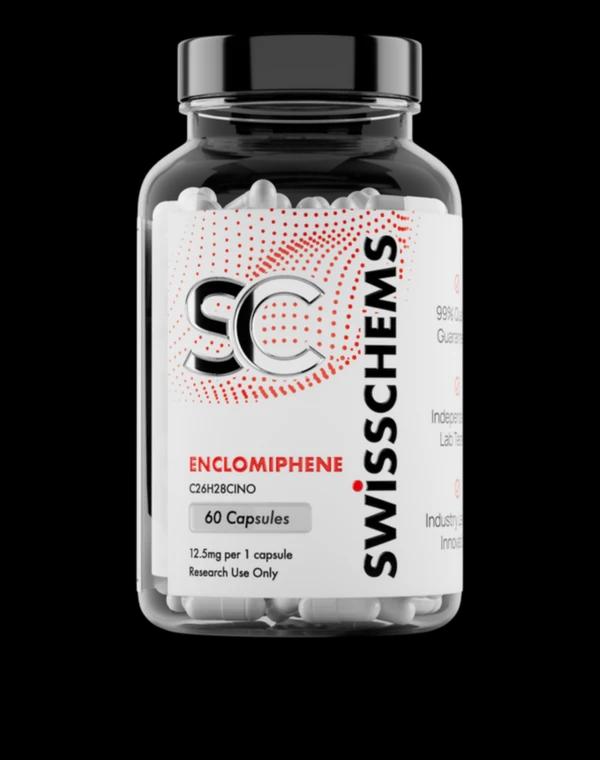
Enclomiphene is also sold outside that system. One example is Swiss Chems enclomiphene 12.5 mg capsules, which are sold labelled for research use only and not for human consumption. They are not a pharmacy product, need no prescription and come with none of the oversight above; the seller states that each batch is tested by an independent lab and posts the reports. The code jqrlsday takes 10% off at checkout. What those lab reports do and do not prove is covered on our enclomiphene for sale page.
Medical Disclaimer: Enclomiphene citrate is not approved by the FDA or the European Medicines Agency for any condition. Compounded enclomiphene is not an FDA-approved drug, and research-labelled enclomiphene is sold for laboratory research use only and is not intended for human or veterinary consumption. This article summarizes published studies and regulatory documents for education only. It is not medical advice, a diagnosis, a dosing protocol or a recommendation for personal use. Low testosterone and infertility have several causes that need testing to tell apart, so consult a qualified healthcare professional before starting or changing any treatment.