Gonadorelin is synthetic gonadotropin releasing hormone, identical to the GnRH the hypothalamus produces, and it works one step higher in the chain than hCG does. Most people encountering gonadorelin today meet it through a TRT clinic that has switched away from hCG, and the honest assessment is that it addresses the same goal through a mechanism with a real theoretical weakness in exactly that setting.
Understanding the weakness is the point of this article, because clinic explanations tend to skip it.
What Gonadorelin Is
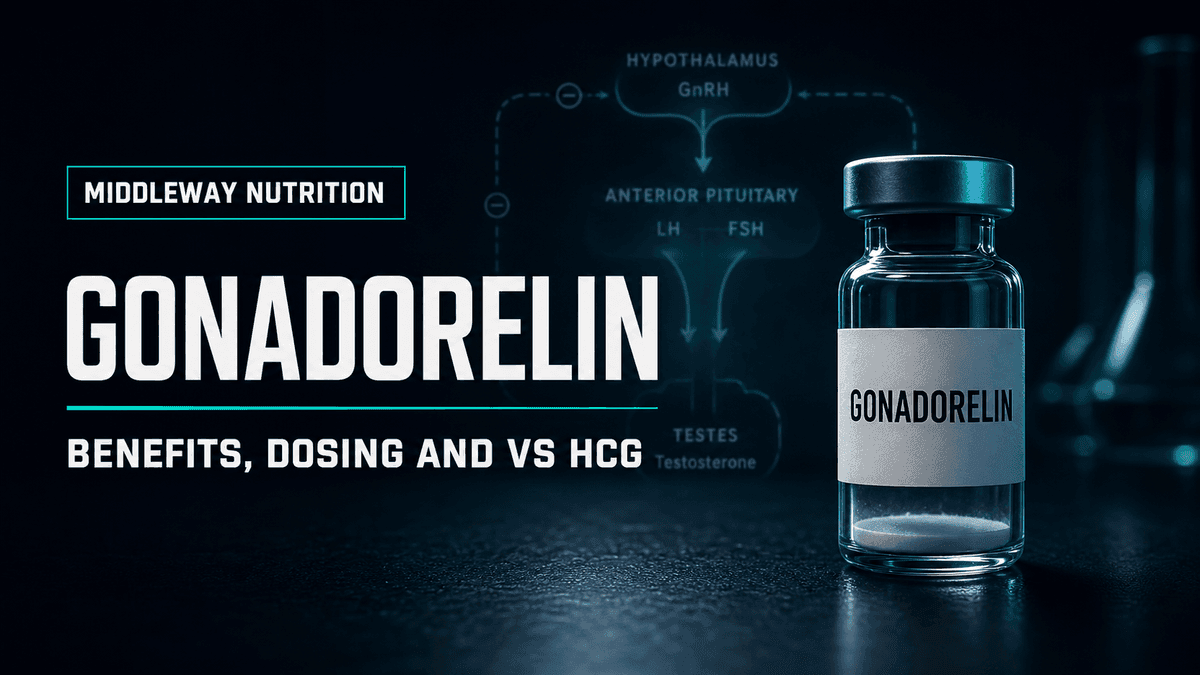
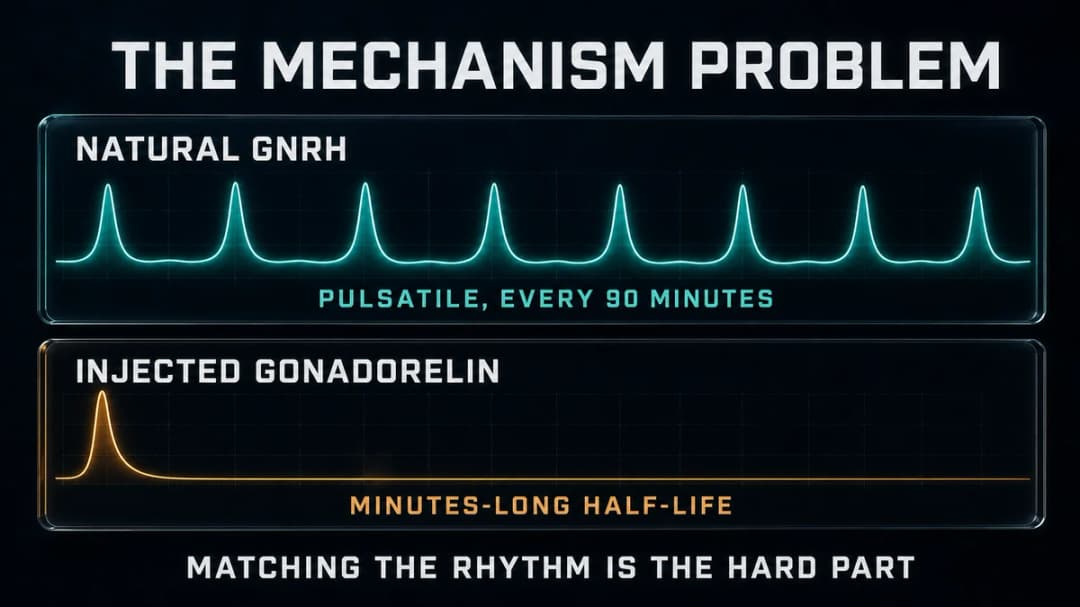
GnRH is released by the hypothalamus in pulses roughly every 60 to 120 minutes. Each pulse prompts the pituitary to release LH and FSH, and LH then stimulates Leydig cells in the testes to produce testosterone. Gonadorelin is a synthetic copy of that decapeptide.
Clinically it has a long history in diagnostic testing of pituitary function and in fertility medicine. Its use as a companion to testosterone therapy is off-label and much more recent.
Its defining property is a very short half-life, in the range of minutes. That is not a flaw: natural GnRH is short-acting by design, because the pituitary responds to pulses and becomes desensitised to continuous stimulation. Continuous GnRH receptor activation actually shuts gonadotropin output down, which is how GnRH agonists are used therapeutically to suppress hormone production in prostate cancer and endometriosis.
The Mechanism Problem Nobody Mentions
Here is the part that matters, and it applies specifically to men on testosterone therapy.
Gonadorelin acts on the pituitary. The pituitary then releases LH, which acts on the testes. That chain requires the pituitary to be capable of responding.
Exogenous testosterone suppresses the axis through negative feedback at both the hypothalamus and the pituitary. So gonadorelin is being asked to stimulate a gland that circulating testosterone is actively suppressing. It can produce an LH pulse, but the size of that response in a suppressed system is not the same as in an intact one.
hCG has no such dependency. It binds the testicular receptor directly, downstream of the pituitary, so it works regardless of how suppressed the upstream system is.
This is a genuine mechanistic distinction, and it is the strongest argument that gonadorelin is not a straight replacement for hCG in this specific use.
Why Clinics Switched Anyway
The switch was driven by supply and regulatory factors rather than by evidence that gonadorelin works better. Access to compounded hCG became more complicated, and gonadorelin was available through compounding pharmacies as an alternative.
That is a legitimate reason to offer a different option. It is not a reason to present it as equivalent, and anyone told it is a like-for-like swap has been given an incomplete picture.
Typical Dosing
| Parameter | Commonly reported in TRT use |
|---|---|
| Dose | 100 to 300 mcg per injection |
| Frequency | 2 to 3 times weekly, sometimes daily or more often |
| Route | Subcutaneous |
| Timing | Alongside the testosterone protocol |
| Half-life | Minutes |
The frequency question is where protocols diverge, and it follows directly from the pharmacology. A compound cleared in minutes cannot mimic a pulse pattern occurring every one to two hours if it is given twice a week. Some protocols therefore use daily or more frequent dosing on the grounds that it better approximates natural pulsatility, at the cost of far more injections.
There is no trial establishing which approach works better for testicular preservation. These are conventions.
Gonadorelin Compared With hCG
| Gonadorelin | hCG | |
|---|---|---|
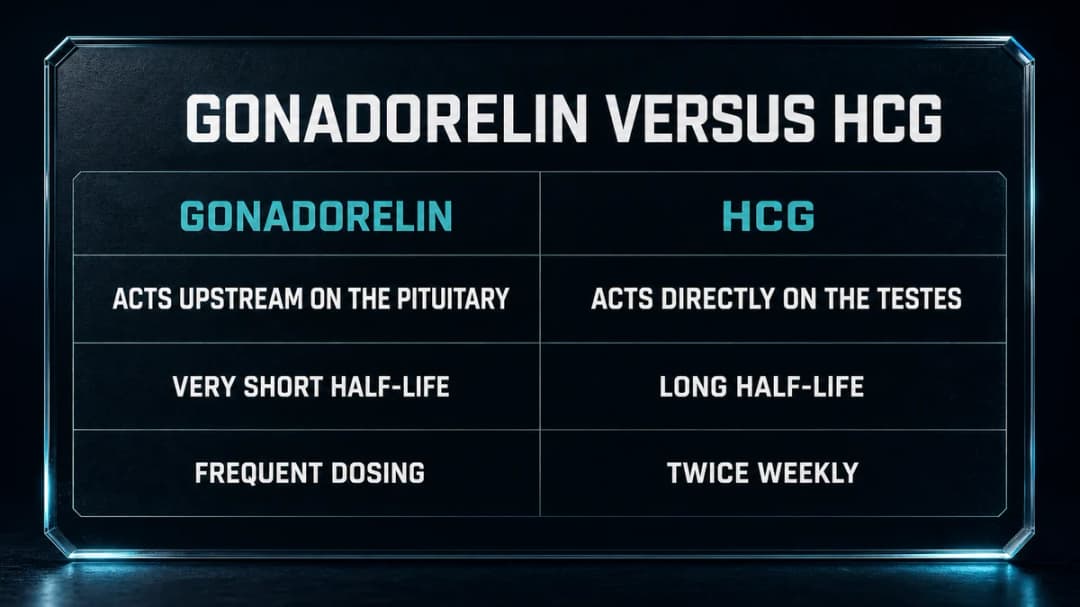
| Acts on | Pituitary GnRH receptor | Testicular LH receptor |
| Needs a responsive pituitary | Yes | No |
| Half-life | Minutes | More than a day |
| Injection frequency | Frequent, protocol dependent | 2 to 3 times weekly |
| Effect on oestradiol | Generally less pronounced | Frequently raises it |
| Evidence in TRT support | Off-label, no trials in this use | Long clinical use, better established |
| Availability | Through compounding | Prescription product |
The oestradiol difference is the one real advantage in gonadorelin's favour. hCG commonly raises oestradiol enough to cause symptoms, and that is the usual reason its dose gets reduced. A gentler stimulus produces less of that problem, though it may also produce less of the intended effect.
What to Track
Total and free testosterone, as part of routine TRT monitoring.
LH, which is informative here in a way it is not with hCG. If gonadorelin is working through the pituitary, LH should show a response. Persistently flat LH suggests the pituitary is too suppressed to answer.
Oestradiol, since the whole point of the comparison partly rests on this.
Testicular volume, assessed clinically over months. It is the outcome the protocol exists to protect, and it changes slowly.
Semen analysis, if fertility is the actual goal, and not before around three months.
For the alternative, see our hCG guide and the hCG dosage breakdown. The kisspeptin overview covers yet another point of entry into the same axis, one step further upstream again.
Side Effects
Reported effects are mild: injection site reactions, headache, occasional flushing. Because it stimulates the body's own gonadotropin release rather than delivering a strong sustained signal, the downstream hormonal effects tend to be more modest than with hCG.
The theoretical concern with any GnRH analog is desensitisation. Continuous receptor stimulation suppresses gonadotropin release rather than promoting it, which is precisely how GnRH agonists are used as suppressive therapy. Gonadorelin's short half-life makes this unlikely at intermittent dosing, but it is the reason very frequent dosing schedules deserve some thought rather than automatic adoption.
Frequently Asked Questions
Is gonadorelin as good as hCG for preventing testicular atrophy?
There is no trial comparing them for this purpose, so the honest answer is that nobody knows. The mechanistic argument favours hCG, because it acts directly on the testes and does not depend on a pituitary that testosterone therapy is actively suppressing. Gonadorelin needs that pituitary to respond.
How often should gonadorelin be injected?
Protocols vary widely, from two or three times weekly to daily or more often. The pharmacological argument favours frequent dosing, since natural GnRH pulses every one to two hours and gonadorelin is cleared in minutes. No trial establishes the best schedule for this off-label use.
Does gonadorelin raise oestrogen like hCG?
Generally less so, and this is its clearest practical advantage. hCG frequently raises oestradiol enough to cause symptoms, which is the usual reason its dose gets lowered. Gonadorelin produces a gentler stimulus, though that may cut both ways.
Why did TRT clinics switch from hCG to gonadorelin?
Largely because of supply and regulatory changes affecting access to compounded hCG rather than because of evidence that gonadorelin performs better. It is a reasonable alternative to offer, but it is not the same intervention and should not be presented as an equivalent swap.
Can gonadorelin restore fertility?
Its role in fertility is established in specific clinical settings involving hypothalamic dysfunction, where pulsatile GnRH delivery can restore gonadotropin output. That is a different situation from a man on testosterone therapy, and fertility restoration in that context is normally managed with hCG, sometimes with FSH, under specialist care.