Kisspeptin peptide benefits sit upstream of testosterone rather than in it, the side effects logged in trials are mild and short lived, and dosage is measured in micrograms. The unusual part is the clock: this molecule clears the blood in minutes, which makes timing a bigger variable than quantity and makes most simple dosing advice about it wrong.
- Kisspeptin is a family of neuropeptides from the KISS1 gene that act on the KISS1R receptor, also written GPR54, on GnRH neurons in the hypothalamus.
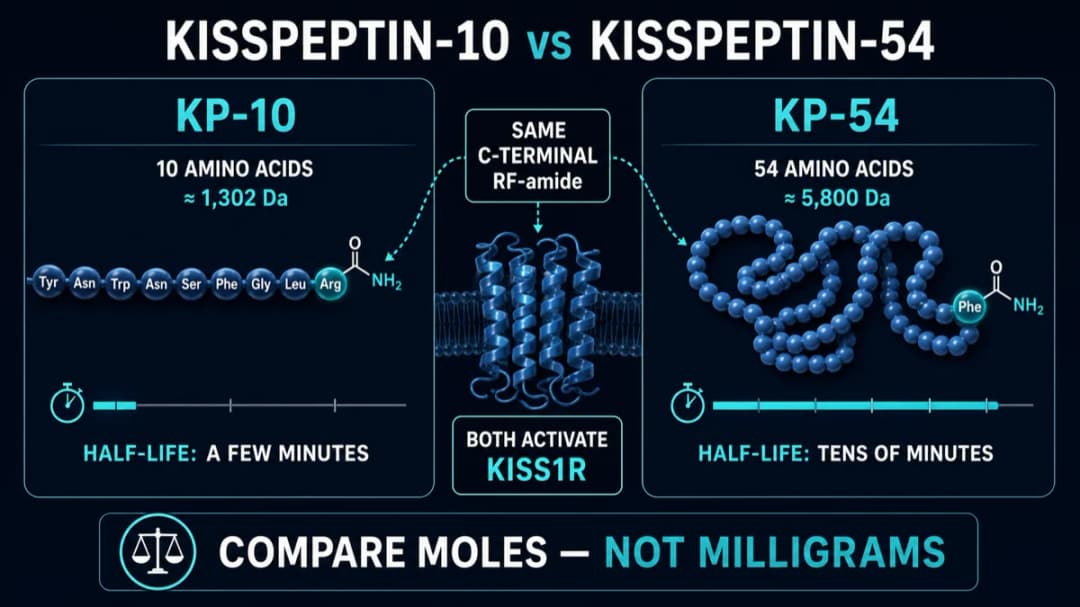
- The two forms sold as research material are kisspeptin-10 (roughly 1,302 Da, sequence Tyr-Asn-Trp-Asn-Ser-Phe-Gly-Leu-Arg-Phe-NH2) and kisspeptin-54 (roughly 5,800 Da), and both hit the same receptor because they share the same C-terminal RF-amide tail.
- Half-life is the defining constraint: the short 10-amino-acid form clears the circulation within a few minutes, while the 54-amino-acid form persists somewhat longer, on the order of tens of minutes.
- Human trial doses fall into two families, molar dosing for IVF work (1.6 to 12.8 nmol/kg of kisspeptin-54) and weight-based microgram dosing for gonadotropin studies (0.1 to 1.0 mcg/kg).
- Reported adverse events are limited to facial flushing, nausea, injection site reactions and occasional headache. Long-term and repeat-dosing safety data does not exist.
What Kisspeptin Actually Is
The KISS1 gene encodes a 145-amino-acid precursor protein that gets cleaved into shorter active fragments. The longest of these is kisspeptin-54, originally named metastin when the gene was first characterized in 1996 as a suppressor of tumor metastasis. Shorter cuts follow at 14, 13 and 10 amino acids. All of them terminate in the same arginine-phenylalanine amide motif, and since that tail is what docks into the receptor, all of them are biologically active at KISS1R.
That shared potency has a practical consequence buyers miss. The two forms sit in the same range of potency per molecule, with kisspeptin-54 modestly ahead in the one trial that infused both side by side, but kisspeptin-54 weighs about four and a half times more, so comparing them by milligram is not comparing like with like. This is why the clinical literature expresses IVF dosing in nmol/kg rather than mcg.
The reproductive role was not discovered until 2003, when two research groups independently traced a form of hypogonadotropic hypogonadism, meaning failure to enter puberty at all, to loss-of-function mutations in GPR54. Gain-of-function variants in the same pathway have since been tied to precocious puberty. That is about as clean a piece of bidirectional genetic evidence as endocrinology gets, and it establishes kisspeptin as necessary rather than merely modulatory.
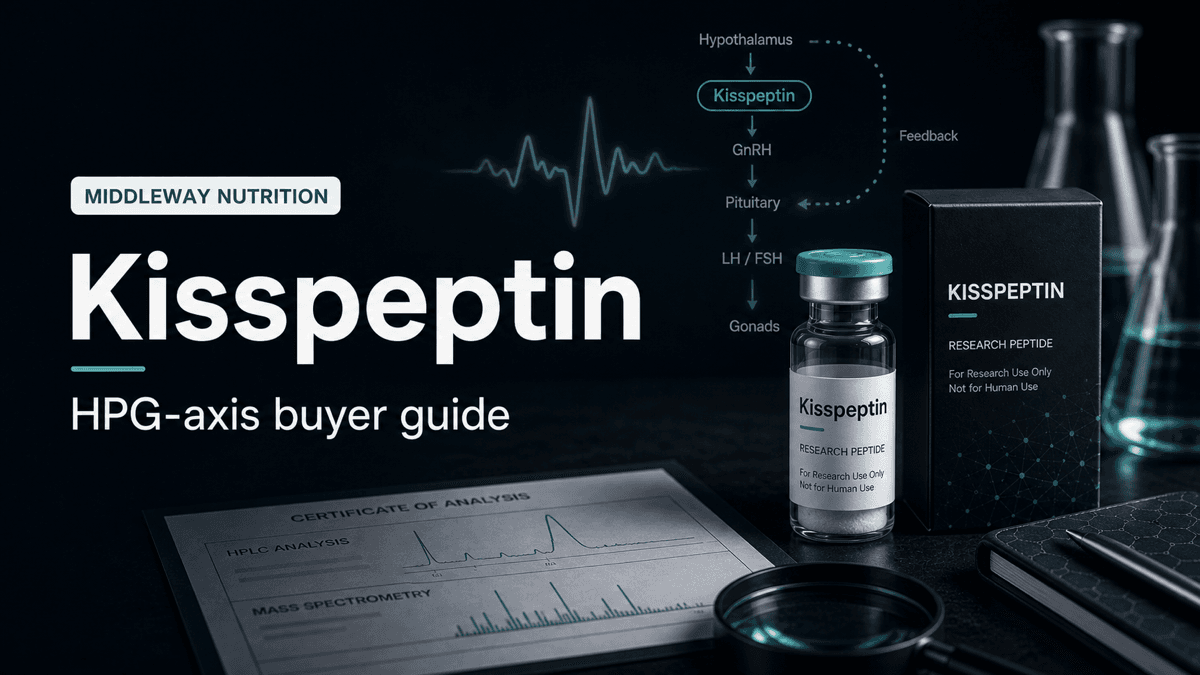
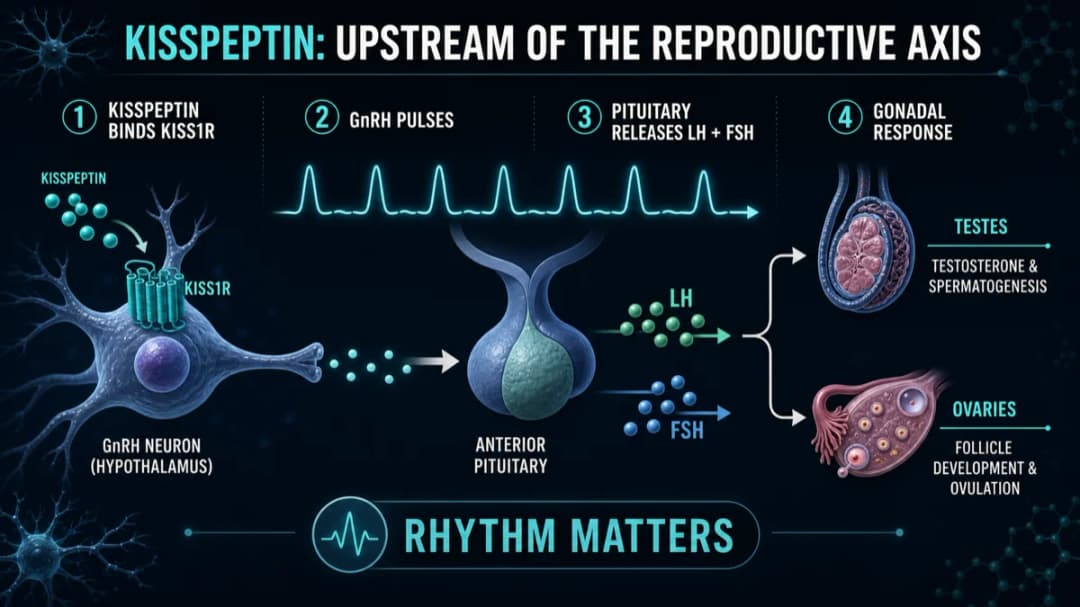
Mechanically, kisspeptin neurons cluster in two hypothalamic populations. The arcuate nucleus population sets the rhythm, firing in bursts that pattern GnRH release. The second cluster, sitting in the anteroventral periventricular region, is the one estrogen talks to, and its output is what produces the surge of LH that precedes ovulation. Kisspeptin binds KISS1R on GnRH neurons, GnRH travels to the anterior pituitary, the pituitary releases LH and FSH, and those two hormones drive testosterone and spermatogenesis in men or follicular development and ovulation in women.
Rhythm is the whole story here. The axis reads pulses, not volume, and a signal that never switches off eventually reads as no signal at all. Clinical practice exploits that inversion deliberately: sustained GnRH-agonist exposure is used to shut the axis down rather than drive it. The lesson carries over to anything acting upstream. Kisspeptin is not FDA approved for any indication, and everything below reports what has been observed in research settings rather than what anyone should do.
Kisspeptin-10 vs Kisspeptin-54
Most material sold for research is kisspeptin-10. Most of the human trial evidence quoted to sell it was generated with kisspeptin-54. That mismatch is worth sorting out before reading anything else about the compound.
Kisspeptin-10 is the last ten amino acids of the longer molecule, trimmed down to the fragment that docks into KISS1R. Kisspeptin-54 is the full-length cleavage product of the KISS1 precursor, the one originally named metastin. Both activate the same receptor. What separates them is how long each survives in circulation and how thoroughly each has been studied in people.
| Property | Kisspeptin-10 | Kisspeptin-54 |
|---|---|---|
| Length and mass | 10 amino acids, roughly 1,302 Da | 54 amino acids, roughly 5,800 Da |
| Shorthand | KP-10 | KP-54, metastin |
| Circulating half-life | About 4 minutes in mice, no published human figure | 27.6 minutes, plus or minus 1.1, in healthy men |
| Route in published human work | Almost entirely intravenous bolus or infusion | Subcutaneous and intravenous |
| Best-documented human use | Acute LH response and LH pulse frequency studies | IVF oocyte maturation trigger, repeat dosing in hypothalamic amenorrhea |
| LH area under the curve, 3-hour infusion at 1.0 nmol/kg/h | 10.8 plus or minus 1.7 | 14.4 plus or minus 1.3 |
| Units used in the literature | mcg/kg and nmol/kg | nmol/kg |
The area-under-the-curve row comes from the only trial that ran the two molecules against each other, three-hour intravenous infusions at 0.1, 0.3 and 1.0 nmol/kg per hour in healthy men, five men per dose group, published in Human Reproduction in 2015. Kisspeptin-54 produced the larger LH response, though not by a wide margin. The figure worth taking from that study is the third arm. GnRH infused alongside them returned an LH area under the curve of 34.1, between two and three times either kisspeptin. Kisspeptin is not the most powerful way to raise LH. It is the most upstream one, which is a different claim and a smaller one.
There is a mechanistic reading behind the half-life gap. In mice, systemic injection of kisspeptin-54 activated GnRH neurons while kisspeptin-10 did not, which tracks with time of exposure rather than with any difference in receptor affinity. That is rodent work and does not carry across to humans as a result. It is here as the reason the two forms should not be treated as interchangeable at matched molar doses.
One further finding gets dropped from nearly every summary. An intravenous kisspeptin-10 bolus raised LH in men at doses from 0.3 nmol/kg upward, while the same peptide given to women during the follicular phase moved gonadotropins not at all. Responsiveness reappeared in the preovulatory phase. Sex and cycle timing change the answer, so a number lifted from a study in men does not transfer.
One practical note for anyone comparing vials. A milligram figure means little without the form attached to it, since five milligrams of kisspeptin-10 contains roughly four and a half times as many molecules as five milligrams of kisspeptin-54.
Kisspeptin Benefits
Grading this honestly means separating three tiers: what controlled human trials have shown, what is mechanistically plausible but untested, and what is marketing.
Gonadotropin and testosterone response in men (human data, short term). Infusion studies in healthy men and in men with central hypogonadism consistently show LH rising within 30 to 60 minutes of administration, with testosterone following over the following hours. This is the best-supported effect in the literature. A dose-ranging study in healthy men put numbers on it: an intravenous kisspeptin-10 bolus reached maximal stimulation at 1 mcg/kg, taking mean LH from 4.1 to 12.4 IU/L, while continuous infusion raised LH pulse frequency from 0.7 to 1.0 pulses per hour, in groups of six to eight men. The caveat that gets dropped in most write-ups is duration. These are acute responses in controlled infusion settings. Whether intermittent subcutaneous injection produces a durable shift in resting testosterone across weeks has not been demonstrated in a controlled trial.
Ovulation triggering in IVF (human data, the strongest evidence). This is the most clinically advanced use. Work led by groups at Imperial College London used subcutaneous kisspeptin-54 to trigger final oocyte maturation as an alternative to an hCG trigger. The advantage is structural: hCG has a long half-life and keeps stimulating the ovary, while kisspeptin produces the body's own LH surge, which self-terminates. Reported outcomes include lower peak estradiol and reduced markers of ovarian hyperstimulation syndrome. Two trials carry most of the weight. In a single-arm study, 53 women received subcutaneous kisspeptin-54 at 1.6 to 12.8 nmol/kg and eggs matured at every dose tested, with embryos transferred in 92 percent of cycles and clinical pregnancy in 23 percent. A phase 2 trial then randomized 60 women at high risk of OHSS across four doses and reported oocyte maturation in 95 percent, live birth in 45 percent overall and 62 percent in the 9.6 nmol/kg group, and not one case of moderate, severe or critical OHSS. Neither trial ran an hCG trigger as a control arm, so these are dose-finding results rather than proof that kisspeptin outperforms the standard trigger. It remains investigational, not approved.
Restoring LH pulsatility in hypothalamic amenorrhea (human data, small studies). In women whose cycles have stopped because of low body weight, stress or heavy training load, pulsatile kisspeptin has restored measurable LH pulse patterns, addressing the actual defect rather than replacing downstream hormones. The studies are small and short.
Sexual and emotional brain processing (human data, limited). Brain imaging in healthy male volunteers has picked up changes in emotional and reward-related circuitry while participants viewed sexual or romantic material after kisspeptin infusion, alongside lower self-reported negative mood. The timing is the interesting part, since these shifts appear well before any hormonal change could account for them, which argues for the peptide acting directly in the brain. It is a real finding from a small sample, not evidence of a reliable libido treatment. If acute sexual response is the target, PT-141 acts through melanocortin receptors with far more human dosing precedent, and the two are not substitutes for each other.
Post-TRT or post-cycle axis restart (no controlled human data). The reasoning is sound, since recovery requires the hypothalamus to resume pulsatile GnRH output and kisspeptin acts precisely there. But no controlled trial has compared kisspeptin restart protocols against standard approaches, and claims that it outperforms them are extrapolation.
Metabolic effects (preclinical and observational). The receptor turns up in tissues that have nothing to do with reproduction, including pancreas, fat and bone, and signals tied to energy availability feed into kisspeptin neurons. That link offers one explanation for why fertility falls away when body fat drops too low. Nowhere near a human application.
Kisspeptin Side Effects
Across the published human trials, which collectively involve hundreds of participants under short-term dosing, the tolerability record has been good and no serious adverse events have been attributed to the compound. That is a genuine finding, and it is also a narrower claim than it sounds. Here is what has been recorded.
- Facial flushing. The most frequently reported effect, consistent with hypothalamic vasodilation, typically mild and resolving within minutes to hours.
- Nausea. Occasional, generally mild, more likely at the upper end of dose ranges.
- Injection site reactions. Redness or local irritation with subcutaneous administration, unremarkable for any injected peptide.
- Headache. Infrequent.
- Abdominal discomfort. Rare and short lived.
- Downstream hormonal shifts. Changing LH, FSH and testosterone is the intended effect, but shifts in mood, libido or fluid balance during the first weeks are a plausible consequence of moving those hormones and should not be read as unrelated.
Now the gaps, which matter more than the list above. Nearly every safety observation comes from short protocols, often a single administration or a few hours of infusion, and there is no meaningful data on repeated dosing across weeks or months. Interactions have not been studied either. Kisspeptin has no known pharmacological interactions through its own receptor, but stacking it with TRT, hCG, clomiphene or a GnRH analog produces additive hormonal effects nobody has characterized.
The most concrete theoretical risk is that the receptor stops answering. Push KISS1R without letting up and the expected result is fewer available receptors and a quieter axis, the same inversion seen one step downstream when GnRH signaling is held constant. Short-term pulsatile administration appears to preserve sensitivity, and for kisspeptin-54 the frequency question has been tested directly. Imperial College investigators gave women with hypothalamic amenorrhea 6.4 nmol/kg subcutaneously twice daily for two weeks, five women per arm. The first injection took LH to 24.0 IU/L. By day 14 the same injection managed 2.5. The response had largely worn off. The same group then ran twice-weekly injections for eight weeks and saw only partial desensitization, with reproductive hormones still significantly above placebo at the end. Context shifts the picture again: twice-daily dosing across days 7 to 14 of the cycle in healthy women did not abolish cyclicity and shortened cycles by roughly two days, from 28.6 to 26.8. What that body of work supports is narrow but useful. Twice weekly held up over two months in one small study, twice daily did not, no equivalent frequency work has been published for kisspeptin-10, and once-daily dosing of either form sits between the two tested frequencies with nothing measured under it.
Two further cautions belong on the record. Kisspeptin rises sharply in normal pregnancy through placental production, but exogenous administration during pregnancy has never been studied for safety. And because the compound sits in a hormonal signaling pathway, there is a theoretical concern in hormone-sensitive cancers, with no direct evidence either way.
Kisspeptin Dosage Chart
No approved human dosing standard exists. The figures below are ranges reported in published research and in supplier and community documentation, listed so you can interpret what you read elsewhere. They are not a protocol.
| Research context | Reported range | Frequency | Typical cycle |
|---|---|---|---|
| IVF oocyte maturation trigger (KP-54, subcutaneous) | 1.6 to 12.8 nmol/kg, with the upper part of that range reported as more consistent | Single administration, about 36 hours before retrieval | One dose per cycle |
| Acute gonadotropin response (KP-10 or KP-54, IV bolus) | 0.1 to 1.0 mcg/kg | Single bolus, LH peaks at 30 to 60 minutes | Single session |
| Acute stimulation testing (clinical) | 1 to 10 mcg/kg | Single administration, IV or subcutaneous | Single session |
| Pulsatile infusion for LH pulsatility | 0.1 to 0.3 mcg/kg per pulse | Every 60 to 90 minutes | Hours to days, in-facility |
| Non-clinical reported use, lower end (KP-10, subcutaneous) | 50 to 100 mcg | 2 to 3 times weekly | 4 weeks |
| Non-clinical reported use, standard (KP-10, subcutaneous) | 100 mcg | Once daily, commonly evening | 4 to 8 weeks |
| Non-clinical reported use, upper end (KP-10, subcutaneous) | 100 to 500 mcg | Once to three times daily | Not standardized |
The top half of that table and the bottom half are not the same kind of information. The clinical rows come from controlled studies with hormone measurement and mostly intravenous delivery. The lower rows describe what circulates in supplier and community documentation, with no trial support and no evidence that fixed daily dosing produces the pulsatile pattern the physiology depends on.
Clearance makes this harder rather than easier. Because the native peptide is gone from circulation in minutes to tens of minutes depending on form and route, one injection a day amounts to a single brief signal followed by most of a day of silence. Whether that counts as useful pulsatility or a wasted signal has not been settled. Pharmaceutical developers treated the half-life as the core obstacle and responded by building longer-acting analogs, MVT-602 and TAK-448 among them, rather than by raising the dose of the native peptide. Frequency is the one dosing variable with real human data behind it, covered in the side effects section above: twice-weekly kisspeptin-54 held its effect across eight weeks, twice daily lost most of it inside two.
Reconstitution and Storage
Kisspeptin arrives as a white lyophilized powder, and it is less stable in solution than most peptides people are used to handling.
Use bacteriostatic water or sterile saline, aim the stream at the glass wall instead of straight down onto the cake, and swirl the vial rather than shaking it. The arithmetic is where people come unstuck, because the doses are so small. Take a 10 mg vial brought up in 2 mL: that is 5 mg per mL, which puts a 100 mcg dose at 0.02 mL, roughly two ticks on a 100-unit insulin syringe. If that is too small a mark to read reliably, the fix is more diluent, not more guessing.
Keep the sealed powder in a freezer, around minus 20 degrees Celsius, and move it to ordinary fridge temperature, roughly 2 to 8 degrees Celsius, once it is in solution. Usable windows quoted for the reconstituted vial range from about one to three weeks, on the short side compared with sturdier peptides, since this one breaks down readily. Keep it dark, and do not put it through repeated freeze-thaw cycles. Swallowing it achieves nothing, since digestive enzymes take it apart before any of it reaches the bloodstream. The nasal route has been examined in clinical settings and can raise LH, though how much of a given dose gets absorbed is both lower and less predictable than with an injection. If you want the numbers in a single reference rather than spread through an article, a Kisspeptin dosage chart lays out the reconstitution maths by vial size.
Stacking
Genuine documentation for combinations is thin, and only one pairing has any published rationale behind it.
The kisspeptin plus hCG combination is discussed in the literature on the logic that the two act at different levels of the same axis, kisspeptin at the hypothalamus and hCG directly at the testicular LH receptor. Some researchers have raised it as a way to support both signaling and end-organ output at once. What does not exist is trial data on the combination or any worked-out dosing for it, and layering two hormonal inputs multiplies the ways the axis can be pushed somewhere unintended.
Combining kisspeptin with clomiphene, aromatase inhibitors or exogenous testosterone falls into the same category, plausible on paper and uncharacterized in practice. In someone already on TRT, the pituitary is suppressed, so an upstream signal has little to act on.
Pairings outside the hormonal axis, such as running kisspeptin alongside Selank for mood, have no documented interaction either way. That means no known conflict, not evidence of synergy.
How to Verify What You Buy
Kisspeptin is dosed in micrograms and degrades faster in solution than most peptides, so an underfilled or partly degraded vial is difficult to detect from the effect alone. Ask for a third-party HPLC and mass spectrometry report tied to the specific lot, and confirm the mass matches the form you ordered, near 1,302 Da for kisspeptin-10 and near 5,800 Da for kisspeptin-54. Our where to buy kisspeptin page covers which suppliers publish per-lot testing, and the kisspeptin for sale listing tracks current vial sizes and pricing.
Frequently Asked Questions
What does kisspeptin peptide do?
It activates KISS1R receptors on GnRH neurons in the hypothalamus, triggering GnRH release. GnRH prompts the pituitary to secrete LH and FSH, which in turn drive testosterone production and spermatogenesis in men, and follicular development and ovulation in women. It sits at the top of that cascade rather than replacing anything within it, which means it can only do something if the rest of the chain is intact.
Does kisspeptin increase libido?
The sexual-response research is brain-imaging research, and the distinction matters. Two randomized, placebo-controlled crossover trials at Imperial College, one in 32 women and one in 32 men, all of them with hypoactive sexual desire disorder, infused kisspeptin-54 intravenously at 1 nmol/kg per hour for 75 minutes and scanned participants while they viewed sexual and attraction-related material. Both met their primary endpoint, which was a change in brain activity, and the study in men also recorded movement in penile tumescence and self-reported desire as secondary measures. What none of that establishes is that an injection at home raises libido over days or weeks. Each trial used a single 75-minute intravenous infusion under a scanner, took brain signal as the main outcome, and did not follow participants forward. Read it as a mechanism confirmed in humans, not as an effect demonstrated in ordinary use.
Is kisspeptin safe?
Short-term human trials have reported a favorable tolerability profile, with flushing, mild nausea and injection site reactions as the main effects and no serious adverse events attributed to the compound. That record covers single doses and short infusions in monitored settings. Repeated administration over weeks or months has not been studied, receptor desensitization from too-frequent dosing is a real theoretical risk, and safety in pregnancy is unknown. "Well tolerated in short studies" is the accurate statement, not "safe."
How much kisspeptin is used in research?
Controlled human studies used 0.1 to 1.0 mcg/kg as an intravenous bolus for gonadotropin response, 0.1 to 0.3 mcg/kg per pulse for pulsatile infusion every 60 to 90 minutes, and 1.6 to 12.8 nmol/kg of kisspeptin-54 subcutaneously as an IVF trigger. Non-clinical documentation reports 50 to 100 mcg of kisspeptin-10 two or three times weekly at the low end, with higher and more frequent schedules described but not validated. There is no established human dosing standard.
How long does a 10 mg vial of kisspeptin last?
Two clocks run at once and the shorter one decides. A 10 mg vial holds 10,000 mcg. Reconstituted with 2 mL of bacteriostatic water it becomes 5 mg per mL, so one unit on a 100-unit insulin syringe, which is 0.01 mL, carries 50 mcg, and a 100 mcg dose is two units. On paper the vial holds 100 doses. The solution will not last 100 days. Reconstituted kisspeptin is generally quoted as usable for about one to three weeks refrigerated, so at once-daily dosing most of a 10 mg vial gets discarded, and at two or three times weekly, more of it still. The long shelf life belongs to the sealed lyophilized powder kept frozen, and the clock changes the moment diluent goes in. Smaller vials waste less at microgram-scale use. If two units is too fine a mark to read, reconstitute with 5 mL instead: 2 mg per mL, 100 mcg in 0.05 mL, five units.
Is kisspeptin legal?
In the United States it is not scheduled or controlled, and it is not FDA approved for any therapeutic indication. It sells legally as a research chemical for laboratory use, a different legal category from a drug approved for human administration. Import rules in particular vary by country, so check your own jurisdiction before ordering.