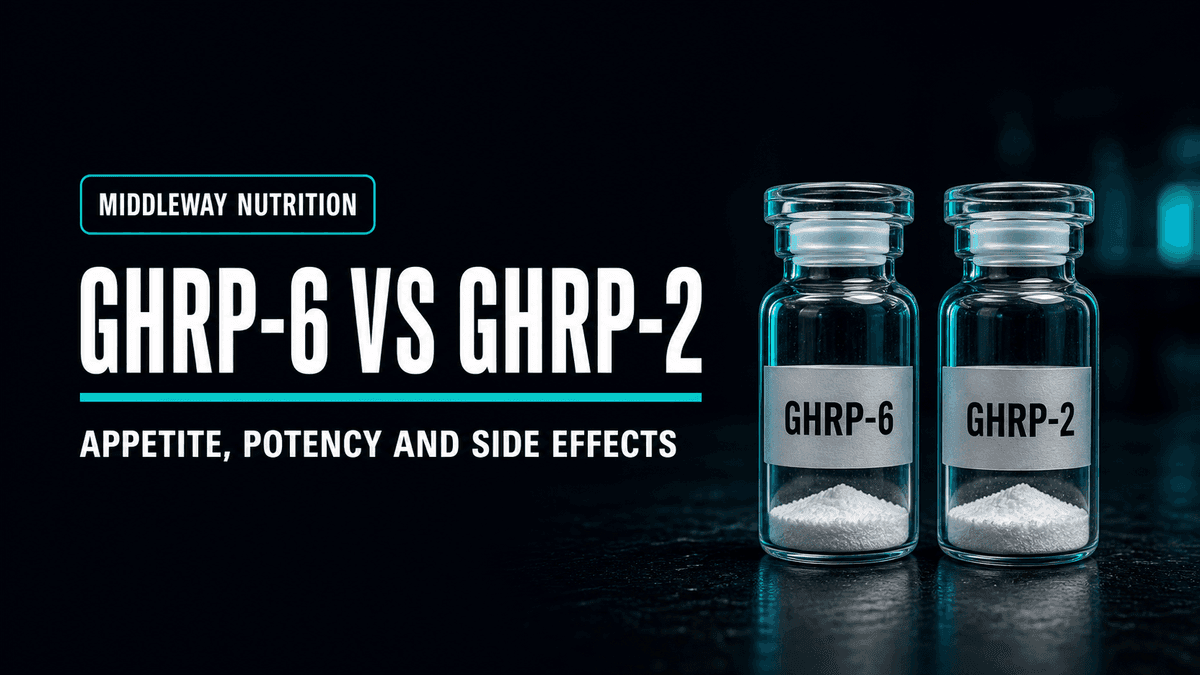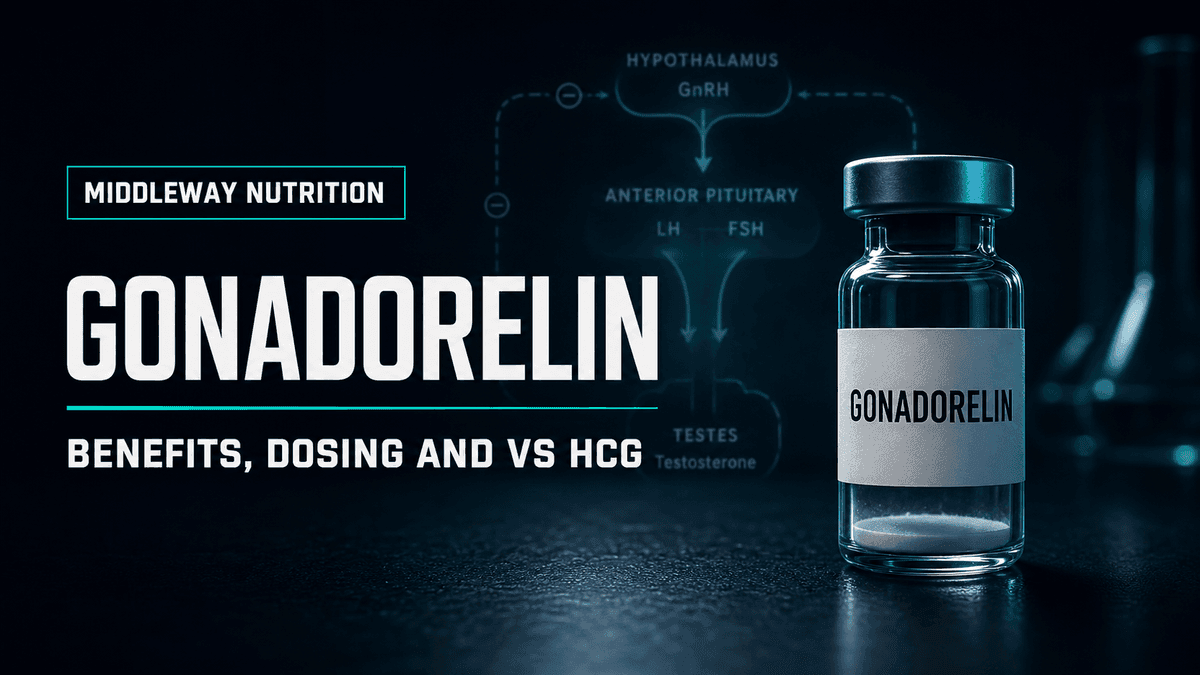
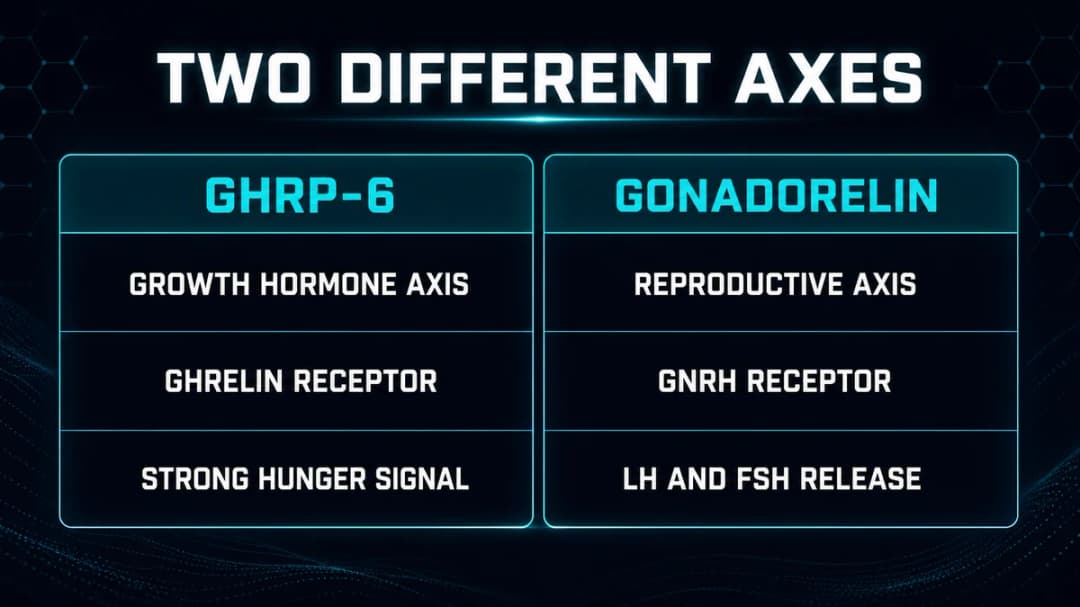
GHRP-6 & gonadorelin for sale is a search that pairs two compounds with almost nothing in common beyond both being sold in the research peptide market. GHRP-6 is a growth hormone releasing peptide that works on the ghrelin receptor and is best known for the ferocious appetite it produces. Gonadorelin is synthetic GnRH, used mainly alongside testosterone replacement to keep the testicular axis working, which is a completely different job.
Anyone searching for both together is usually building a stack out of two unrelated goals. It is worth separating them before buying either.
GHRP-6: What It Does
A six amino acid peptide that binds the growth hormone secretagogue receptor, the same one ghrelin uses. Binding triggers a pulse of growth hormone from the pituitary. It works through a different receptor from GHRH analogues like CJC-1295, which is why the two are commonly stacked: two levers, one outcome, more output than either alone.
Its half-life is very short, in the range of fifteen minutes to an hour, so a single daily injection does very little. Reported protocols use it two or three times a day.
The appetite effect is what GHRP-6 is famous for. Within half an hour to an hour of an injection, most users report strong, insistent hunger. If the goal is eating more during a bulk, that is the reason to choose it. If the goal is fat loss, it is disqualifying, and ipamorelin is the compound that does the same job without it.
The other side. GHRP-6 also raises cortisol and prolactin moderately, which the newer selective compounds do not. That is the trade for its potency, and it is why most modern protocols moved on. See our comparison of growth hormone secretagogues.
Reported dosing
| Parameter | Reported range |
|---|---|
| Dose per injection | 100 to 300 mcg, most protocols sit at 100 to 200 |
| Frequency | Two or three times daily |
| Timing | On an empty stomach, 30 to 60 minutes before eating |
| Cycle | 8 to 12 weeks, then a break of about four weeks |
Doses above 300 mcg per injection appear to produce little additional growth hormone release and considerably more of the appetite and hormonal effects. Timing matters because food, particularly fat and carbohydrate, blunts the growth hormone response.
Reconstitution. A 5 mg vial with 2.5 ml of bacteriostatic water gives 2 mg per ml. A 100 mcg dose is 5 units on a standard insulin syringe. See our guide to bacteriostatic water.
Receptor desensitisation is real with this compound. Running it continuously without breaks produces a fading response that a higher dose does not fix.
Gonadorelin: What It Does
Completely unrelated pharmacology. Gonadorelin is a synthetic version of gonadotropin-releasing hormone, the signal the hypothalamus sends to the pituitary to release LH and FSH, which in turn drive testicular testosterone production and sperm production.
Its practical use is almost entirely alongside testosterone replacement therapy. Exogenous testosterone suppresses that signalling chain, which causes testicular atrophy and impaired fertility. Gonadorelin is used to keep the chain active.
Two things are worth understanding before buying it.
The half-life problem. Natural GnRH is released in pulses, and the pituitary responds to pulses rather than to continuous exposure. Gonadorelin's half-life is measured in minutes, which means dosing has to mimic that pattern to work at all. Continuous or poorly timed exposure can actually downregulate the response, which is the opposite of the intent.
It is a clinical question. Anyone taking testosterone replacement is under medical supervision by definition, and the fertility question in particular is one where adding an unverified research compound to a prescribed regimen without telling the prescriber is a bad idea. hCG is the more commonly prescribed option for the same purpose and comes through a pharmacy.
Reported protocols in the research market sit around 100 to 200 mcg subcutaneously, dosed several times weekly or daily depending on the protocol. Those numbers vary widely between sources, which itself says something about how settled the practice is.
GHRP-6 & Gonadorelin for Sale: Where to Buy Them
Neither is an approved medicine in the form sold online. Both are sold as research compounds, and the legality of personal purchase varies by country.
We do not point at a particular supplier for either compound, so the vetting is entirely on the buyer. Sourcing the peptide and the bacteriostatic water from the same place at least means one set of paperwork to verify rather than several.
Whatever the supplier, the checks are the same:
- A batch-specific certificate of analysis, tied to the lot number on the vial rather than a generic document on the product page
- A stated HPLC purity figure, not a claim of "pharmaceutical grade", which means nothing
- Sterility and endotoxin testing on anything intended for injection
- A physical address and a real returns process. A supplier that will not put its location on the site is telling you something
- Prices that make sense. Unusually cheap peptides are usually under-filled, degraded or something else entirely
Products sold with dosing instructions for humans are being sold illegally in most jurisdictions, which is a reason for caution rather than reassurance.
Should They Be Stacked?
Not for any coherent reason. They act on separate axes and address separate goals, and running both simply means two sets of unknowns at once.
If the goal is growth hormone release, the more sensible pairing is a ghrelin receptor agonist with a GHRH analogue, which is genuinely synergistic. If appetite stimulation is not wanted, ipamorelin is the cleaner compound in that role. See our CJC-1295 vs ipamorelin comparison and ipamorelin side effects.
If the goal is preserving testicular function on testosterone replacement, that is a conversation with the prescriber managing the replacement, not a research peptide purchase.
Safety Notes That Apply to Both
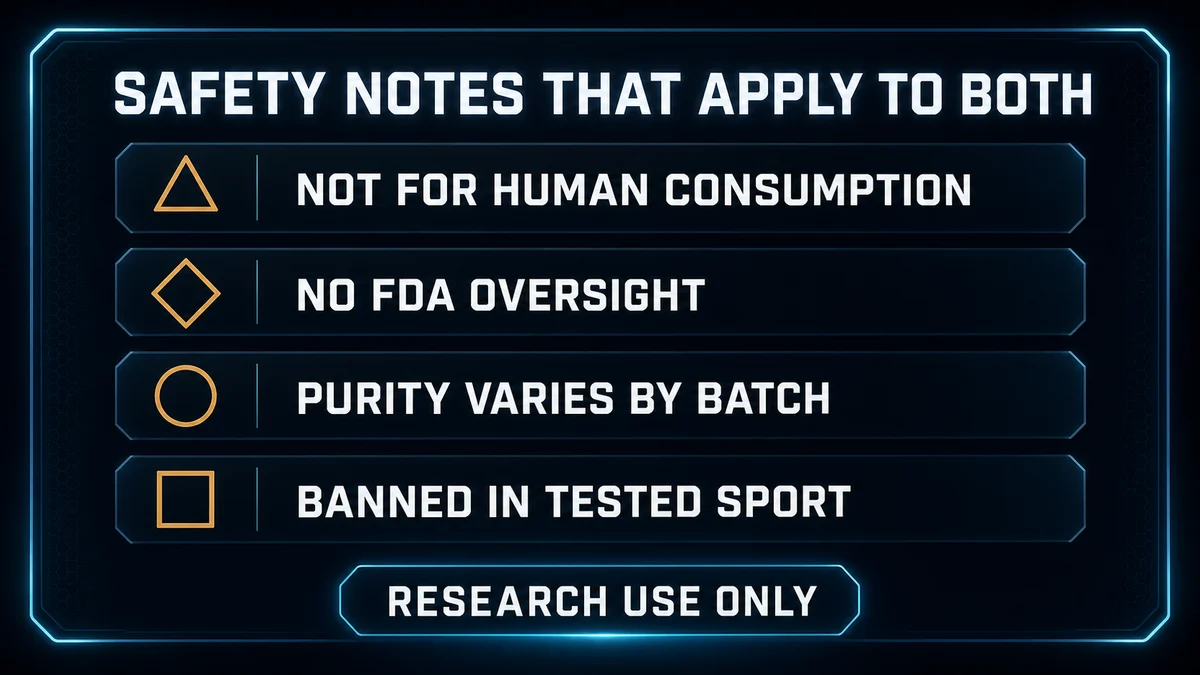
- Neither has meaningful long-term human safety data outside limited clinical contexts
- Growth hormone secretagogues are contraindicated with active cancer, in pregnancy, and under 18, and need medical input for anyone on insulin
- Both are on the World Anti-Doping Agency prohibited list
- Home reconstitution and injection carry real contamination and dosing risks independent of the compound
FAQ
Are GHRP-6 and gonadorelin related?
No. GHRP-6 acts on the ghrelin receptor to release growth hormone. Gonadorelin is synthetic GnRH and acts on the pituitary to release LH and FSH. They appear together in searches because both are sold in the same market, not because they do anything similar.
Why does GHRP-6 make you so hungry?
It binds the same receptor as ghrelin, the body's hunger hormone, and unlike the newer selective compounds it does not separate the growth hormone signal from the appetite signal. That is useful during a bulk and unworkable during a cut.
What is a standard GHRP-6 dose?
Reported protocols use 100 to 300 mcg per injection, two or three times daily, on an empty stomach. Most settle at 100 to 200 mcg, since higher doses mainly increase the side effects rather than the growth hormone release.
Is gonadorelin the same as hCG?
No. hCG mimics LH directly and acts on the testes. Gonadorelin acts one step earlier, on the pituitary, prompting it to release LH and FSH itself. hCG has a much longer half-life, which makes it easier to dose, and it is available through a pharmacy on prescription.
Do these need to be cycled?
GHRP-6 does, because continuous stimulation of the same receptor reduces pituitary responsiveness over time and the effect fades. Reported protocols run eight to twelve weeks with a break afterwards.
What should I check before buying either?
A batch-specific certificate of analysis matching the lot number on the vial, a stated HPLC purity figure, and sterility and endotoxin testing. Anything less means you are trusting a label with nothing behind it.