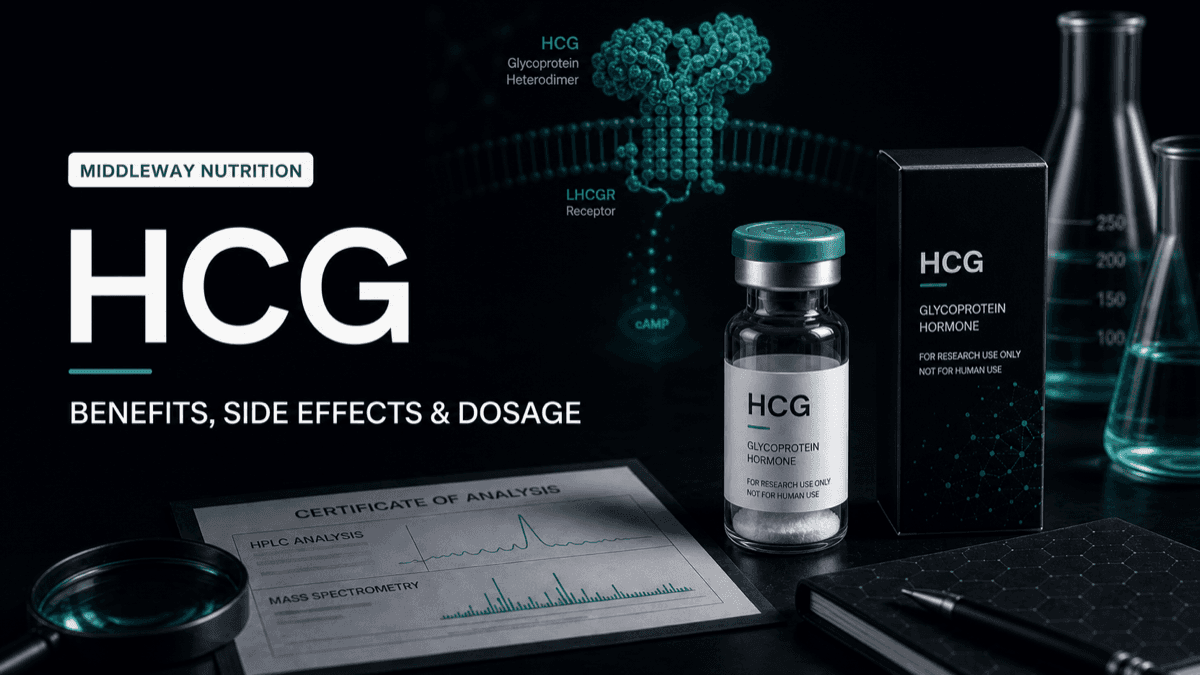
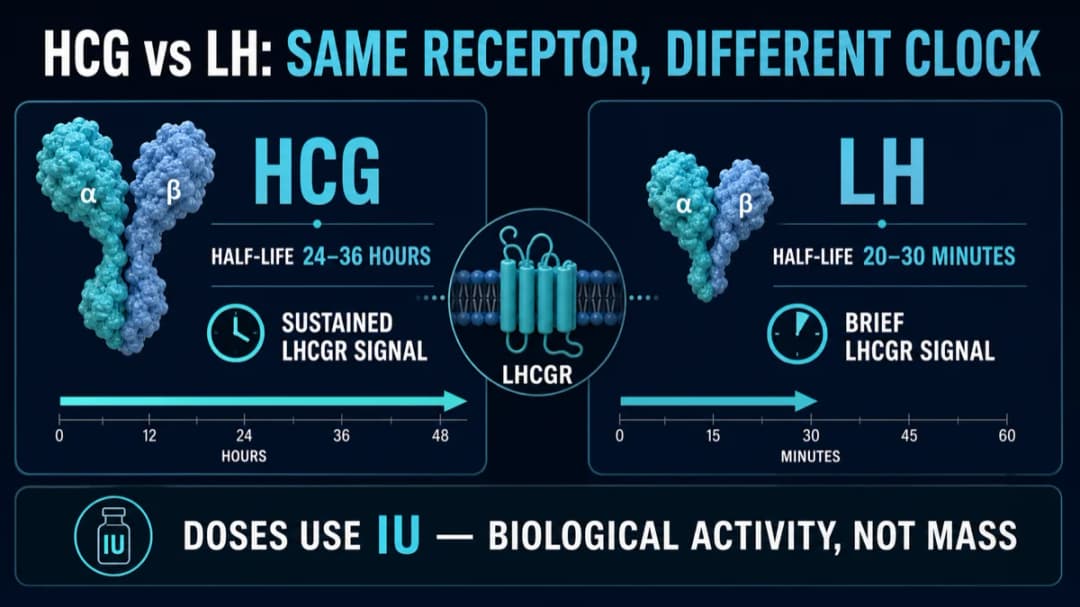
HCG benefits are reproductive rather than metabolic, the side effects reported most often trace back to estrogen, and dosage is counted in international units rather than milligrams. That last detail trips people up: IU describe biological activity, not mass, so a vial labeled 5,000 IU says nothing about what it weighs.
- HCG, or human chorionic gonadotropin, is a glycoprotein hormone of roughly 36.7 kDa, not a short linear peptide. It is a heterodimer, pairing a common alpha chain found across several pituitary hormones with a beta chain belonging to HCG alone.
- Its target is LHCGR, the luteinizing hormone receptor, expressed on the steroid-producing cells of both the testis and the ovary, where it reproduces the signal luteinizing hormone itself would deliver.
- Half-life is roughly 24 to 36 hours against about 20 to 30 minutes for LH, which is why reported protocols space doses days apart instead of hours.
- Reported ranges run from 250 to 500 IU per dose for testicular support up to a single 5,000 to 10,000 IU ovulation trigger in fertility medicine.
- The evidence against HCG as a weight loss agent is settled: controlled comparisons attribute the loss to calorie restriction, and the FDA has warned against over-the-counter HCG weight loss products.
What HCG Actually Is
Most compounds covered on this site are short chains of amino acids you can write out letter by letter. HCG is not one of them, and the difference matters for handling, labeling and testing.
HCG is a glycoprotein hormone built from two protein chains. The alpha chain is identical to that of luteinizing hormone, follicle-stimulating hormone and thyroid-stimulating hormone. The beta chain is what makes HCG itself. Both carry attached sugar groups, and that glycosylation governs stability in circulation and is a large part of why the molecule clears so slowly. Total molecular weight lands near 36.7 kDa, roughly 28 times the mass of a small research peptide like kisspeptin-10.
The molecule originates in the placenta. Its job there is to sustain progesterone output from the corpus luteum through early gestation, and its presence in urine is what a pregnancy test is actually reading. Everything pharmacological about it follows from an accident of structure: the beta chain resembles that of LH closely enough that HCG binds and activates the LH receptor.
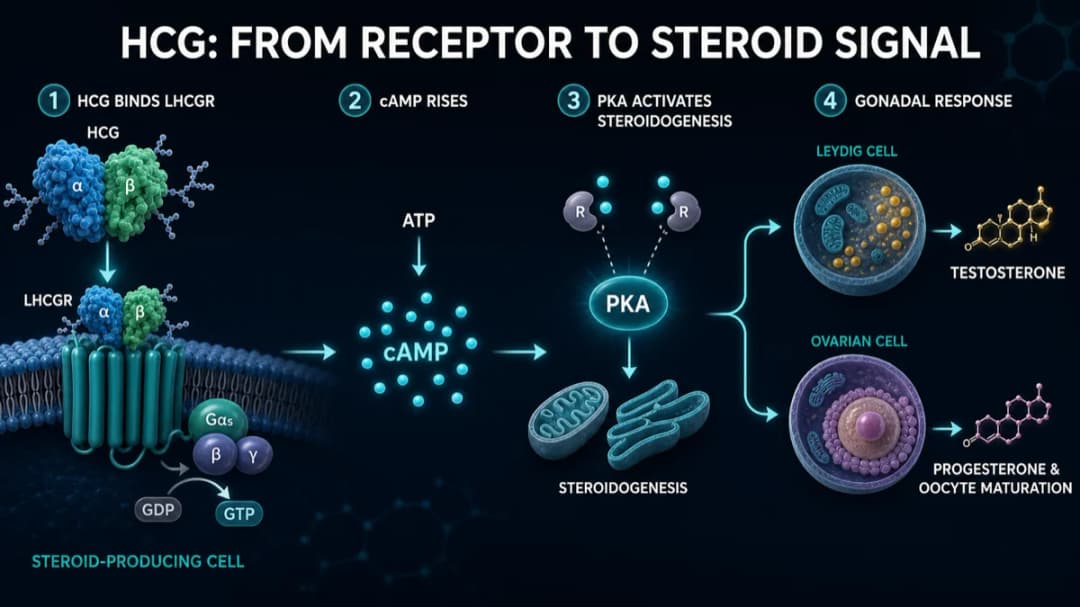
That receptor, LHCGR, is a G protein coupled receptor. HCG binding raises intracellular cyclic AMP, activating protein kinase A and switching on the steroidogenic cascade that walks cholesterol through pregnenolone to testosterone in men or progesterone in the corpus luteum in women. The signal is identical to the one LH sends, and the only meaningful difference is how long it lasts. Native LH disappears from circulation within roughly half an hour, which rules it out as an injectable. HCG lingers for well over a day, so a single administration does the work that LH itself would need a continuous infusion to accomplish.
One point of status matters before the numbers: HCG is an approved prescription hormone, not an unscheduled research chemical, and everything below reports what has been observed in clinical and research settings rather than a protocol to follow.
HCG Benefits
HCG has a narrow set of well-evidenced effects, all downstream of one receptor, and a much larger set of claims that do not survive scrutiny.
Testicular preservation during exogenous testosterone (strong human evidence). When testosterone is supplied from outside the body, the hypothalamic-pituitary-gonadal axis reads it as sufficient and stops releasing LH and FSH. Without LH, Leydig cells go quiet and the testes lose volume within months. HCG substitutes for the missing signal directly at the testes, which is its best-documented non-fertility use.
Maintaining intratesticular testosterone (strong human evidence). Testosterone inside the testis sits at a far higher concentration than anything a blood draw reports, commonly cited as one to two orders of magnitude above serum, and it is that local pool rather than the serum figure that sperm production actually depends on. Exogenous testosterone raises serum levels while intratesticular levels collapse; HCG sustains the local environment.
Supporting or restoring sperm production (good human evidence, slow). Because it preserves intratesticular testosterone, HCG supports spermatogenesis where testosterone alone suppresses it. Two caveats that promotional writing usually drops: HCG covers the LH side only, so fertility-directed protocols frequently add an FSH source such as HMG or recombinant FSH, and recovery is measured in months, commonly 3 to 6, not weeks.
Ovulation triggering in assisted reproduction (strong evidence, approved use). A single timed HCG injection reproduces the mid-cycle LH surge and drives final oocyte maturation, with retrieval typically scheduled around 36 hours later. This is HCG's longest clinical track record.
Testosterone stimulation without exogenous testosterone (moderate evidence). In secondary hypogonadism, where the shortfall is pituitary signaling rather than testicular failure, HCG can raise testosterone on its own by stimulating testes that still work. None of that carries over to primary hypogonadism. Where the testis itself has failed, amplifying the upstream message accomplishes nothing, because there is nothing left to receive it.
Mood and libido reports (weak evidence). Some men describe better mood or libido than on testosterone alone, but this is self-report rather than controlled comparison, and rising estradiol can produce the opposite effect in the same person. Sexual response specifically sits with melanocortin signaling rather than the gonadal axis, where PT-141 has far more direct human dosing precedent.
Weight loss (no evidence). The HCG diet pairs microdoses with roughly 500 calories a day. When calorie intake is held equal, adding the hormone changes nothing about the outcome, which places the entire effect on the restriction itself. Regulators have separately acted against the over-the-counter products marketed on this claim.
HCG Side Effects
HCG has decades of clinical use behind it, so its safety profile is better characterized than most compounds in this category. The reported effects fall into three groups: consequences of raising sex steroids, dose-dependent receptor effects, and one serious risk confined to fertility use.
Estrogen elevation. The most consistently reported issue in men. HCG raises testosterone production inside the testes and stimulates aromatase activity there, so more of that testosterone converts to estradiol. Complaints follow the estrogen curve: water retention, nipple sensitivity, mood swings, irritability. This is described as dose-related and more prominent at higher monotherapy-level doses, though published rates are not well established. Clinical practice monitors estradiol with a sensitive assay rather than relying on symptoms, because the changes can be gradual enough to miss.
Gynecomastia. The endpoint of unmanaged estrogen elevation rather than a separate effect. Clinicians commonly describe it as uncommon at low doses such as 250 to 500 IU and more likely at higher doses without estrogen management, but we have no sourced incidence figures to give you.
Ovarian hyperstimulation syndrome. The serious one. In women undergoing ovarian stimulation, an HCG trigger can precipitate OHSS, in which the ovaries swell and fluid shifts out of the vasculature. Severity ranges from uncomfortable to medically urgent, that fluid shift is where the thromboembolic concern originates, and multiple pregnancy is a further documented outcome of triggering ovulation in a stimulated cycle. OHSS is why fertility protocols stay ultrasound-monitored, and why kisspeptin-based triggers, which produce a self-terminating endogenous LH surge instead of sustained stimulation, have been investigated as an alternative. See the kisspeptin guide for that comparison.
LH receptor desensitization. Some users and clinicians worry that sustained high-dose exposure can blunt Leydig cell responsiveness. That concern is plausible from receptor biology but is not established in controlled human data, and it is the reasoning behind the preference for smaller, more frequent doses. Cycling is sometimes suggested as mitigation, though no controlled data on an optimal pattern exists.
Injection site reactions, headache, fatigue and fluid retention. Mild and generally transient. The label specifies intramuscular use only; subcutaneous injection is an off-label practice that some users report finds easier to tolerate, without controlled comparison.
Where the data is thin: the reassurance about long-term safety comes from supervised clinical use at defined doses for defined indications. Multi-year continuous use in otherwise healthy men is not well characterized, and neither is the interaction profile with compounds HCG gets informally combined with. Absence of reported harm there is absence of study.
HCG Dosage Chart
Only the ovulation-induction row below comes straight from the label; the rest are reported ranges or clinic and community conventions, not published label doses, and none is a recommendation. The label states intramuscular use only. Doses are expressed in international units because HCG is standardized by biological activity rather than by weight.
| Goal or context | Reported range | Frequency | Typical duration |
|---|---|---|---|
| Testicular support alongside exogenous testosterone | 250 to 500 IU | 2 to 3 times weekly | Ongoing with therapy |
| Fertility-focused support in men (clinic convention) | 500 to 1,000 IU | 2 to 3 times weekly | Until fertility goal is met |
| Fertility restart or stimulation (clinic convention) | 1,000 to 2,000 IU | 2 to 3 times weekly | 3 to 6 months |
| Post-cycle bridge after suppression (community convention, not a label dose) | 500 to 1,500 IU | Every other day to 3x weekly | 2 to 4 weeks, then taper |
| Monotherapy in secondary hypogonadism (clinic convention, not a label dose) | 1,500 to 3,000 IU | 2 to 3 times weekly | Ongoing, monitored |
| Ovulation induction after menotropin pretreatment (label) | 5,000 to 10,000 USP units | Single injection one day after the last menotropin dose | One dose |
| Ovulation trigger in IVF or IUI | 5,000 to 10,000 IU | Single timed injection | One dose |
Two things are worth reading out of that table. First, the spread from 250 IU to 10,000 IU is not a range of intensities but a set of different endpoints: a trigger dose produces one large surge, while a testicular support dose maintains a baseline signal without one. Second, frequency is set by the half-life. At 24 to 36 hours, dosing every second or third day keeps receptor stimulation reasonably continuous, which is why nearly every reported protocol lands on two or three administrations per week rather than daily. The higher-dose rows are also the ones tied to the problems above, since estrogen elevation and desensitization both scale with dose.
Reconstitution and Storage
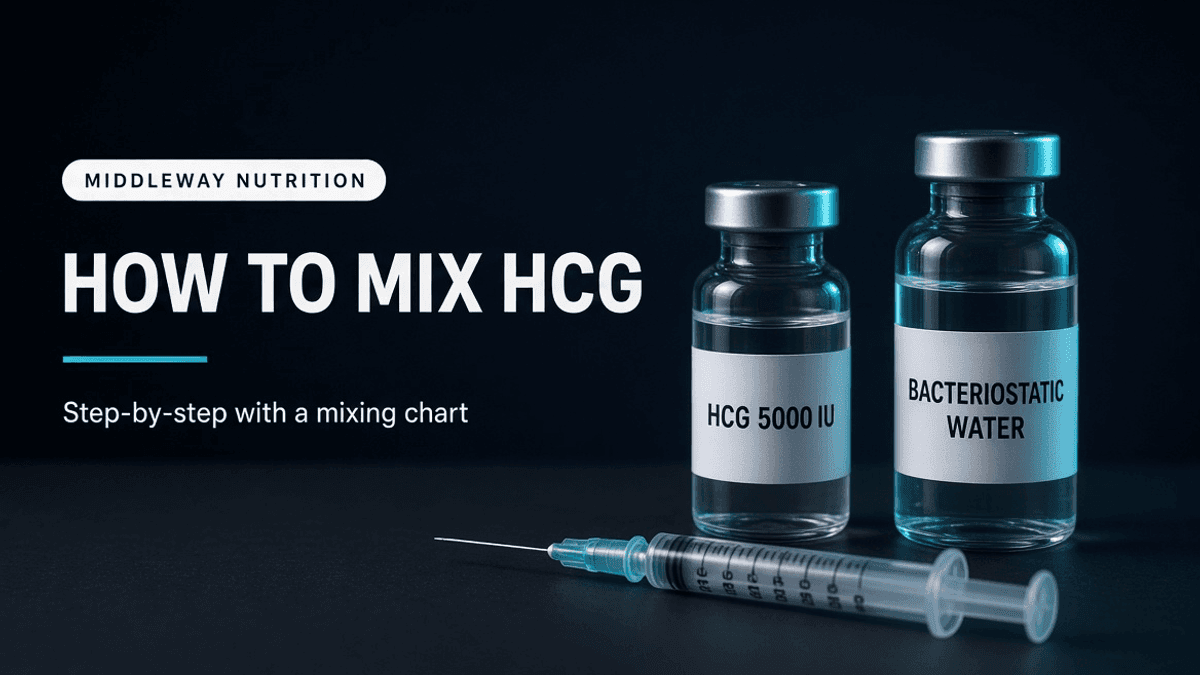
HCG ships as a lyophilized powder, typically in 5,000 IU or 10,000 IU vials, and it is more heat-sensitive than most lyophilized peptides. Unmixed powder is stored at room temperature, 20 to 25C, according to the Novarel label on DailyMed; freezer storage at -20C is a common habit for other lyophilized peptides but is not what this label specifies. Reconstitution uses bacteriostatic water added slowly down the vial wall rather than onto the powder, followed by gentle swirling. Never shake it: agitation denatures glycoproteins, and unlike a short peptide, HCG has structure to lose.
The concentration math is straightforward. A 5,000 IU vial reconstituted with 2.5 mL of bacteriostatic water gives 2,000 IU per mL, so 250 IU occupies 0.125 mL, or 12.5 units on a U-100 insulin syringe. Using 5 mL instead halves the concentration and doubles the injection volume, which is easier to measure accurately.
Once reconstituted, the vial belongs in the refrigerator at 2 to 8C, upright, capped and out of light. The same label says to refrigerate the mixed product and use it within 30 days (when mixed with bacteriostatic water). Some sources quote longer windows, up to 60 days, but those are not label claims. Cloudiness is a reason to discard it.
Stacking and Combinations
HCG appears in documented clinical combinations more often than most research peptides, but those are narrower than the informal ones.
The one genuinely evidenced pairing is with an FSH source. HCG covers LH signaling only, and spermatogenesis needs FSH as well, so fertility protocols in men with pituitary-origin deficiency commonly pair HCG with HMG or recombinant FSH.
The second is with an aromatase inhibitor, which is less a stack than a countermeasure. Because HCG drives aromatase activity in the testes, protocols that push estradiol out of range often add a low-dose inhibitor. Whether that is needed is a bloodwork question, not a default.
The third is sequential: HCG followed by a SERM such as clomiphene or enclomiphene in restart protocols, where HCG stimulates the testes directly while the SERM works upstream to bring endogenous LH and FSH back online.
Beyond that, combinations are conventional rather than evidenced. HCG appears alongside growth hormone secretagogues in men's health programs, but the axes are separate and the pairing is convenience rather than documented interaction. If GH-axis support is the objective, the sermorelin guide covers that mechanism separately.
How to Verify What You Buy
HCG cannot be verified by mass spectrometry the way a short peptide can, because it is a large glycosylated heterodimer, so a certificate of analysis should carry an identity and bioactivity method suited to a glycoprotein rather than a purity percentage borrowed from peptide testing. Ask which lab ran it, whether it is batch-specific, and whether a third party issued it. Our guide to where to buy HCG covers the suppliers that publish testing you can check.
Looking for the numbers behind this guide? Our HCG dosage chart sets label and trial doses beside what Reddit users report taking and our HCG side effects separates documented effects from what users report.
Frequently Asked Questions
What does HCG do?
It activates the LH receptor on the steroid-producing cells of the testes and ovaries, reproducing the signal luteinizing hormone normally sends. In men that drives testosterone production inside the testes; in women it triggers final egg maturation and ovulation and supports progesterone output. Its long half-life relative to LH is what makes it practical.
Does HCG count as a peptide?
Not strictly. HCG is a heterodimeric glycoprotein hormone of roughly 36.7 kDa, far larger than the short linear peptides usually discussed in this category. It is grouped with them because it is an injectable lyophilized compound sold through the same channels, but the structural difference affects handling, testing and stability.
Is HCG safe?
Within supervised clinical use at established doses it has a long, well-documented safety record. The meaningful risks are estrogen elevation in men, ovarian hyperstimulation syndrome in women undergoing fertility treatment, and receptor desensitization at sustained high doses. Long-term unsupervised use in healthy men is not well characterized, and that gap is missing data rather than evidence of safety.
How much HCG is typically used?
Reported ranges span 250 IU to 10,000 IU depending entirely on the goal, and only the 5,000 to 10,000 unit ovulation dose is a label dose. Testicular support clusters at 250 to 500 IU two or three times weekly; fertility restart protocols run 1,000 to 2,000 IU for several months; an ovulation trigger is a single 5,000 to 10,000 IU dose. These are literature ranges, not instructions.
Is HCG legal?
HCG is an approved prescription hormone in the United States for reproductive indications, so obtaining it for human use legally requires a prescription, and since the 2020 reclassification as a biologic, compounding pharmacies can no longer prepare it freely. The legal sources are a licensed prescriber and a licensed pharmacy. Material sold by research suppliers is for laboratory use only, and buying it does not make personal use lawful. It is also banned under most anti-doping codes.