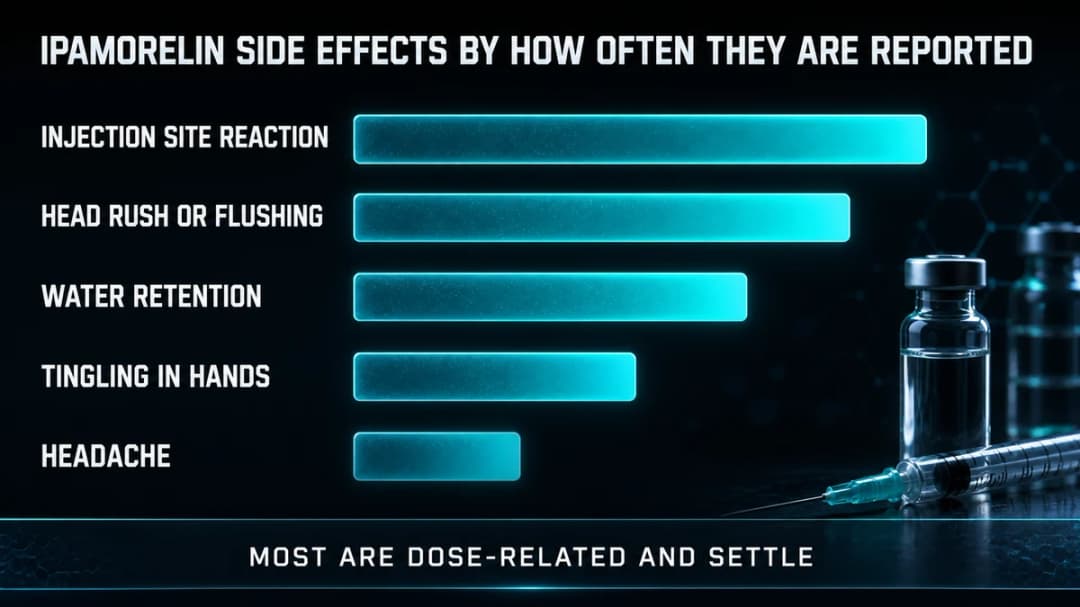
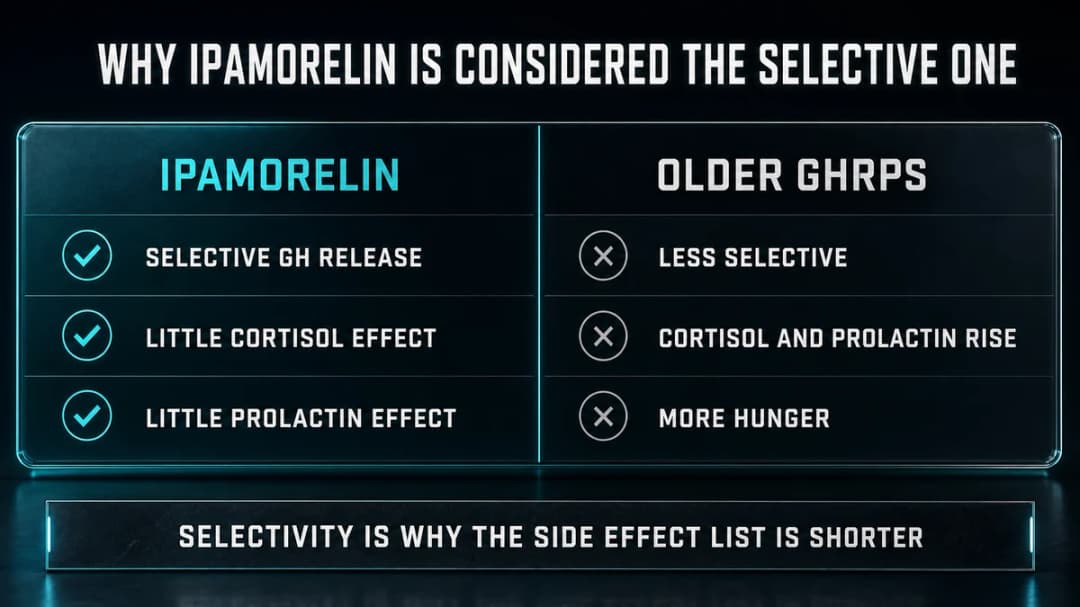
Ipamorelin side effects are, in the reports available, mild and short lived: a warm flush for half an hour after injection, a headache in the first week or two, some puffiness in the hands and face, and occasional drowsiness if the dose is taken at night. The reason people talk about ipamorelin side effects as unusually tame is selectivity, since unlike GHRP-2 and GHRP-6 it does not measurably raise cortisol or prolactin at the doses studied.
That is the useful headline. The caveat underneath it is that ipamorelin has never been approved for human use, so there is no post-marketing safety database behind those reports, only small studies and user accounts.
Ipamorelin Side Effects Reported Most Often
These cluster in the first two to four weeks and usually settle without anyone doing anything.
Flushing and warmth. The most reliably reported effect. Skin, particularly the face and neck, warms for roughly fifteen to thirty minutes after the injection. It comes from vasodilation associated with ghrelin receptor activation and it does not indicate anything going wrong.
Headache. Common in the first week or two, then generally gone. If it persists, the dose is usually the culprit rather than the compound.
Water retention. Puffy hands in the morning, slight facial fullness, rings feeling tight. This is a growth hormone class effect: rising IGF-1 promotes sodium and water retention at the kidney. It is dose related, more likely above roughly 300 mcg per injection, and generally resolves as the body equilibrates. Restricting fluids makes it worse, not better.
Injection site redness. Standard for any subcutaneous injection. Rotate sites and it stays a non-issue.
Drowsiness after an evening dose. Frequently reported and usually welcomed, since growth hormone's largest natural pulse happens in deep sleep and evening dosing is meant to sit alongside it.
The Less Common Ones
Nausea. Uncommon at typical research doses. When it happens it is usually tied to injecting on a long-empty stomach with blood sugar already low. A small snack shortly afterwards tends to prevent it.
Lightheadedness. Same underlying cause as the nausea in most reports. Injecting after five or more hours without food makes it more likely.
Brief tingling in the hands or feet. Short lived and harmless in isolation. Persistent tingling is a different matter, covered below.
Restlessness or mild anxiety. Rare. If it appears and does not settle within a few days, the dose is too high for that person.
How Ipamorelin Compares With Other Growth Hormone Peptides
The reason ipamorelin displaced the earlier compounds is visible in a single table.
| Effect | Ipamorelin | GHRP-2 | GHRP-6 | Hexarelin |
|---|---|---|---|---|
| Cortisol rise | Not detected at tested doses | Moderate | Moderate | Marked |
| Prolactin rise | Not detected at tested doses | Moderate | Moderate | Marked |
| Appetite stimulation | Mild at most | Moderate | Strong, often the main complaint | Moderate |
| Flushing | Common | Common | Common | Common |
| Water retention | Mild | Moderate | Moderate | Moderate |
| Growth hormone release | Moderate | Strong | Strong | Strongest |
The trade is straightforward. Ipamorelin gives up some raw potency in exchange for a much cleaner hormonal profile. If the goal is a growth hormone pulse without a cortisol and prolactin passenger, that trade is worth making. If someone specifically wants appetite stimulation, ipamorelin is the wrong compound.
Dose Is Almost Always the Variable
Nearly every complaint on this page scales with dose. Reported research protocols sit around 100 to 300 mcg per injection, and most of the difficulty people describe starts at the upper end of that or above it.
| Reported dose per injection | What tends to be reported |
|---|---|
| 100 mcg | Flushing at most, often nothing else |
| 200 mcg | Flushing, occasional headache in week one |
| 300 mcg | Above plus noticeable water retention in some people |
| 400 mcg and above | Water retention more likely, appetite effect appears, joint stiffness reported by some |
Starting at the low end and moving up slowly is not caution for its own sake. It makes the side effects legible: if something appears after a dose increase, the cause is obvious.
The Signals That Mean Stop and Reassess
Most of what is described above is nuisance rather than warning. Three things are different.
Persistent numbness or pins and needles in the hands. This is the recognisable pattern of fluid-driven nerve compression seen in growth hormone excess, in a much milder form. It is dose related and it resolves when exposure comes down. It should not be pushed through.
Joint aches and stiffness that build over weeks. Same family of effects, same response: reduce the dose.
Puffiness that has not settled by six weeks. Early water retention is expected. Water retention that never resolves means the exposure is above what that person tolerates.
Growth hormone also opposes insulin, so anyone with existing insulin resistance, prediabetes or diabetes has a reason to monitor fasting glucose rather than assume nothing is happening. In healthy adults at research doses the glycaemic effect appears small.
What Changes When It Is Stacked With CJC-1295
Almost nobody runs ipamorelin alone, so the practical question is how the pairing behaves. The answer is that stacking does not introduce a new category of side effect. CJC-1295 acts on the GHRH receptor rather than the ghrelin receptor, and it has its own clean profile, so the combination adds no cortisol or prolactin burden.
What it does add is total growth hormone and IGF-1 exposure, because the two pathways together release more than either alone. Everything that scales with that exposure therefore becomes more likely: water retention first, then joint stiffness and hand tingling at the higher end. The version of CJC-1295 matters here too, since the long-acting DAC form keeps IGF-1 elevated continuously rather than in pulses.
For more on the pairing, see our CJC-1295 vs ipamorelin comparison and the FIT stack guide.
Practical Ways to Keep It Mild
- Begin at 100 mcg per injection and increase over a fortnight rather than starting high
- Inject on a relatively empty stomach for the growth hormone response, but not after a very long fast, which is when nausea and lightheadedness show up
- Use the evening dose deliberately, since drowsiness there is useful rather than disruptive
- Rotate injection sites
- Keep fluid intake normal. Dehydration worsens retention rather than helping it
- Cycle rather than running continuously. Pituitary receptor sensitivity falls with constant stimulation, and the usual convention is a block of weeks on followed by a comparable break
None of that is a substitute for medical oversight, and none of it makes an unapproved research compound into a medicine.
FAQ
Does ipamorelin have serious side effects?
Nothing serious has been documented at typical research doses in healthy adults. The reported effects are mild and reversible. What is missing is long-term human safety data, so "no serious effects reported" is not the same as "proven safe over years".
Does ipamorelin make you hungry?
Far less than GHRP-6, which is notorious for it. Ipamorelin binds the same receptor as ghrelin, so an appetite effect is mechanistically possible, but most people on standard doses report little or none until the dose rises.
Why does ipamorelin cause water retention?
Higher growth hormone raises IGF-1, and IGF-1 promotes sodium and water retention at the kidney. It is the same mechanism behind fluid retention with growth hormone therapy, in a milder form, and it is dose dependent.
Can ipamorelin raise cortisol?
At the doses that have been tested, no. That selectivity is structural rather than something achieved by dosing technique, and it is the main pharmacological argument for choosing ipamorelin over the older growth hormone releasing peptides.
Does ipamorelin affect blood sugar?
Growth hormone is counter-regulatory to insulin, so a small upward nudge in glucose is plausible. In healthy adults with normal insulin sensitivity the effect appears minor. Anyone already insulin resistant, or on insulin therapy, needs medical input before using any secretagogue.
How long do the side effects last?
Flushing lasts under an hour per dose. Headache typically fades within a fortnight. Water retention usually settles in two to four weeks. Anything still present after six weeks is a dose signal, not an adjustment period.