The FIT Stack pairs two growth hormone secretagogues in one vial, so its benefits, side effects, and dosage are really two profiles, not one. That distinction gets lost in most write ups, which treat the bundle as if it were a single molecule with a single safety sheet. It is not. Understanding it means understanding each half, then understanding what happens when they are given together.
Key Takeaways
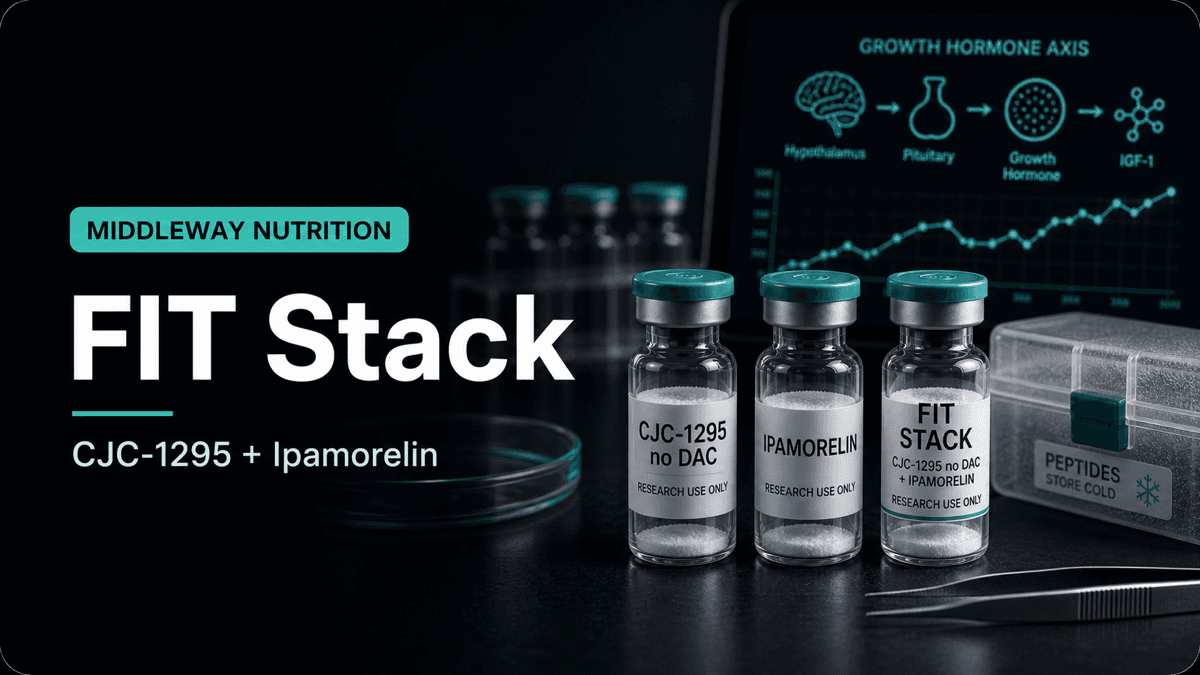
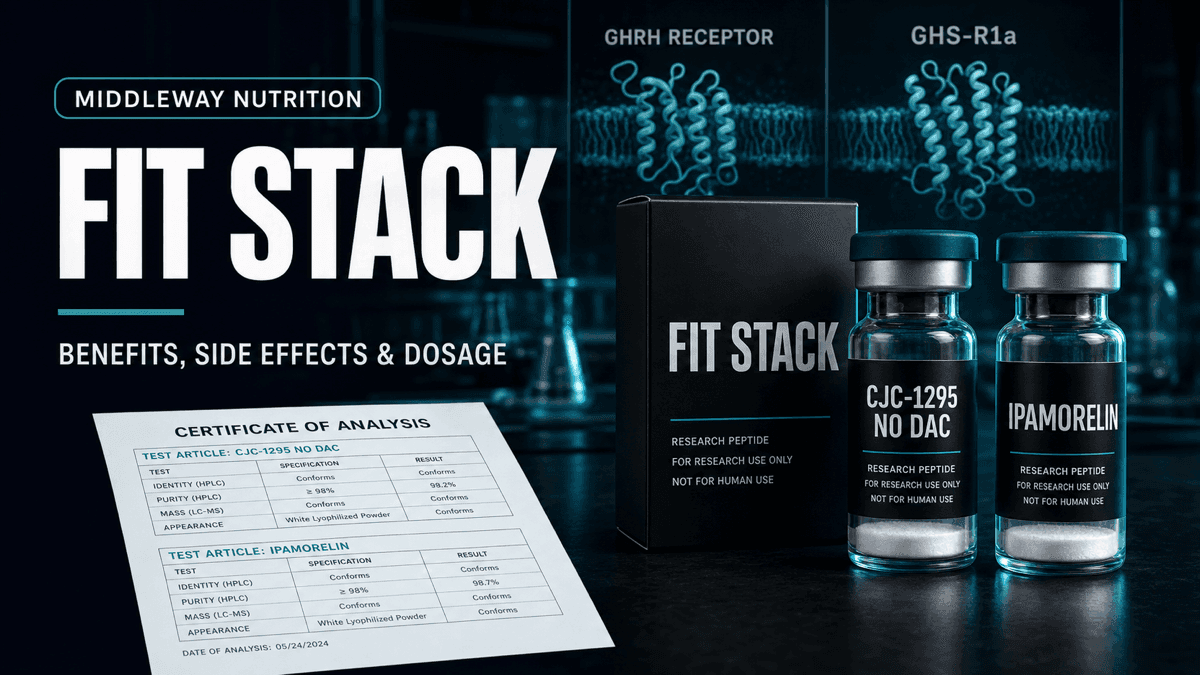
- FIT Stack is a product name, not a compound. It is a two vial bundle of CJC-1295 without DAC and ipamorelin, typically 5 mg of each as lyophilized powder.
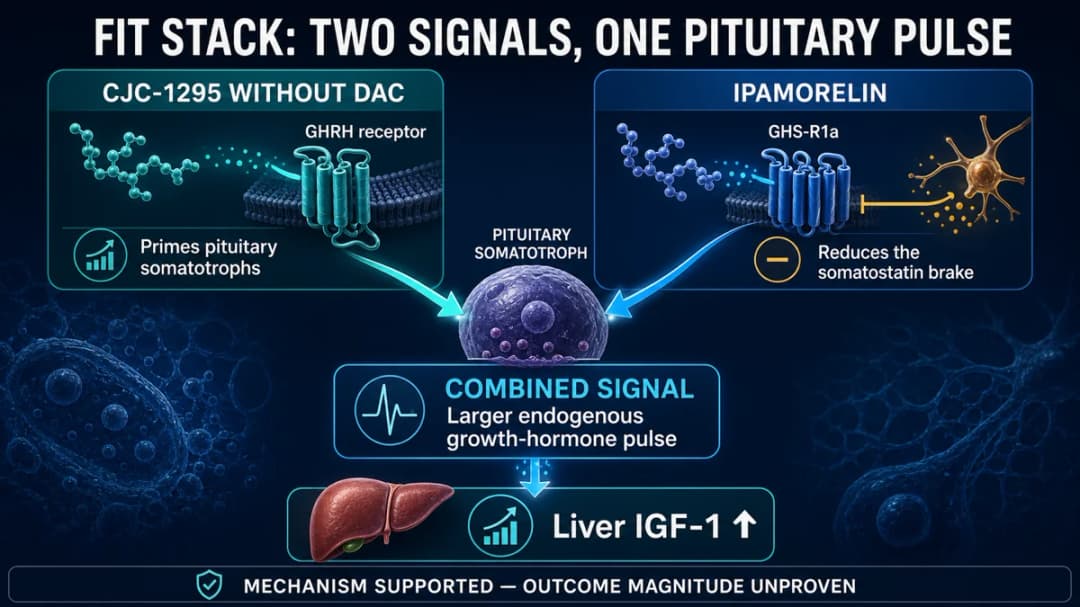
- The two work on separate receptors. CJC-1295 hits the GHRH receptor, ipamorelin hits the ghrelin receptor GHS-R1a, and hitting both at once produces a larger growth hormone pulse than either produces alone.
- Reported research figures cluster around 100 to 200 mcg of each compound per subcutaneous injection, one to three times daily, over cycles of roughly 12 to 16 weeks.
- Side effects have to be read per component. Neither is exotic, but the water retention, tingling, and flushing reports come from slightly different places.
- Neither compound is FDA approved. Nothing below is a protocol, a recommendation, or a substitute for a clinician.
What the FIT Stack Actually Contains
Vendors selling a FIT Stack are selling two vials in one box. The contents are consistent across sellers: CJC-1295 in its no DAC form, and ipamorelin, each usually supplied at 5 mg of lyophilized powder. Because it is a bundle rather than a formulation, the two peptides are not premixed. They are reconstituted and handled separately, and in most reported research protocols they are drawn into the same syringe only at the point of injection, if at all. Vial specs and prices for the individual halves are covered in our guide to ipamorelin for sale.
CJC-1295 without DAC is a shortened, stabilized version of growth hormone releasing hormone, and you will also see it sold under the name modified GRF 1-29. It binds GHRH receptors on the somatotroph cells of the anterior pituitary and prompts those cells to synthesize and release the growth hormone they already hold. The DAC in the other version stands for Drug Affinity Complex, an addition that binds the peptide to serum albumin and stretches its activity out over days. Strip that off and the half life falls to roughly thirty minutes. Shorter is not worse here. A brief signal produces a discrete pulse, which is closer to how the pituitary behaves on its own, and that is why most research use of this compound favors the no DAC version. Our fuller breakdown lives in the CJC-1295 guide.
Ipamorelin is a five amino acid chain acting on a completely different receptor. It binds GHS-R1a, the receptor ghrelin uses, which sits both on pituitary somatotrophs and in the hypothalamus. Activating it does two things at once: it raises the amplitude of the growth hormone pulse and it dampens somatostatin, the brake the body applies to shut that pulse down. Its circulating half life runs around two hours. What set ipamorelin apart from the older GHRPs it replaced was selectivity, covered in more depth in the ipamorelin guide.
The reason these two get bundled is mechanistic rather than commercial. GHRH signaling widens the pool of pituitary cells that will answer a secretagogue signal. A ghrelin receptor agonist then increases how much each responding cell puts out. Applied together the effect is more than additive, and this is one of the better established observations in growth hormone axis pharmacology. It is not a marketing claim. It is why the pairing became the default in the first place.
Both compounds are research chemicals in the United States. Neither is approved for human therapeutic use, and CJC-1295 and ipamorelin both appear among substances the FDA has moved to keep out of compounding pharmacy practice. Everything that follows describes what has been reported in research settings, not what anyone should do.
FIT Stack Benefits
The honest version of this section separates what is measured from what is inferred.
Growth hormone and IGF-1 elevation is the measured part. This is the endpoint the compounds were built to hit and the one with actual human data behind it. Clinical work on the DAC form of CJC-1295 showed multi fold increases in circulating growth hormone against baseline with IGF-1 staying elevated for several days after a single administration. The no DAC form trades that duration for a sharper, briefer peak. Ipamorelin's ability to raise growth hormone in humans is likewise documented. Combined administration producing a larger pulse than either alone is well supported at the level of pituitary physiology. What is not well supported is any precise percentage figure for the combination advantage. You will see numbers quoted with confidence around the internet; treat them as estimates rather than findings.
Sleep quality is the most consistent subjective report. There is a real physiological hook here, since the largest natural growth hormone pulse occurs during slow wave sleep, and secretagogue timing in reported protocols is built around that window. Reports of deeper sleep and more vivid dreaming within the first week or two are common. They are also self reported and unblinded, which is exactly the kind of endpoint most vulnerable to expectation. Grade it plausible, not proven.
Body composition change is inferred from what growth hormone does, not measured for this stack. Growth hormone promotes lipolysis and supports lean mass, and studies of growth hormone deficient adults on replacement therapy show reductions in fat mass, particularly visceral fat, alongside lean tissue gains. Whether the more modest, pulsatile elevation a secretagogue produces in someone with a normal axis reaches the same endpoint is a genuinely open question. Reported timelines put visible change somewhere past the six to eight week mark and continuing through twelve to sixteen. Nobody has run the trial that would confirm the magnitude.
Recovery and connective tissue effects sit on the weakest evidence. Growth hormone and IGF-1 are involved in tissue repair, and improved joint comfort and faster recovery between training sessions come up often in user reports. The mechanism is not fantasy. The human data specific to these peptides is close to nonexistent. If recovery is the goal, that is worth knowing before spending money on it.
One thing the stack does not do is supply growth hormone. It asks the pituitary for more of its own. That caps the ceiling at whatever the gland can produce and keeps release pulsatile rather than flat. Both are usually presented as safety advantages over exogenous growth hormone, and both are also the reason the effect size is moderate. Our FIT Stack review goes further into what the pairing actually delivers.
FIT Stack Side Effects
Read this per compound, because the profiles overlap but are not identical.
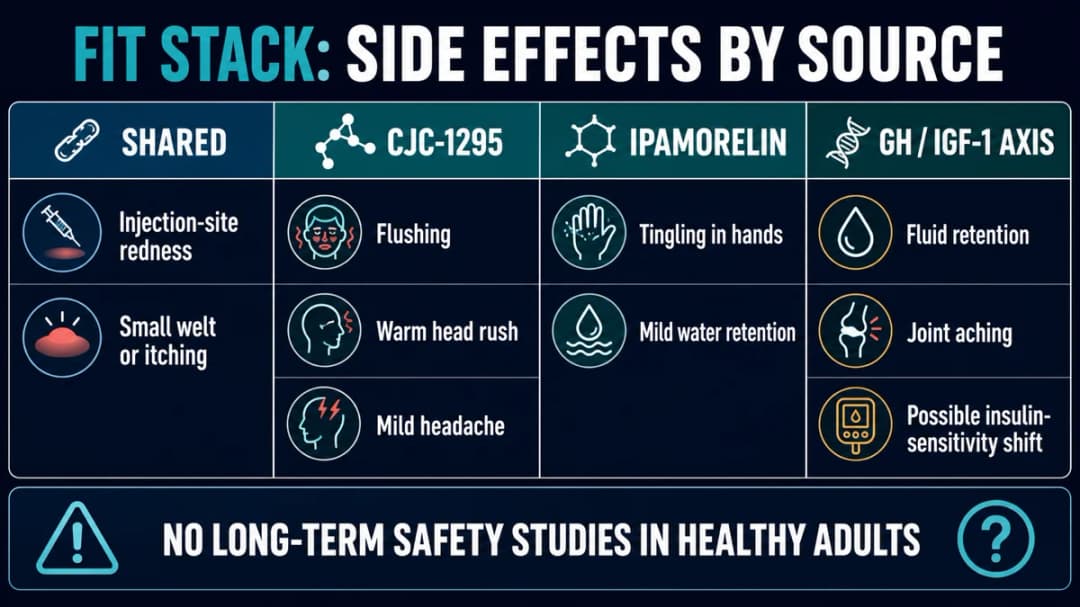
Shared across both: injection site reactions are the most frequent complaint, usually redness, a small welt, or brief itching that resolves within hours. Rotating sites is the standard mitigation mentioned in reported protocols.
More associated with CJC-1295: flushing and a warm head rush in the minutes after injection, occasional lightheadedness, and mild headache. These track with the vasodilatory effects of GHRH signaling and generally fade as use continues.
More associated with ipamorelin: tingling or numbness in the hands and fingers, and mild water retention showing up as puffiness in the hands or face. Both are consistent with growth hormone driven fluid shifts.
Attributable to growth hormone elevation itself, from either or both: fluid retention, joint aching, and in some reports transient wrist discomfort. These are dose related and are the same class of effect seen at the low end of growth hormone therapy.
Worth watching, thinly documented in this context: growth hormone antagonizes insulin, so sustained elevation can reduce insulin sensitivity and nudge fasting glucose upward. This is well characterized for growth hormone therapy. Whether intermittent secretagogue driven pulses do the same to any meaningful degree has not been properly studied. It is the single most plausible metabolic concern with long term use and the one where the data is thinnest.
Ipamorelin's specific advantage over older GHRPs is what it does not do. GHRP-6 drives strong hunger and GHRP-2 raises cortisol and prolactin alongside growth hormone. Ipamorelin at typical research doses moves cortisol, prolactin, and ACTH very little, which is the main reason it displaced them.
The larger unknown applies to the stack as a whole. There are no long term safety studies of chronic growth hormone secretagogue use in healthy adults. Theoretical concerns about sustained IGF-1 elevation and cell proliferation are why cycling appears in every reported protocol, and why anyone with a personal or family cancer history is routinely told to stay away. That caution is inference from growth hormone biology, not a documented outcome, but it is reasonable inference.
FIT Stack Dosage Chart
These are figures reported in research and vendor literature. They are recorded here for reference, not offered as instructions.
| Context | Reported range (each compound) | Frequency | Typical cycle |
|---|---|---|---|
| Common baseline in reported protocols | 100 mcg CJC-1295 + 100 mcg ipamorelin | 1x daily, pre sleep | 12 to 16 weeks on, 4 to 8 weeks off |
| Two dose research schedule | 100 to 200 mcg of each | 2x daily, morning fasted and pre sleep | 12 to 16 weeks on, 4 to 8 weeks off |
| Three dose research schedule | 100 to 200 mcg of each | 3x daily, morning, post exercise, pre sleep | 12 to 16 weeks on, 4 to 8 weeks off |
| CJC-1295 alone, reported range | 100 to 200 mcg | 1 to 3x daily | Cycled |
| Ipamorelin alone, reported range | 100 to 200 mcg | 2 to 3x daily | Cycled |
A few points of context the numbers alone do not carry.
Timing matters more here than magnitude. The pre sleep injection appears in essentially every reported protocol because it stacks a secretagogue signal on top of the natural nocturnal pulse. Reported protocols also place injections thirty to sixty minutes away from food, since elevated blood glucose and insulin blunt growth hormone release.
Dose response flattens. Above roughly 200 mcg per injection the pituitary's release capacity, not the amount of peptide present, becomes the limiting factor. Higher figures circulate but there is no evidence they buy a proportionally larger pulse, and side effect frequency rises with them.
Cycling is universal in reported protocols, generally around twelve to sixteen weeks on followed by four to eight off. The stated rationale is receptor sensitivity and avoiding continuous IGF-1 elevation. As a practical matter a 5 mg vial of each compound covers a meaningful stretch of a typical schedule.
Reconstitution and Storage
Each vial ships as a freeze dried cake that has to be brought back into solution before anything can be drawn from it, and bacteriostatic water is the diluent used in reported handling. That handling is straightforward: add the diluent slowly down the vial wall rather than directly onto the powder, then swirl gently. Do not shake. Peptides are fragile enough that mechanical agitation can degrade them.
A common figure is 2 mL of bacteriostatic water per 5 mg vial, which yields 2500 mcg per mL and makes a 100 mcg measure equal to 4 units on a standard insulin syringe. Once reconstituted both peptides go in the refrigerator, and reported shelf life for the mixed solution is roughly 28 to 30 days. Unopened lyophilized powder is far more stable and keeps for a year or more refrigerated, longer frozen. Keep both away from light. Because the FIT Stack is two separate vials, each gets reconstituted on its own.
Stacking Beyond the Two Components
The stack is itself the stacking decision, and it is the well documented one. Beyond it the evidence thins quickly.
Substituting a different GHRH analog is the change with the clearest logic. Tesamorelin is the only GHRH analog in this family with FDA approval for an indication, and it has real human data on visceral fat reduction that CJC-1295 does not. It is more expensive and shorter acting in practice, but if visceral fat is the endpoint, it is the compound with the evidence.
Adding MK-677 comes up often as a way to maintain elevation between injection windows. It is orally active and long acting, which is precisely why it flattens the pulsatile pattern the no DAC version of CJC-1295 was chosen to preserve. Combining them works against the reason for the stack's design.
Pairing with BPC-157 for recovery is common in practice and has essentially no controlled human data supporting the combination specifically. Treat that as an anecdote, not a finding.
How to Verify What You Buy
Because this is a bundle, verification applies twice: you want a current third party certificate of analysis for the CJC-1295 vial and a separate one for the ipamorelin vial, each identifying the peptide by mass spectrometry and reporting purity by HPLC. A vendor supplying one document for a two peptide box is not showing you enough. Our FIT Stack sourcing guide walks through which sellers publish per lot documentation and which reuse the same PDF across batches.
Frequently Asked Questions
What does the FIT Stack actually do?
It prompts the pituitary to release more of its own growth hormone by hitting two receptors at once. CJC-1295 activates the GHRH receptor and ipamorelin activates the ghrelin receptor, and the combined signal produces a larger pulse than either alone. Downstream, growth hormone drives IGF-1 production, which is where the reported effects on body composition, recovery, and sleep are presumed to come from. Growth hormone elevation is the measured part. The rest is inference.
Is the FIT Stack safe?
Short term tolerability in research settings has been reasonable, with side effects mostly limited to injection site reactions, fluid retention, tingling, and flushing. That is not the same as established safety. There are no long term studies of secretagogue use in healthy adults, the effect on insulin sensitivity over months is unstudied, and the theoretical concern about sustained IGF-1 elevation is why cycling shows up in every protocol. Anyone with diabetes, active cancer, or a significant family cancer history is routinely advised against these compounds.
How much is typically used?
Reported figures center on 100 to 200 mcg of each compound per subcutaneous injection, one to three times daily, with a pre sleep dose in nearly every published schedule. Cycles run about twelve to sixteen weeks with four to eight weeks off. These are observed ranges from research literature and vendor documentation rather than validated human dosing, and there is no approved standard for either compound.
Is the FIT Stack legal?
Both peptides can be legally sold in the United States as research chemicals labeled not for human consumption, and buying them for laboratory use is lawful. Neither is FDA approved for human use, and both fall under restrictions that keep compounding pharmacies from formulating them. Both are prohibited in competitive sport under WADA rules as growth hormone secretagogues. Rules vary considerably by country, so check local law rather than assuming.
Medical disclaimer: This article is for informational and educational purposes only and is not medical advice. CJC-1295 and ipamorelin are not approved by the FDA for the treatment of any condition. The dosing figures described here are reported ranges drawn from research literature and product documentation, presented for reference only, and are not a recommendation or protocol. Do not use any research compound without consulting a qualified healthcare professional.