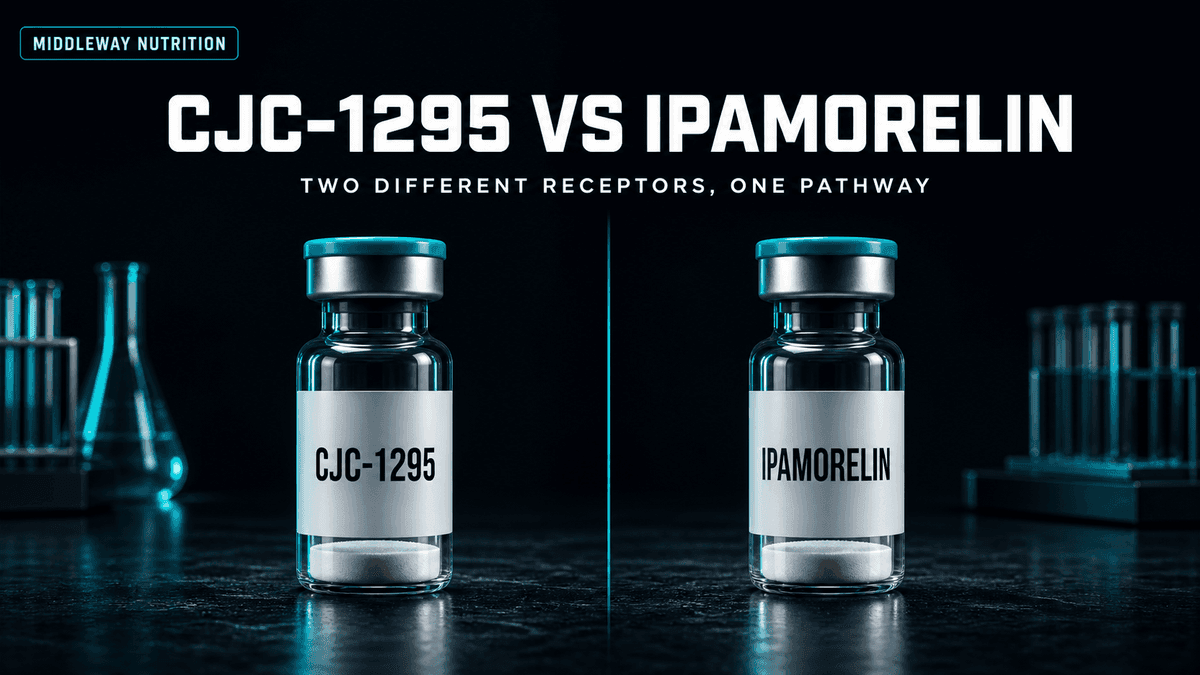
CJC-1295 vs ipamorelin is not really a choice between rivals. CJC-1295 is a GHRH analogue that raises the baseline signal telling the pituitary to make growth hormone, while ipamorelin is a ghrelin receptor agonist that opens the gate and releases a pulse. They act on different receptors, which is exactly why researchers run them together rather than picking one.
If you only want the practical takeaway: ipamorelin alone is the cleaner and simpler option, CJC-1295 alone produces a broader and longer signal, and the combination produces more growth hormone release than either does by itself. None of the three is an approved medicine.
CJC-1295 vs Ipamorelin: The Core Difference
Growth hormone release is controlled by two opposing inputs from the hypothalamus, plus a permissive one from the gut. Growth hormone releasing hormone tells the pituitary to release. Somatostatin tells it to stop. Ghrelin, better known as an appetite signal, also amplifies release and blunts somatostatin.
CJC-1295 copies the first of those. It is a modified 29 amino acid version of GHRH, engineered to survive in the bloodstream far longer than the natural hormone, which is broken down within minutes.
Ipamorelin copies the third. It is a five amino acid peptide that binds the ghrelin receptor on pituitary cells, producing a rapid pulse of growth hormone without dragging cortisol and prolactin up with it, which is what its predecessors GHRP-2 and GHRP-6 do.
Because they push on separate levers, the effect of using both is more than additive. That pharmacological point is the entire reason the pairing exists.
The Two Versions of CJC-1295 Matter More Than the Comparison
Most confusion in this topic comes from people comparing ipamorelin to "CJC-1295" without saying which one.
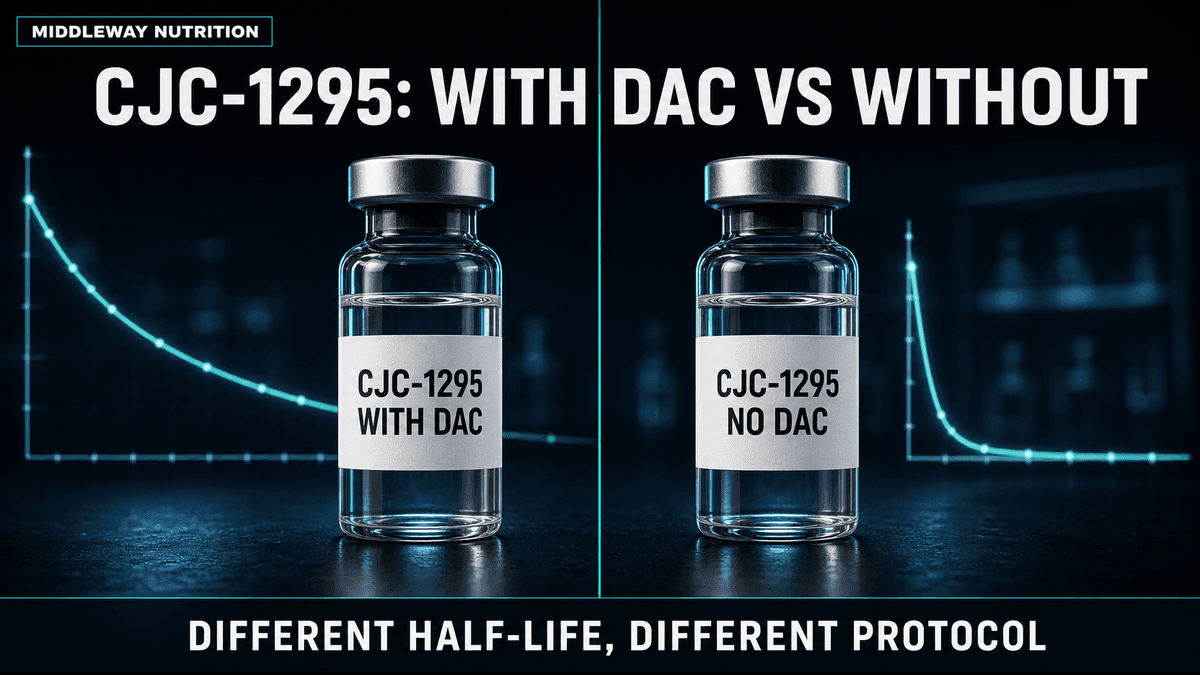
CJC-1295 with DAC carries a drug affinity complex that binds it to albumin in the blood. That pushes the half-life out to roughly six to eight days, so a single injection keeps GHRH signalling elevated for most of a week. Growth hormone release stops being pulsatile and becomes a raised plateau.
CJC-1295 without DAC, usually sold as Mod GRF 1-29, has no albumin binder and clears in about half an hour. Each dose produces a discrete pulse, then baseline returns. This is the version almost always paired with ipamorelin, because their timelines are compatible and the pulsatile pattern is closer to normal physiology.
Whether continuous or pulsatile signalling is preferable is unsettled. Natural growth hormone secretion is strongly pulsatile, and the pulses appear to matter for how tissues respond, which is an argument against flooding the system continuously. Against that, sustained IGF-1 elevation is easier to produce with the DAC version. The honest position is that nobody has run the trial that settles it.
Side by Side
| Factor | CJC-1295 with DAC | CJC-1295 no DAC (Mod GRF 1-29) | Ipamorelin |
|---|---|---|---|
| Class | GHRH analogue | GHRH analogue | Ghrelin receptor agonist |
| Size | 29 amino acids | 29 amino acids | 5 amino acids |
| Receptor | GHRH receptor | GHRH receptor | GHS-R1a |
| Half-life | About 6 to 8 days | About 30 minutes | About 2 hours |
| Release pattern | Sustained elevation | Pulsatile | Pulsatile |
| Reported research frequency | 1 to 2 times weekly | 2 to 3 times daily | 2 to 3 times daily |
| Cortisol and prolactin | Not implicated | Not implicated | Not implicated at tested doses |
| Appetite effect | None expected | None expected | Mild, dose dependent |
| Typical reported dose | Weight based in early trials | 100 to 300 mcg per dose | 100 to 300 mcg per dose |
| Human trial depth | Early phase only | Limited | Limited |
Those dose figures come from research protocols, not from any approved label. There is no established human therapeutic dose for either compound, because neither has an approved therapeutic use.
What the Human Evidence Actually Shows
This is where the topic usually gets oversold, so it is worth being precise about how much exists.
CJC-1295. Early phase human work with the DAC version reported large multiples of baseline growth hormone after single doses, with IGF-1 staying elevated for well over a week. Injection site reactions and flushing were the main tolerability findings. Development did not continue to later phase trials, and the published record does not extend to long-term outcomes, body composition endpoints in large samples, or safety over months of use.
Ipamorelin. The pharmacology is well characterised: it produces dose-dependent growth hormone release and, unlike GHRP-2 and GHRP-6, does not measurably shift cortisol or prolactin. Human clinical investigation went furthest in post-surgical bowel recovery rather than body composition, and it did not lead to an approved product.
The combination. The synergy between a GHRH analogue and a ghrelin receptor agonist is a genuine and repeatedly demonstrated pharmacological effect in pituitary physiology. What has not been demonstrated is that the resulting growth hormone increase translates into the fat loss, recovery and lean mass outcomes the marketing around these peptides implies. Growth hormone going up is a measurement. Body composition changing is a claim, and the trials that would test it have not been run at any useful scale.
That gap is the single most important thing to understand about this whole category. See our growth hormone secretagogue comparison and the note on CJC-1295, IGF-1 and the regulatory problem for more on where the evidence thins out.
Which One on Its Own
Ipamorelin alone makes sense if the priority is a clean, short-acting signal with minimal knock-on hormonal effects and the ability to stop quickly. It is the most selective compound in its class and the easiest to reason about. If ipamorelin on its own is the pick, our guide to ipamorelin for sale covers vial sizes and COA checks.
CJC-1295 no DAC alone is rarely used by itself. Its value is as the GHRH half of a pair, and on its own it produces a modest pulse that ipamorelin would amplify considerably.
CJC-1295 with DAC alone is the option for anyone who wants fewer injections. The tradeoff is that a compound with a week-long half-life cannot be un-injected if something goes wrong, and continuous signalling is more likely to blunt pituitary responsiveness over time than intermittent signalling.
The stack is what most protocols use, typically the no-DAC version co-administered with ipamorelin, dosed on an empty stomach because food, particularly fat and carbohydrate, blunts the growth hormone response.
Side Effects and What They Have in Common
The reported profiles overlap heavily, which makes sense given both end in the same downstream hormone.
Shared: injection site redness, flushing, headache, water retention in the first weeks, occasional lightheadedness after dosing. Ipamorelin adds a mild appetite effect and, with evening dosing, drowsiness that most people consider a benefit rather than a side effect.
Shared cautions: both raise IGF-1, both can nudge blood glucose upward because growth hormone opposes insulin, and both are unsuitable for anyone with an active cancer diagnosis, diabetic retinopathy, or during pregnancy and breastfeeding. Long-term human safety data does not exist for either.
Both are also on the World Anti-Doping Agency prohibited list, so both are off limits for tested athletes.
FAQ
Can CJC-1295 and ipamorelin be mixed in the same syringe?
In research practice they are commonly reconstituted separately and drawn into one syringe for a single injection, since the no-DAC version and ipamorelin have compatible timing. Doing this correctly depends on sterile technique and accurate reconstitution, which is where most home errors happen.
Which is better for muscle growth?
Neither has been shown in a proper trial to build muscle in humans. Both raise growth hormone, and the combination raises it more, but the step from higher growth hormone to measurable hypertrophy has not been demonstrated at any useful scale in this class of compound.
Why do people use CJC-1295 without DAC instead of with DAC?
Two reasons. The short half-life keeps growth hormone release pulsatile, which more closely matches normal physiology, and it pairs cleanly with ipamorelin's similar timing. The DAC version's week-long action makes it convenient but harder to control.
Does ipamorelin cause hunger the way GHRP-6 does?
Far less. Ipamorelin binds the same receptor as ghrelin, so an appetite effect is possible, but its structure produces a much weaker appetite signal. Most people on standard doses notice little or nothing until the dose gets high.
Are either of these legal to buy?
Neither is approved for human use, so both are sold as research chemicals. Legality of personal purchase varies by country, and quality is guaranteed by nothing except the seller's own testing. Batch-specific certificates of analysis are the minimum worth insisting on.
How long do people run these compounds?
Reported research protocols usually run eight to twelve weeks with a break afterwards, on the reasoning that continuous stimulation downregulates pituitary receptor sensitivity. The break length is convention rather than something established by trial data.