This Melanotan dosage guide covers what people actually use rather than anything approved, because Melanotan II has no licence anywhere and is sold as a research compound. Any Melanotan dosage guide worth reading has to start with the same point: reported protocols begin at 0.25 mg to test tolerance, because the nausea at higher first doses is what stops most people.
Melanotan I is a different situation. Its pharmaceutical form, afamelanotide, is an approved medicine for a rare light-sensitivity disorder, given as an implant under specialist supervision. What is sold online as MT-I is not that product.
What These Compounds Do
Both are analogues of alpha-melanocyte stimulating hormone, the natural signal that tells pigment cells to produce melanin. Both are far more stable than the natural hormone, which degrades within minutes.
The difference is receptor selectivity, and it explains almost everything about how they behave.
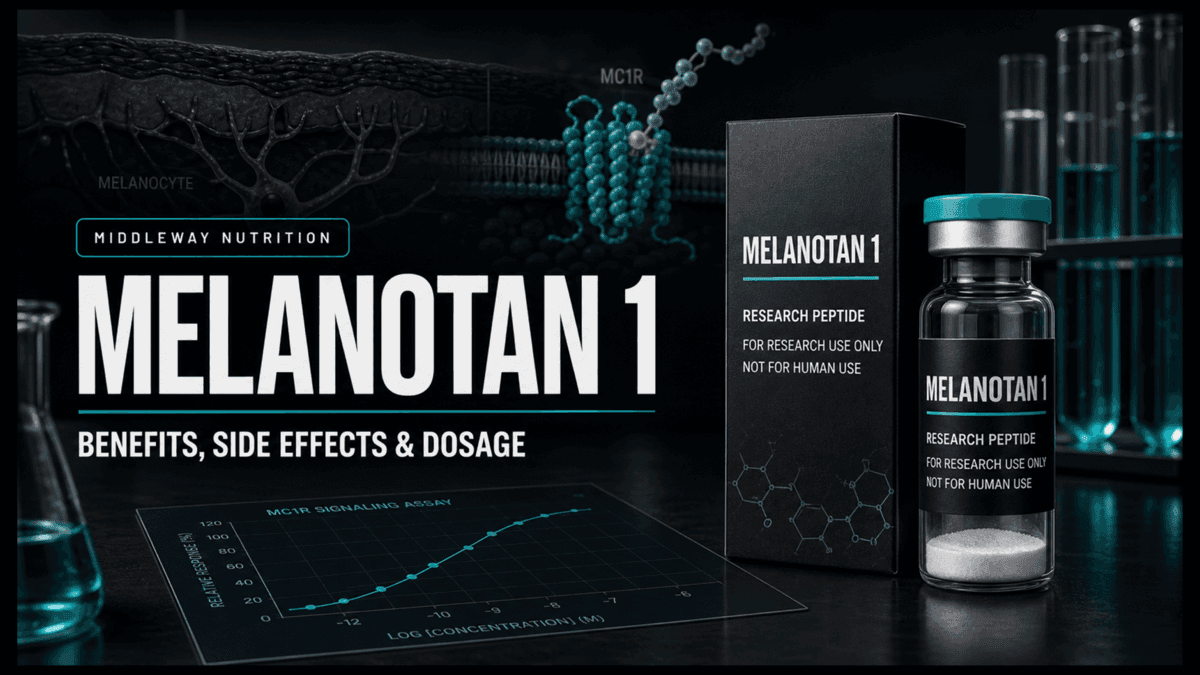
Melanotan I is relatively selective for MC1R, the receptor on pigment cells. Tanning develops more slowly and there are fewer effects elsewhere in the body.
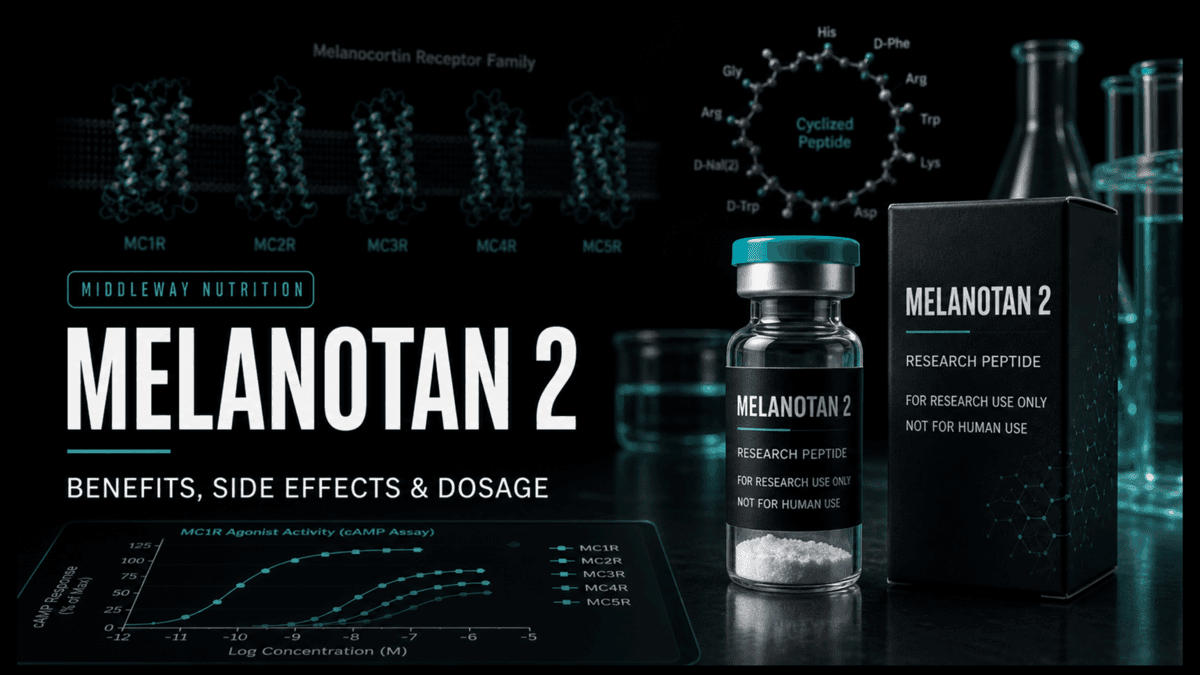
Melanotan II is a shorter, cyclic molecule that binds several melanocortin receptors, including MC4R, which sits in pathways governing appetite and sexual arousal. That is why it tans faster and also why it produces nausea, flushing, appetite suppression and spontaneous erections in men. The extra effects are not impurities or bad batches. They are the drug.
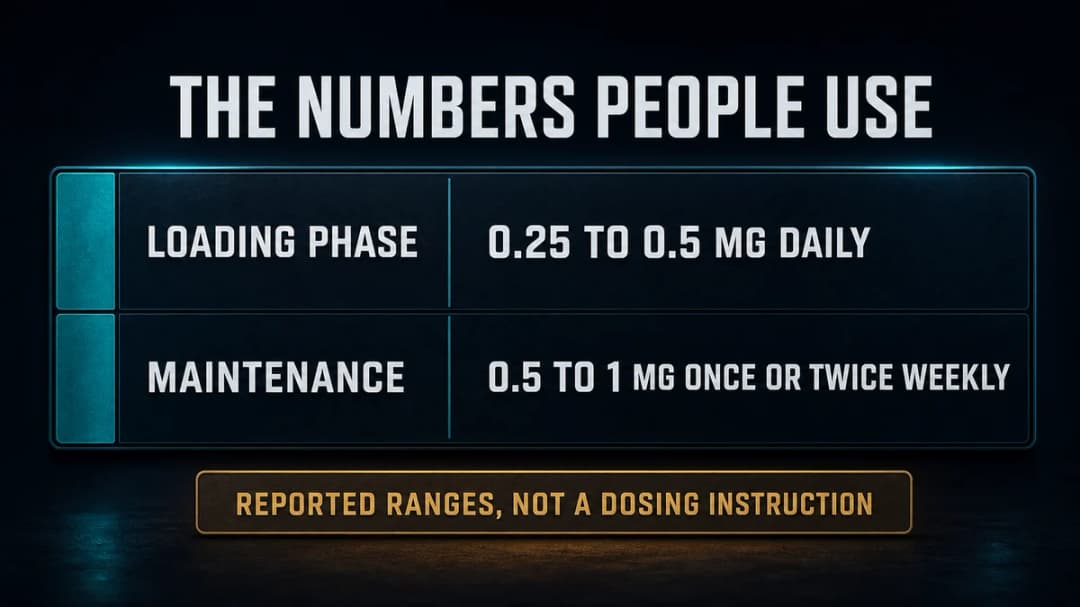
Melanotan Dosage Guide: The Numbers People Use
These are reported research and user protocols, not medical recommendations, and there is no approved dose to compare them against.
Melanotan II
| Phase | Dose | Frequency | Notes |
|---|---|---|---|
| Tolerance test | 0.25 mg | Once, in the evening | Assesses nausea and flushing before going further. Fair-skinned users often start lower still |
| Loading | 0.5 mg | Daily | Continued until the desired depth of colour, alongside UV exposure |
| Maintenance | 0.5 to 1 mg | Two or three times weekly | Holds the colour with much less UV needed |
Doses above 1 mg per injection appear in user protocols and buy very little additional effect for a considerable increase in nausea.
Melanotan I
Reported subcutaneous protocols sit around 0.5 to 1 mg daily, higher in milligram terms than MT-II for a slower effect, which reflects the lower potency of a more selective molecule. The clinical implant form uses a much larger total dose released slowly over months, and it is not comparable to a daily injection.
Reconstitution
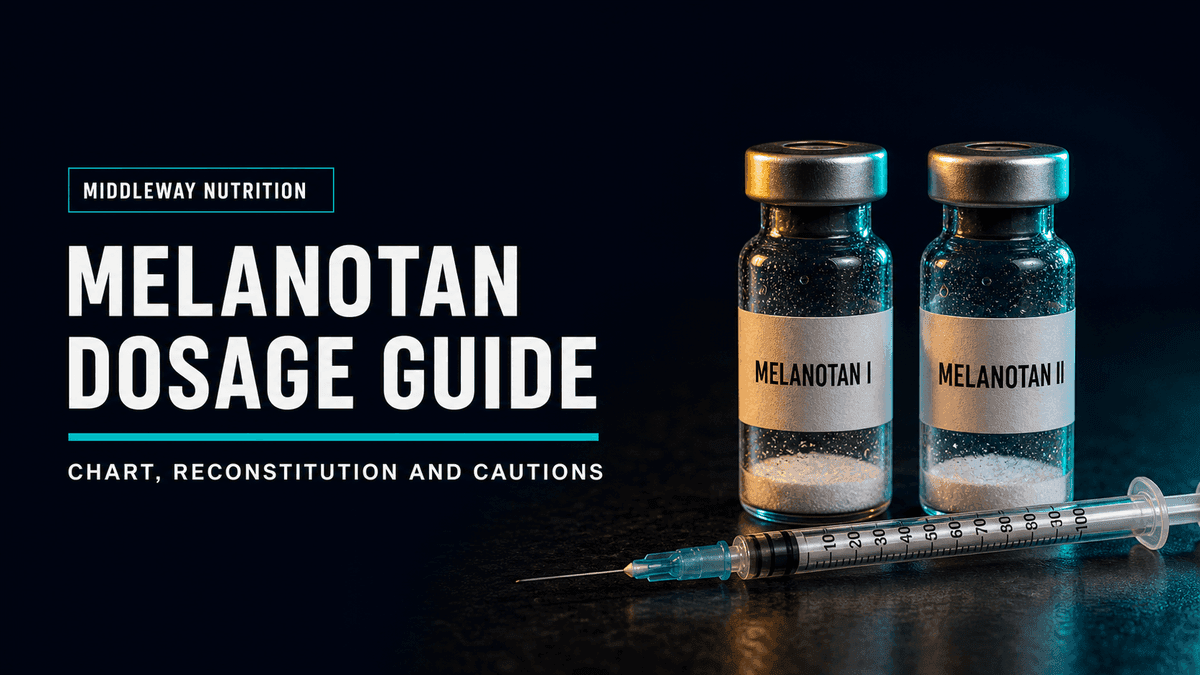
Melanotan arrives as a lyophilised powder and needs bacteriostatic water before use.
| Vial | Water added | Resulting concentration | 0.25 mg dose | 0.5 mg dose | 1 mg dose |
|---|---|---|---|---|---|
| 10 mg | 2 ml | 5 mg per ml | 0.05 ml, 5 units | 0.1 ml, 10 units | 0.2 ml, 20 units |
| 10 mg | 1 ml | 10 mg per ml | 0.025 ml, 2.5 units | 0.05 ml, 5 units | 0.1 ml, 10 units |
Units refer to a standard 100-unit insulin syringe. The 2 ml dilution is easier to measure accurately at small doses, which matters more than the extra volume.
Practical points:
- Add the water slowly down the side of the vial. Do not shake
- Refrigerate after reconstitution and use within about four weeks
- Protect from light. These peptides are light sensitive and a clear vial left on a windowsill degrades
- Rotate injection sites
Vial planning. At 0.5 mg daily, four weeks of loading uses roughly 14 mg, so two 10 mg vials. At 1 mg three times weekly for maintenance, a 10 mg vial lasts a little over three weeks.
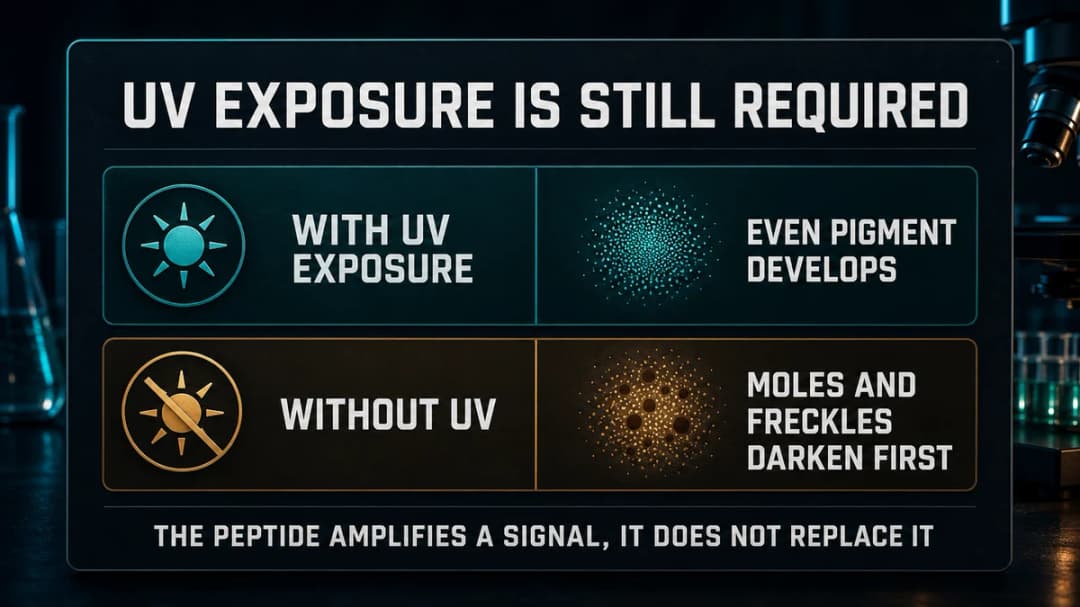
UV Exposure Is Still Required
This is the part people miss and then conclude the product was fake.
Melanotan primes the pigment pathway. It does not complete it. Melanin synthesis needs ultraviolet light as the trigger, so without UV exposure the compound produces very little visible change. Reported protocols pair dosing with short exposures, typically five to fifteen minutes, and reduce them once colour has developed.
That creates the obvious tension. The compound increases sensitivity to UV, and the protocol requires deliberate UV exposure, which is the exact exposure that drives skin cancer risk in the first place. Anyone framing melanotan as a way to avoid sun damage has the logic backwards.
Timing and Practical Notes
Evening dosing is near universal in reported protocols, for two reasons. Nausea peaks in the one to three hours after an injection, and sleeping through it is the simplest management. The same window covers the erectile effect in men.
Nausea is dose dependent. It reliably improves after the first week or two. Starting at 0.25 mg rather than 0.5 mg is the single most effective thing anyone can do about it.
The tan fades over roughly four to eight weeks once dosing and UV exposure stop, which is why maintenance protocols exist.
See our pages on Melanotan 2, Melanotan side effects and the Melanotan I and II comparison.
The Cautions That Belong in a Dosing Article
A dosing guide that ignores these is not being useful.
Moles darken. Melanotan stimulates pigment cells generally, not just the ones producing an even tan. Existing moles get darker, and new pigmented spots are commonly reported. That is expected. What is not expected, and needs a dermatologist rather than a forum, is any mole changing shape, developing an irregular border, or behaving differently from its neighbours.
The melanoma question is unresolved. There is no trial demonstrating that melanotan causes skin cancer, and there are published case reports of melanoma and of changes in moles in users. Combined with the deliberate UV exposure the protocol requires, dermatology bodies and several national regulators have advised against use. Anyone with fair skin, many moles, atypical moles, or a family history of melanoma is in the group with the most to lose and the least reason to accept an unquantified risk.
Nothing regulates what is in the vial. Identity, purity and sterility all depend on the seller. Batch-specific certificates of analysis are the minimum worth insisting on for anything intended for injection.
It is on the World Anti-Doping Agency prohibited list, so it is unavailable to anyone in tested sport.
FAQ
What dose of Melanotan should someone start with?
Reported protocols start at 0.25 mg as a single evening dose to assess tolerance, with fair-skinned users often starting lower. The reason is nausea, which is strongly dose related and worst on the first few injections.
Do you need sun exposure while using Melanotan?
Yes. The compound primes melanin production but ultraviolet light is what triggers the pigment response. Without UV exposure the visible effect is minimal, which is also the uncomfortable part of the risk calculation.
How do you reconstitute a 10 mg vial?
Two millilitres of bacteriostatic water gives 5 mg per ml, so 0.5 mg is 10 units on an insulin syringe. Add the water slowly down the side of the vial, refrigerate afterwards, keep it away from light and use within about four weeks.
Why do reported doses differ so much between MT-I and MT-II?
Melanotan II is more potent and hits several melanocortin receptors, so smaller doses do more, including the effects nobody asked for. Melanotan I is more selective for the pigment receptor, so it needs more milligrams for a slower and cleaner effect.
How long does the colour last after stopping?
Usually four to eight weeks of gradual fading without continued dosing and UV exposure. Maintenance dosing two or three times a week is what people use to hold it.
Can women use Melanotan II?
Reported use in women follows the same dose ranges without the erectile effect, though increased libido is commonly described and nausea is sometimes reported as more pronounced. The safety questions around pigment cells apply equally.