Melanotan 2 peptide benefits are narrower than the before-and-after photos suggest, the side effects are close to universal, and reported dosage sits far lower than most vendor pages imply. That gap between marketing and pharmacology is the whole story of this compound. It is one of the few peptides whose effect is visible in a mirror, which makes it easy to sell and hard to evaluate soberly.
- Melanotan 2 is a lab-made ring-closed analog of alpha-melanocyte-stimulating hormone, seven residues long, that came out of academic melanocortin chemistry in the 1980s.
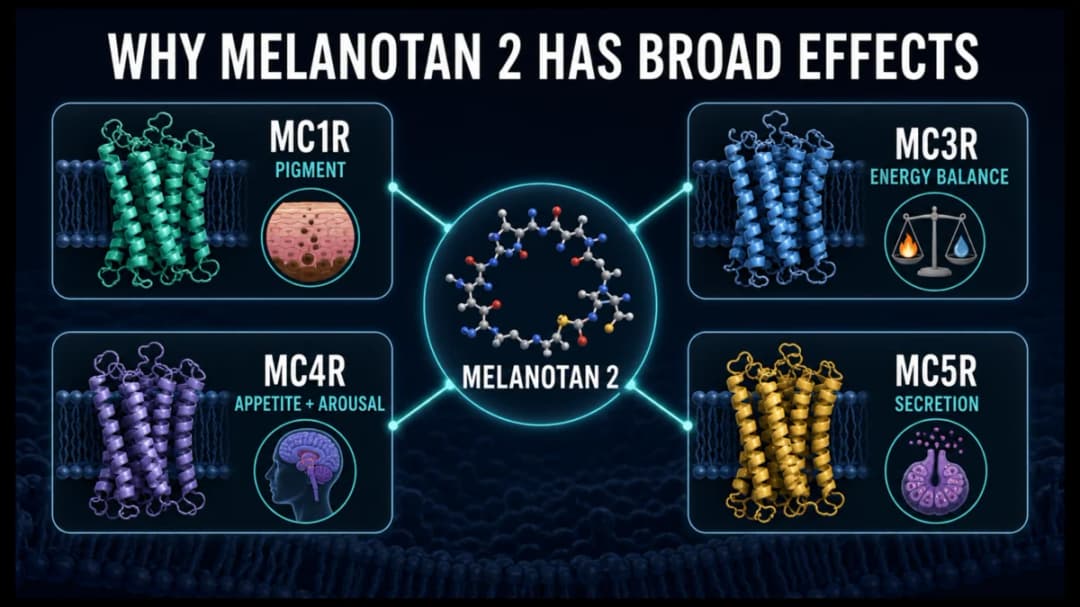
- It binds the melanocortin receptor family without much selectivity, which is why one injection can affect pigment, appetite, arousal and blood pressure at the same time.
- The pigment effect is not standalone. Without ultraviolet exposure you mostly get darker moles and freckles rather than an even tan.
- Reported research ranges cluster at 0.25 to 0.5 mg per day during an initial phase, then 0.5 to 1 mg once or twice weekly. The peptide itself clears the bloodstream inside about an hour.
- Darkening of existing moles is close to universal, and it complicates the visual screening dermatologists rely on to catch melanoma early.
- Neither the FDA nor the EMA has approved melanotan 2 for any use. Only its selective cousin afamelanotide holds an approval, and for a rare photosensitivity disorder, not tanning.
What the Melanotan 2 Peptide Actually Is
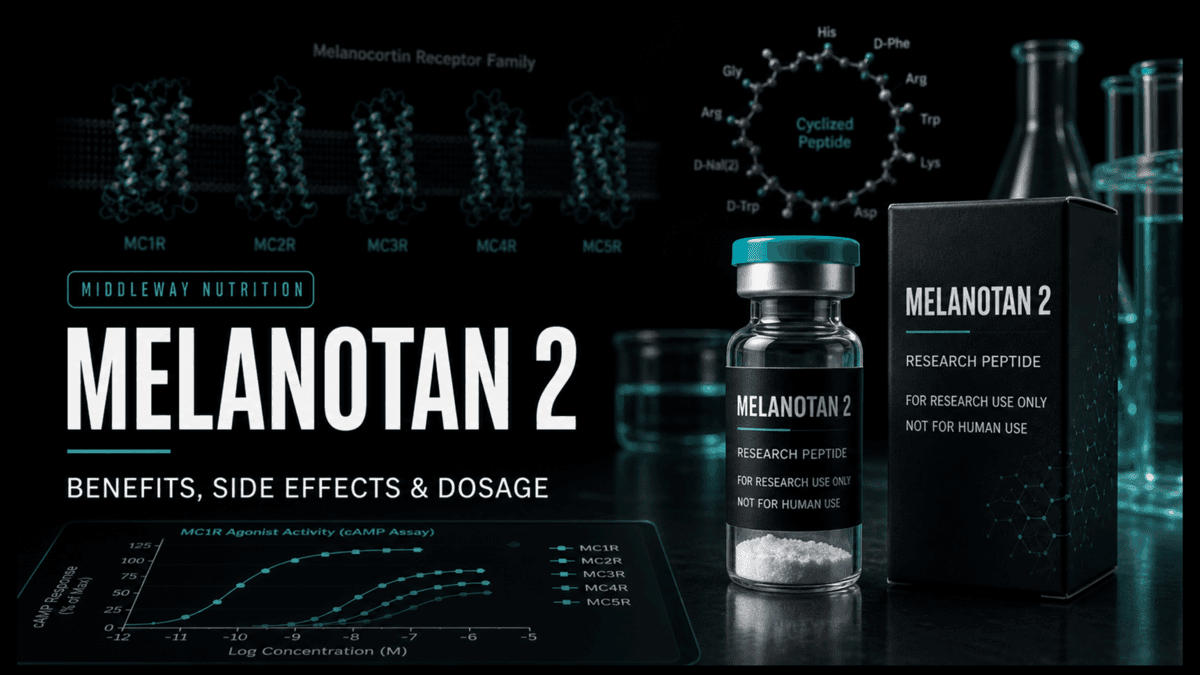
Melanotan 2, often written MT-2 or Melanotan II, is a seven-residue peptide closed into a ring, with the sequence Ac-Nle-cyclo[Asp-His-D-Phe-Arg-Trp-Lys]-NH2 and a molecular weight near 1,024 daltons. The cyclization matters. Closing the backbone into a lactam ring makes the molecule far harder for circulating peptidases to break apart than the linear hormone it imitates, and it locks the peptide into a shape that binds melanocortin receptors tightly. Even so, clearance is quick. The peptide is gone from circulation within roughly an hour, which sounds like a problem until you remember that the downstream effect, melanin synthesis, unfolds over weeks and outlasts the molecule by a wide margin.
Its parent is alpha-melanocyte-stimulating hormone, the signal your own body releases in response to ultraviolet light. That hormone touches all five melanocortin receptor subtypes, and melanotan 2 inherited the promiscuity:
- MC1R sits on the pigment cells of the skin. Switching it on tilts the pigment a melanocyte makes toward the darker, more protective form and away from the lighter reddish form. This is the tanning arm.
- MC3R shows up in the brain and gut and has a hand in how the body budgets energy.
- MC4R is the brain-side receptor behind fullness cues and arousal signaling. Most of what users call side effects trace back here.
- MC5R turns up in oil-producing and other secretory tissue.
A compound that hit MC1R alone would be a tanning agent and nothing else. Melanotan 2 is not that compound, and the entire history of the melanocortin field since has been an effort to separate these arms. PT-141 was carved out of melanotan 2 by shifting selectivity toward MC4R and away from pigment, which is covered in our PT-141 peptide guide. Melanotan 1 went the other direction, staying selective for MC1R, and that split is worth reading about in the melanotan 1 peptide guide if pigment is the only thing you care about.
Vials sold online carry research-use labeling. They are not a pharmaceutical product and there is no established human dosing standard. Nothing below is an instruction to administer anything.
Our top pick: Ascension Peptides
Melanotan II 10mg is in stock at Ascension Peptides, with every batch independently tested by a third-party lab. The certificates cover HPLC purity (>98% pass mark), LC-MS identity, net content, endotoxin, a rapid sterility screen and heavy metals, and all 85 are published in a public library. US shipping only, free over $250, and all sales are final, with damaged or incorrect items replaced if reported quickly.
We earn a commission if you buy, at no extra cost to you.
Melanotan 2 Benefits
Graded honestly, the benefit list is short and only one item has anything close to solid support.
Induced pigmentation. The well-established effect and the reason the compound exists. Mechanistically it is not in dispute: binding at the pigment-cell receptor sets off a second-messenger cascade inside the melanocyte that ends with more of the enzymatic machinery for building melanin being transcribed, and pigment output rises accordingly. User reports describe visible darkening from around two to three weeks with regular ultraviolet exposure and a full effect in the six to eight week range. Fair-skinned people who normally burn instead of tan often respond, because the peptide substitutes for a weak endogenous MC1R signal rather than depending on it. The caveat vendor pages bury is that ultraviolet light is still required to express the pigment. On its own, melanotan 2 mostly darkens moles and freckles.
Appetite suppression. Real, MC4R-mediated, and dose-dependent. MC4R agonism is a legitimate target in obesity pharmacology, so the mechanism is not speculative. What is missing is any controlled human data quantifying how much appetite reduction melanotan 2 produces or whether it translates into weight change. Treat it as a documented effect of unknown magnitude.
Libido and arousal. Also MC4R-mediated and reported in both sexes. In men it commonly produces spontaneous erections, typically starting one to two hours after a dose. Whether this belongs in a benefits section depends entirely on context, and many users categorize it as a side effect.
Photoprotection. This was the original scientific rationale: more eumelanin should absorb more ultraviolet energy before it damages DNA. The logic holds in the abstract. What does not exist is any controlled trial showing melanotan 2 reduces sunburn injury or skin cancer incidence. Anyone framing it as sun protection is extrapolating well past the evidence, and it does not substitute for sunscreen.
What it does not reliably do: repigment vitiligo, deliver a permanent tan, or improve skin texture and aging. For skin quality the evidence points elsewhere, which is why copper peptide is covered separately in our GHK-Cu peptide guide.
Melanotan 2 Side Effects
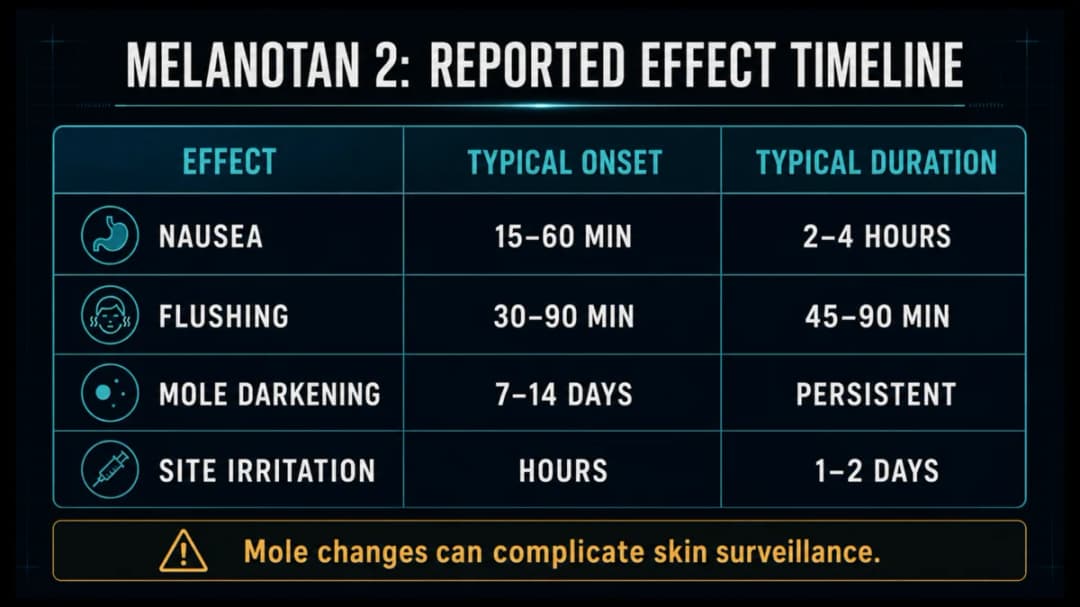
Nearly everyone who uses melanotan 2 experiences something. No controlled trial has ever measured how often each effect occurs, so the table below describes only how commonly each one turns up in user accounts. Treat it as shape, not measurement, and note that no percentage in it would survive scrutiny if anyone tried to attach one.
| Effect | How often it is described | Typical onset | Typical duration |
|---|---|---|---|
| Nausea | Very common | 15 to 60 minutes | 2 to 4 hours |
| Facial flushing | Very common | 30 to 90 minutes | 45 to 90 minutes |
| Spontaneous erections (men) | Very common | 1 to 2 hours | 30 minutes to 4 hours |
| Yawning and drowsiness | Common | 1 to 2 hours | 1 to 2 hours |
| Mole and freckle darkening | Near universal | 7 to 14 days | Persistent, slow to reverse |
| Blood pressure and heart rate elevation | Commonly described at higher amounts | 90 to 120 minutes | 6 to 8 hours |
| Injection site irritation | Common, usually mild | Hours | 1 to 2 days |
Nausea and flushing tend to ease over the first week or two as tolerance develops, and both scale with dose. The reported rise in systolic pressure and heart rate is the reason melanotan 2 is a poor idea for anyone with hypertension, arrhythmia or cardiovascular disease.
Three things deserve a different level of attention.
Mole darkening and melanoma surveillance. This is the honest concern and it is not resolved. Existing nevi darken in nearly all users, and some develop new pigmented lesions. No controlled trial has shown melanotan 2 causes melanoma, and no controlled trial has ruled it out. The more immediate problem is practical: early melanoma detection depends on noticing that a mole changed, and a compound that changes every mole at once degrades that signal. The conservative approach is baseline full-body photography before any use, an annual dermatology skin check, monthly self-checks against the ABCDE criteria, and a low threshold for biopsy on anything evolving. Anyone with a personal or family history of melanoma, or with many atypical moles, is in the group that should stay away entirely.
Priapism. An erection lasting beyond four hours is a urological emergency, not an inconvenience. It is rare but reported with melanocortin agonists generally.
Serious neurological events. Isolated case reports in the medical literature describe severe neurological episodes in people using melanotan products. Single case reports establish nothing about how often this happens, but severe headache paired with confusion or vision change is a stop-immediately-and-seek-care situation.
Where the data is genuinely thin: long-term use. There is no cohort followed for years, no carcinogenicity program, no reproductive safety data. Absence of reported harm across a decade of unsupervised use is not demonstrated safety.
Melanotan 2 Dosage Chart
There is no approved human dose for melanotan 2 because there is no approved human use. What follows is a summary of the ranges that appear consistently across research discussion and user-reported protocols. It describes what has been reported, not what anyone should do.
| Goal or context | Reported range | Frequency | Typical cycle |
|---|---|---|---|
| Initial low-sensitivity start | 0.1 to 0.25 mg | Daily | First 5 to 7 days |
| Standard loading phase | 0.25 to 0.5 mg | Daily | 7 to 14 days |
| Extended loading toward target pigment | 0.5 to 1 mg | Daily | Roughly 2 further weeks |
| Maintenance once pigment is established | 0.5 to 1 mg | 1 to 2 times weekly | Ongoing while desired |
| Discontinuation | None | None | Pigment fades over 4 to 8 weeks |
A few things the chart cannot show. Reports consistently indicate that exceeding 1 mg during early weeks sharply worsens nausea and cardiovascular effects without improving the pigment outcome, so the ceiling is about tolerability rather than potency. Fitzpatrick type shifts the picture: very fair skin is described as starting at the low end and progressing slowly with more pronounced side effects, while darker baseline pigmentation produces a proportionally smaller visible change. Reported amounts for women skew lower, generally attributed to body size and MC4R sensitivity.
None of this is validated. All of it comes from a population dosing itself without medical oversight and measuring outcomes in a mirror.
Reconstitution and Storage
Melanotan 2 ships as a lyophilized white to off-white powder, most commonly in 10 mg vials. Reconstitution follows the same rules as any injectable research peptide: bacteriostatic water run slowly down the inner wall of the vial rather than squirted onto the powder, then swirled gently until clear. Agitation and foaming can denature peptides, so shaking is a mistake.
A 10 mg vial with 2 mL of bacteriostatic water yields 5 mg per mL. On a U-100 insulin syringe that puts 250 mcg at the 5 unit mark, 500 mcg at 10 units and 1 mg at 20 units. Sealed lyophilized vials keep best at -20 degrees C and protected from light, since melanocortin peptides are light sensitive. Once reconstituted, refrigerate at 2 to 8 degrees C and expect a usable window near three to four weeks. Discard any solution that clouds, discolors or throws visible particulate.
Stacking
Genuine documentation for melanotan 2 combinations is thin, and most of what circulates is preference rather than evidence.
The pairing mentioned most often is melanotan 2 with a copper peptide for skin, on the reasoning that one addresses pigment and the other addresses matrix and repair, so the mechanisms do not overlap. That is a plausible rationale, not a studied combination.
Combining melanotan 2 with PT-141 is worth flagging as a bad idea. Both are melanocortin agonists hitting overlapping receptors, so the effect is additive at the same targets rather than complementary, and nausea, flushing and cardiovascular load compound accordingly. The same logic rules out running it alongside melanotan 1.
How to Verify What You Buy
Melanotan 2 is where sourcing failures show up most clearly, because an underdosed vial simply produces no tan while an unexpectedly potent one produces a rough week. Ask for a batch-specific HPLC purity report matched to the lot number on your vial, not a generic certificate reused across every order, plus mass spectrometry confirming a mass consistent with the roughly 1,024 dalton parent. Our where to buy melanotan 2 page walks through which suppliers publish testing that can actually be checked and which ones rely on unverifiable claims.
Frequently Asked Questions
What does the Melanotan 2 peptide do?
It impersonates the body's own tanning hormone and switches on the same receptor family, in skin and in brain alike. In skin that means more pigment and visible darkening. In the brain it dampens appetite and raises arousal, and in oil-producing tissue it nudges secretion. The pigment effect still depends on ultraviolet exposure to express fully, so melanotan 2 on its own behaves more like a primer than a finished result.
Is Melanotan 2 safe?
Nobody can answer that with confidence, which is itself the answer. Short-term effects are well characterized in user reports and mostly tolerable, though nausea, flushing and cardiovascular changes are common. The unresolved question is melanoma surveillance, since near-universal mole darkening makes early skin cancer harder to spot. No long-term safety data exists in any form. People with melanoma risk factors, atypical moles, cardiovascular disease, a history of priapism or sickle cell trait, or who are pregnant or breastfeeding fall outside any reasonable risk calculation.
How much Melanotan 2 is typically reported?
Reported research ranges cluster at 0.25 to 0.5 mg daily during an initial phase of one to two weeks, sometimes starting as low as 0.1 mg in sensitive individuals, followed by 0.5 to 1 mg once or twice weekly to hold the effect. Reports agree that going above 1 mg early does not improve the outcome and reliably worsens nausea. These are observed ranges from unsupervised use, not a dosing recommendation.
Is Melanotan 2 legal?
It is not approved by the FDA, the EMA, or comparable agencies anywhere, and selling or marketing it for human use is illegal in most jurisdictions including the United States, United Kingdom, European Union and Australia. Purchasing it labeled for research use occupies a gray area in many countries and is more restricted in others, Australia in particular. It is also prohibited in competitive sport under WADA rules. Legal status is not a safety signal in either direction.