The oxytocin peptide is a nine amino acid hormone, studied in humans most often at an intranasal dose of 24 international units, and its effects on social behaviour depend heavily on the situation a person is in rather than being uniformly prosocial. The reason oxytocin peptide research has produced such inconsistent findings is that the hormone appears to amplify social salience rather than simply generating warmth, and amplification cuts both ways.
Oxytocin is a real medicine in specific contexts. Intravenous formulations are used in obstetrics to induce labour and manage postpartum haemorrhage. That is a different drug, a different route and a different clinical purpose from a nasal spray used for social effect.
The Three Routes Are Not Interchangeable
| Route | Context | What it does |
|---|---|---|
| Intravenous | Hospital obstetric use | Powerful uterine effects. Tightly monitored. Not comparable to other routes |
| Intranasal | Almost all behavioural research | The standard research route, on the theory of some direct central access |
| Subcutaneous | Occasionally reported non clinical use | Systemic exposure with little central delivery rationale |
The intranasal preference in research exists because oxytocin crosses the blood brain barrier poorly. The nasal route is proposed to allow some access along olfactory and trigeminal pathways. How much actually reaches the brain in humans remains genuinely contested, and it is one of the field's persistent methodological arguments.
Injecting oxytocin subcutaneously delivers it systemically. Systemic oxytocin acts on peripheral receptors including those in the uterus and cardiovascular system, which is a meaningfully different risk profile from a nasal spray.
Oxytocin Peptide Dosage Used in Research
| Parameter | What studies have used |
|---|---|
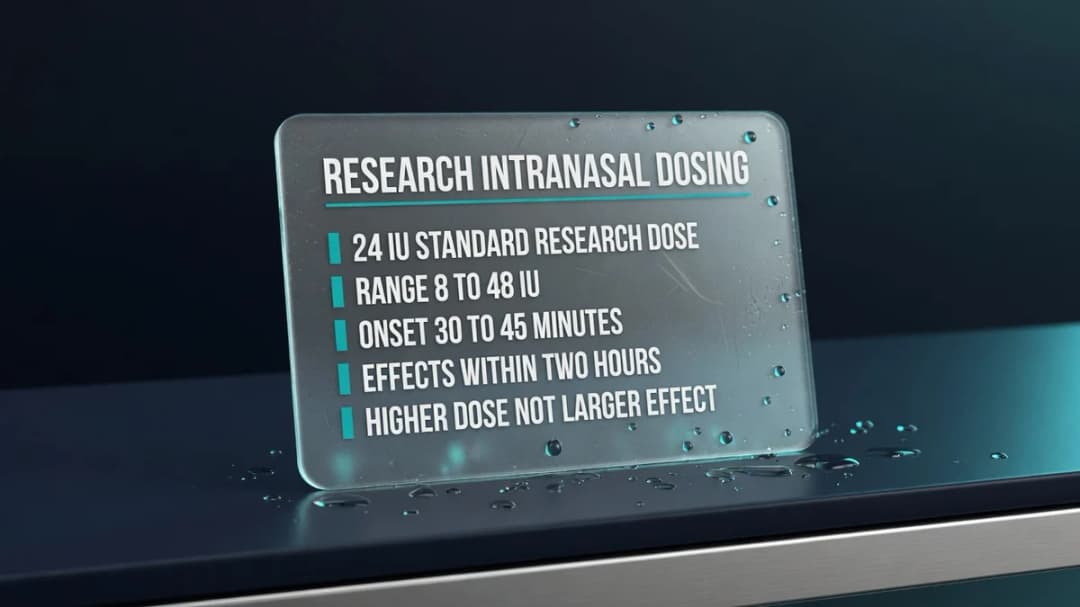
| Standard intranasal dose | 24 IU, the convention across most behavioural studies |
| Range explored | Roughly 8 to 48 IU |
| Onset | Effects usually measured from 30 to 45 minutes after administration |
| Duration | Behavioural effects typically measured within a two hour window |
| Frequency in trials | Single dose for acute studies, daily dosing in longer trials |
The 24 IU figure has become a convention more than a validated optimum. It was adopted early and repeated, and the dose response relationship is not well characterised. Some evidence suggests higher doses do not produce larger effects and may produce different ones.

What the Research Actually Found
Early studies produced eye catching results on trust, generosity and reading emotional expressions, and those findings drove a decade of enthusiasm.
The picture since has been considerably less tidy. Replication has been inconsistent, effect sizes have shrunk under scrutiny, and the field has grappled with the same publication bias problems that affected social psychology more broadly.
The clearest negative result came from clinical work in autism. A large, well conducted randomised trial of intranasal oxytocin in children and adolescents with autism spectrum disorder found no benefit on social function compared with placebo. That trial was substantially larger and more rigorous than the earlier positive studies it followed, and it substantially changed how the field views the compound.
What has held up better is the more nuanced framing. Oxytocin appears to increase the salience of social information rather than producing generalised warmth. In a supportive context that can look like increased trust and connection. In a competitive or threatening context, studies have found increased in group favouritism, defensiveness and even envy. Context is not a caveat here, it is the finding.
Safety Boundaries
- Not for use in pregnancy outside obstetric supervision. Oxytocin causes uterine contraction, and this is not a theoretical concern
- Hyponatraemia is the serious risk. Oxytocin has antidiuretic activity, and high doses combined with high fluid intake can cause dangerously low sodium. This is why obstetric use is monitored
- Cardiovascular effects including changes in blood pressure and heart rate occur with systemic administration
- Interaction with psychiatric medicines has not been well characterised
- Compounded nasal products vary in concentration and preservative content, and stability is a real issue for this peptide
Reported side effects at research doses are mild: headache, nasal irritation, mild nausea, drowsiness. The more common outcome is no perceptible effect at all.
Where the Honest Assessment Lands
Oxytocin is one of the most studied peptides in human behavioural research and one of the least conclusive. That combination is unusual and worth respecting.
If the expectation is a reliable social or intimacy enhancer, the evidence does not support it. If the interest is in a hormone whose behavioural role is real but far more context dependent than the popular account, the research is genuinely interesting.
For anyone whose actual concern is social anxiety, relationship difficulty or sexual function, those have evaluated treatments with far better evidence than a compounded nasal spray. Our PT-141 guide covers the compound most often confused with oxytocin in the sexual function context, which works through an entirely different melanocortin mechanism. For a related peptide with an anxiolytic reputation and similarly thin human evidence, see our Selank guide.
Why the Research Went the Way It Did
The oxytocin story is a useful case study in how a field can move quickly in one direction and then have to reverse.
The early findings were genuinely exciting, they were published in prominent journals, and they fitted a compelling narrative about a bonding hormone. That combination produced a wave of small studies, many of which found positive effects, and few of which were large enough to be reliable on their own.
What followed was the pattern now familiar across several areas of psychology. Larger, preregistered studies found smaller effects or none. Meta-analyses shrank as unpublished null results were accounted for. The clinical trials, which had the most at stake and the best methodology, were the least encouraging of all.
None of that means oxytocin does nothing. It means the size and reliability of what it does were substantially overstated for about a decade, and the honest current position is more modest than either the enthusiastic or the dismissive account.
FAQ
How much oxytocin is used in studies?
24 international units intranasally is the convention in most behavioural research, with a range from around 8 to 48 IU explored. The dose response relationship is poorly characterised and higher does not appear to mean more effect.
How long does intranasal oxytocin take to work?
Studies typically measure effects from around 30 to 45 minutes after administration, within a window of roughly two hours. Whether a perceptible subjective effect occurs at all varies widely between individuals.
Does oxytocin increase trust?
Early studies suggested it did, and later work has substantially complicated that. Current understanding is that oxytocin amplifies the salience of social cues, which can increase trust in a supportive setting and increase defensiveness or in group bias in a competitive one.
Is oxytocin safe to use recreationally?
It carries real risks that a nasal spray's convenience obscures, particularly hyponatraemia at higher doses with high fluid intake, and uterine effects that make it unsuitable in pregnancy. It is a hormone with systemic actions, not a mood supplement.
Does oxytocin help autism?
A large randomised trial in children and adolescents with autism found no benefit on social function compared with placebo. Earlier smaller studies had suggested otherwise, and the larger trial is the more reliable result.