PT-141 peptide benefits sit in one narrow area, its side effects are unusually well documented, and reported doses run below what vendor pages imply. That combination makes it one of the easier peptides to evaluate honestly, because unlike most compounds sold in this category, PT-141 has been through registrational human trials and carries a published label. You do not have to guess at the safety profile. You do have to be careful about where the vial comes from.
- PT-141 (bremelanotide) is a small ring-shaped peptide of seven residues that switches on melanocortin receptors in the brain, chiefly MC3R and MC4R.
- It is the active ingredient in Vyleesi, approved in the United States in 2019 for hypoactive sexual desire disorder in premenopausal women. Research-grade vials sold online are not that product.
- Human evidence is strongest for desire and arousal. Everything else attributed to it is either extrapolation or animal work.
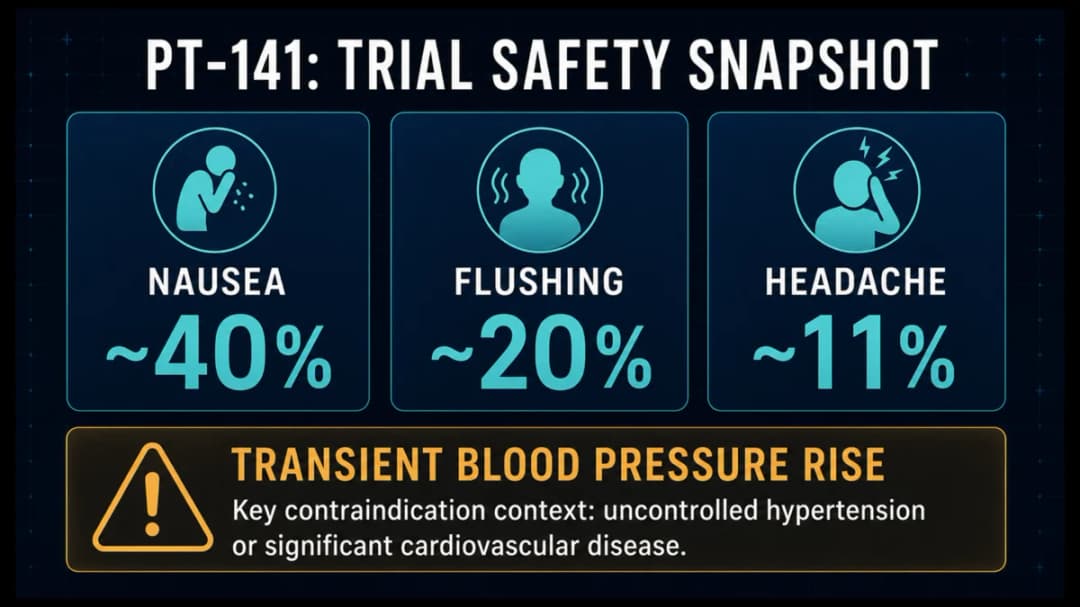
- Nausea is the dominant adverse effect, reported by roughly 40 percent of trial participants, followed by flushing near 20 percent and headache near 11 percent.
- The licensed dose is a fixed 1.75 mg subcutaneous injection, capped at one dose per 24 hours and eight doses per month. Research reports commonly describe smaller amounts.
What the PT-141 Peptide Is
Chemically, PT-141 is a short synthetic chain of seven residues closed into a ring, written as Ac-Nle-cyclo[Asp-His-D-Phe-Arg-Trp-Lys]-OH. The ring is not cosmetic. Closing the backbone makes the molecule harder for peptidases to chew through and sharpens which receptors it prefers, which is the difference between a research curiosity and something with a usable half-life. Plasma half-life is short, in the region of 2.7 hours. Vendor listings, forum threads and search boxes render the name three ways, PT-141, PT 141 and PT141, and all three point at the same molecule.
Its ancestry explains the side effect profile. PT-141 came out of work on melanotan II, an earlier melanocortin peptide built to darken skin. Melanotan II hits all five melanocortin receptor subtypes fairly indiscriminately, and early human work turned up sexual arousal effects that nobody had been aiming for. PT-141 is what you get when a chemist optimizes around that accident: activity pushed toward MC3R and MC4R, which are dense in the hypothalamus and limbic system, and pulled away from MC1R, which drives melanin production. Pulled away, not removed. That leftover MC1R activity is why pigment changes still show up. If you are comparing the two directly, our melanotan-2 peptide guide covers the parent compound.
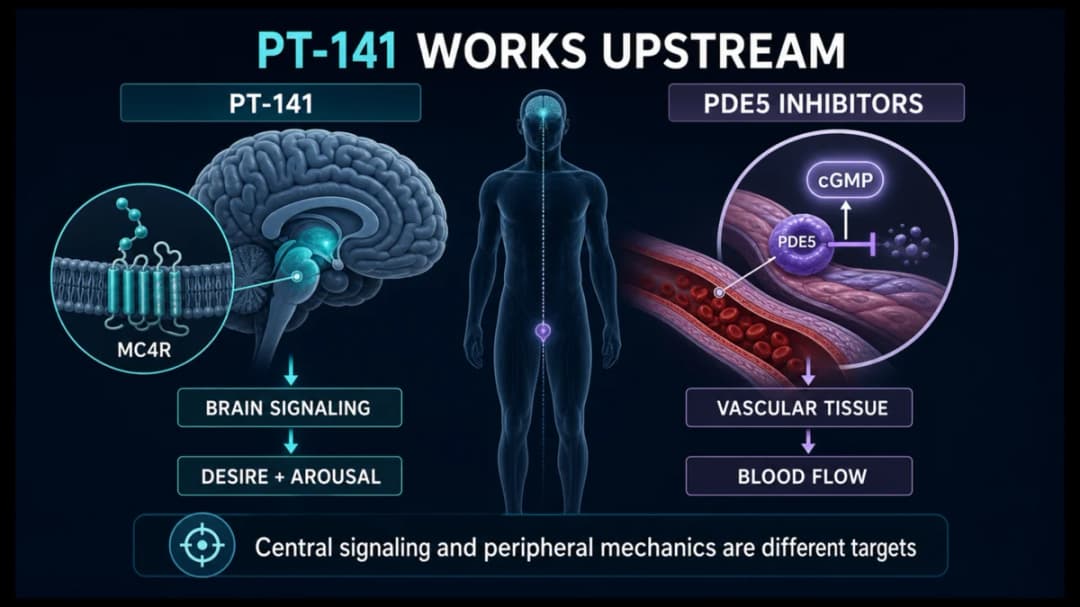
Mechanistically, PT-141 works upstream of every other sexual health drug in common use. PDE5 inhibitors like sildenafil block an enzyme in penile tissue so that cyclic GMP persists longer and smooth muscle stays relaxed. That is plumbing. PT-141 never touches the plumbing. It binds MC4R in hypothalamic nuclei, including the paraventricular nucleus, and modulates downstream dopaminergic and oxytocinergic signaling associated with sexual motivation. The practical consequence is that PT-141 can raise interest where there was none, and cannot reliably produce a mechanical response in someone who is not mentally engaged.
Vials sold by peptide suppliers are labeled for laboratory research only. They are not prescription bremelanotide, they carry no label, and nothing in this guide is an instruction to administer them.
PT-141 Benefits
The honest version of PT-141 benefits is short, which is a point in its favor. A compound with one well-evidenced effect and a clear mechanism is easier to reason about than one with fifteen vague ones.
| Claimed benefit | Best human evidence | What that actually supports |
|---|---|---|
| Sexual desire in premenopausal women with HSDD | Two Phase 3 randomized placebo-controlled trials | The approved indication. Real improvement in desire and in desire-related distress, moderate in size |
| Erectile function in men | Phase 2 only, including men who had failed sildenafil | Encouraging and unfinished. No Phase 3, no regulatory conclusion, off-label everywhere |
| Central arousal signaling | Animal and mechanistic work plus human imaging | Explains why the compound works. Not a clinical benefit on its own |
| Tanning, fat loss, testosterone, fertility | None | Not supported. Those claims belong to other molecules |
The approved label is narrower than the marketing around it. Vyleesi is indicated only for premenopausal women with acquired, generalized HSDD, and the label states plainly that it is not indicated for postmenopausal women, for men, or to enhance sexual performance. Everything outside that box, including the male use the compound was originally designed for, sits off-label.
Sexual desire in women. Strong human evidence. This is the only indication with Phase 3 backing. The RECONNECT program ran two randomized placebo-controlled trials in premenopausal women with generalized acquired hypoactive sexual desire disorder, using a fixed 1.75 mg subcutaneous dose as needed. Desire scores and desire-related distress both improved against placebo. Worth being precise about the size of the win: the effect was statistically clear and clinically meaningful, but moderate rather than transformative, and it did not translate into a dramatic shift on every endpoint the trials measured. That is a real drug effect, not a miracle.
Erectile function in men. Moderate human evidence, incomplete. Male erectile dysfunction was the original target. Phase 2 work in men with psychogenic ED used intranasal delivery with objective rigidity monitoring and reported improvement over placebo, including in men who had already failed sildenafil. Separate work in men with organic causes pointed the same direction. This is genuinely encouraging data, and it is also where the story stops. The program was never taken through Phase 3, partly over blood pressure concerns and partly because the PDE5 market was already crowded. So male use has Phase 2 support and no regulatory conclusion, which is a meaningfully weaker position than the female indication.
Central arousal pathways generally. Mechanistic and animal evidence. Preclinical work established that MC4R activation in the paraventricular nucleus drives pro-erectile signaling through oxytocin neurons projecting to the spinal cord, independent of peripheral vascular mechanisms. Imaging work in humans has pointed to changes in arousal-associated brain regions. This is the layer that explains why the compound works at all, but it should not be quoted as a clinical benefit in itself.
What is not established: PT-141 is not a testosterone modulator, a fertility treatment, or a general wellbeing compound. If you are looking at hormonal axis effects specifically, that is a different class of molecule, and our kisspeptin peptide guide and HCG peptide guide cover compounds that actually operate there.
PT-141 Dosage Chart
Everything below describes amounts reported in clinical literature and research contexts. It is a record of what has been used and studied, not a protocol, and it is not a recommendation to administer anything.
| Context | Reported range | Route | Frequency | Notes on cycle |
|---|---|---|---|---|
| Licensed product (Vyleesi), women with HSDD | 1.75 mg fixed | Subcutaneous | Max 1 dose per 24 hours | Label caps use at 8 doses per month |
| Subcutaneous clinical research, general | 1.0 to 2.0 mg | Subcutaneous | As needed before activity | The 1.75 mg point carries the most data |
| Research reports, off-label male use | 1 to 2 mg | Subcutaneous | As needed, 60 to 90 minutes ahead | No Phase 3 basis; off-label and unapproved |
| Lower-dose research reports | 0.5 to 1.25 mg | Subcutaneous | As needed | Described as easier on the stomach than 2 mg |
| Early intranasal trials | 4 to 20 mg | Intranasal | Single dose per session | Route abandoned; poor absorption drove the switch |
| Intravenous, research only | 0.5 to 1.0 mg (unverified) | Intravenous | Single dose | We could not confirm this figure in a primary source; lab-only route |
Two things stand out in that table. First, the intranasal amount needed is several times the subcutaneous amount, which tells you most of what you need to know about why that route was dropped. Second, the licensed 1.75 mg is the only dose with Phase 3 data behind it, and the label reports nausea in 40.0 percent of users against 1.3 percent on placebo, highest after the first dose. Some online reports describe lower amounts as gentler on the stomach, but no controlled data show that a lower amount gives a similar effect with less nausea, so treat that as anecdote rather than a finding.
On timing, the label specifies administration at least 45 minutes ahead of anticipated activity, with peak plasma concentration around an hour after a subcutaneous dose. Reported subjective onset runs slower than that, commonly one to two hours in some accounts (many users in online discussions report it taking longer, often three to six hours or more, which is user-reported and not controlled data), with effects persisting well past the 2.7 hour half-life because the downstream neural signaling outlasts the drug. Anyone expecting a sildenafil-style 30 minute window is working from the wrong model.
The label also attaches a stop rule to the benefit, which is unusual and worth borrowing: discontinue after eight weeks if the patient reports no improvement. Read as a general frame, that says this is not a compound that needs months of accumulation to declare itself. Either something happens across a handful of attempts or it does not.
Reconstitution and Storage
Research-grade PT-141 arrives as a lyophilized powder, white to off-white, typically in 10 mg vials. Standard handling for this class applies: bacteriostatic water as the diluent, introduced gently down the inner wall of the vial rather than dropped straight onto the powder cake, then swirled instead of shaken, since agitation can shear peptide bonds. Working concentrations vary by vendor and user; a figure of around 2 to 5 mg/mL circulates in community discussions, but it is not from a published protocol, so calculate from your own vial size and diluent volume.
Storage is straightforward. Lyophilized powder holds up long term in a freezer at roughly minus 20 degrees Celsius and tolerates refrigeration for shorter periods. Once it is in solution, it belongs in the fridge at 2 to 8 degrees Celsius, and most handling notes treat about a month as the outer limit.
PT-141 Side Effects
Because bremelanotide went through registrational trials with thousands of participants, the adverse event frequencies here are real numbers rather than forum consensus. That is rare in this space and worth leaning on. The figures below come from the Vyleesi prescribing information.
Nausea, around 40 percent. By a wide margin the most common effect. It tends to arrive within the first few hours, sits at the mild to moderate end for most people, and is reported to fade as exposure repeats. It is the leading reason people abandon the compound. Vomiting is a separate and far rarer event, 4.8 percent against 0.2 percent on placebo, so the nausea figure overstates how many people are actually sick. The label notes nausea is highest after the first dose and tends to lessen afterward. Some users try smaller amounts to cope with it, but that approach is anecdotal and is not supported by a controlled comparison. You will see confident advice online about whether an empty stomach helps or hurts nausea. The claims run in both directions and neither is settled, so treat that particular tip as folklore rather than data.
Flushing, around 20 percent. A wave of warmth and reddening over the face and chest that comes on quickly and is usually gone inside a couple of hours.
Headache, around 11 percent. Typically at the nuisance end and short lived. The blood pressure effect below is a plausible contributor.
Transient blood pressure elevation. Documented in trials, rising for a few hours after administration before settling back over the rest of the day. Maximal mean increases in the trials were about 6 mmHg systolic and 3 mmHg diastolic, with heart rate falling by up to 5 beats per minute, and the effect generally resolved within 12 hours of the dose. Averages hide the tail, and individual responses varied. This is the basis for the label contraindication in uncontrolled hypertension and known cardiovascular disease, and the caution around concurrent antihypertensive therapy. It is the single most important safety item in the profile.
Focal hyperpigmentation, about 1 percent. Patches of darker skin, most often on the face, along the gum line, and in some reports on breast tissue, arising from leftover MC1R activity. That 1 percent figure comes from trial participants dosing no more than eight times a month, and the label flags higher risk in people with darker skin and with daily rather than as-needed use. Resolution after stopping was not confirmed in every case. The monthly dose ceiling on the licensed product is there in part to keep total melanocortin exposure down for exactly this reason.
Injection site reactions, 13.2 percent. Local, minor, and reduced by rotating sites. Placebo injections produced them in 8.4 percent, so a good share of that number is the needle rather than the drug. Common enough to expect, rarely a reason to stop.
Yawning. Frequently reported, harmless, and mechanistically plausible given melanocortin involvement in arousal and sleep-wake circuitry.
Interactions, and where the data is thin. The only contraindications on the label are uncontrolled hypertension and known cardiovascular disease. Naltrexone is an interaction rather than a contraindication, and the mechanism is pharmacokinetic: bremelanotide can significantly reduce the systemic exposure of orally administered naltrexone, so oral naltrexone-containing products should not be combined with it. Bremelanotide also slows gastric emptying, which can blunt absorption of oral drugs that depend on reaching a threshold concentration, with antibiotics as the label's example. There is no adequate human data in pregnancy and it is not recommended. Excretion in breast milk is unknown. Dedicated study in significant hepatic or renal impairment has not been done. And critically, every frequency figure above comes from trials of a controlled pharmaceutical product. None of it describes what happens with an unverified research vial of uncertain purity, which is a different risk category entirely.
Stacking
Documented combination work with PT-141 is sparse, and most of what circulates as stacking advice has no evidence behind it. There is one combination with genuine scientific rationale: pairing a centrally acting compound like PT-141 with a peripherally acting one such as a PDE5 inhibitor, on the logic that the two address different halves of the problem. Early interest in this was real. The obstacle is also real, because both classes influence blood pressure and the licensed label already restricts use in cardiovascular disease and alongside antihypertensives. That is a combination for physician supervision, not experimentation.
Beyond that, be skeptical. PT-141 is sometimes bundled with melanotan II in vendor listings, which is a poor pairing on its face since melanotan II hits MC1R far harder and the pigmentation effect PT-141 was engineered to reduce comes straight back. Combinations with hormonal peptides are proposed regularly and studied essentially never.
How to Verify What You Buy
Bremelanotide is a real pharmaceutical with a published sequence, so anything you purchase should be verifiable against it, and third-party analysis by mass spectrometry and HPLC is the only way to confirm identity and purity of a research vial. Buy only where independent testing is published rather than asserted, and check that the report corresponds to the batch in front of you. We track sourcing and testing practices for this compound on our where to buy PT-141 page, and current listings are compared on our PT-141 for sale page.
Looking for the numbers behind this guide? Our PT-141 dosage chart sets label and trial doses beside what Reddit users report taking.
Frequently Asked Questions
What does the PT-141 peptide do?
It activates melanocortin receptors in the brain, principally MC4R in the hypothalamus and limbic system, which modulates the neural signaling underlying sexual desire and arousal. It does not act on blood vessels or erectile tissue directly, which is why it behaves differently from sildenafil and related drugs. In humans, the clearest demonstrated effect is an increase in sexual desire and a reduction in the distress associated with low desire.
Is PT-141 safe?
As a licensed pharmaceutical used under supervision, bremelanotide has a characterized safety profile: common but usually manageable nausea, flushing, and headache, a transient blood pressure rise that makes it inappropriate for people with uncontrolled hypertension or significant cardiovascular disease, and a pigmentation effect with repeated exposure. As an unregulated research vial bought online, safety is a separate question that depends entirely on whether the contents match the label. The two situations should not be conflated.
How much PT-141 do people use?
The licensed product is a fixed 1.75 mg subcutaneous dose, limited to one per 24 hours and eight per month. Research literature and community reports describe subcutaneous amounts from roughly 0.5 to 2 mg; the claim that lower amounts cause less nausea is anecdotal and not established. There is no established dosing standard for research-grade material outside approved medical use, and none of these figures should be read as guidance to self-administer.
Is PT-141 legal?
Bremelanotide is an approved prescription medication in the United States, so obtaining it legitimately means a prescription. Peptide vendors sell PT-141 labeled for laboratory research only, which is legal to sell and purchase in that framing but does not authorize human use. Rules vary by country, and importing peptides can run into customs restrictions regardless of how the seller describes them.