Selank peptide benefits center on anxiety relief without sedation, side effects are mild and dose-related, and reported dosage sits in the microgram range. That last point is the one most buyers get wrong. Selank is dosed in micrograms, not milligrams, which means a 10 mg vial contains twenty or more research-scale doses and a sloppy reconstitution calculation can be off by a factor of ten without anyone noticing.
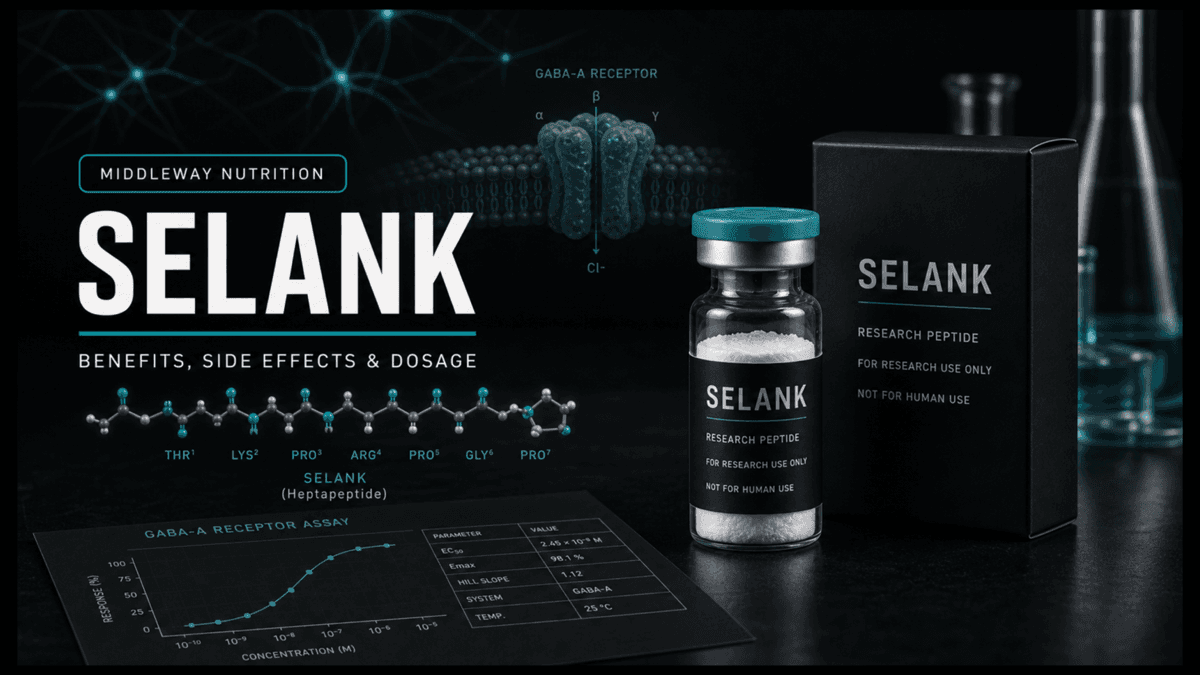
- Selank is a synthetic heptapeptide (Thr-Lys-Pro-Arg-Pro-Gly-Pro, roughly 752 Da) built from the immune peptide tuftsin plus a stabilizing proline-glycine extension.
- It holds regulatory approval in Russia, where the 0.15% nasal drops are listed as an over-the-counter product on the [rlsnet.ru label](https://www.rlsnet.ru/drugs/selank-36612). Everywhere else it is a research compound with no approved human dosing standard.
- Reported research doses cluster at 250 to 500 mcg per administration, one to three times daily, in blocks of two to four weeks.
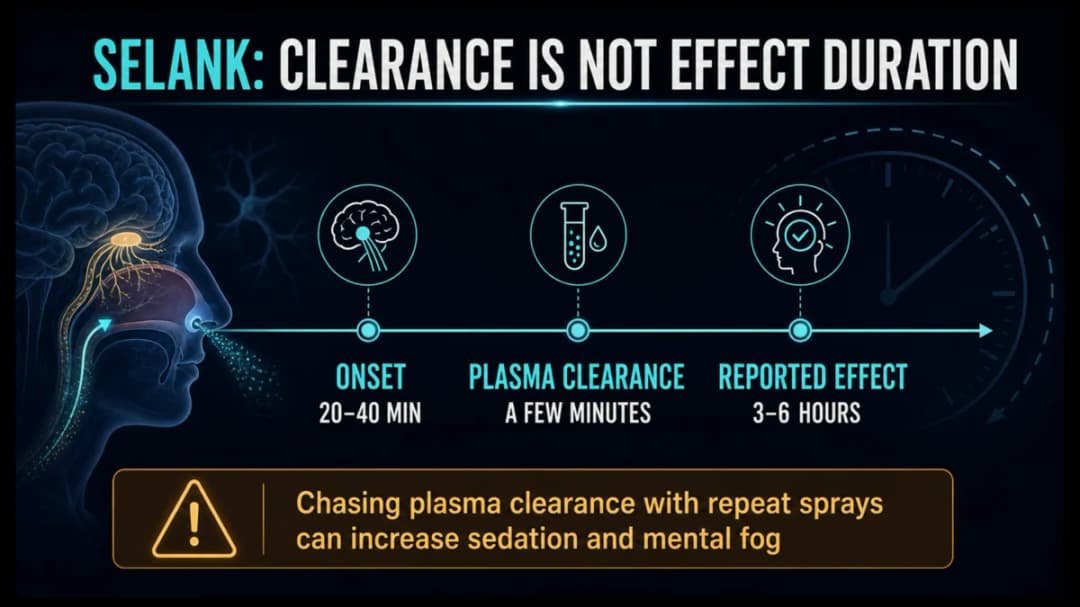
- The plasma half-life is extremely short, reported online as a few minutes (we could not trace that to a primary human pharmacokinetic study), yet reported effect duration runs several hours because intranasal delivery reaches the central nervous system directly.
- Documented adverse effects are mild: sedation at the top of the range, transient fog, nasal irritation, occasional headache. Long-term human safety data is thin.
- The entire human efficacy record is a handful of Russian-language trials totaling fewer than 200 patients, published by one research circle in one journal. None of the English abstracts describe randomization, blinding or a placebo arm.
What Selank Actually Is
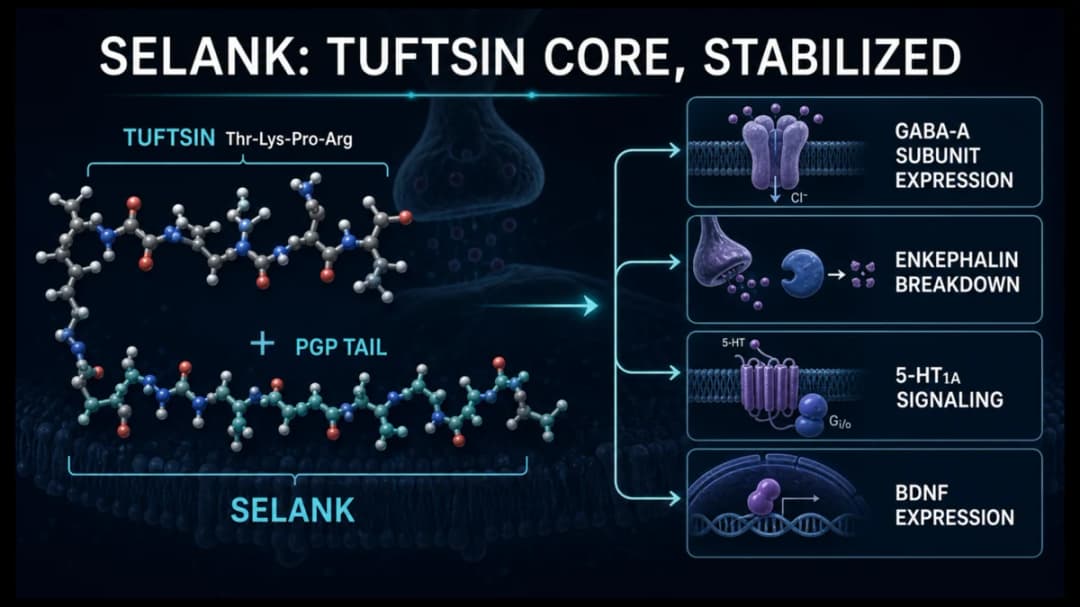
Start with the parent molecule. Tuftsin is a four-amino-acid fragment (Thr-Lys-Pro-Arg) that the body cleaves from the heavy chain of immunoglobulin G. It has real biological activity, particularly in stimulating phagocytosis, but it is destroyed by peptidases almost immediately after it appears. That instability is what kept it from becoming a usable compound.
Researchers at the Institute of Molecular Genetics of the Russian Academy of Sciences addressed this by extending the tuftsin chain with a proline-glycine-proline tail. The resulting seven-amino-acid peptide, Thr-Lys-Pro-Arg-Pro-Gly-Pro, resists enzymatic breakdown far better than the parent fragment while keeping its activity. That compound is Selank, sometimes listed by suppliers under the code TP-7.
Mechanistically, Selank does not behave like a conventional anxiolytic. Rather than binding GABA-A receptors and amplifying inhibitory signaling the way a benzodiazepine does, research indicates it influences the expression of genes encoding GABA-A receptor subunits. The distinction matters: one approach floods a receptor system, the other adjusts how much receptor the tissue builds. That is the most credible explanation for why the anxiolytic effect reported in Russian clinical work arrived without the sedation and memory disruption that define the benzodiazepine class.
The gene-expression account is not the whole picture, though, and the compound's own developers have complicated it. A 2018 radioligand study from the same institute (PMID 30255741) reported that Selank also acts on isolated brain-cell membranes as a subtype-selective positive allosteric modulator of GABA binding, and that it can block the modulatory activity of diazepam and olanzapine. The authors read that as a peptide binding site distinct from the benzodiazepine site but possibly overlapping it in part. So the clean story of "adjusts receptor supply, never touches the receptor" is a simplification of a mechanism still being argued over by the people who built the molecule.
Three secondary pathways show up consistently in the literature. Selank appears to slow the enzymatic degradation of enkephalins, the endogenous opioid peptides involved in mood and stress response. It interacts with serotonergic signaling, with 5-HT1A receptors specifically implicated. And it raises expression of brain-derived neurotrophic factor, the growth factor underpinning synaptic plasticity. The tuftsin inheritance also leaves it with measurable effects on immune signaling and cytokine balance, which is unusual for a compound marketed as a nootropic.
In the United States, Canada and the EU, Selank is not an approved drug and is not scheduled. It is sold as a research chemical. Everything below describes what has been reported in research and supplier documentation, not a protocol for a person to follow.
Selank Benefits
The evidence base here is genuinely uneven, so it is worth separating what has clinical support from what rests on animal work or user report.
| Reported benefit | What actually supports it | How solid |
|---|---|---|
| Anxiety reduction | Russian comparative trials against benzodiazepines in diagnosed patients | The strongest claim on this list, and still small and unreplicated |
| Reduced fatigue and asthenia | The 2008 GAD and neurasthenia trial, which reported antiasthenic and mild psychostimulant effects alongside the anxiolytic one | One trial, one research group |
| Mild cognitive benefit | Reported as a secondary finding in the 2014 trial; Stroop and verbal-fluency testing used in the 2015 add-on trial; animal BDNF and learning work | Secondary endpoints in small trials, plus rodent data |
| Immune and cytokine modulation | A 2008 study of Th1/Th2 cytokine balance over 14 days of dosing in anxiety-asthenic patients | Small, exploratory, mechanistic |
| Blunting benzodiazepine side effects | The 2015 trial in which Selank added to phenazepam reduced sedation, attention and memory complaints versus phenazepam alone | One trial, 70 patients, run under psychiatric supervision |
| Better sleep | User report, and consistent with anxiety reduction rather than any sedative action | No controlled data |
Anxiety reduction is the best-supported claim. Russian clinical trials in generalized anxiety disorder are the reason the compound holds a regulatory approval at all, and those trials reported efficacy in the range of benzodiazepine comparators without the accompanying sedation or cognitive cost. The honest caveat: this research was conducted under Russian regulatory standards and has not been replicated in large Western trials. It is real evidence. It is not the same tier of evidence as a modern multi-site phase III program.
Cognitive effects are mostly indirect and partly inferred. The BDNF mechanism is well described and animal work supports improved learning retention and memory consolidation. In humans, the reported improvement in focus is best understood as anxiety removal rather than stimulation. When a nervous system stops running a threat response, prefrontal performance recovers. That is a real benefit but a different one from what a stimulant delivers, and it explains why people who are foggy from fatigue rather than stress often find Selank underwhelming. Those researchers usually end up looking at Semax, which is the ACTH-derived counterpart built specifically for cognitive drive.
Immune modulation has mechanistic backing and limited human data. Because Selank retains the tuftsin core, effects on phagocytic activity and cytokine balance are plausible and have been observed. Research in neurasthenia and during viral illness exists but is small and mostly Russian. Treat this as an interesting property of the molecule rather than a reason to use it.
Stress resilience and mood stabilization show up constantly in user reports and are consistent with the enkephalin and serotonergic mechanisms, but no controlled human data cleanly isolates them. Reported improvement in sleep appears to be downstream of reduced anxiety rather than any sedative property, which is a meaningful distinction if sleep is the actual target. Compounds studied directly for sleep architecture, such as DSIP, operate on entirely different pathways.
What Selank has not been shown to do: treat clinical depression, replace prescribed psychiatric medication, or produce effects that persist indefinitely after discontinuation.
What the Human Evidence Actually Consists Of
Almost everything known about Selank in people traces back to one research lineage: the Institute of Molecular Genetics of the Russian Academy of Sciences and the Mental Health Research Center in Moscow, publishing largely in the S.S. Korsakov Journal of Neurology and Psychiatry. The papers are written in Russian with English abstracts indexed on PubMed. This is that record, in full, as the index holds it.
| Study | What it tested | Patients | Comparator | PMID |
|---|---|---|---|---|
| Zozulya et al., 2008 | Selank in generalized anxiety disorder and neurasthenia | 62 (30 on Selank, 32 on comparator) | Medazepam, a benzodiazepine | 18454096 |
| Uchakina et al., 2008 | Cytokine and immune effects in anxiety-asthenic disorders over 14 days of dosing | Not stated in the abstract | None | 18577961 |
| Medvedev et al., 2014 | Selank in phobic-anxiety and somatoform disorders | 60 | Phenazepam, a benzodiazepine | 25176261 |
| Medvedev et al., 2015 | Phenazepam alone versus phenazepam plus Selank | 70 (30 versus 40) | Phenazepam monotherapy | 26356395 |
Add the anxiety trials together and the entire human efficacy record runs to fewer than 200 patients, from one country, one journal, and a small circle of authors that includes people from the institute that created the compound on every paper. The English abstracts do not describe randomization, blinding or a placebo arm, and the methods sections that would settle the question are in Russian. There is no Western replication, no phase III program, no FDA or EMA review, and nothing published on continuous use beyond a few weeks. The roughly 135 PubMed records carrying the term are overwhelmingly rat, mouse and cell-culture work.
Read that the right way. It is not folklore and it is not fabricated, because diagnosed patients were treated and measured on standard psychometric scales. It is also several tiers below what a Western regulator would accept, and anyone describing Selank as clinically proven is either unaware of the size of the literature or counting on you being unaware of it.
Two findings from that set are worth carrying forward. The 2008 trial reported anxiolytic effect comparable to its benzodiazepine comparator while additionally showing antiasthenic and mild psychostimulant effects, which is the actual origin of the "calm without sedation" description that gets repeated everywhere. And the 2014 trial reported the anxiolytic effect persisting roughly a week after the last administration, which no compound cleared from plasma in minutes should manage, and which is the strongest published hint that the mechanism is regulatory rather than a matter of occupying a receptor while the drug is present.
Selank Side Effects
Selank has a light adverse-effect profile relative to the anxiolytic drug classes it gets compared to. Light is not the same as absent, and the reported effects follow a clear pattern.
Excess sedation. The most predictable complaint, and almost always dose-linked. Reports of drowsiness cluster among those starting at the top of the range or redosing multiple times in a day. It generally resolves when the amount comes down rather than requiring discontinuation.
Paradoxical anxiety or low mood. The "calm without sedation" framing does not match every account: some users report feeling more anxious, restless or low after Selank rather than calmer, and Reddit reports skew toward this more than toward sedation. These are anecdotes, not trial findings, and the reasons are unknown; see Selank side effects for how user reports compare with documented effects.
Cognitive dulling at higher amounts. This one is counterintuitive given the nootropic framing, but it is well documented in user reports: past a certain point, the calm stops being clean and starts reading as flat. Described as feeling mentally soft, detached, or less sharp. It is the strongest available argument against the assumption that more produces more.
Nasal irritation. Common with intranasal use and frequently blamed on the peptide when the actual cause is the carrier solution, the spray device, or already-inflamed tissue. Presents as dryness, mild burning, sneezing, or tenderness.
Headache and fatigue. Both reported, generally mild and transient. Vivid dreams also appear in user accounts, though nothing systematic documents this.
On dependency: Selank has not demonstrated the tolerance escalation, rebound anxiety, or physical withdrawal that characterize benzodiazepines, and the mechanism gives a decent reason why not. But the correct statement is that no such pattern has been observed in the available data, not that it cannot occur. Human safety data past a few weeks of continuous use is essentially unavailable, and any confident long-term safety claim is running well ahead of the evidence.
The interaction most worth flagging involves anything else acting on inhibitory signaling: prescribed sedatives, alcohol, and similar depressant compounds, where additive effects on a shared system are mechanistically plausible. Anyone on prescribed psychiatric medication is outside the scope of anything this article can usefully address. Animal work points the same way: in a 2017 rat study under chronic mild stress, Selank enhanced the anxiolytic effect of diazepam rather than simply adding to it (PMID 28280289). Rats are not people, and that study was not designed to answer a safety question. But it is a reason to treat the combination as an interaction rather than a stack, and to note that the one human trial pairing Selank with a benzodiazepine ran inside a psychiatric hospital.
Selank Dosage Chart
Two figures come from primary sources. The rlsnet.ru label for Selank 0.15% nasal drops (1.5 mg/mL) lists 2 drops in each nostril 3 times a day for a 14-day course, repeatable after 1 to 3 weeks following a doctor's advice; the label does not state a drop volume, so we do not convert that to micrograms. And a 2012 conference abstract of 20 patients with generalized anxiety disorder (European Psychiatry 2012, abstract P1114) used 2,700 mcg per day intranasally (900 mcg three times daily). The 250 to 500 mcg ranges in the table below are community and supplier figures, not label or trial doses, and they sit below that one clinical figure. None of it is a recommendation.
| Goal / context | Reported range | Frequency | Typical cycle |
|---|---|---|---|
| Low-end sensitivity assessment | 250 mcg per administration | Once daily | About 7 days before any adjustment |
| Standard anxiolytic research protocols | 250 to 500 mcg per administration | 1 to 2x daily | 2 to 4 weeks |
| Higher-frequency protocols | 400 to 500 mcg per administration | 2 to 3x daily | 2 to 3 weeks |
| Upper range cited in research literature | 750 to 1500 mcg per administration | 2 to 3x daily | Short blocks only, sparsely documented |
| Washout period between blocks | None | Not applicable | Roughly 2 weeks |
A few things the table cannot convey. Intranasal is the route used in Russian clinical work and the one nearly all reported protocols assume; subcutaneous administration exists in research settings and gives more predictable systemic levels, but the brain penetration profile differs and less has been published on it. Many online setups assume a spray delivering around 250 mcg per actuation, which is why so many reported figures are multiples of 250; that is a community assumption with no published source, and the actual dose depends on your concentration and pump.
The half-life deserves attention because it is routinely misread. Native Selank is commonly reported to clear plasma within a few minutes of administration (an unsourced figure; we found no human pharmacokinetic study). That speed tempts people into aggressive redosing, but it describes systemic clearance, not duration of action. Intranasal delivery reaches the central nervous system via the olfactory route and bypasses the systemic compartment, with reported effect duration in the three to six hour range and onset typically inside twenty to forty minutes. Chasing the plasma half-life with repeat sprays is the single most common protocol error and lines up directly with the sedation and fog reports above.
There is also a modified version in circulation, NA-Selank amidate, carrying an N-terminal acetyl group and a C-terminal amide cap. Those changes improve resistance to enzymatic degradation. It is a different compound with a different profile, and dosing figures for standard Selank should not be assumed to transfer.
Reconstitution and Storage
Selank ships as a lyophilized white to off-white powder. Reconstitution uses bacteriostatic water, added slowly down the vial wall rather than injected directly into the powder, then swirled gently. Peptides are shear-sensitive; shaking a vial to speed dissolution damages the material.
The arithmetic is where microgram compounds punish carelessness. A 10 mg vial reconstituted in 2 mL yields 5 mg/mL, which is 5000 mcg per mL. At that concentration a 250 mcg unit is 0.05 mL, a volume that is difficult to measure accurately with standard equipment. Diluting to a lower working concentration makes the math tractable and is why most intranasal spray setups run dilute rather than concentrated. Whatever concentration is chosen, it needs to be written on the vial, because reconstruction from memory two weeks later is how tenfold errors happen.
Vial size math. Whatever the label reads, 5 mg or 10 mg or 12.5 mg, three numbers settle everything: total micrograms in the vial, milliliters of bacteriostatic water added, and the micrograms per milliliter that fall out of the division. The table below assumes bacteriostatic water and a U-100 insulin syringe, where 1 mL is 100 units.
| Vial | Water added | Concentration | Volume for 250 mcg | On a U-100 syringe | 250 mcg units per vial |
|---|---|---|---|---|---|
| 5 mg (5,000 mcg) | 2 mL | 2,500 mcg/mL | 0.10 mL | 10 units | 20 |
| 5 mg | 5 mL | 1,000 mcg/mL | 0.25 mL | 25 units | 20 |
| 10 mg (10,000 mcg) | 2 mL | 5,000 mcg/mL | 0.05 mL | 5 units | 40 |
| 10 mg | 4 mL | 2,500 mcg/mL | 0.10 mL | 10 units | 40 |
| 12.5 mg (12,500 mcg) | 2 mL | 6,250 mcg/mL | 0.04 mL | 4 units | 50 |
| 12.5 mg | 5 mL | 2,500 mcg/mL | 0.10 mL | 10 units | 50 |
Notice what the 2,500 mcg/mL rows have in common. A nasal pump specified at 0.1 mL per actuation delivers 250 mcg per spray at exactly that concentration, which is why 2,500 mcg/mL is where most reported intranasal setups land and why the figures in the dosage chart above come in multiples of 250 rather than round numbers. Pump volumes differ between devices, so the specification printed on the actual pump is the number to work from, never the assumption. And the two rows demanding 0.04 mL and 0.05 mL are there as a warning rather than a suggestion: at four or five units on an insulin syringe, an ordinary drawing error is a large fraction of the dose. Adjusting an amount downward is done by diluting further, not by trying to half-press a spray or eyeball a smaller line.
Storage follows the usual peptide rules. Lyophilized powder holds at -20 degrees Celsius for long-term storage and tolerates refrigeration for shorter periods. Once reconstituted, the solution belongs at 2 to 8 degrees Celsius and is often treated online as usable for about 21 days, a figure with no published stability study behind it. For reference, the rlsnet.ru label for the commercial nasal drops says an opened bottle may be kept at or below 25 degrees Celsius for no more than 15 days. Protect from light, avoid freeze-thaw cycling of reconstituted material, and discard anything cloudy or visibly particulate.
Stacking
The only pairing with genuine documentation behind it is Selank with Semax. Both came out of the same Russian institute, both are heptapeptides ending in a proline-glycine-proline stabilizer, and their mechanisms are complementary rather than overlapping: Semax derives from an ACTH fragment and drives focus and neuroprotection, Selank handles the anxiolytic and immune side. The usual reported arrangement is Semax earlier in the day and Selank later. Worth being precise about the evidence, though: no formal clinical trial has studied the combination. What exists is a mechanistic rationale plus a large body of anecdotal tolerability reports, and the sensible reading is to establish response to each compound separately before combining anything.
Beyond that pairing, documented Selank stacks thin out fast. Combinations with recovery peptides or with compounds like kisspeptin that act on entirely unrelated axes are proposed in community protocols but have no interaction data supporting them either way. Absence of documented interaction is not evidence of safety.
How to Verify What You Buy
Ask any supplier for a third-party HPLC and mass spectrometry certificate tied to the specific lot you are buying, and check that the reported mass matches Selank's expected molecular weight of roughly 752 Da rather than a similarly named analog. A vendor that will not produce lot-specific testing, or that supplies only a generic certificate with no lot reference, has told you what you need to know. Our where to buy Selank breakdown covers which suppliers publish verifiable testing, and the Selank for sale page tracks current pricing per milligram so you can compare vials of different sizes honestly. If you are also sourcing Semax, our where to buy Semax page applies the same checks to that compound.
Looking for the numbers behind this guide? Our Selank dosage chart sets label and trial doses beside what Reddit users report taking and our Selank side effects separates documented effects from what users report.
Frequently Asked Questions
What does Selank peptide do?
It is a synthetic tuftsin analog that modulates GABA-A receptor subunit expression, slows enkephalin breakdown, interacts with serotonergic signaling, and raises BDNF. In Russian clinical use it is applied to generalized anxiety disorder. The reported profile is anxiety reduction without the sedation or memory impairment associated with benzodiazepines.
What is Selank peptide good for?
In Russian clinical practice it is used for generalized anxiety disorder and related anxiety-spectrum conditions, and that is the only application with human trial data behind it. Research interest beyond that clusters on three things: the antiasthenic effect reported alongside the anxiolytic one, immune and cytokine modulation inherited from the tuftsin core, and BDNF-linked learning effects observed in animals. What it is not good for is equally worth stating. It has not been shown to treat depression, it does not act as a stimulant in someone who is tired rather than anxious, and it is not a substitute for any prescribed medication.
Is Selank peptide safe?
Reported adverse effects are mild and mostly dose-linked: sedation, mental dulling at higher amounts, nasal irritation, occasional headache. No dependency or tolerance pattern has been documented. The important qualification is that human safety data beyond several weeks of use is very limited, and Selank has not been evaluated by the FDA or EMA. It is a research compound, not an approved medicine.
What are the benefits and side effects of Selank peptide?
| Reported benefits | Reported side effects |
|---|---|
| Anxiety reduction without sedation, reduced fatigue and asthenia, mild cognitive benefit, immune and cytokine modulation | Drowsiness at the top of the range, mental dulling, nasal irritation with intranasal use, headache, fatigue, vivid dreams |
Selank peptide side effects are consistently described as mild and dose-linked, and most resolve on lowering the amount rather than stopping. No dependency, tolerance or withdrawal pattern has been documented. The qualification that matters is that "not documented" rests on trials that mostly ran two to four weeks, so it is a statement about the size of the literature as much as about the molecule.
How much Selank peptide is used in research?
Reported research administrations cluster at 250 to 500 mcg, one to three times daily, in blocks of two to four weeks with a break of roughly two weeks between. Figures up to 750 to 1500 mcg appear in the literature but are sparsely documented. These are observed ranges, not instructions, and no standardized human dose exists.
How many doses are in a 12.5 mg vial of Selank?
Fifty, at 250 mcg per administration, or twenty-five at 500 mcg. Reconstituted with 5 mL of bacteriostatic water, a 12.5 mg vial gives 2,500 mcg per mL, which puts 250 mcg at 0.10 mL: 10 units on a U-100 insulin syringe, or one actuation of a nasal pump specified at 0.1 mL. Put the same 12.5 mg into 2 mL instead and the concentration is 6,250 mcg per mL, which puts 250 mcg at 0.04 mL, four units, a volume too small to draw reliably. That is the whole argument for the larger diluent volume on a microgram-dosed compound.
Is Selank peptide legal?
In the United States, Canada and most of Europe, Selank is not a scheduled substance and is not an approved drug. It occupies the research chemical category and is sold for laboratory use only. In Russia it is an approved medicine sold as 0.15% nasal drops and listed as available without a prescription on the rlsnet.ru label. Local regulations vary and should be checked before ordering.