A peptide calculator turns three things you already have into one number you can draw: the milligrams printed on the vial, the milliliters of bacteriostatic water you add, and the dose your protocol specifies. It gives back the concentration, the volume to inject, the units to pull on a U-100 syringe, and how many doses the vial holds.
If you are standing at the counter with a vial in one hand and a syringe in the other, you do not need a lecture. You need one number and a way to check it. This page gives you both: the three lines of arithmetic, a table of worked examples where every cell has been recomputed, and a ten-second reverse check you can run before the needle goes anywhere.
Key Takeaways
- A peptide calculator needs exactly three inputs: vial strength in mg, water volume in mL, and the dose you were told to give
- Units on a U-100 syringe are a volume mark worth 0.01 mL each. They are not milligrams and not IU
- The same dose can be 5 units or 20 units depending only on how much water you added. Both deliver the same peptide
- Doses per vial is vial mg divided by dose mg, and it is a ceiling rather than a promise, because liquid is left behind in the hub and the vial
- Nothing on this page is a dose recommendation. It converts a dose someone else specified into a syringe reading
What Does a Peptide Calculator Actually Ask You For?
A peptide calculator is a converter, not an advisor. It has no opinion about what you should inject. It asks for the vial strength, the volume of bacteriostatic water you plan to add, and the dose you want to draw, then it does division.
The better tools ask for one more thing: which syringe you are holding. U-100 insulin syringes come in 1 mL, half-mL and third-mL barrels, and the same volume sits at a different place on each one, so the answer is only useful once the tool knows which scale you are reading.
If you want to run your own numbers alongside the worked examples below, PeptideDeck publishes a peptide calculator that takes syringe type, vial size, water volume and target dose and returns concentration, volume per dose, total doses per vial and the units to draw on a U-100 scale. It also carries presets for common compounds such as BPC-157, TB-500, CJC-1295 without DAC, Ipamorelin, Retatrutide, GHK-Cu, MOTS-c and Semax, plus a half-life mode and a microdosing schedule generator. Use it to cross-check the arithmetic on this page rather than to replace it. Two independent answers that agree is a much better state than one answer you trust blindly.
How Do You Calculate Peptide Dosage?
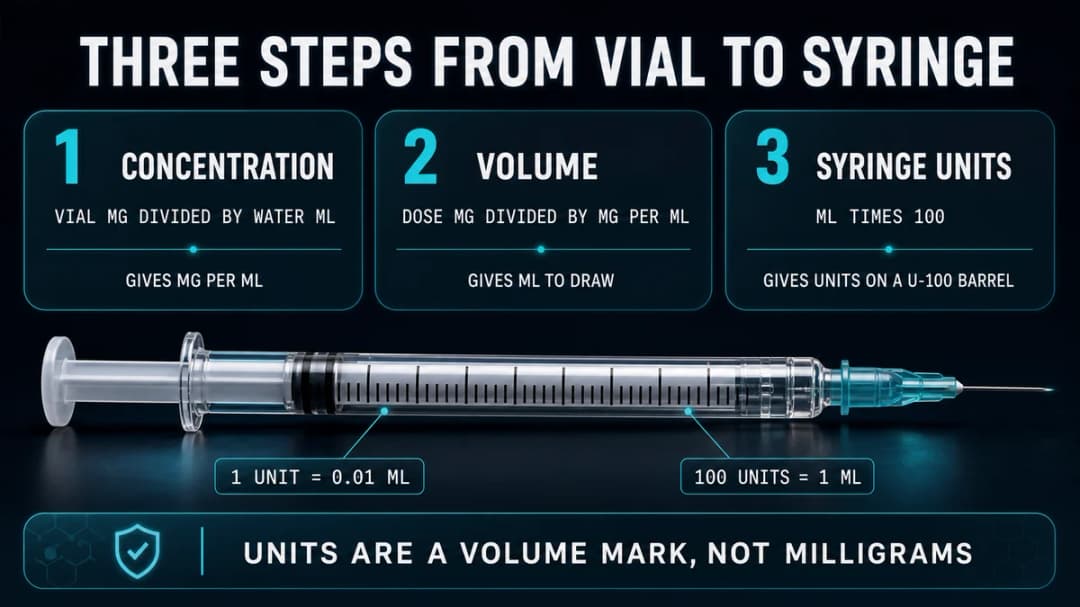
Calculating a peptide dose is three divisions in a fixed order. Do them in that order and nothing else is needed.
Step 1. Concentration.
concentration (mg/mL) = vial strength (mg) / BAC water added (mL)
A 5 mg vial with 2 mL of bacteriostatic water gives 5 / 2 = 2.5 mg/mL.
Step 2. Volume.
injection volume (mL) = dose (mg) / concentration (mg/mL)
A 250 mcg dose is 0.25 mg. At 2.5 mg/mL, that is 0.25 / 2.5 = 0.1 mL.
Step 3. Units.
U-100 syringe units = injection volume (mL) x 100
0.1 mL x 100 = 10 units.
And the question people actually want answered fourth:
doses per vial = vial strength (mg) / dose (mg)
5 / 0.25 = 20 doses.
The one conversion sitting underneath all of it is that 1 mg = 1000 mcg. Nearly every catastrophic error in this arithmetic is a decimal point moved three places in the wrong direction, so convert your dose to milligrams before Step 2 and keep it there.
Why Are Syringe Units a Volume and Not a Milligram Amount?
This is the single most misunderstood point in peptide arithmetic, and getting it right removes most of the fear.
A U-100 insulin syringe is calibrated so that 100 units fill exactly 1 mL. One unit is therefore 1/100 of a milliliter, or 0.01 mL. That is all a unit is. It is a volume marking scratched onto a barrel. It is not a milligram, it is not a microgram, and it is not an international unit of anything.
The scale exists because U-100 insulin contains 100 international units of insulin in every milliliter, so for insulin alone the volume mark and the drug quantity happen to line up. For a reconstituted peptide they never line up, because you decided the concentration yourself when you chose how much water to add. Until you have done Step 1, a unit mark tells you nothing about how much peptide you are about to draw.
Two consequences worth internalizing:
- The same dose can read as different unit numbers. In the table below, a 500 mcg dose from a 10 mg vial is 15 units at 3 mL of water and 20 units at 4 mL. Same peptide, same dose, different mark. Neither is wrong.
- A U-40 syringe will multiply your dose by 2.5. U-40 barrels put 40 units in 1 mL, so one U-40 unit is 0.025 mL. Draw 20 units on a U-40 barrel when your calculation said 20 U-100 units and you have taken 0.5 mL instead of 0.2 mL. Check the barrel before you check the math.
Peptide Calculator Worked Examples
Every cell below was recomputed from the four formulas above. Read across the row: vial strength and water give concentration, dose and concentration give volume, volume gives units, and vial strength and dose give doses per vial.
| Vial size | BAC water | Concentration | Dose | Volume | U-100 units | Doses per vial |
|---|---|---|---|---|---|---|
| 5 mg | 2 mL | 2.5 mg/mL | 250 mcg | 0.1 mL | 10 u | 20 |
| 5 mg | 1 mL | 5 mg/mL | 500 mcg | 0.1 mL | 10 u | 10 |
| 10 mg | 2 mL | 5 mg/mL | 250 mcg | 0.05 mL | 5 u | 40 |
| 10 mg | 3 mL | 3.33 mg/mL | 500 mcg | 0.15 mL | 15 u | 20 |
| 10 mg | 4 mL | 2.5 mg/mL | 500 mcg | 0.2 mL | 20 u | 20 |
| 15 mg | 3 mL | 5 mg/mL | 750 mcg | 0.15 mL | 15 u | 20 |
| 20 mg | 2 mL | 10 mg/mL | 1 mg | 0.1 mL | 10 u | 20 |
| 30 mg | 3 mL | 10 mg/mL | 2.5 mg | 0.25 mL | 25 u | 12 |
| 50 mg | 5 mL | 10 mg/mL | 5 mg | 0.5 mL | 50 u | 10 |
Rows one and two are the pair to study. A 5 mg vial gives 10 units either way, but in the first row those 10 units carry 250 mcg and in the second they carry 500 mcg. The unit count told you nothing until you knew the water volume.
Row four in mg/mL is 10 / 3, which is 3.3333 repeating and is shown rounded to 3.33. The volume is exact anyway: 0.5 divided by 10/3 is precisely 0.15 mL, or 15 units. Round the concentration for display if you like, but never round it before Step 2.
How Many Units Is 250 mcg?
There is no single answer, and any page that gives you one without asking about your vial is guessing. A 250 mcg dose is 0.25 mg, and the units depend entirely on the concentration you created.
| Concentration | Volume for 250 mcg | U-100 units |
|---|---|---|
| 2.5 mg/mL | 0.1 mL | 10 u |
| 3.33 mg/mL | 0.075 mL | 7.5 u |
| 5 mg/mL | 0.05 mL | 5 u |
| 10 mg/mL | 0.025 mL | 2.5 u |
Notice what happens as the solution gets more concentrated: the reading shrinks toward the bottom of the barrel, where a half-unit misread is a large proportional error. At 10 mg/mL a 250 mcg dose is two and a half units, which almost no one can draw reliably. That is an argument for more water, not for squinting harder.
How Many Doses Are in My Vial?
This is the question that actually decides whether a vial is worth what you paid for it, and it is the one most reconstitution charts skip. Doses per vial does not depend on water volume at all. The peptide mass was fixed when the vial was filled.
| Dose | 5 mg vial | 10 mg vial | 20 mg vial | 30 mg vial |
|---|---|---|---|---|
| 100 mcg | 50 | 100 | 200 | 300 |
| 250 mcg | 20 | 40 | 80 | 120 |
| 500 mcg | 10 | 20 | 40 | 60 |
| 1 mg | 5 | 10 | 20 | 30 |
| 2 mg | 2.5 | 5 | 10 | 15 |
Two honest caveats. The 2 mg row on a 5 mg vial reads 2.5, which in practice means two full doses and a partial one you may not be able to draw cleanly. And every figure here is a ceiling rather than a promise: liquid stays behind in the needle hub and in the shoulder of the vial, so the last dose on paper is frequently not recoverable. Removable-needle syringes lose the most.
How Much BAC Water Should I Use?
There is no correct volume, only a readable one. Water changes nothing about how much peptide you own. It changes only where your dose lands on the barrel, so choose the volume that puts your usual dose somewhere you can read without doubt.
Worked example. A 10 mg vial and a 375 mcg dose:
- At 2 mL, concentration is 10 / 2 = 5 mg/mL. Volume is 0.375 / 5 = 0.075 mL, which is 7.5 units.
- At 4 mL, concentration is 10 / 4 = 2.5 mg/mL. Volume is 0.375 / 2.5 = 0.15 mL, which is 15 units.
Same vial, same dose, and the second version lands on a whole mark in a comfortable part of the barrel. If your arithmetic keeps producing halves and thirds, change the water volume rather than the dose. Then write the water volume on the vial in permanent marker, because next week you will not remember it, and a vial with an unknown dilution is a vial you have to throw away.
The physical side of adding that water, meaning how to run it down the glass rather than jetting it onto the powder, and how to store the vial afterwards, is covered in our walkthrough of how to reconstitute tirzepatide, and those handling steps generalize to most lyophilized powders.
How Do You Check the Number Before You Inject?
Run the arithmetic backwards. It takes ten seconds and it catches almost every decimal-point error.
Reverse check. You calculated 15 units at 2.5 mg/mL. Divide by 100 to get milliliters: 15 / 100 = 0.15 mL. Multiply by the concentration: 0.15 x 2.5 = 0.375 mg, which is 375 mcg. If that does not match the dose you started with, stop and redo Step 1.
Percent-of-vial check. This one uses a different route entirely, so it catches errors the reverse check can miss. Your dose as a fraction of the whole vial should equal your units as a fraction of the whole vial's volume in units. A 375 mcg dose is 0.375 / 10 = 3.75 percent of a 10 mg vial. That vial holds 4 mL, which is 400 units of liquid. 3.75 percent of 400 is 15 units. Agreement confirms the answer.
Written as one line, that check is:
units = (dose mg / vial mg) x (BAC water mL x 100)
It is algebraically the same as the three steps, which is exactly why agreement between them is meaningful. If the two routes disagree, one of your three inputs is wrong, and it is almost always the dose.
Where Does Peptide Calculator Math Go Wrong?
The division is trivial. The inputs are where people get hurt.
- The three-place decimal slip. 1 mg is 1000 mcg. A dose entered as 0.25 when it should be 250, or the reverse, is a thousandfold error and the most common one in this space.
- The wrong barrel. U-40 syringes are sold for veterinary use and look almost identical. One U-40 unit is 0.025 mL against a U-100 unit's 0.01 mL, a factor of 2.5.
- A syringe marked in mL, not units. Some 1 mL tuberculin syringes are graduated in 0.01 mL increments with no unit scale at all. The numbers there are milliliters. Skip Step 3 and draw the volume directly.
- Changing the water volume mid-vial. Adding more bacteriostatic water to an already reconstituted vial changes the concentration again. Redo Step 1 from the new total volume, not the original.
- Copying a chart built for a different vial. A units figure from a forum post is only valid for that person's vial strength and water volume. Charts do not transfer. The formula does.
- Treating the printed milligrams as an assay. Vial contents are nominal. Fill tolerance and purity below 100 percent both mean the true mass can differ from the label. Without a batch certificate of analysis you are calculating from an assumption, which is one reason compound context matters as much as arithmetic. Our BPC-157 guide shows how purity documentation and regulatory status fit around the numbers.
What Do the Half-Life and Microdosing Modes Calculate?
Some peptide calculators include two extra modes. Both are still just arithmetic, and knowing what they compute stops you reading more into the output than is there.
Half-life mode estimates how much of a dose is still present after a given interval. One half-life leaves half, and each additional half-life halves it again.
| Elapsed | Fraction of the dose remaining |
|---|---|
| 1 half-life | 50% |
| 2 half-lives | 25% |
| 3 half-lives | 12.5% |
| 4 half-lives | 6.25% |
For a compound with a 24 hour half-life that is 50 percent at 24 hours, 25 percent at 48, 12.5 percent at 72 and 6.25 percent at 96. Semaglutide is the usual worked example in these tools because its half-life is long enough that a weekly injection produces a comparatively flat curve rather than a spike. The model is a simplification and it says nothing about effect, only about quantity.
Microdosing mode divides a weekly total across more frequent injections. A 2 mg weekly total split across seven daily injections is 2 / 7 = 0.2857 mg, or 285.7 mcg per day. Split across a five-on, two-off schedule it is 2 / 5 = 0.4 mg, or 400 mcg per injection day. The weekly total is unchanged in both cases, which is the entire point of the calculation and also its limit: it tells you nothing about whether more frequent dosing is appropriate. That question is covered separately in our overview of microdosing GLP-1 medication.
If you want the reference charts rather than the walkthrough, our peptide reconstitution calculator page carries concentration and micrograms-per-unit lookup tables across 5 mg to 30 mg vials at one, two and three milliliters of water, which is the faster route once you already understand the three steps.
FAQ
What do I enter into a peptide calculator?
Three values, plus your syringe type. Vial strength in milligrams as printed on the label, the volume of bacteriostatic water in milliliters you are adding or already added, and the dose you intend to draw in mcg or mg. The tool returns concentration in mg/mL, the injection volume in mL, the syringe units, and the number of doses in the vial.
How many units is 250 mcg of peptide?
It depends entirely on concentration, so the question cannot be answered from the dose alone. At 2.5 mg/mL, 250 mcg is 0.1 mL, or 10 units. At 5 mg/mL it is 0.05 mL, or 5 units. At 10 mg/mL it is 0.025 mL, or 2.5 units. Find your concentration first by dividing vial milligrams by water milliliters.
What if my peptide calculator gives me a number between two tick marks?
Change the dilution, not the dose. A dose that lands on 7.5 units is a reading problem created by your water volume, not by the peptide. Recompute with more bacteriostatic water until the answer lands on a whole mark. A 10 mg vial and a 375 mcg dose reads 7.5 units at 2 mL and a clean 15 units at 4 mL.
Can I trust the milligram number printed on the vial?
Treat it as nominal rather than measured. Fill tolerance, overfill and purity below 100 percent all mean the actual peptide mass can differ from the printed figure, and without a batch certificate of analysis you have no independent confirmation. The arithmetic on this page is exact, but it is exact about an input you are taking on trust. That is a sourcing problem, not a math problem.
Does a peptide calculator tell me what dose to take?
No, and no calculator should be read that way. It converts a dose that a licensed prescriber or an approved research protocol has already specified into a volume and a syringe reading. Every dose figure on this page is an arbitrary example chosen to demonstrate arithmetic. Choosing the dose itself is a clinical decision that belongs with a qualified clinician.