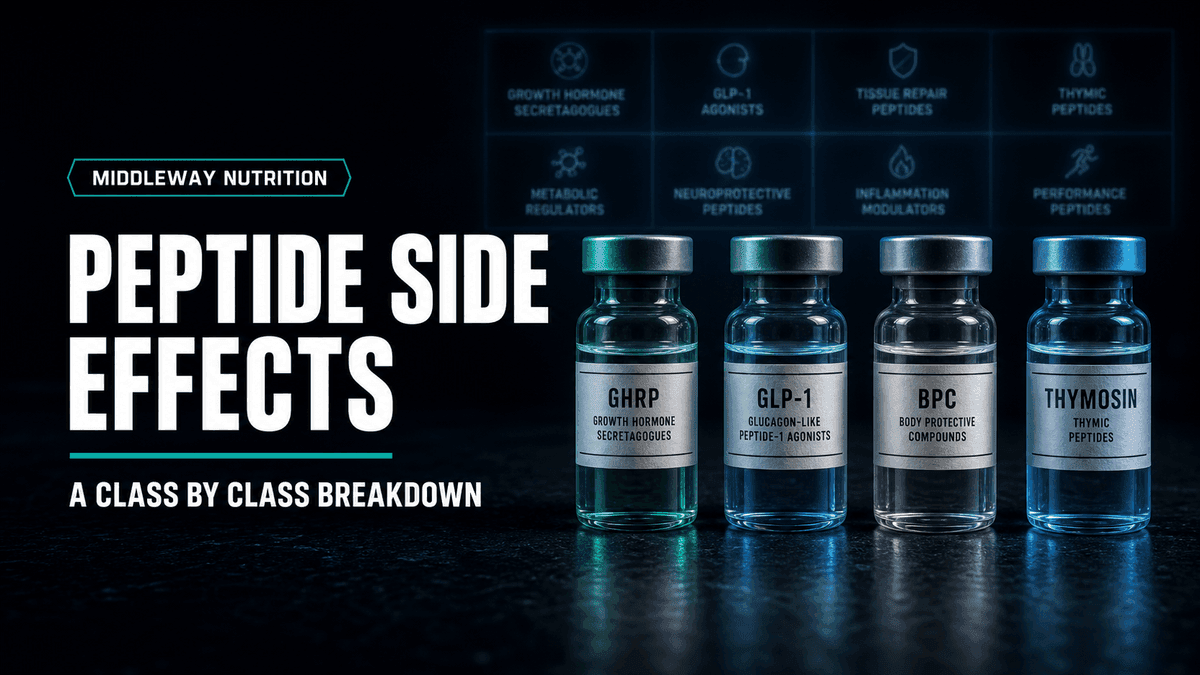
Peptide side effects are not a single profile. They are a property of the individual compound, and the differences between classes are large: a GLP-1 medicine causes gastrointestinal symptoms in a substantial share of users, a growth hormone secretagogue causes fluid retention and tingling, and a melanocortin agonist causes flushing and nausea. Almost nothing carries across.
Asking about peptide side effects in general is close to asking about the side effects of tablets. This page sorts them by class, because that is the only level at which the question has a useful answer, and flags where the honest response is that the long-term data does not exist.
Two Things That Apply Across Every Class
Injection site reactions. Redness, a small raised area, transient itching, occasional bruising. This is the most common complaint with any injectable peptide and is mostly technique rather than pharmacology. Rotating sites, letting the alcohol dry fully before the needle goes in, bringing the vial to room temperature first, and pushing the plunger slowly all reduce it noticeably.
Product quality. Impurities and degradation products cause reactions of their own, and with unregulated research compounds you cannot separate a compound's side effects from its contaminants without third-party testing. A vial that suddenly starts stinging when previous doses did not is more likely a degraded solution than a new sensitivity.
Peptide Side Effects by Class
| Class | Common effects | Less common but notable | Dose related |
|---|---|---|---|
| GLP-1 and incretin drugs | Nausea, constipation, diarrhoea, reflux, fatigue | Gallbladder problems, pancreatitis, severe vomiting | Strongly |
| GH secretagogues | Water retention, tingling in hands, morning grogginess | Raised blood glucose, joint stiffness, raised prolactin at higher doses | Strongly |
| Repair peptides | Injection site reactions, occasional mild headache | Little documented in humans, which is itself the issue | Unclear |
| Melanocortin agonists | Flushing, nausea, appetite change | Darkening of moles, blood pressure effects | Yes |
| Copper peptides | Local irritation, staining at the site | Copper handling concerns with heavy or prolonged use | Yes |
| Nootropic peptides | Mild headache, occasional irritability | Sleep disruption with late dosing | Mild |
GLP-1 and Incretin Medicines
This is the class with real data behind it, because these are approved drugs studied in large trials.
Gastrointestinal effects dominate: nausea, constipation, diarrhoea and reflux, concentrated in the titration period and generally easing as the dose stabilises. In the pivotal trials these affected a large minority to roughly half of participants depending on the drug and dose, and they are the main reason people discontinue.
The practical levers are all about pace. Escalating slowly, eating smaller portions, and reducing fat and fibre load around dose day change the experience considerably. Our pages on GLP-1 nausea and GLP-1 constipation cover the management detail.
The effects that warrant medical attention rather than management are severe or persistent abdominal pain, particularly pain radiating to the back, repeated vomiting with signs of dehydration, and symptoms of gallbladder trouble. Rapid weight loss is itself a gallstone risk factor, independent of the drug.
Growth Hormone Secretagogues
Ipamorelin, CJC-1295, sermorelin, GHRP-2 and GHRP-6 all push endogenous growth hormone release, and their side effect profile follows directly from that.
Fluid retention is the most common: mild puffiness, sometimes a few pounds on the scale that is not fat. Tingling or numbness in the hands is the classic second, and reflects the same fluid shift pressing on the carpal tunnel. Both are dose dependent and both usually settle if the dose comes down.
The one worth taking seriously is glucose. Growth hormone opposes insulin action, so this class can raise fasting glucose and reduce insulin sensitivity. Anyone with prediabetes, insulin resistance or diabetes should not use these compounds without monitoring, and ideally not without a clinician involved.
Within the class there are real differences. GHRP-6 causes pronounced hunger through ghrelin receptor activation, often within half an hour of injecting, and has more effect on cortisol. Ipamorelin is generally described as the most selective, with less impact on cortisol and prolactin and much less appetite stimulation.
Repair and Recovery Peptides
BPC-157, TB-500 and KPV have a reputation for being well tolerated. Reported effects are mostly local: injection site reactions, occasionally a mild headache or a heavy feeling in the first days.
The honest caveat is that this reputation rests almost entirely on animal studies and user reports rather than controlled human safety trials. An absence of documented side effects in a compound that has never been systematically studied in humans is not the same as an absence of side effects. It means nobody has looked properly.
The theoretical concern that gets raised most is angiogenesis. BPC-157 and TB-500 both promote new blood vessel formation, which is how they support tissue repair, and the same mechanism is one a tumour would exploit. There is no evidence that either causes cancer. There is a reasonable argument for avoiding them with an active or suspected malignancy.
Melanocortin Peptides
PT-141 and melanotan-2 act on melanocortin receptors, and share a family of effects: flushing, nausea in the first hour after dosing, and blood pressure changes.
Melanotan-2 carries a distinct concern that separates it from the rest of the category. It darkens existing moles and can prompt new pigmented lesions. That is not a cosmetic footnote; it complicates melanoma surveillance for years afterwards, because the baseline against which a dermatologist judges change has shifted. Anyone with a personal or family history of skin cancer, or a lot of naevi, should treat this as a reason to avoid the compound rather than a manageable trade-off.
Copper Peptides
GHK-Cu applied topically is generally well tolerated, with local irritation the main complaint. Injected, the considerations are different: site reactions are more common, the solution can stain, and copper is a mineral the body regulates carefully. Heavy or extended injectable use raises questions about copper balance that topical use does not.
Nootropic Peptides
Semax, Selank and related compounds tend to produce mild and infrequent effects. Headache and occasional irritability come up most; late dosing can interfere with sleep. Most human data comes from Russian clinical use rather than Western trials, which is worth knowing when you see confident safety claims.
What Should Make You Stop
Some symptoms are adaptation and some are signals. The list below is the second kind, and none of it should be attributed to a peptide settling in.
- Severe or persistent abdominal pain, especially radiating to the back
- Repeated vomiting, or any vomiting with signs of dehydration
- Chest pain, fainting, or a heart rate change that persists
- Swelling of the face, lips or throat, or difficulty breathing
- Sudden changes in vision
- Spreading redness, heat or pus at an injection site
- Any new or changing pigmented skin lesion
The last one matters specifically for melanocortin compounds. The infection point matters for everyone who injects, since a genuine injection site infection escalates faster than people expect.
Reducing Side Effects Without Guessing
Start at the bottom of the reported range. Most peptide side effects follow the dose, so the lowest useful dose is usually the one with the best ratio of effect to problem.
Change one thing at a time. If you increase a dose and add a second compound in the same week, an adverse effect tells you nothing about its cause.
Fix technique before blaming the compound. A large share of what gets reported as side effects is injection technique, cold solution, or a vial that has been open too long.
Get baseline bloods for anything metabolic. Fasting glucose and HbA1c before starting a GH secretagogue turns a vague worry into a number you can track.
FAQ
What is the most common peptide side effect?
Injection site reactions, across every injectable compound. Redness, a small lump, transient itching or a minor bruise. Most of it responds to technique changes rather than stopping the compound.
Do peptide side effects go away?
The dose-related ones usually improve. Gastrointestinal symptoms on GLP-1 medicines typically ease once the dose stops climbing, and fluid retention on GH secretagogues often settles within a few weeks or resolves on a lower dose. Effects that are structural rather than adaptive, mole darkening from melanotan-2 being the clearest example, do not.
Are research peptides safer than approved peptide drugs?
No, and the reverse is closer to the truth. Approved drugs have documented side effect profiles because they were studied in thousands of people. Research peptides appear to have fewer reported side effects largely because nobody has run the studies that would find them.
Which peptides affect blood sugar?
Growth hormone secretagogues can raise fasting glucose and reduce insulin sensitivity, since growth hormone opposes insulin. GLP-1 medicines move glucose in the opposite direction, which is a benefit for most users but a hypoglycaemia risk for anyone also taking insulin or a sulfonylurea.
Can side effects mean the peptide has gone bad?
They can. New stinging, unusual redness, or a compound that stops producing its previous effect from a vial that is a few weeks old are all consistent with degradation. If the solution is cloudy, discoloured or has visible particles, discard it rather than trying to work out whether it is still usable.