Selank for sale runs roughly $45 to $60 for a 10mg vial across established research vendors. Everything is research-use-only, so the batch COA is the only thing standing between you and an unverified powder. Below is what the market charges, then the verification workflow that tells you whether the vial is what the label says.
Key Takeaways
- 10mg is the standard research vial. Expect $45 to $60 list, with promotional and bulk pricing near $42 to $48
- Research-use-only in the US: not FDA-approved and not available as a compounded preparation, so there is no pharmacy route to it
- A batch-specific COA is the minimum bar: it names the lot on your vial, reports HPLC purity, and confirms identity by mass spectrometry
- Check which molecule you are buying. Plain Selank and N-acetyl Selank amidate have different masses and sit on adjacent product pages
- Third-party tested does not mean pure. An honest outside-lab COA can still report a figure below the 98% bar, so read the number
Selank price and specs
| Spec | Detail |
|---|---|
| Size | 10mg vial |
| Price | $45 to $60 list, $42 to $48 on promotional or multi-vial pricing |
| COA | Per-batch, third-party, lot-matched |
| Format | Lyophilized powder, research use only |
Listed prices move, so confirm the current figure before ordering. The thing actually worth paying for is a COA published per lot by a named outside lab rather than one recycled PDF reused across every batch.
For the vendor-by-vendor comparison, see our companion guide on where to buy Selank.
What you are actually buying
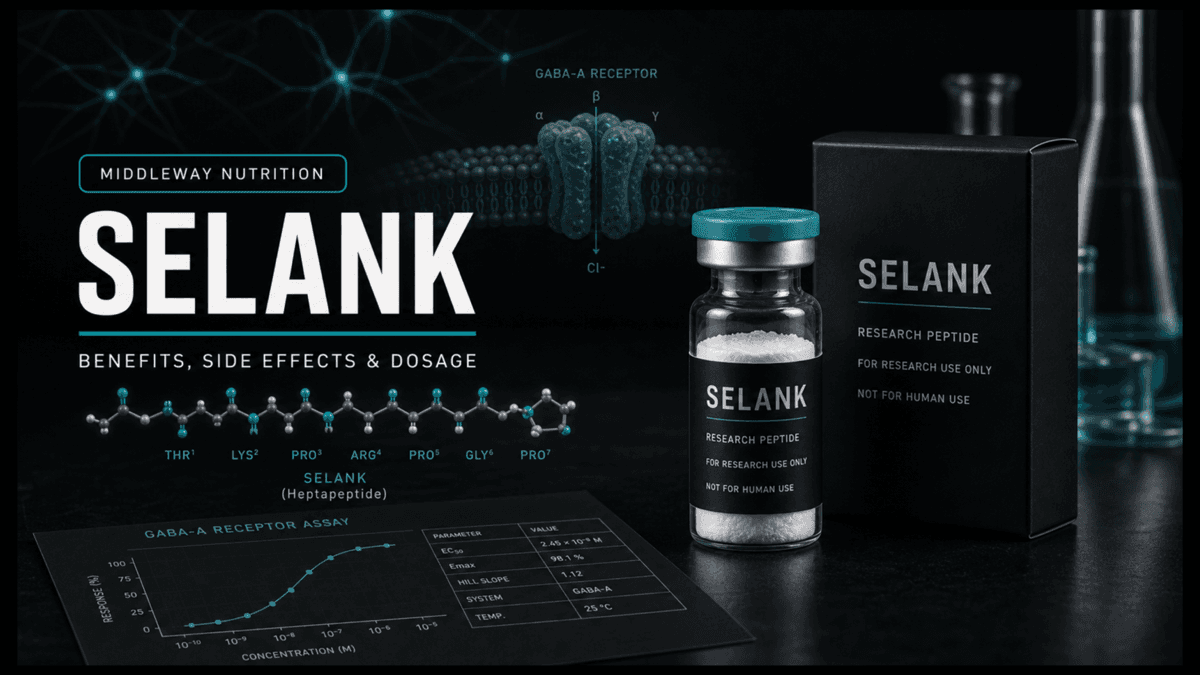
Selank is a synthetic heptapeptide developed in Russia: the tetrapeptide tuftsin (Thr-Lys-Pro-Arg) with a Pro-Gly-Pro tail that slows enzymatic breakdown. The formula is C33H57N11O9 and the mass is about 751.9 daltons, the number a mass spec report has to match.
Research interest centers on anxiolytic and nootropic-style effects. Most of the published literature is Russian, older, and small, and the compound has never been through the process that produces an approved drug. Treat confident vendor claims about clinical efficacy as marketing.
When you see Selank for sale on a vendor site, you are looking at material marketed for laboratory use and labeled not for human or animal consumption. That label is the legal foundation the whole market rests on, with practical consequences:
- No agency verifies purity, sterility, fill weight, or endotoxin load before shipping.
- The seller alone decides what testing to run and what to publish.
- There is no pharmacist, no chain of custody, and no recall mechanism if a lot is bad.
Selank is not a US controlled substance, which is why listings are public and payment processing is normal. But it is not an approved drug and is not available as a compounded preparation, which leaves the research-chemical channel as the only one there is. Legal to sell as research material is not the same as approved, and neither is the same as verified.
Reading a Selank COA properly
Most buying advice stops at "make sure there is a COA." That is the easy part. Here is what to actually read.
Match the lot number, check the date. A product-level certificate describes a product line and may have been run on material made a year ago. A batch-specific certificate names the exact lot printed on your vial, with a recent analysis date. If those strings do not match, the document says nothing about your vial.
Read the HPLC number, not the banner. Chromatography reports what fraction of the sample is the intended compound. Look for 98% or higher. "Third-party tested" gets used as a synonym for "pure" and it is not one: a vendor can publish a genuinely independent COA reporting a figure below the bar you should be buying at. The disclosure is honest, the material still is not.
Confirm identity by mass spectrometry. HPLC can report beautiful purity for the wrong molecule. Mass spec confirms the observed mass matches the expected value near 751.9 Da. A wrong-sequence product looks identical in the vial.
Confirm which Selank. N-acetyl Selank amidate is a modified analogue with a higher mass, sold alongside the plain form at similar prices. The COA must state which one was tested, and it must be the one you ordered.
Look for peptide content. Lyophilized peptides carry counter-ions, acetate or TFA, plus residual moisture. A vial can be 99% pure by HPLC and still be underfilled: purity is the share of peptide that is the correct peptide, while net peptide content is how much of the powder is peptide at all.
Third-party testing: independent, or it does not count
In-house testing is a vendor grading its own homework. Independent means the batch went to an outside lab whose report traces back to that lab, not merely to the seller's server. Janoshik Analytical and Colmaric Analyticals are the names that recur.
A familiar lab name on a PDF is not the finish line, because a PDF is a file anyone can edit. Where the lab offers a verification portal or report reference, use it, and expect a serious COA to reproduce the actual chromatogram and mass spectrum trace rather than a tidy summary table. Two labs on the same batch beats one lab and a purity badge.
Sanity-checking the price
Selank is a short peptide and cheap to synthesize, so the honest spread across established research vendors is narrow. That cuts both ways: a fair price is easy to find, and an unusually low one is hard to explain away. Analytical testing costs real money per batch, so when a 10mg vial sits far under the $45 to $60 band, the cost has come out of testing, fill accuracy, or peptide content. Paying well above the band buys nothing you can verify either. For a broader vendor spread, a current where to buy Selank roundup covers current supplier pricing.
What actually arrives
A correct order is a small sealed glass vial, usually amber or UV-resistant, holding a white lyophilized powder or thin cake under a crimped flip-top. The label should carry the compound name, quantity, lot number, and a research-use statement. Diluent is sold separately, and reconstituted material needs refrigeration at 2-8°C.
Two arrival-stage warnings: a vial that arrives already in solution as a ready-to-use nasal spray has given up the stability that makes lyophilized powder the standard research format, and one that arrives under-filled, discolored, or collapsed into sticky residue has met moisture or heat in transit.
Red flags: walk away
- No COA, or a COA emailed only after payment. Documentation should be public before you buy.
- A generic certificate with no lot number, or a lot that does not match your vial.
- HPLC below 98%, however transparently disclosed.
- No mass spectrometry data. Purity without identity is half a test.
- Ambiguity about Selank versus N-acetyl Selank amidate in the listing or the COA.
- Prices far below the normal band, or permanent site-wide clearance pricing.
- Human dosing instructions or anxiety-treatment language. A vendor writing prescribing advice for a research chemical has told you what its research-use label is worth.
- Crypto or bank transfer only, no card option, no refund policy.
Legal and safety reality
Selank is legal to sell and buy in the US as a research chemical, and it is not scheduled. That is the extent of the legal comfort available. It is not FDA-approved for any indication, and no regulator has evaluated the material you would be buying. Immunogenicity, the risk that an impure peptide provokes an immune response, sits directly downstream of purity, which is why the COA work above is not paperwork for its own sake.
Pre-purchase checklist
- The listing names the exact compound, Selank or N-acetyl Selank amidate.
- The COA is public before purchase, with no email gate, and its lot matches your vial.
- HPLC purity is 98% or higher, and mass spec confirms identity near 751.9 Da.
- The testing lab is independent and named, with real traces on the report.
- The price sits inside the normal band for a 10mg vial.
- The vendor takes card payment, has a refund policy, and ships lyophilized powder marked research use only.
Frequently Asked Questions
How much does Selank cost?
A 10mg vial runs roughly $45 to $60, with promotional and multi-vial pricing landing nearer $42 to $48 per vial. The band is tight because Selank is short and inexpensive to synthesize, so a price well below it signals what was skipped rather than a bargain.
Is Selank legal to buy?
In the US, yes, when sold and bought as a research chemical. Selank is not a controlled substance, which is why vendors list it openly and take ordinary card payments. It is not FDA-approved for any medical use, and it is not dispensed by pharmacies in any form. Legality elsewhere varies.
How do I know Selank is real?
Documentation, not appearance: lyophilized powder looks identical regardless of what it is. Ask for a batch-specific COA whose lot matches your vial, showing HPLC purity of 98% or higher and a mass spectrometry result near 751.9 daltons, from a named independent lab.
Do I need a prescription for Selank?
No, because there is no prescription version to get. Selank is not an approved drug in the US, and the compounding route open to some peptides is not available for it either. Every available supply is research material.
What is the difference between Selank and N-acetyl Selank amidate?
They are different molecules. N-acetyl Selank amidate carries an acetyl group at one end and an amidated other end, changes intended to improve stability, and it has a different molecular mass. A COA for one does not validate the other.
Where to buy verified Selank
If you have decided to buy, the verification steps on this page are the whole filter. Pull the COA before you pay, match the lot number to the vial in front of you, read the purity figure rather than the badge above it, and confirm the mass. Those four steps separate a verified vial from a hopeful one, whichever supplier you order from.
Medical Disclaimer: Selank is sold for laboratory research use only. It is not approved by the FDA or any comparable regulator for any condition, and it is not intended for human or veterinary consumption. This article is educational and is not medical advice, a dosing protocol, or a recommendation for personal use. Consult a qualified healthcare professional about any health concern.