
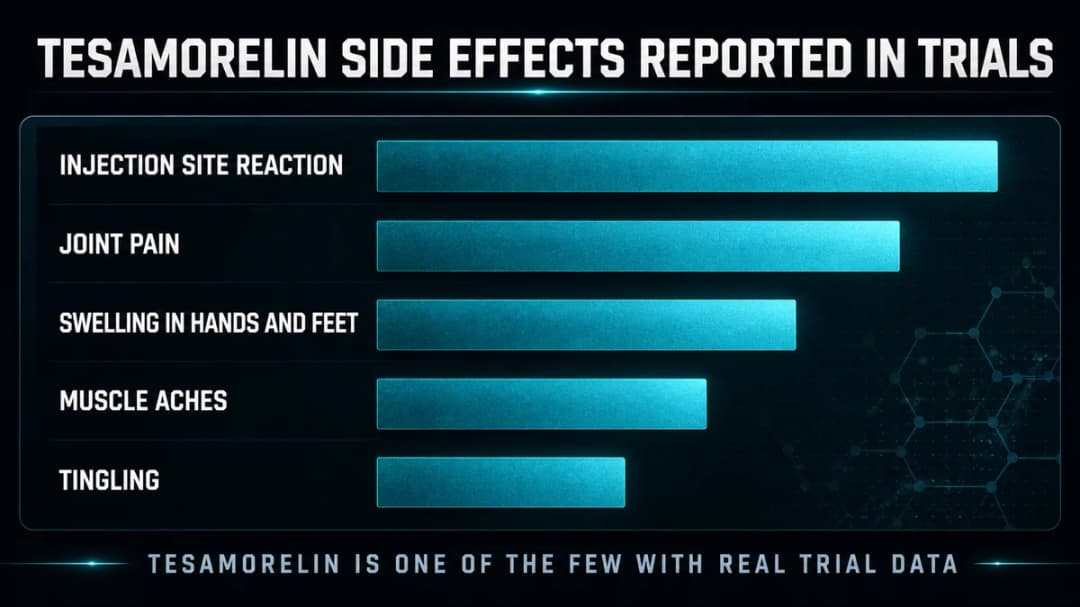
Tesamorelin side effects are one of the few areas in peptide content where the numbers come from randomised trials rather than forum reports, and the picture is a common but minor nuisance effect, a set of classic growth hormone effects, and one metabolic question worth monitoring. Injection site reactions dominate the tesamorelin side effects list at roughly a quarter to a third of trial subjects, followed by joint pain, muscle aches and fluid retention.
Having approval and trial data does not mean the compound is benign. It means the risks are characterised rather than guessed at, which is a different and more useful thing.
Tesamorelin side effects: frequencies from the trials
| Effect | Reported frequency | What is behind it |
|---|---|---|
| Injection site reactions: redness, swelling, itching, bruising | Roughly 25 to 35% | Daily subcutaneous injection, largely technique-related |
| Joint pain | Roughly 8 to 13% | Classic growth hormone effect |
| Muscle aches | Around 7% | Same category |
| Peripheral swelling | Roughly 5 to 8% | Fluid retention, a known growth hormone effect |
| Nausea | Around 5% | Not well characterised |
| Fatigue in the first weeks | Common, usually settling | Adjustment to a changed GH pattern |
Less frequent but documented: headache, tingling or numbness in the extremities, and carpal tunnel-type symptoms with longer use.
Injection site reactions
The most common problem and the least interesting one. Tesamorelin is a daily subcutaneous injection, so even a minor local response becomes noticeable when it happens every day in the same handful of square centimetres.
Almost all of it responds to technique. Rotate sites properly rather than using the same patch of lower abdomen repeatedly. Inject slowly, taking several seconds on the plunger. Let the alcohol dry before the needle goes in. Use a fine 29 to 31 gauge needle. Do not inject straight from the fridge.
The exception that matters: a site that is more painful, redder or more swollen at 48 hours than at 12 is not a normal injection reaction. Spreading redness, warmth or fever suggests infection and needs to be seen.
Joint pain, aches and swelling
These three belong together because they share a cause. Fluid retention and joint discomfort are recognised effects of raised growth hormone across the whole category, from tesamorelin through to growth hormone itself.
What people describe is puffiness, a softer look, rings feeling tight, and joints that ache in a way that reads as feeling older rather than injured. It is more disappointing than dangerous, which is exactly why people push through it when they should not.
The correct response is to lower the dose or escalate more slowly, not to tolerate it. Someone starting straight at 2 mg daily with no adjustment period is more likely to run into it than someone who spent a couple of weeks at 1 mg.
Carpal tunnel-type symptoms, meaning tingling, numbness or weakness in the hand, are the version of fluid retention that should stop a protocol rather than prompt a dose tweak. Persistent nerve compression symptoms are not something to wait out.
The glucose question
This is the one that deserves the most careful handling, because the internet gets it wrong in both directions.
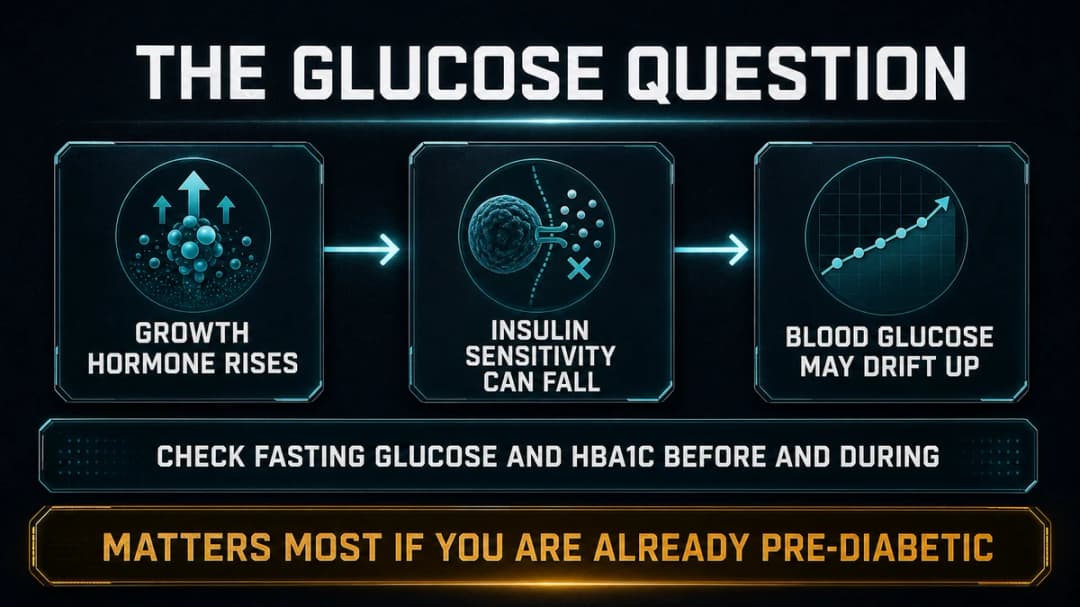
The mechanistic concern is real: growth hormone opposes insulin, so anything that raises growth hormone has a plausible route to worsening glucose control. That is not speculation, it is basic endocrinology.
The trial data, though, did not show a significant rise in fasting glucose at 2 mg daily over 52 weeks. That is a genuinely reassuring finding and it should be reported honestly rather than buried.
Both facts are true, and the resolution is that trial averages describe trial populations. The people most drawn to a visceral fat drug are frequently the people whose glucose control is already marginal, and an average that includes everyone tells you little about the individual at the metabolic edge.
The practical position: if you have prediabetes, insulin resistance, a family history of type 2 diabetes or any existing glucose problem, monitor fasting glucose before starting and periodically afterwards, and involve a clinician. If your metabolic health is good, the trial data suggests you are unlikely to have a problem.
Who should not use it
- Anyone with an active cancer, since growth hormone stimulation is a theoretical route to promoting tumour growth
- Anyone with a pituitary disorder, pituitary tumour or previous pituitary surgery, because the mechanism requires an intact gland
- Anyone with hypothalamic-pituitary axis disruption from head injury, radiation or surgery
- Pregnancy and breastfeeding, where safety is not established
- Anyone with known hypersensitivity to tesamorelin or to mannitol, used in the formulation
Reducing the odds of trouble
Start at 1 mg rather than jumping to 2 mg, and give it a couple of weeks. Almost every effect on this page is dose-related, and starting low separates adjustment effects from genuine intolerance.
Rotate injection sites systematically rather than approximately.
Track fasting glucose if you have any metabolic risk factor at all.
Take swelling, numbness and persistent joint pain seriously rather than as a cost of doing business.
Be realistic about duration. The longer a protocol runs, the more that sloppy habits and slow-accumulating effects show up.
For the trial data and dosing detail, see our tesamorelin review, and for the mechanism the tesamorelin peptide page.
The thing people misread
"FDA-approved" gets mentally translated into "cannot really go wrong". Approval means a regulator judged that the benefits outweighed the risks for a defined population with a defined condition, at a defined dose, under medical supervision. It says nothing about a healthy adult using it off-label for physique reasons without monitoring, which is a scenario no regulator has evaluated.
Tesamorelin is better characterised than almost any peptide in circulation. That makes it a better bet, not a safe one.
FAQ
What are the most common tesamorelin side effects?
Injection site reactions are by far the most common, affecting roughly a quarter to a third of trial subjects. Joint pain, muscle aches, peripheral swelling and mild nausea follow, each in the single digits to low teens as a percentage.
Does tesamorelin raise blood sugar?
Growth hormone opposes insulin, so the concern is mechanistically sound, but trials at 2 mg daily over 52 weeks did not find a significant rise in fasting glucose. Anyone with prediabetes, insulin resistance or diabetes should still monitor, since averages do not describe individuals at the metabolic edge.
Why does tesamorelin cause swelling?
Fluid retention is a recognised effect across the growth hormone axis and shows up as puffiness or tightness in the hands and feet. It is usually mild and responds to a lower dose or slower escalation.
Should joint pain on tesamorelin be ignored?
No. Mild aching in the first weeks is common and often settles, but pain that persists or worsens is a signal to reduce the dose. Tingling, numbness or hand weakness suggests nerve compression from fluid retention and is a reason to stop rather than adjust.
Is tesamorelin safer than growth hormone?
It has a more favourable profile, because it works through the pituitary with the feedback loop intact rather than replacing the hormone and driving levels continuously. That reduces the risk of the supraphysiological effects associated with injected growth hormone, but it does not eliminate growth hormone side effects.
How do I reduce tesamorelin side effects?
Start at 1 mg, escalate slowly, rotate injection sites properly, inject slowly with a fine needle, and monitor glucose if you have any metabolic risk factors. Most of what people experience is either dose-related or technique-related.