The tesamorelin peptide is a 44-amino-acid analogue of growth hormone-releasing hormone that tells the pituitary to release growth hormone in its own natural pulses, rather than replacing that hormone from outside. What makes the tesamorelin peptide unusual is not the mechanism, which it shares with sermorelin and CJC-1295, but that it went through full clinical trials and holds an approval, which means the claims attached to it can be checked.
The results timeline below reflects that trial evidence where it exists and says so plainly where it does not.
Upstream versus downstream
The distinction that matters most is between stimulating the pituitary and replacing what the pituitary makes.
Injected human growth hormone bypasses the gland entirely. It produces a sustained elevation rather than a pulse, raises IGF-1 continuously, and over time suppresses the body's own production because the feedback loop reads the high level and shuts the tap. That is a genuinely different risk profile from anything upstream.
Tesamorelin binds GHRH receptors on the anterior pituitary and asks the gland to do its job. Growth hormone comes out in pulses. Somatostatin rises in response and dampens further release, so the system self-limits. IGF-1 climbs moderately rather than being driven.
The structural change that makes this possible is a trans-3-hexenoic acid group on the N-terminus, which slows enzymatic breakdown. Native GHRH is degraded within minutes and would be useless as an injection. Tesamorelin survives long enough to produce a meaningful pituitary response, with a plasma half-life of around 26 minutes.
A short half-life looks like a weakness and is not. GHRH is a pulse signal by design, and a compound that produced a sustained GHRH level would defeat the point of using a GHRH analogue at all.
What it is approved for, and what it was tested on
Tesamorelin was approved in 2010 as Egrifta for reducing excess abdominal fat in people with HIV-associated lipodystrophy, a condition in which antiretroviral therapy drives fat to redistribute inward while it disappears from the limbs and face.
The pivotal trials in that population showed visceral adipose tissue falling by roughly 15 to 18% relative to placebo, with no meaningful change to subcutaneous fat. Lipids improved. Later analysis found increases in skeletal muscle area and density.
Everything else people use it for, general visceral fat reduction, growth hormone axis support, physique work, sits outside that evidence.
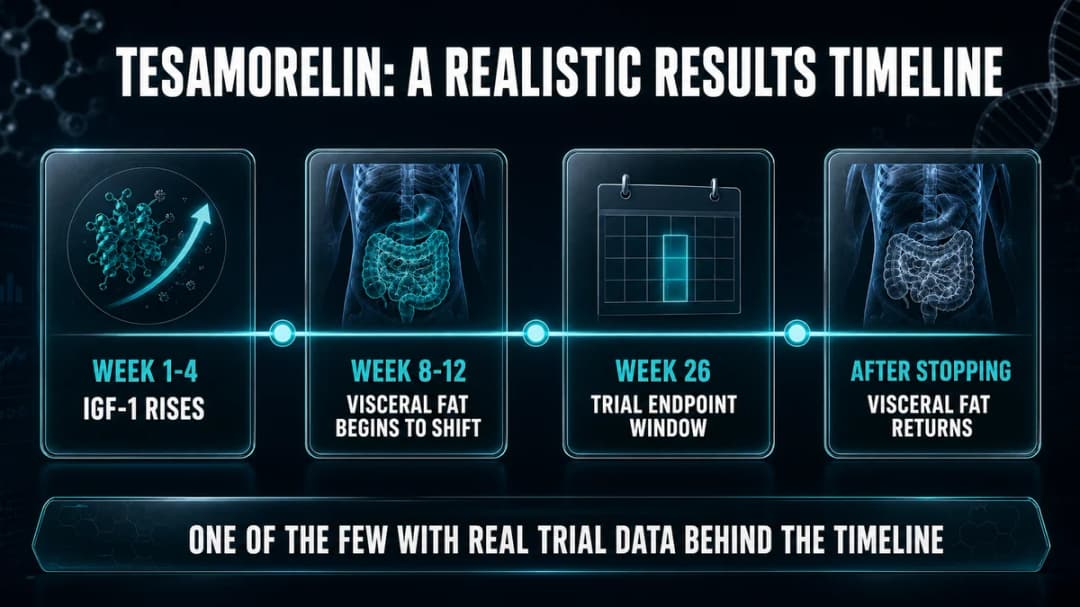
Tesamorelin peptide results: a realistic timeline
| Period | What is plausible | Confidence |
|---|---|---|
| Week 1 to 2 | Nothing visible. Some report better sleep quality; fatigue and injection site reactions are the more common early experiences | Low, these are subjective |
| Week 3 to 4 | IGF-1 rising toward a new steady state. Still nothing you can see | Reasonable, IGF-1 kinetics are understood |
| Week 6 to 8 | The earliest point at which waist measurements plausibly change | Moderate |
| Week 12 to 26 | The window where trial-scale visceral fat reduction accumulated | Good, this matches the trial timeline |
| After stopping | Visceral fat reaccumulates unless the underlying drivers have changed | Good |
Two things follow from that table. First, this is slow. Anyone assessing at week four is assessing nothing. Second, the trials that produced the headline number ran for 26 to 52 weeks of continuous daily treatment, which is a different commitment from an eight-week cycle.
Why the scale is the wrong instrument
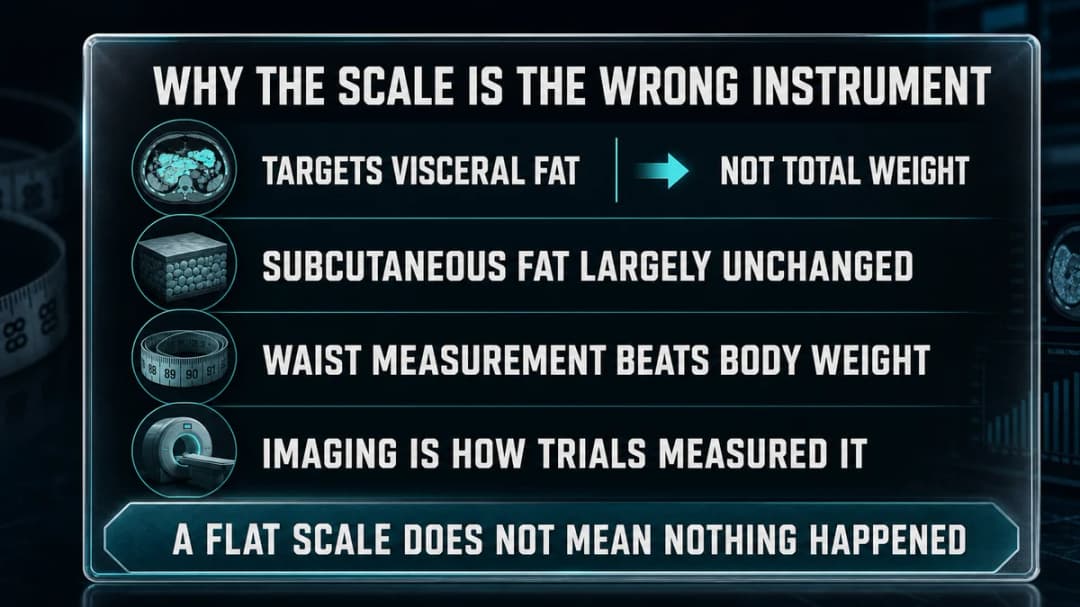
Visceral fat is the deep abdominal fat packed around organs, and it is a small proportion of total body fat even in people who carry a lot of it. Removing 18% of it is metabolically meaningful and barely registers on body weight.
Meanwhile tesamorelin can cause fluid retention, which adds weight. It can increase lean tissue, which adds weight. A person could have a genuinely successful response and see the scale go up.
Waist circumference measured at a consistent point, taken in the morning, is a better proxy. Imaging is the only accurate method and almost nobody has access to it outside a trial. If you are going to try this, measure your waist before you start and stop weighing yourself daily.
What it does not do
It does not reduce subcutaneous fat, which is the fat you can pinch and the fat most people actually want to lose. The trials were specific about this.
It is not an anabolic compound in the sense people usually mean. The muscle changes in the trial data were modest changes in area and density, not the kind of effect that substitutes for training.
It does not cure anything. The visceral fat returns when treatment stops, because nothing about why it accumulated has changed.
And it does not outperform the boring interventions. Visceral fat is the fat depot most responsive to energy deficit, resistance training, sleep and reduced alcohol intake. A drug producing an 18% reduction is competing against lifestyle changes with far better evidence and no side effects.
Practical notes
Reported protocols use 1 to 2 mg subcutaneously daily, into the abdomen below the navel, rotating sites. Bedtime dosing is favoured because it aligns with the natural growth hormone pulse during early deep sleep, and dosing a couple of hours after eating avoids the insulin rise that blunts growth hormone release. Only the 2 mg daily regimen has trial support; the rest is off-label convention.
It is commonly combined with a growth hormone releasing peptide such as ipamorelin, which acts on a different receptor and is thought to amplify the same pulse. That reasoning is mechanistically sound and has not been tested in a trial.
For dosing detail and the trial numbers, see our tesamorelin review, for the safety profile our tesamorelin side effects page, and for the wider category growth hormone secretagogues. For vial specs, pricing and lot testing, see our tesamorelin for sale page.
Who it is genuinely not for
Anyone with an active cancer, since growth hormone stimulation is a plausible route to promoting tumour growth. Anyone with a pituitary disorder or a history of pituitary surgery, since the mechanism requires an intact gland and simply will not work without one. Anyone pregnant or breastfeeding. And anyone hoping this will address subcutaneous fat, who is buying the wrong compound.
FAQ
How long does tesamorelin take to work?
Trial results accumulated over 26 weeks of daily treatment, and the earliest realistic point for a change in waist measurement is around six to eight weeks. Nothing visible happens in the first month, which catches out people expecting a faster compound.
Does tesamorelin help with subcutaneous fat?
No. The trials found no significant effect on subcutaneous fat. It acts specifically on visceral fat, the deep abdominal depot around the organs, which is metabolically important but not the fat most people are trying to lose for appearance.
Is tesamorelin the same as HGH?
No, and the difference matters. Injected growth hormone replaces the hormone and bypasses the pituitary, producing sustained levels and eventually suppressing your own production. Tesamorelin stimulates the pituitary to release its own growth hormone in pulses, with the feedback system intact.
Why is the half-life so short?
Because GHRH is naturally a pulse signal, not a sustained one. A half-life of around 26 minutes produces a growth hormone pulse without flooding the system, which is the entire physiological argument for using a GHRH analogue rather than growth hormone itself.
Will I gain weight on tesamorelin?
Possibly, and it would not mean the drug is failing. Fluid retention is a recognised effect and lean tissue may increase, while the visceral fat being lost is a small share of total mass. Waist measurement is a more useful gauge than the scale.
Does tesamorelin work in people without HIV?
The trial evidence is almost entirely in people with HIV-associated lipodystrophy. The mechanistic case for it working elsewhere is reasonable, since visceral fat is visceral fat, but studies in other populations are limited and using it that way means extrapolating rather than following evidence.