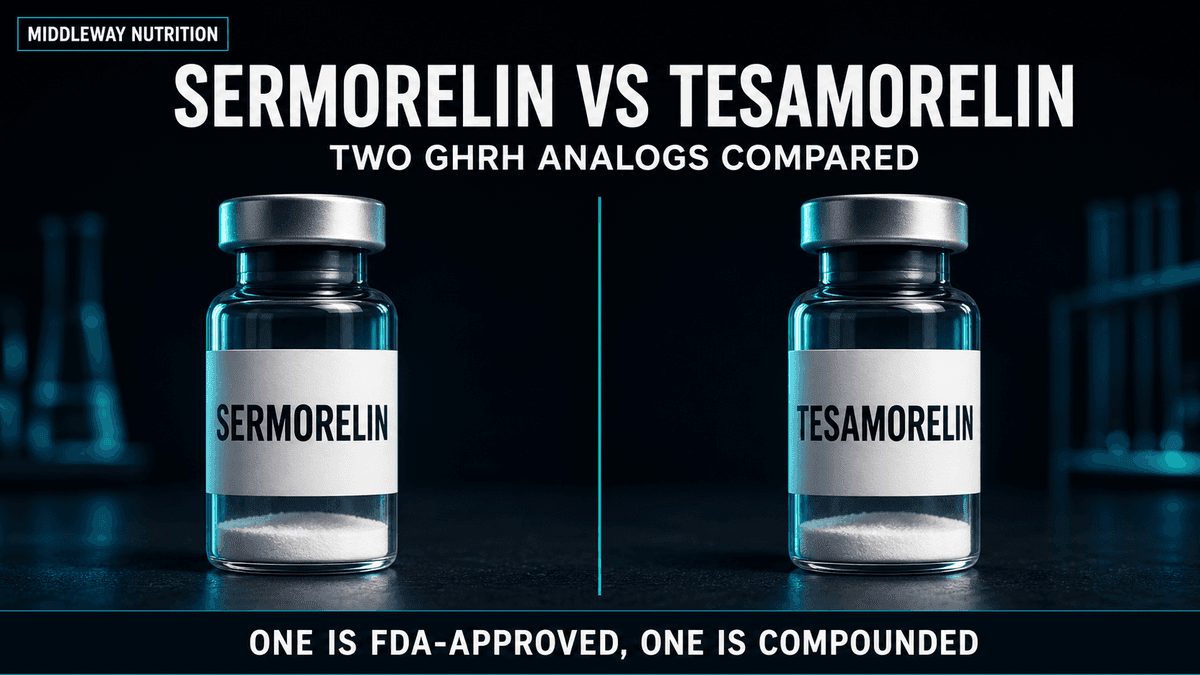

Tesamorelin peptide benefits rest on unusually solid trial data, its side effects are documented rather than guessed at, and reported dosage sits in a narrow 1 to 2 mg daily band. That combination is rare in this category, and it changes how you should read everything that follows.
- Tesamorelin is a 44 amino acid analog of growth hormone releasing hormone (GHRH), stabilized with a trans-3-hexenoic acid group at the N-terminal tyrosine.
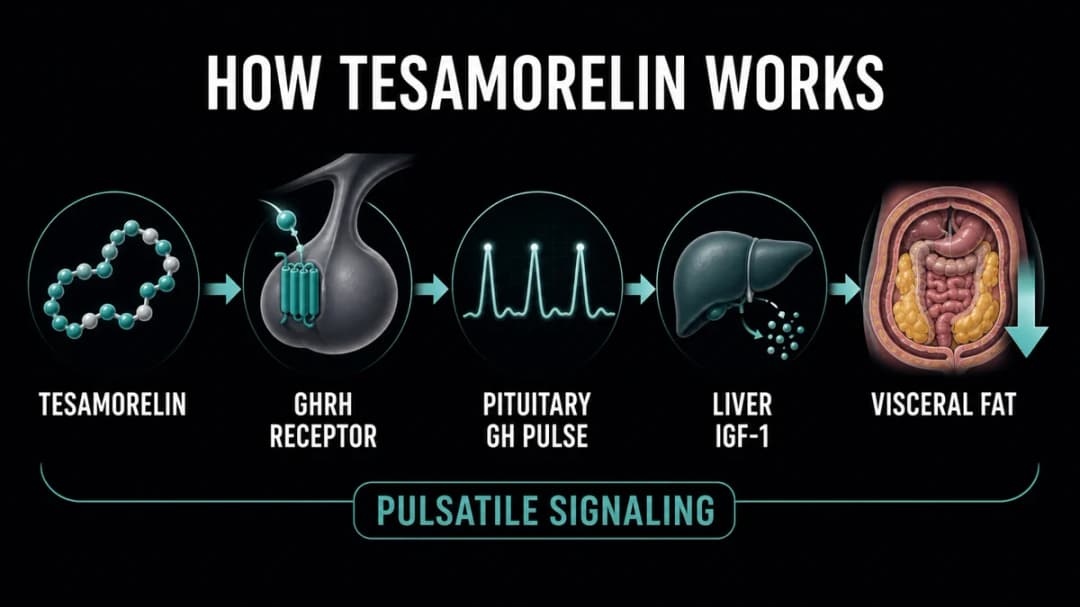
- It signals the pituitary to release growth hormone in pulses rather than supplying growth hormone directly, so the body's own feedback loop stays in the circuit.
- The strongest evidence is for visceral fat reduction, measured directly by imaging over roughly six months in the trials that supported its approval for HIV-associated lipodystrophy.
- Reported research dosing runs 1 to 2 mg subcutaneously once daily, most often fasted, across cycles of 12 to 26 weeks.
- Fluid retention, joint aching, injection site reactions and a small upward drift in fasting glucose are the effects that show up consistently.
What Tesamorelin Actually Is
Tesamorelin belongs to the GHRH analog class, the same family as sermorelin and CJC-1295. Where it differs is structural. Native human GHRH is 44 amino acids long and falls apart in plasma within a few minutes, which makes it useless as a therapeutic on its own. Tesamorelin keeps the full 44 amino acid backbone and adds a trans-3-hexenoic acid group to the tyrosine at position one. That single modification shields the molecule from the enzymes that would otherwise clip it. What it does not buy is a long circulating half-life: the approved labels put mean elimination half-life at 8 minutes for the 1.4 mg Egrifta SV dose and 11 minutes for the 1.28 mg Egrifta WR dose in healthy subjects. Tesamorelin clears in minutes, like the native hormone. The advantage is that enough intact molecule survives to reach the receptor at all.
Compare that to sermorelin, which is only the first 29 residues of GHRH and is cleared faster still. Both bind the same receptor, but the longer tesamorelin remains intact, the more of that receptor occupancy translates into an actual hormone pulse, which is the mechanistic reason a single dose produces a larger and more reproducible response. Our sermorelin peptide guide covers the shorter fragment separately.
The mechanism is upstream, and that is the whole point. The molecule docks onto GHRH receptors in the anterior pituitary, and the gland empties part of its own stored growth hormone within minutes. Hepatic tissue reads that pulse and answers with IGF-1, and it is IGF-1, not growth hormone itself, that carries out most of what people are actually after: fat oxidation and tissue repair. Injecting recombinant growth hormone skips all of that and holds IGF-1 flat. Tesamorelin does not, and the preserved pulsatility is the main argument in its favor.
One framing note. Tesamorelin is approved as a pharmaceutical under the brand name Egrifta for a specific indication, and the pharmacy product has been reformulated twice since launch, most recently as Egrifta WR in 2025. The lyophilized vials sold to researchers are not that product and are supplied for laboratory research only. Everything below describes what has been reported in research settings, not a protocol for anyone to follow.
Tesamorelin Benefits
Because tesamorelin went through full Phase III development, the evidence here is stratified in a way it rarely is for research peptides. Worth separating the tiers honestly.
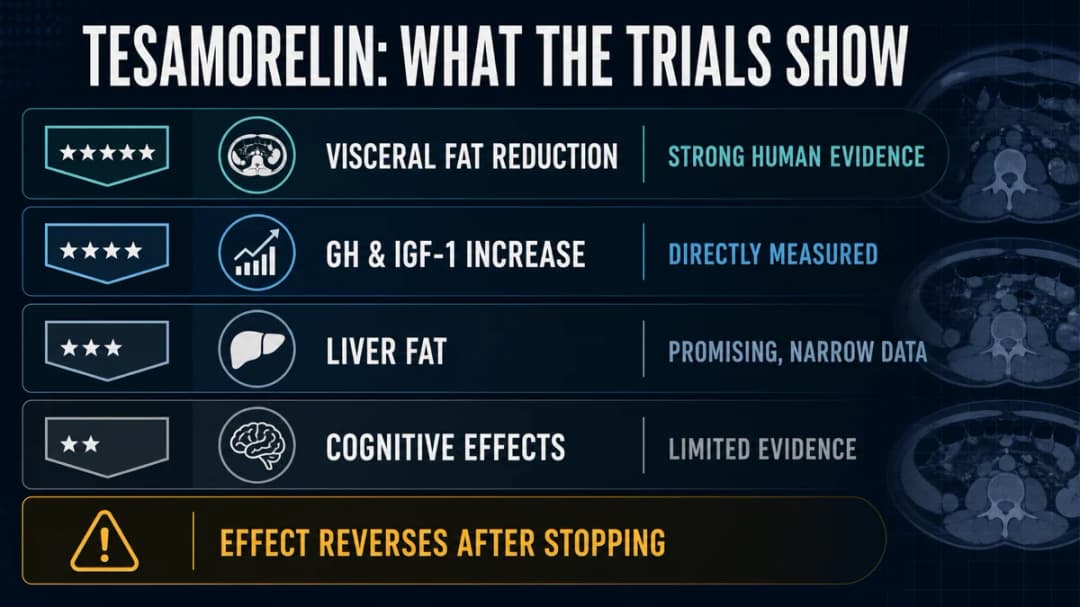
Visceral fat reduction. Strong human evidence. The registration trials enrolled adults with HIV-associated lipodystrophy and excess abdominal adiposity, and measured visceral adipose tissue directly rather than inferring it from weight. Deep abdominal fat fell significantly against placebo over the six-month treatment window: visceral adipose tissue dropped 18% in Study 1 and 14% in Study 2 against placebo changes of plus 2% and minus 2%, and the first of those trials reported a 15.2% fall versus a 5.0% rise on placebo. Two details matter more than any headline number. First, the loss was selective: the second registration trial found no change in limb or abdominal subcutaneous fat, and lean body mass did not merely hold, it rose by 1.2 to 1.3 kg while placebo groups lost a little. Second, the effect reversed. Patients re-randomized off tesamorelin at week 26 regained 25 cm squared and 24 cm squared of visceral fat by week 52, which tells you the mechanism is maintenance-dependent rather than a permanent reset.
More recent work holds that up. A subgroup analysis of a randomized, double-blind trial in people with HIV and fatty liver, covering the 38 participants on integrase inhibitor regimens with 31 completing 12 months at 2 mg daily, reported a median visceral fat change of minus 25 cm squared on tesamorelin against a median increase of 14 cm squared on placebo, and 67% of the treated group versus 13% of placebo hit the FDA-defined threshold of at least an 8% visceral fat reduction.
IGF-1 and growth hormone axis elevation. Strong, and directly measurable. Trial participants showed IGF-1 climbing well above baseline, which is exactly what a working GHRH signal should produce. This is the one benefit anyone can verify with a blood draw rather than a mirror, and it is the cleanest way to confirm a given vial is doing anything at all.
Liver fat. Promising, narrower evidence base. Randomized work in people with HIV and fatty liver reported reductions in liver fat content. The proposed mechanism, growth hormone driven hepatic fat oxidation, has no obvious reason to be HIV-specific, but the trials were run in that population and extrapolation to the general fatty liver population is not yet supported by equivalent data.
Cognitive measures. Interesting, thin, and easy to overstate. The evidence here is essentially one randomized, double-blind, placebo-controlled trial in 152 adults aged 55 to 87, 66 of them with mild cognitive impairment, given tesamorelin 1 mg daily for 20 weeks. It reported a favorable overall effect on cognition (P=0.03 intent-to-treat), carried mainly by executive function (P=0.005), with verbal memory only trending. IGF-1 receptors are present in the hippocampus and prefrontal cortex, so a plausible mechanism exists, but this is one 20-week trial in a population unrelated to the approved indication, and anyone presenting tesamorelin as a cognitive enhancer is running well ahead of it.
Lipid markers. Secondary and largely inferential. The lipid endpoints the registration trials actually carried were triglycerides and the ratio of total cholesterol to HDL, not the triglyceride to HDL ratio quoted in a lot of secondary write-ups. Both improved: triglycerides fell 50 mg/dL against a 9 mg/dL rise on placebo, and the total cholesterol to HDL ratio fell 0.31 against a 0.21 rise, most likely as a consequence of the fat loss rather than a direct drug effect. Sleep and recovery. Anecdote only. Deeper sleep and faster training recovery fit what growth hormone does and are widely reported by users, but no tesamorelin trial measured either, at any endpoint, so there is nothing here to cite.
What tesamorelin does not do is worth stating plainly. It is not a strong subcutaneous fat loss agent, so the visible leanness people associate with growth hormone protocols is muted when it is run alone. It is not meaningfully anabolic in the way androgens are. The approved label is blunt about the scale specifically: tesamorelin is weight neutral and is not indicated for weight loss management, because what it moves is the deep abdominal compartment rather than total body mass. And it does not work quickly. The trial endpoints sat at 26 weeks for a reason.
Tesamorelin Side Effects
Tesamorelin peptide side effects are milder than what exogenous growth hormone produces, and the reason is structural rather than lucky. Because the pituitary is still regulating output, IGF-1 climbs to a high-normal range instead of overshooting it, which keeps the classic growth hormone problems off the table at typical doses.
The effects reported most often:
- Injection site reactions. A red patch, itching, a small firm lump, or brief soreness. The most frequent complaint by a wide margin, and heavily influenced by needle technique and whether sites are rotated.
- Fluid retention and peripheral edema. Puffiness in the hands, feet or face, typically appearing in the first one to two weeks and settling within two to three as the body adjusts to the new growth hormone level. The scale can move up slightly during this phase while fat mass has not changed at all.
- Joint aching and stiffness. Small load-bearing joints in the hands and lower limbs complain first. Onset around weeks two to four, dose-dependent, and generally the first thing to improve when a dose is lowered.
- Paresthesia. Tingling or numbness in the hands and feet, related to the same fluid shifts rather than nerve damage, and usually transient.
- Muscle aching and headache. Less common, generally mild, and often confounded with the fluid retention phase.
- Nausea. Uncommon, mostly post-injection, and reported more with fasted morning dosing.
Those are the qualitative reports. The approved label is the only place hard incidence numbers exist, drawn from the pooled 26-week placebo-controlled trials:
| Adverse reaction, 26-week trials | Tesamorelin (n=543) | Placebo (n=263) |
|---|---|---|
| Injection site reaction | 17% | 6% |
| Arthralgia (joint pain) | 13% | 11% |
| Pain in extremity | 6% | 5% |
| Myalgia (muscle pain) | 6% | 2% |
| Peripheral edema | 6% | 2% |
Read the placebo column before reacting to the drug column. Joint pain ran 11% on placebo, so most of that complaint is background in this population rather than the drug. Injection site reactions and the fluid-related effects are where tesamorelin genuinely separates from placebo, and injection site reactions separate by the widest margin.
The glucose question deserves its own paragraph because it is the one effect with a real mechanistic basis rather than a nuisance profile. Growth hormone is counter-regulatory to insulin. Trials recorded small increases in fasting glucose in some participants. For metabolically healthy people this rarely amounted to anything clinically relevant, and the visceral fat reduction pushes in the opposite direction over time, potentially offsetting it. For anyone already insulin resistant, prediabetic or diabetic, that offset cannot be assumed, and this is the parameter most worth tracking.
The label puts figures on that. Over 26 weeks, 5% of treated patients versus 1% on placebo crossed an HbA1c of 6.5%, and the label reports an intent-to-treat hazard odds ratio of 3.3 (CI 1.4 to 9.6) for developing diabetes. Longer follow-up reads better: that same 12-month integrase inhibitor analysis at 2 mg daily found no significant change in fasting plasma glucose or HbA1c from baseline, with hyperglycemia occurring at similar frequency in both arms. Both results can be true at once, which is why an A1c before starting and another at three months is the cheapest piece of monitoring available.
Where the data is genuinely thin: long-term use beyond a year, use in people without a clinical indication, and the theoretical concern that sustained IGF-1 elevation could support growth of an existing malignancy. On that last point the label does not report a trial malignancy finding either way. What it carries instead is an Increased Risk of Neoplasms warning, a statement that the effects of prolonged IGF-1 elevation are unknown, and the observation that 36% of treated patients had IGF-1 more than 3 standard deviation scores above normal by week 26. Trial durations were months, not decades, so nothing here settles the question. Tesamorelin is contraindicated in active malignancy and in known pituitary lesions, and there is no research population that establishes what indefinite use looks like. The label's own limitations section says it plainly: long-term cardiovascular safety has not been established. Its full contraindication list is active malignancy, pregnancy, known hypersensitivity to tesamorelin or its excipients, and any disruption of the hypothalamic-pituitary axis from hypophysectomy, hypopituitarism, pituitary tumor or surgery, head irradiation or head trauma.
Tesamorelin Dosage Chart
Only one row below traces to a trial protocol: 2 mg once daily for 26 weeks is the registration-trial regimen. The single other daily dose with a controlled trial attached to it anywhere is 1 mg for 20 weeks, from the cognition study, in a population with nothing to do with abdominal fat. The rest, the 1.5 mg step, the GHRP pairing and the intermittent schedule, are community practice with no trial behind them and no published outcome data. None of it is a recommendation, and there is no established dosing standard for use outside the approved indication.
| Context | Reported range | Frequency | Typical cycle |
|---|---|---|---|
| Tolerance assessment / conservative entry | 1 mg | Once daily, subcutaneous | 2 to 4 weeks |
| Intermediate step-up | 1.5 mg | Once daily, subcutaneous | 4 to 8 weeks |
| Clinical-style visceral fat protocol | 2 mg | Once daily, subcutaneous | 26 weeks (3 to 6 months) |
| General growth hormone axis support | 1 to 2 mg | Once daily, subcutaneous | 12 to 26 weeks |
| Paired with a GHRP | 1 mg tesamorelin + 200 to 300 mcg ipamorelin | Once daily, subcutaneous | 12 weeks and up |
| Intermittent variant | 1 to 2 mg | 5 days on, 2 days off | 3 to 6 months |
A note on the 1 mg versus 2 mg discrepancy you will see across sources. The 2 mg daily dose is the trial dose of the older Egrifta formulation (1 mg vials), and the registration trial published visceral fat outcomes were built on it. It is no longer the labeled dose: current Egrifta SV is 1.4 mg (0.35 mL) daily and Egrifta WR is 1.28 mg (0.16 mL) daily, as the table below shows. The widespread 1 mg starting point is not a formal protocol step; it is a tolerability practice meant to blunt early edema and joint discomfort. Both numbers are real, but citing 1 mg while quoting the 2 mg outcome data conflates them. The current pharmacy formulations complicate the picture further, and the section below sets those numbers side by side.
Research vials are not pre-measured, so the figure that actually matters at the bench is units on a U-100 insulin syringe, where 100 units is 1 mL. That depends entirely on the concentration chosen at reconstitution:
| Dose | At 1 mg/mL | At 2 mg/mL | At 2.5 mg/mL |
|---|---|---|---|
| 1 mg | 100 units (1 mL) | 50 units (0.5 mL) | 40 units (0.4 mL) |
| 1.4 mg | 140 units (two draws) | 70 units (0.7 mL) | 56 units (0.56 mL) |
| 1.5 mg | 150 units (two draws) | 75 units (0.75 mL) | 60 units (0.6 mL) |
| 2 mg | 200 units (two draws) | 100 units (1 mL) | 80 units (0.8 mL) |
A 2 mg vial reconstituted with 1 mL gives 2 mg/mL; a 5 mg vial with 2 mL gives 2.5 mg/mL. Concentration is a trade-off in both directions: at 1 mg/mL a 2 mg dose no longer fits in one syringe, while at 8 mg/mL, the concentration the current pharmacy product uses, a 0.1 mg difference is 1.25 units on the barrel, which is below what anyone draws reliably by eye.
Timing has the clearest mechanistic rationale of any variable here. Somatostatin is the brake on growth hormone release, insulin encourages the hypothalamus to apply it, and a recent meal therefore costs pulse amplitude. That is why reported protocols cluster around a stomach that has been empty for a couple of hours, which in practice means before breakfast or well clear of the evening meal.
On cycling: the registration program extended past the six-month endpoint without the pituitary becoming refractory, so the case for mandatory breaks is weaker than it is usually presented. The practical arguments for 3 to 6 months on with a break are cost, the chance to assess whether anything changed, and caution about a duration nobody has studied. Serial IGF-1 testing is the only objective way to confirm a response. The approved label treats that as a requirement rather than an option: monitor IGF-1 during treatment and consider stopping in patients with persistent elevations, with more than 3 standard deviation scores given as the example threshold, particularly where the response is not robust.
Egrifta, Egrifta SV and Egrifta WR: the Approved Dosing
Tesamorelin is one of the few compounds in this category with a live FDA-approved product behind it, and the approved dose has changed twice. That is where a good deal of the milligram confusion online comes from. All three versions carry the same indication, reduction of excess abdominal fat in adults with HIV-associated lipodystrophy, and none of them is approved for anything else.
| Product | Vial strength | Daily dose | Diluent | Mixed solution |
|---|---|---|---|---|
| Egrifta, original 1 mg/vial formulation | 1 mg | 2 mg | Not applicable, superseded | Not applicable, superseded |
| Egrifta SV, 2 mg/vial formulation | 2 mg | 1.4 mg (0.35 mL) | 0.5 mL sterile water for injection | Inject immediately, do not refrigerate or freeze |
| Egrifta WR, 11.6 mg/vial formulation (F8), approved March 2025 | 11.6 mg | 1.28 mg (0.16 mL at 8 mg/mL) | 1.3 mL bacteriostatic water for injection | Room temperature, discard 7 days after mixing |
The falling milligram number is a formulation story, not a de-escalation. Tesamorelin's absolute subcutaneous bioavailability is under 4%, so small changes in how the powder is formulated move exposure a long way. FDA approved Egrifta SV on the original trials plus a demonstration that systemic exposure, Cmax and AUC, at 1.4 mg matches the old 2 mg dose. Egrifta WR is the newest step: still a daily injection, but one reconstitution covers a week instead of every day, and the injection volume is a fraction of the previous one. It became available in September 2025. Both labels remain current on DailyMed, and the WR label is explicit that the two formulations are not substitutable.
Two things follow for anyone reading a research vial label. First, a 1 mg vial is not an odd research size, it is the original pharmaceutical unit, which is why 1 mg turns up so often in older protocols and in searches. Second, milligram-for-milligram comparisons between a research vial and a pharmacy product are not meaningful when the formulations differ, and no research supplier publishes anything resembling an exposure bridge.
Stacking
The one combination with a genuine pharmacological rationale is a GHRH analog paired with a growth hormone releasing peptide. They act on separate systems: tesamorelin drives the GHRH receptor directly, while a GHRP like ipamorelin works through the ghrelin receptor and suppresses somatostatin, the brake on growth hormone release. Releasing the brake while pressing the accelerator produces a substantially larger pulse than either compound alone. Ipamorelin ends up being the default partner because of what it leaves alone: unlike GHRP-2 and GHRP-6, it is selective enough to skip the appetite spike and the cortisol and prolactin drift those two can carry. Our ipamorelin peptide guide covers that side of the pairing in detail.
What does not make sense is stacking tesamorelin with another GHRH analog. Sermorelin and CJC-1295 compete for the same receptor, so you are paying twice to occupy one site. With the DAC version of CJC-1295 there is an additional issue: its multi-day half-life produces a sustained elevation rather than discrete pulses, which works against the specific reason to choose tesamorelin in the first place.
Reconstitution and Storage
Tesamorelin arrives as a lyophilized powder, most often in 2 mg or 5 mg vials. It is reconstituted with bacteriostatic water, added slowly down the inside wall of the vial rather than jetted directly onto the cake, then swirled gently. Shaking shears peptide chains and is the single most common handling error.
Concentration is a choice, not a fixed value. Putting 1 mL into a 2 mg vial yields 2 mg/mL, so a full 1 mL draw is one 2 mg dose. Putting 2 mL in yields 1 mg/mL, which makes partial doses far easier to measure accurately on an insulin syringe. For anyone titrating between 1 mg and 2 mg, the lower concentration is the more forgiving option.
Unreconstituted vials are stable refrigerated for the manufacturer's stated shelf life. Once reconstituted, refrigerate immediately, protect from light, and do not freeze. No published stability study covers research-grade tesamorelin reconstituted with bacteriostatic water, so the commonly repeated 28 to 30 day figure is a peptide-handling convention rather than a measured shelf life for this compound. Because tesamorelin is dosed daily, a vial gets punctured far more often than a twice-weekly peptide, so clean stopper technique matters more here than usual.
Worth noting how differently the pharmacy products behave: Egrifta SV is mixed and injected on the spot with nothing kept over, and Egrifta WR sits at room temperature and is discarded seven days after mixing. Neither schedule transfers to a research vial reconstituted with bacteriostatic water, which is a different formulation with a different preservative situation.
How to Verify What You Buy
GHRH analogs are unforgiving of degradation. A vial that has been heat-stressed or poorly synthesized will not stimulate a pulse, and there is no subjective symptom that reliably tells you the difference between a bad vial and a non-responder. Ask any supplier for third-party testing that identifies the peptide and quantifies purity, and check that the report corresponds to the batch you were actually shipped rather than a generic sample. Our where to buy tesamorelin page walks through which suppliers publish verifiable testing, and the tesamorelin for sale listing tracks current vial sizes and pricing so you can sanity check anything that looks unusually cheap.
Looking for the numbers behind this guide? Our tesamorelin dosage chart sets label and trial doses beside what Reddit users report taking.
Frequently Asked Questions
What does tesamorelin peptide do?
It stimulates the anterior pituitary to release its own growth hormone by binding GHRH receptors, which in turn raises IGF-1. The best-documented downstream effect is a selective reduction in visceral abdominal fat, with subcutaneous fat and lean mass largely spared. It does not supply growth hormone directly, so the body's normal pulsatile rhythm and negative feedback stay intact.
Is tesamorelin safe?
Within the trial populations and durations studied, the safety profile was manageable and clearly milder than exogenous growth hormone. Fluid retention, joint discomfort, injection site reactions and a modest rise in fasting glucose account for most of what was observed. The honest caveats are that safety data comes from a specific clinical population over months rather than years, that it is contraindicated in active malignancy and pituitary lesions, and that research-grade material carries an entirely separate set of risks around identity and purity that no trial addresses.
How much tesamorelin is used in research?
Reported ranges are 1 to 2 mg subcutaneously once daily, with 2 mg being the dose behind the published visceral fat outcomes and 1 mg commonly used as a tolerability starting point. Cycles in the literature run 12 to 26 weeks, and the pivotal work extended beyond that. These are reported figures, not guidance, and no dosing standard exists for use outside the approved indication.
Is tesamorelin used for growth hormone deficiency?
No, and the label specifically excludes the population most people mean by the question. The only approved indication is reduction of excess abdominal fat in adults with HIV-associated lipodystrophy, and tesamorelin is contraindicated when the hypothalamic-pituitary axis has been disrupted by hypophysectomy, hypopituitarism, pituitary tumor or surgery, head irradiation or head trauma, which covers most causes of diagnosed adult growth hormone deficiency. The reason is mechanical. A GHRH analog only does anything if there is a responsive pituitary downstream of it, and confirmed deficiency often means there is not. Deficiency diagnosed clinically is treated with growth hormone itself, not with a secretagogue. The 1 mg figure attached to these searches is a vial size rather than a deficiency dose: 1 mg per vial was the original Egrifta presentation, at a 2 mg daily dose.
Is cardio good on tesamorelin?
No completed trial has tested tesamorelin against training, so what follows is mechanism plus one caveat. The label is explicit that tesamorelin is weight neutral and not indicated for weight loss, so what it moves is the visceral compartment while training remains the variable driving everything else. The one interaction worth planning around is the same one that governs dose timing: insulin prompts somatostatin, somatostatin blunts the growth hormone pulse, so a carbohydrate-heavy meal or drink near an injection costs pulse amplitude while fasted work does not. That gap is currently being filled. The TRIUMPH trial at Massachusetts General Hospital, which began in July 2025 and estimates completion in December 2028, randomizes 100 adults with HIV to tesamorelin 1.28 mg daily or placebo, both on the same home-based exercise program, with repeated chair-stand time at week 24 as the primary outcome. If the question is cardiovascular safety rather than cardiovascular exercise, the label answer is that long-term cardiovascular safety has not been established.
Is tesamorelin legal?
Tesamorelin is an approved prescription drug in the United States under the brand name Egrifta, indicated for excess abdominal fat in HIV-associated lipodystrophy, and obtaining that product legitimately requires a prescription. Research-grade tesamorelin in lyophilized vials is legal to buy and possess for laboratory research, but it is not approved for human use and marketing it for human consumption is not lawful. Rules vary by country, so check your own jurisdiction.
Sources
- EGRIFTA WR (tesamorelin) for injection, prescribing information — DailyMed, U.S. National Library of Medicine
- EGRIFTA SV (tesamorelin) for injection, prescribing information — DailyMed, U.S. National Library of Medicine
- Efficacy and Safety of Tesamorelin in People with HIV on Integrase Inhibitors — PubMed Central
- Tesamorelin as an Adjunct to Exercise for Improving Physical Function in HIV, NCT06554717 — ClinicalTrials.gov
- Theratechnologies Receives FDA Approval for EGRIFTA WR (Tesamorelin F8) — Theratechnologies
- Theratechnologies Announces Availability of EGRIFTA WR (tesamorelin) for injection — Theratechnologies
- Metabolic Effects of a Growth Hormone-Releasing Factor in Patients with HIV (Falutz et al., NEJM 2007; NCT00123253) — PubMed
- Effects of Tesamorelin in HIV-Infected Patients with Abdominal Fat Accumulation (Falutz et al., JAIDS 2010; NCT00435136) — PubMed
- Effects of Growth Hormone-Releasing Hormone on Cognitive Function in Adults with Mild Cognitive Impairment and Healthy Older Adults (Baker et al., Arch Neurol 2012; NCT00257712) — PubMed