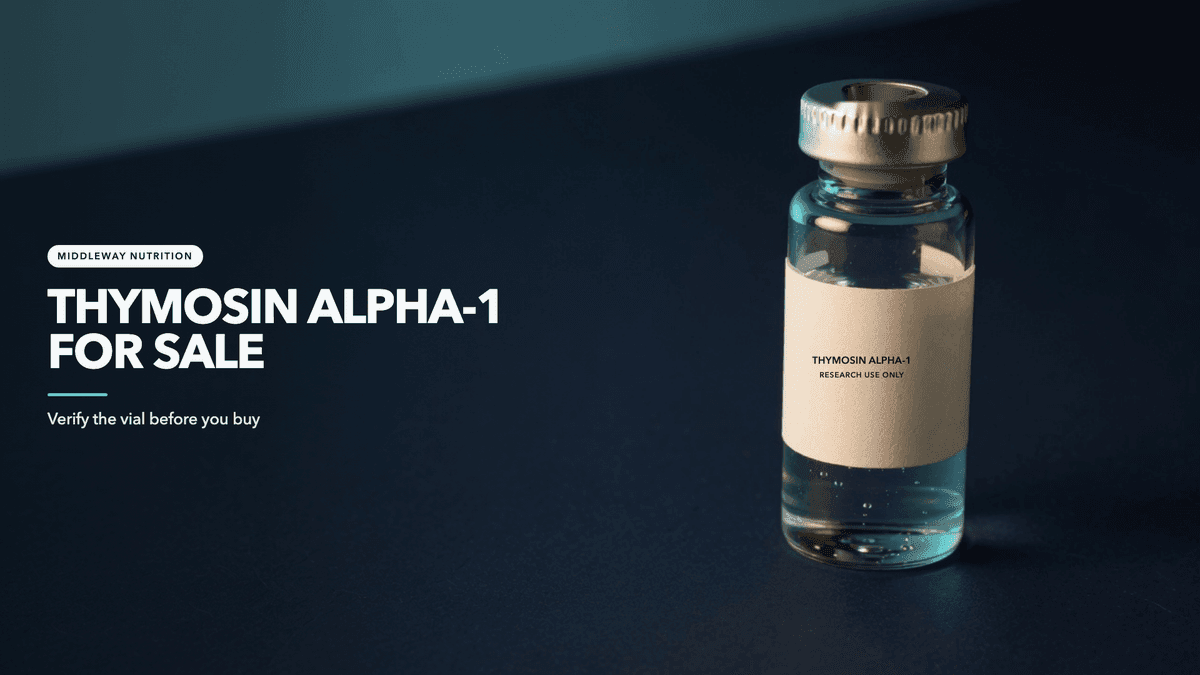
Any thymosin alpha-1 for sale online is a research vial, not the Zadaxin medicine, and the certificate for your lot is the only proof of what is inside. This page covers what to verify before you pay.
Key Takeaways
- Online listings are research material. The branded drug (Zadaxin, thymalfasin) is an approved medicine in some countries, but a vial from a research vendor is not that product
- The listing prices we checked on 2026-10-10 span about $4.80 to $13 per mg, with one 10mg vial at $71.00 ($7.10/mg) on the Ascension product page
- A real certificate matches your lot number and shows mass near 3,108 Da as well as an HPLC trace
- Thymosin alpha-1 (28 amino acids) and thymosin beta-4 / TB-500 (43) are different molecules that get mixed up on listings
- A "99%" banner is not evidence. We found one product page quoting four different purity figures
What you are actually buying
Thymosin alpha-1 is a 28-amino-acid peptide, acetylated at the N-terminus, with a formula of C129H215N33O55 and a molar mass of about 3,108 g/mol. It was originally isolated from thymus tissue, and the synthetic version is called thymalfasin. Research interest is in immune modulation: it is described as acting on T-cell maturation and on dendritic cells and macrophages.
This is an unusual peptide because it has a genuine clinical history. A 2025 systematic review of randomized trials in sepsis pooled 11 trials and reported lower 28-day mortality overall (odds ratio 0.73), but the higher-quality and multicenter subsets did not show a mortality benefit and the authors said the sample was still too small. That is the honest state of the evidence, and it describes the pharmaceutical product given to hospital patients. It says nothing about a vial of powder from a website.
Thymosin alpha-1 for sale: what the listing really means
When you search for thymosin alpha-1 for sale, two very different things share the results page. One is the approved medicine, which according to the reference sources we checked is licensed in some countries for hepatitis B and C and is not dispensed through US pharmacies. The other is a lyophilized research vial marked for laboratory use. Sellers in the second group usually say so on the page: one product page we read says it is not a drug or dietary supplement and not FDA approved, and another says it is "considered research only and not approved for human use."
The comparison below shows why that distinction matters for a buyer.
Zadaxin versus a research vial of thymosin alpha-1
| Pharmaceutical (Zadaxin) | Research vial | |
|---|---|---|
| Status | Approved medicine in some countries (hepatitis B and C) | Not approved; sold for laboratory use |
| Oversight | Regulator-reviewed manufacturing and labeling | Whatever the seller chooses to test and publish |
| US pharmacy | Not dispensed through US pharmacies | Not applicable |
| Proof of contents | Regulated release testing | Your lot's COA |
Practically, the research label means nobody checks purity, fill weight, sterility or endotoxin before a vial ships. The seller picks the lab, picks what to test, and picks what to publish. There is no pharmacist, no recall and no regulator reading the paperwork. Legal to sell as research material is a narrow statement. It does not mean approved, and it does not mean verified. If a seller wraps medical promises around a research vial, that tells you how seriously they take their own label.
How to read a thymosin alpha-1 COA
Most buying advice stops at "get a COA." The certificate is only useful if you read it against the vial.
Match the lot. A batch-specific certificate names the lot printed on your vial, with a test date. A product-level PDF may describe a run from months ago. When we looked at one vendor's page, the certificate listed a batch number and a 2026 test date; the vendor also told buyers to check that the lot on the vial matches the posted COA before starting. That is the right instruction, so do it.
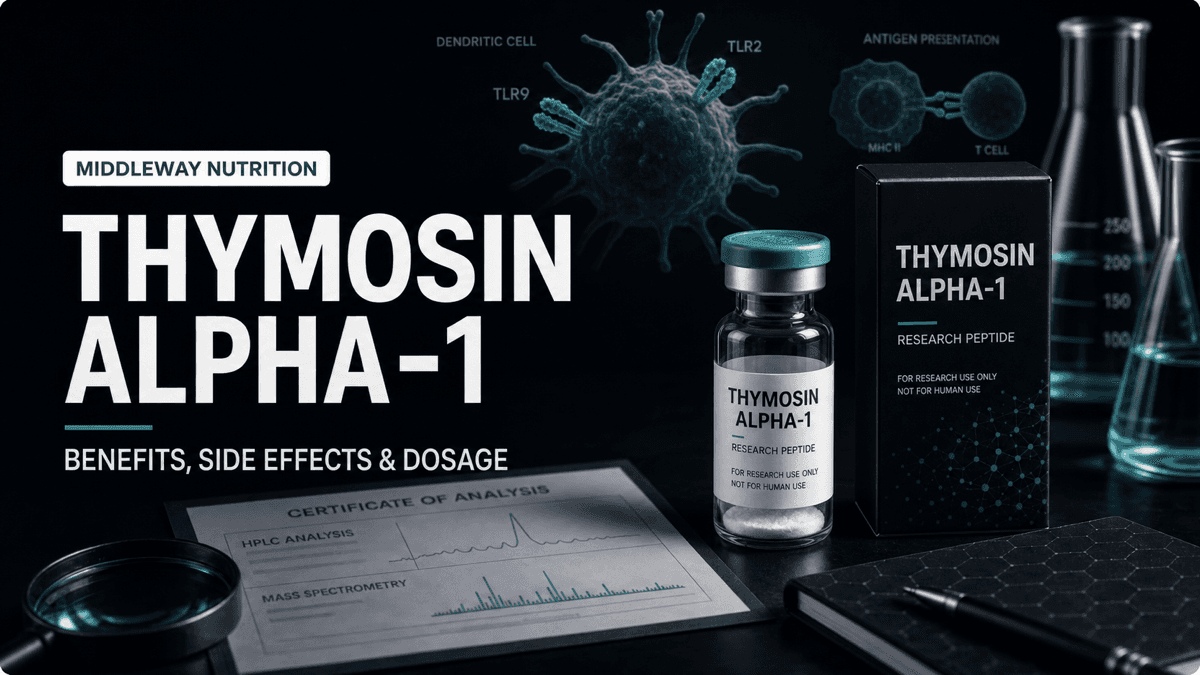
Look for mass, not only purity. HPLC tells you what fraction of the sample is one peak. Mass spectrometry tells you what that peak is. A cheaper peptide can post a clean HPLC trace. For this compound you want an observed mass near 3,108 Da. One certificate we saw described its method as HPLC-UV/VIS for identity and purity; a UV trace alone confirms a retention time, not a molecular weight, so ask whether LC-MS was run.
Check the sequence and the name. Naming drift happens: one certificate on the Ascension page is titled "Thymosin alpha-I", and another seller's page described a 5mg vial as a 3mL ampule. Neither proves a problem, but both show why you read the document and not the banner. The molecule should be the 28-residue form. Thymosin beta-4, sold as TB-500, is 43 residues and a different compound, and vendors confuse the two.
Compare the purity figure with what the page claims. On one 5mg listing we read, the header said 99.82%, the lot COA link said 99.41%, the about section said more than 99.9%, and the FAQ promised 98% or higher. A vendor that cannot keep its own number straight is not giving you data.
Five checks for a thymosin alpha-1 certificate
- 1Lot number matches
The lot on the PDF is the lot printed on your vial. - 2Mass near 3,108 Da
Mass spectrometry confirms identity, not just cleanliness. - 3HPLC chromatogram shown
A real trace with a purity figure, not a bare percentage. - 4Date and lab are checkable
A named lab and a test date you can compare with the listing. - 5Right molecule named
Thymosin alpha-1 (28 residues), not thymosin beta-4 (43).
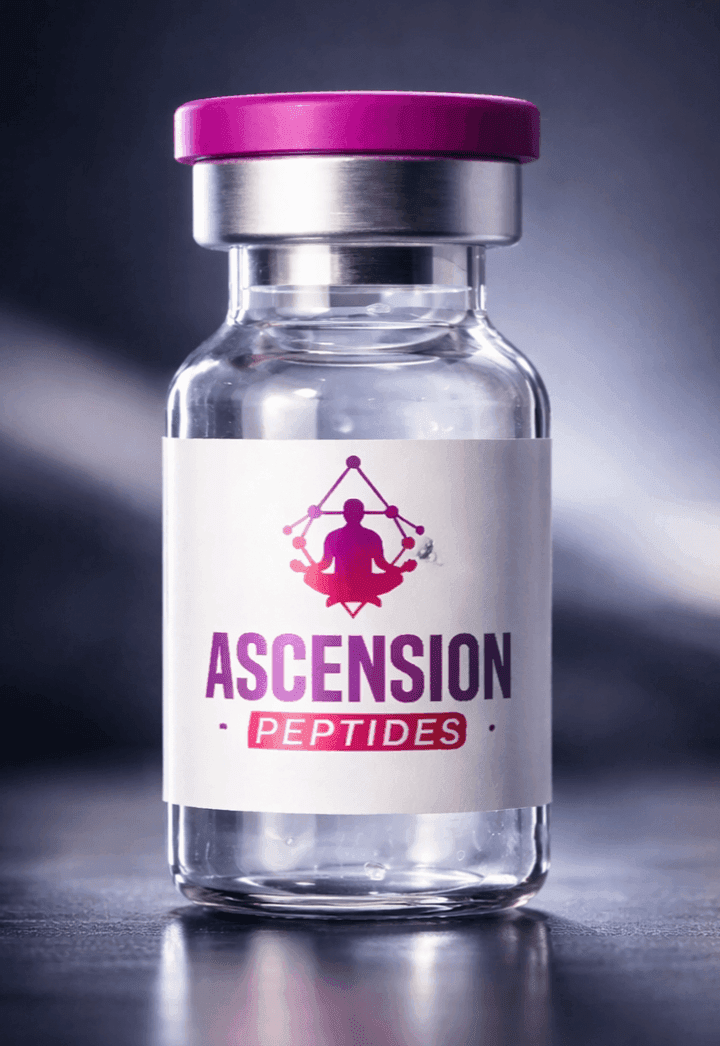
For the vendor we point people to, the product page lists a Kovera Labs certificate dated May 26, 2026 and an older MZ Biolabs one dated February 13, 2026. Ascension states that Kovera tests every batch for HPLC purity, LC-MS identity, net content, endotoxin, sterility and heavy metals, with a pass mark above 98%, and a public library of 85 batch certificates. The product page itself shows no purity figure, so read the certificate for the batch you get. If you have decided to buy and want that documentation trail, Ascension Peptides lists the 10mg vial at $71.00, and new customers get 50% off with code PEPTIDEDECK.
Third-party testing: what it does and does not prove
A named outside laboratory beats an unnamed "independent lab." Several sellers name theirs, and some publish an open library of certificates you can read before ordering. That is the useful part: you can check the paperwork without an account or a purchase.
What it does not prove is that every vial you receive matches the sample the lab saw. Testing a batch tells you about that batch. It is the lot match that ties the certificate to your vial. It also does not prove quantity unless the report includes net peptide content. Lyophilized peptides carry salts and moisture, so a vial can be very pure and still hold less peptide than the label says. Ascension lists net content among its tests, which is worth looking for on any certificate.
One more trap: "third-party tested" and "98% or higher" are different statements. An independent lab can honestly report a number below the bar you wanted. Read the figure.
Thymosin alpha-1 price and cost: a sanity check
Per-milligram arithmetic is the quickest filter, because vial sizes vary. On 2026-10-10 the pages we fetched showed:
| Seller | Vial | List price | Per mg |
|---|---|---|---|
| Ascension (product page) | 10mg | $71.00 | $7.10 |
| Biotech Compounds | 10mg | $96.99 | $9.70 |
| BioLongevity Labs | 10mg | $129.97 | $13.00 |
| Bluum Peptides | 5mg | $69.00 | $13.80 |
A comparison site listed 10mg vials from four further sellers at $47.99, $58.00, $65.00 and $85.00 ($4.80 to $8.50 per mg), and a 5mg vial at $63.99. We did not fetch those sellers' own pages, so treat them as indicative. Core Peptides showed a combined $81 to $149 range without labeling sizes. The chart below puts these on one scale.
Thymosin alpha-1 list price per mg, October 2026
Our own comparison guide, where to buy thymosin alpha-1, covers the vendors side by side, so this page stays on the buyer's checks. What matters here is the logic. Synthesizing and testing a 28-residue peptide costs real money, so a price well under the low end of the band should make you ask which step was skipped: the HPLC, the mass spec, the fill weight or the sterility check. A price above the band is not a quality guarantee either. The most expensive 10mg listing we found sat at $13 per mg and carried a "99%+" badge without a figure for the lot on its product page.
Bulk tiers shift the math. Ascension lists 3 vials at $68.87 each, 5 at $67.45 and 10 at $63.90, and other sellers run their own tiers. Judge the post-discount price per mg, not the percentage off. Bacteriostatic water is a separate purchase, and Ascension does not sell it.
What actually arrives
A correct order is a sealed glass vial holding white lyophilized powder or a thin cake, with a label that carries the compound name, quantity, lot number and a research-use statement. Check the lot against the certificate on the day it arrives, not weeks later. Storage guidance on vendor sheets for the powder is cold and protected from light, so follow what your own label says.

Two arrival-stage warnings. Powder that has collapsed into a sticky film, or that arrives discolored, has met heat or moisture in transit. And a ready-mixed solution with no batch date gives up the stability that makes the freeze-dried format the standard: you cannot verify it, and you cannot tell how old it is. The same caution applies to strips, capsules and other non-vial forms, where a certificate is much harder to interpret and absorption claims usually come with no independent data.
Ascension ships within the US only, with free shipping over $250. All sales are final, with replacement for damaged or incorrect items, so verify before you order rather than after.
Red flags: walk away
- No certificate, or one emailed only after payment. You should be able to read it first
- A generic PDF with no lot number, or a lot that does not match your vial
- A purity figure that changes across the same page, or a bare "99%+" with no chromatogram
- No mass spectrometry data, so purity is claimed without identity
- Confusion with thymosin beta-4 or TB-500 in the listing or on the certificate
- A price far below the normal band, or permanent clearance pricing
- Treatment language or dosing instructions. A seller writing prescribing advice for a research chemical is ignoring its own label
- No card option or refund policy, only crypto or bank transfer
- Unverifiable "labs" with no site, portal or certificate ID
Legal and safety reality
Thymosin alpha-1 is not a US controlled substance, which is why listings are public and card payments are normal. It is not approved by the FDA, and the approved pharmaceutical form is not something you can pick up at a US pharmacy. In countries where Zadaxin is approved, a physician can prescribe it, which is a completely different route from ordering a vial online. Rules for personal importation vary by country.
Because this is an immune-active peptide, impurities matter more than they would for a cosmetic compound: an unclean preparation can provoke an immune reaction of its own. That is a reason to read the certificate, not a reason to skip it. This page is not medical advice and does not suggest anyone self-administer a research chemical.
Pre-purchase checklist
- The listing names thymosin alpha-1 (28 amino acids, about 3,108 Da), not TB-500
- The COA is readable before you pay, and its lot will match your vial
- HPLC shows a real trace at 98% or higher, and mass spec confirms the identity
- The lab is named and checkable, with a recent test date
- The price per mg sits inside the band above, and bulk discounts are judged per mg
- The seller takes card payment, states its refund policy and ships lyophilized powder marked research use only
Frequently Asked Questions
Is thymosin alpha-1 legal to buy?
In the US, research vials are sold openly and the compound is not a controlled substance, but it is not FDA approved and is sold for laboratory use. The approved medicine, Zadaxin, is licensed in some other countries. Rules elsewhere differ, so check your own.
How much does thymosin alpha-1 cost?
On the pages we checked on 2026-10-10, a 10mg vial listed from $71.00 to $129.97, with lower figures on a comparison site and 5mg vials near $64 to $69. That works out to roughly $4.80 to $13.80 per mg. Compare on a per-mg basis.
How do I know thymosin alpha-1 is real?
Appearance tells you nothing, because all lyophilized powders look alike. Ask for a batch COA whose lot matches your vial, showing an HPLC trace at 98% or higher and a mass near 3,108 Da, from a named laboratory.
Do I need a prescription for thymosin alpha-1?
A prescription applies to the pharmaceutical product in countries where it is approved. Research vials sold online are not prescribed, and they are not medicines. Neither fact makes a research vial safe or verified.
Is thymosin alpha-1 the same as Zadaxin and thymalfasin?
Thymalfasin is the synthetic form of thymosin alpha-1 and Zadaxin is the brand name of the medicine. A research vial uses the same sequence but is unapproved material without a medicine's regulatory controls.
Is thymosin alpha-1 the same as TB-500?
No. TB-500 is associated with thymosin beta-4, a 43-amino-acid peptide. Thymosin alpha-1 has 28 amino acids. Check that the certificate names the right one.
Where to buy verified thymosin alpha-1
If you have decided to buy, the checks above do the heavy lifting. Ascension Peptides is the vendor we point people to: a 10mg vial at $71.00 on 2026-10-10, per-batch third-party certificates from Kovera Labs, and US shipping. Whoever you choose, match the lot, read the purity figure and confirm the mass.
Medical Disclaimer: Thymosin alpha-1 research vials are sold for laboratory research use only and are not approved by the FDA for any use. This article is educational and is not medical advice, a dosing protocol or a recommendation for personal use. Consult a qualified healthcare professional about any health concern.