Thymosin Alpha-1 peptide benefits, side effects, and dosage rest on a larger clinical record than most research compounds can claim, with a reference dose that is documented rather than guessed. That last part is rare. Almost everything else in this market is extrapolated from rodent work and forum consensus. This one has a registered drug name, a manufacturer, and thirty years of prescribing data behind it in other countries, which changes both what you should expect and what you should be suspicious of.
- A 28 amino acid peptide cut from the larger prothymosin alpha protein, sequenced and synthesized in the 1970s. One of the oldest characterized peptides still in active research.
- Sold as a prescription drug called Zadaxin, generic name thymalfasin, in a number of countries (a manufacturer figure of "more than 35" circulates but is unverified; FDA's December 2024 briefing document says it is not approved in Japan or in Europe except Italy and could not verify the manufacturer's claims). No FDA approval in the US, so domestic access runs through compounding pharmacies or the research chemical market.
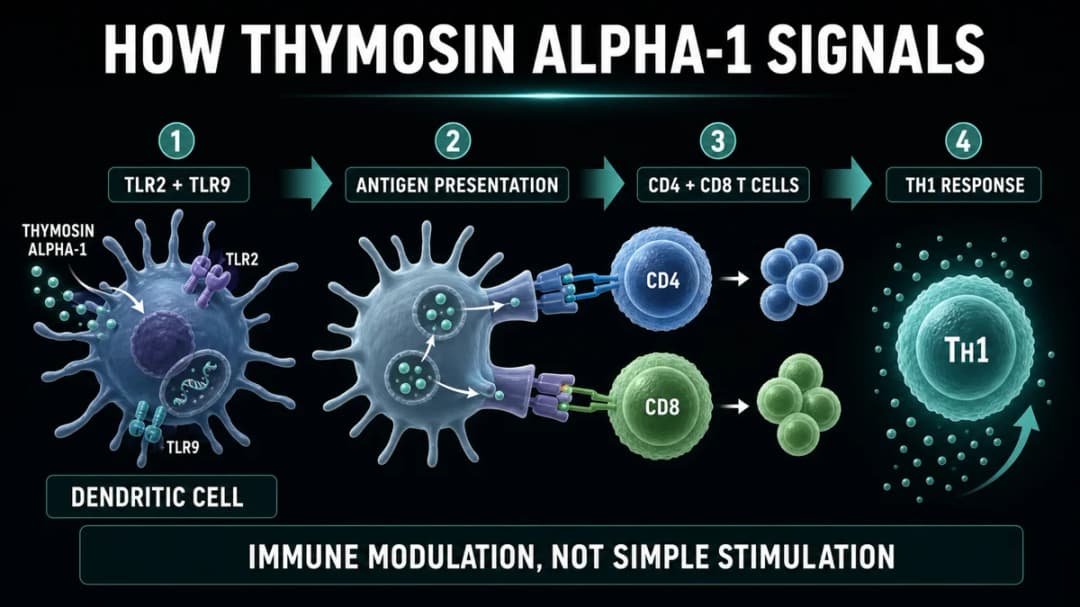
- The mechanism is immune modulation through toll-like receptors 2 and 9 on dendritic cells, improving antigen presentation and downstream T-cell function rather than crudely stimulating immunity.
- The clinical reference dose is 1.6 mg subcutaneously twice weekly. Reported protocols run from 300 mcg daily to short 3.2 mg loading courses depending on the objective.
- Serum half-life is roughly two hours with no accumulation, which is why consistent scheduling matters more than total weekly milligrams.
What Thymosin Alpha-1 Actually Is
The thymus is where immature T-cells learn to tell your own tissue from a pathogen. That organ does not stay the same size for life: it contracts from adolescence onward, and output of the peptides it secretes falls alongside it. Thymosin Alpha-1 is one of those secreted signals.
Chemically it is a 28 residue fragment with an acetylated N-terminus, sequence Ac-SDAAVDTSSEITTKDLKEKKEVEEEAEN, molecular weight around 3,108 g/mol. The body does not build it as a standalone molecule; it is cut out of prothymosin alpha, a 113 amino acid precursor. The peptide traces back to work in the 1970s on a crude thymic preparation, from which it was pulled out, sequenced, and then made synthetically ahead of the rest of its family.
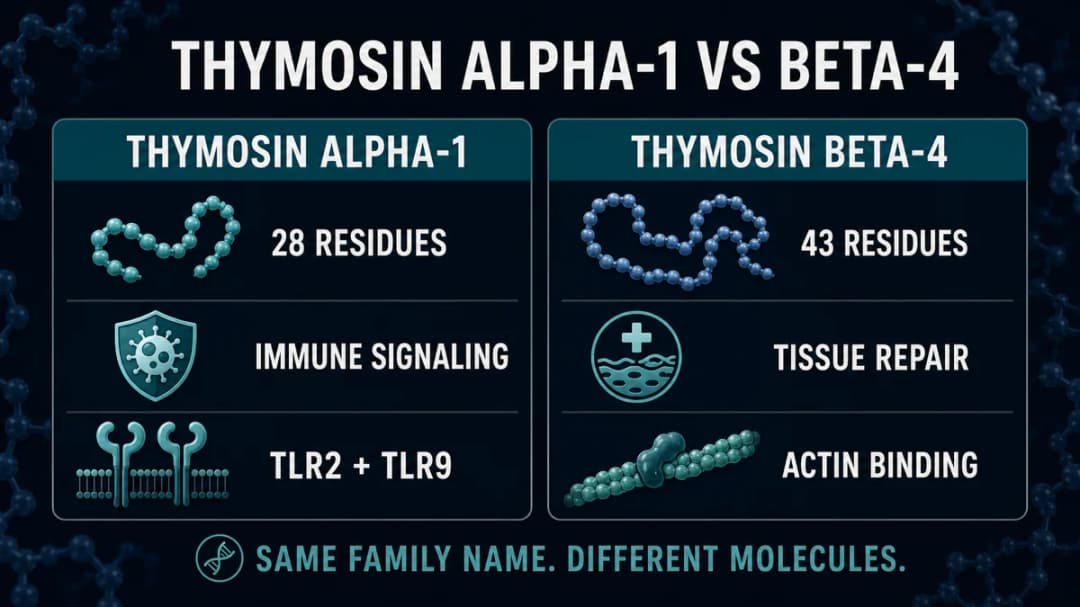
Worth clearing up immediately: Thymosin Alpha-1 and Thymosin Beta-4 share a family name and almost nothing else. Beta-4 is 43 residues and works on actin binding and cell migration, which is why it sits in the tissue repair category. Alpha-1 is an immune signaling molecule. Vendors occasionally blur the two.
The receptor story is reasonably well characterized. Thymosin Alpha-1 engages TLR2 and TLR9, pattern recognition receptors on dendritic cells and macrophages. TLR9 normally reacts to unmethylated bacterial and viral DNA motifs, so activating it puts the innate immune system into a posture it would otherwise adopt during infection. Downstream, NF-kB and IRF3 signaling rises, dendritic cells mature, and antigen presentation improves. Reported consequences include enhanced CD4 and CD8 differentiation, increased interferon-alpha and interleukin-2 output, and a tilt toward Th1, the cellular arm that handles intracellular pathogens.
The word used consistently in the literature is modulation, not stimulation. Trial data in immunosuppressed populations shows counts climbing toward normal rather than overshooting, which is the mechanistic argument for why it has been tolerated in patients you would not normally hand an immune stimulant to. It is an argument, not a guarantee.
Orphan drug designations for several conditions are often cited, but we could not verify them and FDA's December 2024 briefing document does not rely on them; what is certain is that there is no US marketing approval, so any vial bought online is a research chemical regardless of how clinical the surrounding copy sounds.
Thymosin Alpha-1 Benefits
The evidence base is genuinely unusual. Human trial work on this peptide spans multiple indications, multiple countries, and several decades, which puts it in a different tier from the compounds it is shelved next to online. That does not mean every claimed benefit is supported. The clinical record sits in sick populations, and the uses driving retail demand sit almost entirely outside it.
Chronic hepatitis B and C (strongest human evidence). This is the approved indication in most countries where Zadaxin is registered. Trials have run it as monotherapy and alongside interferon-alpha, with sustained virologic response as the endpoint. A notable feature of the hepatitis C combination data is a delayed response, with benefit appearing a year or more after the course finished. Direct-acting antivirals have largely displaced it for hepatitis C in wealthy markets.
Cancer chemotherapy adjunct (moderate human evidence). Used to hold CD4 counts up and reduce infection rates during cytotoxic treatment. Studied in hepatocellular carcinoma, melanoma, and non-small-cell lung cancer, with protocols typically running the standard twice-weekly dose for months at a stretch rather than weeks.
Critical care and severe infection (moderate, mixed). ICU trials cover sepsis, ARDS, severe pneumonia, pancreatitis, and peritonitis, several reporting mortality reduction in defined subgroups. Subgroup findings are the weakest form of positive result, so discount accordingly.
COVID-19 and post-viral recovery (mixed, contested). The peptide was tested widely in hospitalized patients during the pandemic, and the pooled picture never resolved cleanly: some analyses report a survival signal confined to particular subgroups, others find nothing that survives scrutiny. Interest concentrated on patients whose T-cell counts had crashed. Extending any of that to long COVID in otherwise healthy people is mechanistically reasonable and clinically unproven.
Immune reconstitution in profound lymphopenia (limited). Reported protocols in patients whose CD4 counts stay low despite otherwise controlled disease use the higher 3.2 mg twice-weekly dose over a course of months. The recurring investigator comment is that short courses may simply be too short to show what the peptide can do here.
Vaccine response in older adults (small but real). Small studies report improved antibody titers when the peptide is given around the time of vaccination, including single-dose use in patients whose immune response to vaccines is typically blunted.
General immune support and healthy aging (weakest). This is what most retail buyers actually want, and it has the least direct support. If the thymus quiets down with age, topping up one of its messengers ought to count for something. The reasoning is coherent; what is missing is any completed trial testing immune maintenance in healthy adults against hard endpoints. Reported effects here are self-assessed: fewer minor infections, better stamina under stress. Treat that as anecdote.
If your interest is antimicrobial defense rather than adaptive immune signaling, the LL-37 peptide guide covers a compound that attacks pathogens directly instead of coordinating the response to them. For inflammatory bowel work the KPV peptide guide is the better comparison, since KPV suppresses inflammatory signaling where Thymosin Alpha-1 raises immune activity.
Thymosin Alpha-1 Side Effects
We rarely get to write a section this short. Decades of prescription use abroad have not turned up a serious toxicity signal, and regulatory safety reviews describe daily dosing well above the standard clinical amount, sustained for a year, without significant harm. What follows is mostly minor and mostly self-limiting.
Documented and reasonably common:
- Injection site reactions. Local pinkness, tenderness, sometimes an itch that fades within the day. This is the event trials log most often, and it needs nothing but site rotation.
- Transient fatigue. Clusters at the start of a course and tapers off. The conventional reading is immune activation, not toxicity.
- Mild flu-like symptoms. Low-grade aching or chills for a day or two, same interpretation as above.
- Headache. Infrequent in trial reporting and minor when it does appear.
Worth separating out: in hepatitis trials combining Thymosin Alpha-1 with interferon-alpha 2b, fever, fatigue, and muscle aches appeared at higher rates than with interferon alone. Interferon produces those effects reliably on its own, so attributing the whole picture to the peptide overstates its risk.
Where the data is thin:
- Active autoimmune disease. A compound that improves T-cell activation could aggravate a condition driven by T-cell activation. Reports in stable remission patients are reasonably reassuring, but there is no adequate trial in active flare.
- Continuous multi-year use in healthy people. Trials run 6 to 12 months in patients with a disease. Nobody has followed healthy adults on repeated courses for a decade.
- Pregnancy, breastfeeding, and pediatric use. Insufficient data in each case. Absence of reported harm is not evidence of safety.
- Transplant recipients and anyone on deliberate immunosuppression. The clearest exclusion, since the peptide's purpose runs opposite to the therapy keeping the graft alive.
One practical note with nothing to do with pharmacology: a meaningful share of adverse experiences with any grey-market peptide come from the vial rather than the molecule. Endotoxin contamination and non-sterile reconstitution produce fever, malaise, and injection site inflammation that look exactly like the effects listed above.
Thymosin Alpha-1 Dosage Chart
Everything below records what has been reported in published trials and community protocols. It is reference material, not a protocol for you to follow. Therapeutic use belongs with a physician.
| Goal / context | Reported range | Frequency | Typical cycle |
|---|---|---|---|
| Standard clinical reference (hepatitis B/C) | 1.6 mg | Twice weekly | 6 to 12 months |
| Cancer adjuvant protocols | 1.6 mg (about 900 mcg/m2) | Twice weekly | 6 to 12 months |
| Immune reconstitution, persistent low CD4 | 3.2 mg | Twice weekly | 12 weeks to 12 months |
| Pre-immunotherapy loading (solid tumor) | 3.2 mg | Daily | 7 days |
| Severe illness, retrospective ICU use (unsourced here, not a label dose) | 10 mg | Daily | At least 7 consecutive days |
| Acute immune challenge, short course | 1 to 1.5 mg | Daily | 5 to 10 days |
| Community immune loading | 1 to 1.5 mg | Daily | 10 to 30 days |
| Community maintenance | 450 to 900 mcg | Daily | Several weeks |
| Daily low-dose titration | 300 mcg, then 500 mcg | Daily | About 8 weeks |
| Vaccine adjuvant (schedules in trials varied, so treat this row as indicative only) | Single dose | Once, or 1 to 3 days | Around vaccination |
| General immune modulation, non-disease | 1.6 mg | Twice weekly | 4 to 8 weeks, reassess |
Two things make the chart cohere. First, the pharmacokinetics: subcutaneous absorption peaks near two hours, serum half-life is about two hours, and levels return to baseline within a day. Nothing accumulates. That is why 500 mcg daily and 1.6 mg twice weekly land in a similar place on weekly exposure, roughly 3.5 mg either way, and why irregular dosing degrades the signal more than a slightly low dose does.
Second, duration tracks the objective rather than the compound. Priming lymphocytes before an immunotherapy infusion is a one-week job. Shifting a chronic viral equilibrium is a six to twelve month job. Longer is not better in the first case, and shorter is not adequate in the second.
Reconstitution and Storage
Thymosin Alpha-1 ships as a lyophilized powder, most often in 5 mg, 10 mg, or 20 mg vials. Bacteriostatic water is the standard diluent, since the benzyl alcohol in it allows repeated draws.
The arithmetic is not difficult. Divide vial strength by the water you add: 10 mg into 5 mL lands at 2 mg per mL, which on a U-100 insulin syringe puts a 1 mg dose at the 50 unit mark and a 500 mcg dose at 25. Keep the concentration at or below about 1 to 2 mg per mL: FDA's December 2024 briefing document cites water solubility of roughly 1 to 2 mg/mL, so a stronger mix such as 10 mg in 2 mL (5 mg/mL) may not fully dissolve. Adding more water does not dilute the course, only the increments, so pick a volume that makes your intended dose easy to read off the barrel.
Add the water down the vial wall rather than jetting it into the powder, and let it dissolve without shaking. Store unopened vials refrigerated at 2 to 8 degrees C, keep them out of light, and do not freeze reconstituted solution, often described online as usable for about 30 days held cold, though that is not well supported: FDA's December 2024 briefing document cites stability of only 2 to 7 days at 4 degrees C, so plan on using a reconstituted vial within about a week.
Stacking
Genuine combination data is limited to the clinical setting: Thymosin Alpha-1 with interferon-alpha for hepatitis, and with chemotherapy or checkpoint inhibitors in oncology. Those are physician-run protocols, not stacks in the consumer sense.
Community combinations are reasoned from mechanism rather than tested. Pairing with BPC-157 is common post-surgery or post-infection, on the logic that one handles immune coordination and the other tissue repair. Pairing with an antimicrobial peptide such as LL-37 follows similar reasoning for infection contexts. For mucosal and gut-focused work some people add VIP or KPV, again on mechanism rather than trial data. Vitamin D and zinc appear alongside almost every immune protocol and at least carry their own independent evidence.
The one combination that genuinely matters in the other direction is systemic immunosuppressants. Do not run Thymosin Alpha-1 with them outside physician coordination.
How to Verify What You Buy
Because the peptide exists as a real prescription drug abroad, marketing copy often borrows Zadaxin's clinical credibility for a vial that has nothing to do with it. Ask for a batch-specific third-party analysis showing both HPLC purity and mass spectrometry identity, since a 28 residue peptide can fail on sequence while passing on purity, and check that the reported mass matches the acetylated form near 3,108 daltons. Our guide to where to buy Thymosin Alpha-1 covers current vendors and what their documentation does and does not establish. If you have already decided to buy, our guide to thymosin alpha-1 for sale shows how to check a vial before you pay.
Looking for the numbers behind this guide? Our thymosin alpha-1 dosage chart sets label and trial doses beside what Reddit users report taking, our thymosin alpha-1 side effects separates documented effects from what users report and our thymosin alpha-1 benefits tiers each claimed benefit by the strength of its evidence.
Frequently Asked Questions
What does Thymosin Alpha-1 peptide do?
It signals through toll-like receptors 2 and 9 on dendritic cells and macrophages, improving antigen presentation and downstream T-cell differentiation. In practice that means stronger cell-mediated immunity with a Th1 lean. Clinically it has been used for chronic hepatitis B and C, as a chemotherapy adjunct, and in critical care. Retail interest is mostly in immune support and post-viral recovery, the least evidenced application.
Is Thymosin Alpha-1 safe?
Its safety record is better documented than nearly any other research peptide, built on decades of prescription use abroad with no signal of serious toxicity, including at doses well above the clinical standard held for a year. The caveats are specific rather than general: active autoimmune disease, deliberate immunosuppression, pregnancy and breastfeeding, and children. Product quality is the larger practical risk for anyone buying outside a pharmacy.
How much Thymosin Alpha-1 is typically used?
The clinical anchor is 1.6 mg subcutaneously twice weekly, run for months rather than weeks in the approved indications. Reported protocols span 300 mcg daily at the low end to 3.2 mg daily for a week as a loading course. Because the half-life is short and nothing accumulates, schedule consistency does more than dose size. None of these figures are a recommendation for personal use.
Is Thymosin Alpha-1 legal?
It is a licensed prescription medicine as thymalfasin in some countries (the "more than 35" figure is a manufacturer claim FDA could not verify). In the US it has no FDA approval, and the orphan drug designations sometimes cited are unverified, so it cannot be sold as a therapeutic. It is legal to buy and possess as a research chemical and is available from compounding pharmacies with a prescription. Import status varies by country and is worth checking before ordering.
This article is for informational purposes only and is not medical advice. Thymosin Alpha-1 is not approved by the FDA for any use in the United States, and material sold as a research peptide is not intended for human consumption. Dosages described here are reported ranges from published literature and user communities, not recommendations. Speak with a licensed healthcare provider before considering any peptide, particularly if you have an autoimmune condition, are taking immunosuppressive medication, are undergoing cancer treatment, or are pregnant or breastfeeding.