What is ipamorelin? It is a synthetic peptide of five amino acids that binds the ghrelin receptor on the pituitary and prompts a pulse of growth hormone, and it was designed specifically to do that without the cortisol and prolactin rise that the earlier compounds in its class produce. Anyone asking what is ipamorelin usually wants to know what it does over time, so the second half of this page is a results timeline with the evidence quality attached to each stage.
It is not an approved medicine in any jurisdiction. It is sold as a research compound. Vial specs, pricing and certificate checks are covered on our ipamorelin for sale page.
What Is Ipamorelin? A Plain Definition
The sequence is Aib-His-D-2-Nal-D-Phe-Lys, a pentapeptide. The Aib residue at the start and the D-form amino acids are what give it both its stability and its selectivity.
It belongs to a class called growth hormone secretagogues, and more specifically to the subgroup that mimics ghrelin. Ghrelin is best known as an appetite hormone, but it also amplifies growth hormone release and blunts somatostatin, the brake on that release. Ipamorelin copies the growth hormone half of that job and largely leaves the appetite half alone.
Circulating half-life is around two hours, considerably longer than sermorelin's few minutes and much shorter than the week-long action of CJC-1295 with DAC.
Development began inside a pharmaceutical programme in the late 1990s. Human investigation went as far as trials in post-surgical bowel recovery and did not produce an approved product. Everything since has happened in the research chemical market rather than in clinical development.
How It Works
Growth hormone is not secreted continuously. It comes in pulses, largest during the first period of slow wave sleep and again after intense exercise. Between pulses, output is low.
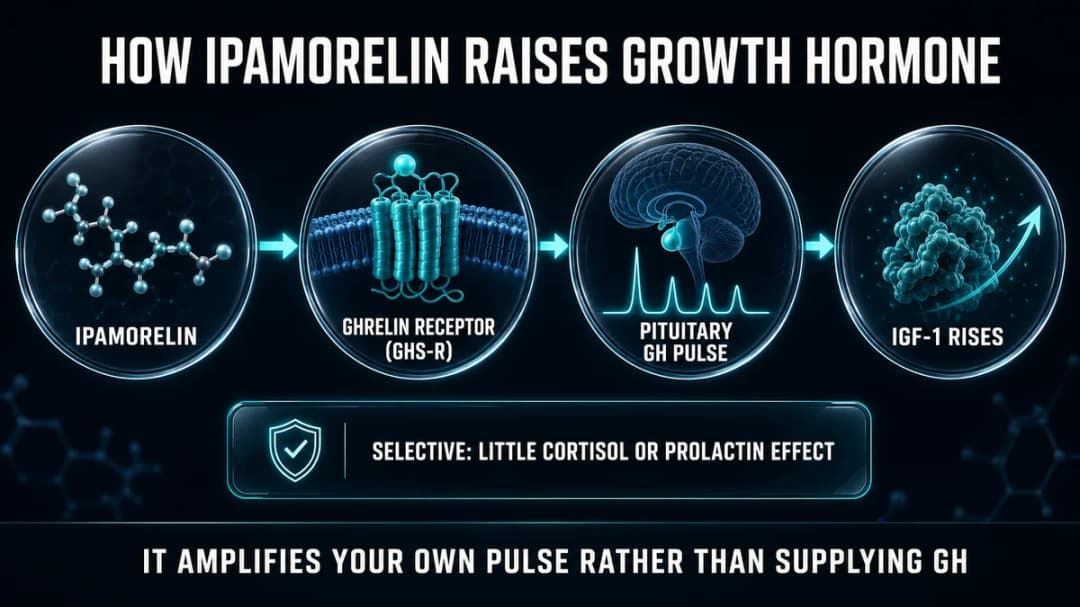
Ipamorelin adds to those pulses. It binds GHS-R1a on pituitary somatotrophs, which triggers release of growth hormone already produced and stored there. The liver responds to circulating growth hormone by producing IGF-1, and IGF-1 is what mediates most of the effects people are actually after.
Two consequences follow from that pulsatile design. It keeps the increase within physiological range rather than the sustained supraphysiological levels that injected growth hormone produces, which is the main safety argument for the secretagogue approach. And it means the compound cannot work if the pituitary has nothing to release, which is why response tends to be weaker in people whose growth hormone axis is already impaired for structural reasons.
Results Timeline, With Honest Labels
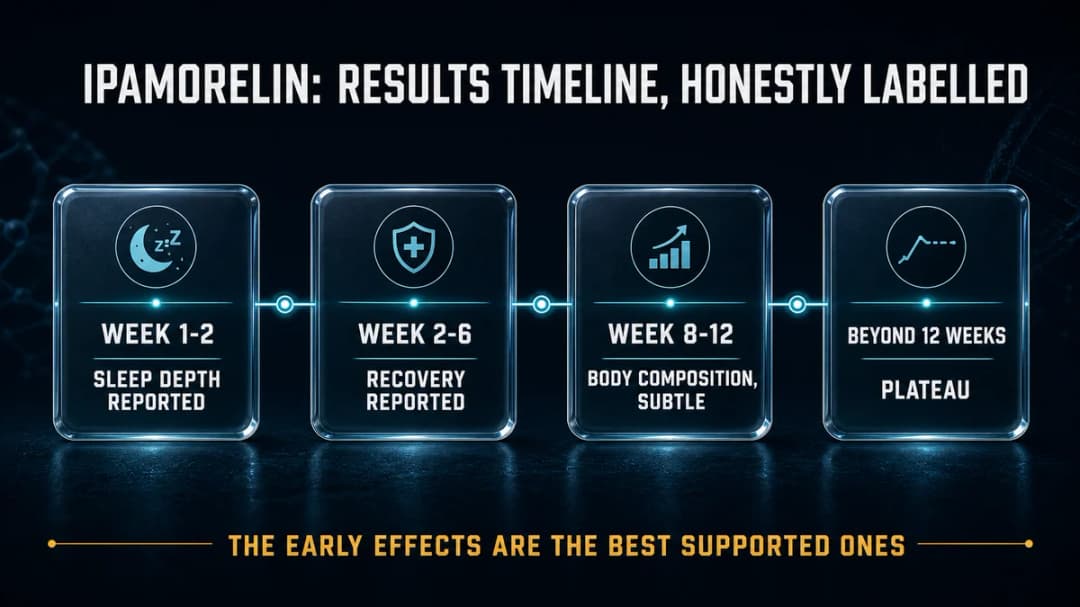
This is the part most articles get wrong by presenting user reports as findings. The table separates the two.
| Period | Commonly reported | What is actually measured |
|---|---|---|
| Weeks 1 to 4 | Deeper sleep, vivid dreams, some fluid retention and morning puffiness | Growth hormone release is immediate and measurable. IGF-1 begins to rise. Sleep reports are subjective and unblinded |
| Weeks 5 to 8 | Better recovery between training sessions, clothes fitting differently | IGF-1 elevation is real. Body composition claims at this stage are not supported by trial data for this compound |
| Weeks 9 to 12 | Visible change in body composition, skin texture comments from others | Nothing established. This is the point at which diet and training changes made at the start would also be showing |
| Months 4 to 6 | Cumulative body recomposition, joint comfort, skin firmness | Not tested. Anyone claiming a documented six month outcome for ipamorelin is describing growth hormone therapy, not this compound |
The single most useful thing to understand about the timeline is that the first stage is the only one with a hard measurement behind it, and it is also the one people find least impressive. Everything that sounds impressive is at the end, where the evidence is thinnest.
The second most useful thing: almost nobody starts a peptide protocol and changes nothing else. Training gets more consistent, sleep gets prioritised, food gets tidied up. A three month before and after photo captures all of it, not just the injection.
Reported Dosing
There is no approved dose. What follows is the range that appears in research protocols and user practice.
| Approach | Reported dose per injection | Frequency | Usual timing |
|---|---|---|---|
| Conservative start | 100 mcg | Once daily | 30 to 60 minutes before sleep |
| Common range | 200 to 300 mcg | Once or twice daily | Pre-sleep, plus fasted morning or post-exercise |
| Stacked with CJC-1295 | 100 to 200 mcg each | Once or twice daily | Co-administered |
Timing is not arbitrary. The pre-sleep dose sits alongside the largest natural growth hormone pulse of the day. Doses are kept away from carbohydrate-heavy meals because insulin suppresses growth hormone release, which also explains the fasted morning convention.
Blocks of eight to sixteen weeks followed by a break are standard practice, on the reasoning that continuous receptor stimulation reduces pituitary responsiveness. The specific numbers are convention rather than trial derived.
Men and Women
The mechanism is the same. What differs in practice is dosing convention and which effects people notice.
Reported doses for women tend to sit lower, often 100 to 200 mcg, and the effects women most often describe are skin quality, sleep and fat distribution rather than lean mass. Whether the underlying response genuinely differs by sex has not been tested for this compound, so it is safer to treat the lower doses as a starting convention than as a finding about physiology.
One point does matter for women specifically. The older compounds in this class raise prolactin, which disrupts menstrual cycles and hormone balance. Ipamorelin does not appear to at the doses studied, and that is a real advantage rather than a marketing one.
Does It Affect Testosterone?
Not directly. Ipamorelin does not act on the hypothalamic-pituitary-gonadal axis, does not stimulate LH or FSH, and does not raise testosterone by any direct route.
The indirect argument runs through sleep and body fat. Testosterone production depends heavily on sleep quality, and visceral fat increases aromatase activity, which converts testosterone to oestrogen. If a protocol genuinely improves sleep and reduces visceral fat, testosterone may improve as a consequence. That is a long causal chain with several unproven links in it, and it is not a reason to use ipamorelin for that purpose.
What to Watch For
The reported side effects are mild and mostly early: flushing for up to half an hour after injection, headache in the first fortnight, water retention in the first month, drowsiness with evening dosing. Persistent tingling in the hands, joint stiffness, or puffiness still present after six weeks are dose signals rather than adjustment effects.
It should not be used by anyone with an active cancer diagnosis, during pregnancy or breastfeeding, by anyone under 18, or by anyone on insulin without medical input. It is on the World Anti-Doping Agency prohibited list.
For more detail, see our pages on ipamorelin benefits, ipamorelin side effects and whether ipamorelin is safe.
FAQ
Is ipamorelin the same as HGH?
No. Injected growth hormone delivers the hormone directly and can suppress the body's own production. Ipamorelin signals the pituitary to release its own, which keeps the increase pulsatile and within physiological range. The effects are correspondingly smaller.
How quickly does ipamorelin work?
The growth hormone pulse itself happens within about half an hour of injection. Anything a person can notice takes longer, and the first reported change is usually sleep within the first week or two.
Do you need to inject it before bed?
That is the convention, and there is a reason behind it: the largest natural growth hormone pulse occurs shortly after sleep onset, and the dose is meant to amplify it. Morning fasted doses also work, they just sit alongside a smaller natural pulse.
Does ipamorelin cause weight gain?
Some early weight gain is common and it is fluid, not fat. Growth hormone raises IGF-1, which promotes sodium and water retention at the kidney. It usually settles within a month.
Is ipamorelin legal?
It is not approved for human use, so it is sold for research purposes only. Whether personal purchase is lawful varies by country, and nobody regulates the quality, which makes batch-specific certificates of analysis the minimum worth insisting on.
How long can it be used for?
Reported protocols run in blocks of a few months with breaks in between. Continuous use has not been studied in humans, and the predictable consequence of never stopping is a diminishing response as receptors downregulate.