Ipamorelin peptide benefits center on growth hormone release, its side effects are mostly mild and short lived, and commonly reported dosage sits near 100 to 300 mcg per injection, a community convention rather than a figure from a published human protocol. What makes this compound worth understanding is not the size of the effect but the cleanliness of it. Ipamorelin was built to do one thing and avoid the rest.
Key Takeaways
- Ipamorelin is a five amino acid chain built in a lab to switch on GHS-R1a, the receptor ghrelin normally occupies, which prompts the pituitary to fire off a burst of growth hormone.
- What sets it apart from the older secretagogues is how narrow its footprint is: at ordinary research doses the GH signal goes up and the stress and lactation hormones essentially stay put.
- Most reported research figures fall between 100 and 300 mcg per subcutaneous injection, one to three times daily, across cycles of roughly 8 to 12 weeks.
- Documented tolerability issues are minor and transient: a brief flush or head rush, mild water retention, tingling in the hands, and injection site irritation.
- It is not an approved drug in the United States. Everything below describes research findings and reported protocols, not a treatment plan.
What Ipamorelin Actually Is
Ipamorelin is a five amino acid chain with the structure Aib-His-D-2-Nal-D-Phe-Lys-NH2. Three positions are non-standard: the alpha-aminoisobutyric acid at the N-terminus, the D-configured naphthylalanine, and the D-phenylalanine. Those substitutions are the whole point. They lock the molecule into a shape that fits the growth hormone secretagogue receptor tightly while giving it almost nothing to grab onto elsewhere, and they slow enzymatic breakdown enough to yield a circulating half-life of roughly two hours.
It came out of Novo Nordisk research in the 1990s. The earlier compounds in its class worked but were messy: GHRP-6 drove appetite hard through the same ghrelin pathway it used to release GH, and GHRP-2 lifted cortisol and prolactin alongside growth hormone. Ipamorelin was the attempt to strip that down to a single signal, and it is now generally treated as the reference point for selectivity in the GHRP class.
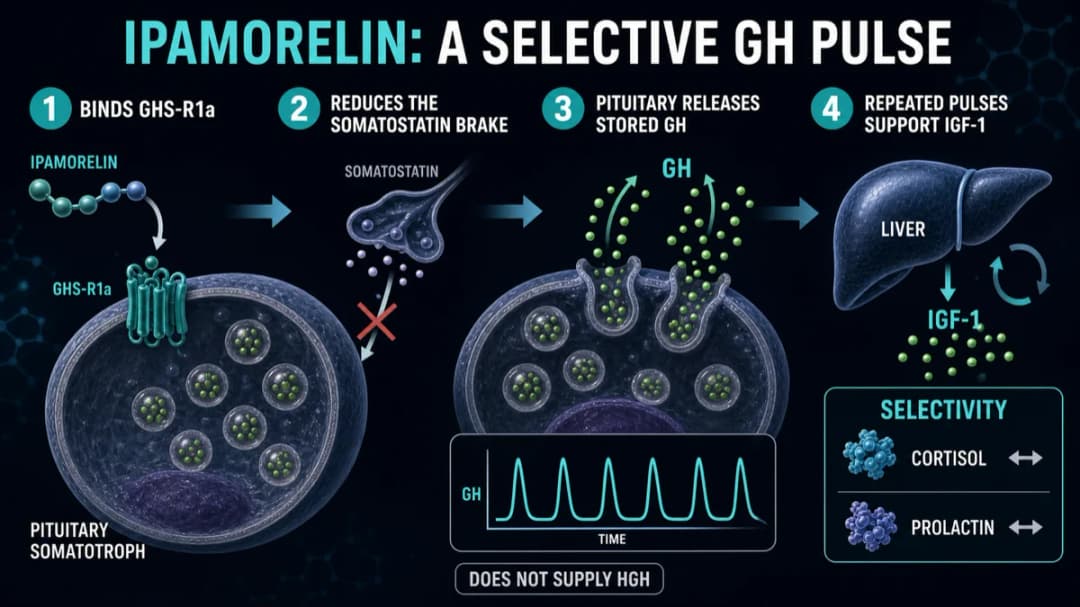
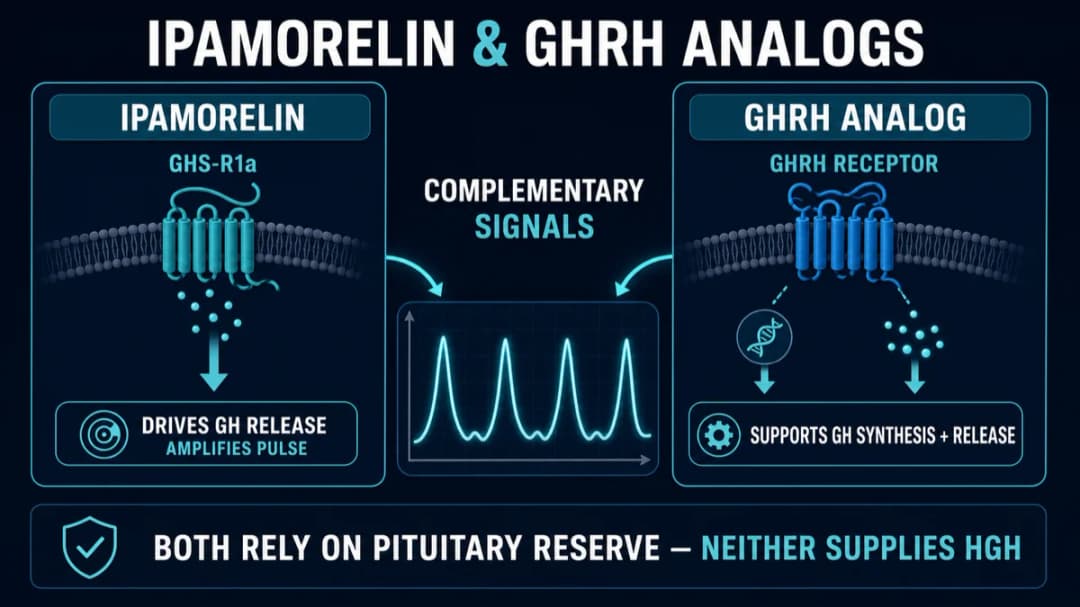
It belongs to the GHRP family, a different pathway from the GHRH analogs. GHRH analogs such as sermorelin, CJC-1295, and tesamorelin bind the GHRH receptor on pituitary somatotrophs and increase both synthesis and release of GH. Ipamorelin binds GHS-R1a instead, amplifying pulse amplitude while blunting somatostatin, the brake the body uses to shut GH release down. The two pathways are complementary rather than redundant, which is why they get combined so often.
One consequence worth stating plainly: ipamorelin does not supply growth hormone, it asks the pituitary to release its own. The effect is therefore capped by what the gland can produce, and release stays pulsatile rather than becoming a flat elevated line. Both are usually framed as advantages over exogenous GH, and both are also why the effect size is modest.
Ipamorelin has never been approved by the FDA or the EMA for any indication. It is sold in the United States as a research chemical and its US compounding status has changed over time (it was placed on FDA's Category 2 list in 2023, and nominations were reportedly withdrawn in 2024), so verify the current status before relying on any statement about it.
Ipamorelin Benefits
The honest summary: the mechanism is well established, the acute hormonal effect is well documented, and the downstream outcomes people actually care about rest mostly on inference from growth hormone physiology rather than trials of ipamorelin itself.
Growth hormone release. Strong evidence, animal and human. The endpoint ipamorelin was designed against and the one measured most directly. Administration produces a dose dependent GH pulse, and the human dose-ranging study reported GH release at every dose tested. The idea that the curve flattens above 300 to 400 mcg is a community assumption with no published source, so treat it as unverified. The GH pulse itself is not controversial.
A narrow hormonal footprint. Strong evidence. Across preclinical work the pattern holds: GH climbs while the adjacent axes stay quiet at ordinary doses. This is the best supported claim anyone makes about the compound, and it is why the older members of the class largely fell out of research use once it existed.
IGF-1 elevation. Weak, inferred from GH release. The human study measured GH only, and a rat study found no change in IGF-1, so the idea that repeated pulses reliably raise circulating IGF-1 is a plausible inference from the mechanism, not a demonstrated result for ipamorelin. Whether that translates into the outcomes below is a separate question.
Body composition. Weak to moderate, mostly inferential. Growth hormone promotes lipolysis and supports lean mass, so a sustained increase in pulse amplitude plausibly nudges body composition. What is thin is direct trial data on ipamorelin producing meaningful fat loss or lean mass gain in humans. Reports of visible recomposition are anecdotal and describe a slow drift over months, not anything dramatic.
Sleep quality. Weak, largely anecdotal. GH secretion peaks during slow wave sleep, and a pre-sleep dose is often described as improving sleep depth. The rationale is coherent, but controlled sleep architecture data specific to ipamorelin is not something you should assume exists.
Bone density. Weak, animal only. Early ghrelin receptor work suggested osteogenic effects. Not established in humans, and better treated as an open research direction than a benefit.
Recovery and tissue repair. Weak, inferential. GH contributes to protein synthesis and repair, and recovery is among the most commonly reported subjective effects. No ipamorelin specific human trial demonstrates faster healing.
Notably absent from that list: ipamorelin does not touch the HPG axis. It does not raise or lower testosterone, LH, or FSH, and there is no post cycle protocol associated with it.
Ipamorelin Side Effects
Ipamorelin has one of the more forgiving tolerability profiles in the peptide space, which is a low bar but a genuine one. The reported effects are consistent across sources and generally short lived.
Injection site reactions. Redness, itching, or a small welt where the needle went in. Moving the site each time cuts this down substantially.
Warmth and a swimming head. The sensation people describe most often shows up within a minute or two of injecting and reads as a wave of heat plus a moment of unsteadiness. It clears on its own quickly enough that most accounts treat it as unremarkable.
Pins and needles in the hands. Any compound that raises GH can produce this, and ipamorelin is no exception. Usually fleeting. The reason to pay attention is that numbness which sticks around suggests fluid is pressing on the median nerve, which is a signal to back off rather than push through.
Puffiness in the first stretch of a cycle. GH shifts how the body handles fluid, so a slightly swollen look through week one or two turns up regularly. It tends to fade as things equilibrate.
Headache. Occasional, usually resolving quickly, more often reported at the upper end of the dose range.
Appetite increase. Much smaller than with GHRP-6, but not zero. Because the compound works on the ghrelin receptor, some hunger signal is mechanistically expected, particularly at higher doses or alongside a GHRH analog.
Fatigue or lethargy. Sometimes reported early in a cycle. Poorly characterized.
Where the data is genuinely thin, and this needs saying: there is no long term human safety dataset for ipamorelin. Nobody has run multi year follow up. The main theoretical concern is chronic IGF-1 elevation, since IGF-1 is a proliferative signal with complex implications for cell growth, which is why the literature emphasizes finite cycles and periodic IGF-1 measurement over open ended use. Anyone with a history of malignancy sits well outside what the available research can speak to. Long horizon effects on insulin sensitivity are also poorly mapped, since GH is counter-regulatory to insulin. Acute tolerability looks good and is reasonably documented; long term safety is an open question.
Ipamorelin Dosage Chart
The figures below are community convention, not doses from a published human protocol. None of it is a recommendation, and no established human dosing standard exists for ipamorelin because it has never been through the approval process that would create one.
| Goal / context | Reported range | Frequency | Typical cycle |
|---|---|---|---|
| Initial response assessment | 100 to 150 mcg per injection | 1 to 2 times daily | 8 to 12 weeks |
| General GH axis and body composition research | 200 to 250 mcg per injection | 2 to 3 times daily | 8 to 12 weeks |
| Upper end of the reported range | 300 mcg per injection | Up to 3 times daily | 8 to 12 weeks |
| Single nightly dose protocols | 100 to 300 mcg | Once daily, 30 to 60 min pre-sleep | 8 to 12 weeks |
| Paired with CJC-1295 (no DAC) | 100 to 300 mcg ipamorelin plus 100 to 200 mcg CJC-1295 | 1 to 3 times daily | 8 to 12 weeks |
| Extended longevity and anti-aging models | 200 to 300 mcg per injection | 2 to 3 times daily | 16 to 20 weeks, then 4 to 6 week washout |
A few points of context that matter more than the numbers themselves.
Many users describe 300 mcg as a practical ceiling, on the assumption that the dose response curve flattens past 300 to 400 mcg per injection. That is an unverified community assumption: the 1999 human study reports GH release at every dose it tested and describes no plateau.
Frequency exists because the half-life is short. Each dose produces a discrete pulse lasting roughly two to three hours, so splitting into multiple daily administrations is how protocols raise total daily GH output rather than increasing any single dose.
Food suppresses the response. Elevated glucose and insulin increase somatostatin tone, the exact brake ipamorelin is trying to release. Protocols consistently specify a fasted state or a gap of two to three hours after eating, and the pre-sleep dose is described as the highest value single administration because it stacks onto the natural nocturnal GH surge.
Cycling is precautionary rather than mandatory. Ipamorelin does not appear to cause meaningful receptor desensitization at standard doses, and it does not suppress endogenous GH production the way exogenous HGH does. The 8 weeks on, 4 weeks off pattern mostly exists to re-establish a clean baseline and confirm IGF-1 returns to it.
Administration in research protocols is subcutaneous, using a 29 to 31 gauge insulin syringe, with sites rotated across the abdomen, outer thigh, and flank.
Reconstitution and Storage
Ipamorelin ships as a lyophilized powder, most commonly in 5 mg vials, and is reconstituted with bacteriostatic water.
The dilution choice deserves more thought than it usually gets, because the doses are tiny. A 5 mg vial reconstituted with 1 mL of BAC water yields 5,000 mcg/mL, putting a 200 mcg dose at 0.04 mL, or four units on an insulin syringe and a very small target to hit accurately. Two mL gives 2,500 mcg/mL and a 0.08 mL dose. Five mL gives 1,000 mcg/mL and a 0.2 mL dose, which is far easier to draw with precision. For a compound dosed in the low hundreds of micrograms, the more dilute preparation usually makes sense.
Handling basics: let the vial reach room temperature first, wipe the stopper with alcohol and let it dry, and run the water down the inside wall rather than firing it into the powder. Swirl gently until clear, never shake, and label the vial with the reconstitution date.
Unreconstituted powder is stable long term when kept cold and dark. Once mixed, it needs refrigeration at 2 to 8 degrees Celsius, and the usable window is measured in weeks rather than months. Sources differ on exactly how many, so the conservative reading is to treat roughly three weeks as the working limit and to discard anything cloudy or discolored regardless of date.
Stacking
The only ipamorelin combination with real mechanistic support is pairing it with a GHRH analog. The two receptor pathways are independent, and the combined signal produces a substantially larger GH pulse than either compound alone: the GHRH analog increases what is available to release while ipamorelin drives the release itself.
The most common pairing is with CJC-1295 without DAC, sometimes labeled Modified GRF 1-29, at 100 to 200 mcg alongside 100 to 300 mcg of ipamorelin. The no-DAC version is preferred because its short half-life produces a discrete pulse matching ipamorelin's timing, rather than the flat sustained elevation the DAC version creates. The two are chemically compatible and often drawn into the same syringe.
Sermorelin is used the same way, usually as a single nightly administration. Tesamorelin is the outlier here in being an approved drug with real trial data, though its studied use is HIV associated lipodystrophy rather than general GH support, and combining it with a GHRP is not something that trial data covers.
Beyond GHRH analogs, documented combinations thin out fast. Pairings with repair peptides get discussed, but they act independently rather than synergistically, so calling them a stack overstates it.
How to Verify What You Buy
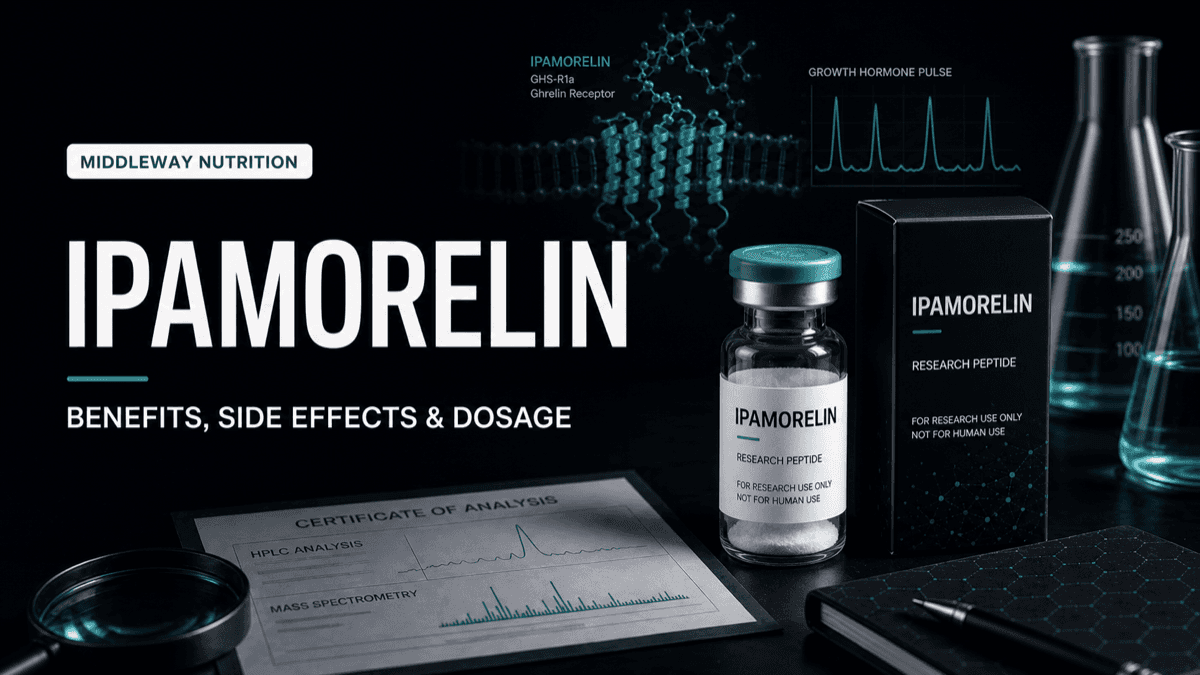
Ipamorelin is a research chemical in the US, which means no regulatory body is checking what is in the vial. Before buying, ask for a recent third-party analysis showing identity by mass spectrometry and purity by HPLC, and confirm the certificate references the specific lot you are receiving rather than a generic sample. Our vetting notes on suppliers and what their testing documentation actually shows are in the where to buy ipamorelin guide, with current pricing and vial sizes compared on the ipamorelin for sale page.
Looking for the numbers behind this guide? Our ipamorelin dosage chart sets label and trial doses beside what Reddit users report taking and our ipamorelin benefits tiers each claimed benefit by the strength of its evidence.
Frequently Asked Questions
What does ipamorelin peptide do?
It occupies the ghrelin receptor in the pituitary and hypothalamus, which prompts the gland to release a pulse of the growth hormone it already holds. Nothing is supplied from outside. What makes it distinctive is how contained that signal stays, leaving the neighboring hormonal axes largely untouched. Over repeated pulses IGF-1 drifts upward, and IGF-1 is the intermediary through which nearly every claimed effect on body composition or recovery would have to operate.
Is ipamorelin safe?
Short term tolerability in the available research looks favorable, with reported effects limited to mild transient issues like flushing, water retention, tingling, and injection site irritation. But "well tolerated in research settings" is not the same as "safe," and ipamorelin has no long term human safety data. The unresolved question is what sustained IGF-1 elevation does over years, which is why finite cycles and IGF-1 monitoring appear consistently in the literature. It is not FDA approved and is not something to treat as a supplement.
How much ipamorelin do people report using?
Commonly reported figures cluster at 100 to 300 mcg per subcutaneous injection, one to three times daily, over cycles of roughly 8 to 12 weeks. The 300 mcg ceiling is a community assumption, not an established plateau. These are community-convention ranges, described for reference rather than as a protocol anyone should follow.
Is ipamorelin legal?
In the United States it can be legally sold and bought as a research chemical, but it is not approved for human use and has had a shifting compounding status in the United States (listed in FDA's Category 2 in 2023, with nominations reportedly withdrawn in 2024), so verify the current status. It is also prohibited by WADA, so athletes subject to anti-doping testing should avoid it entirely. Rules vary by country and importing peptides into some jurisdictions carries real legal exposure, so check local law before ordering.
This article is for informational purposes only and is not medical advice. Ipamorelin is a research compound and is not approved by the FDA or any equivalent regulatory agency for the diagnosis, treatment, or prevention of any condition. Dosing figures described here are reported research ranges, not recommendations, and no human dosing standard exists for this peptide. Consult a qualified healthcare professional before considering any peptide compound.