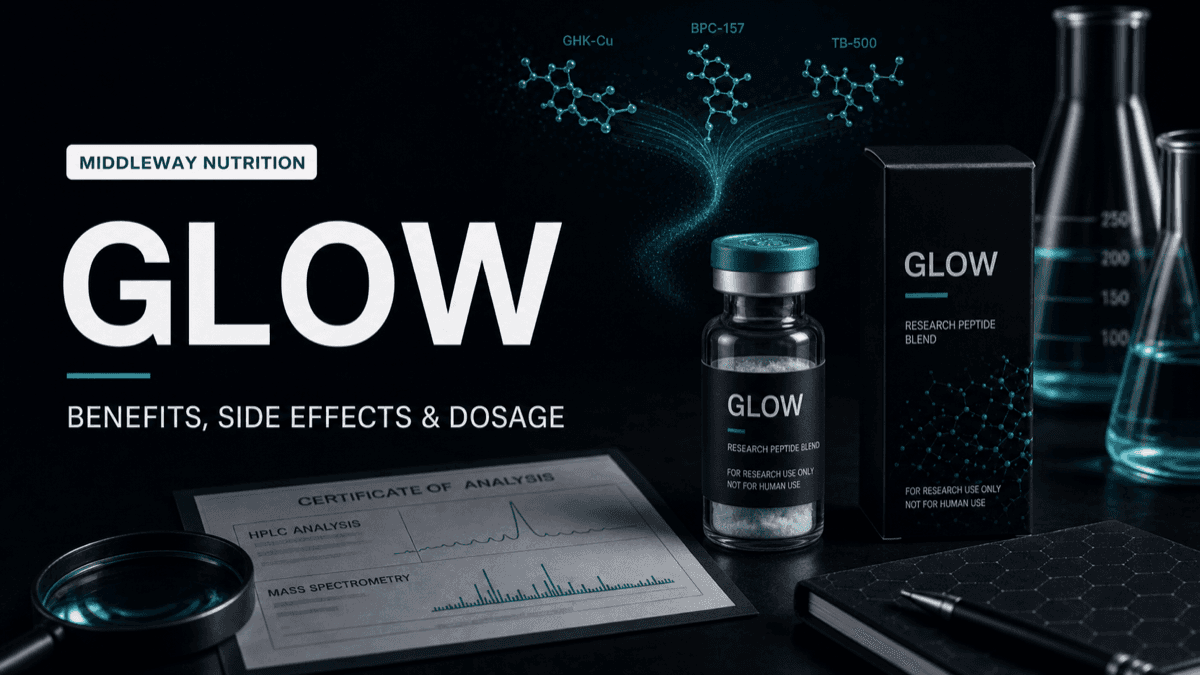
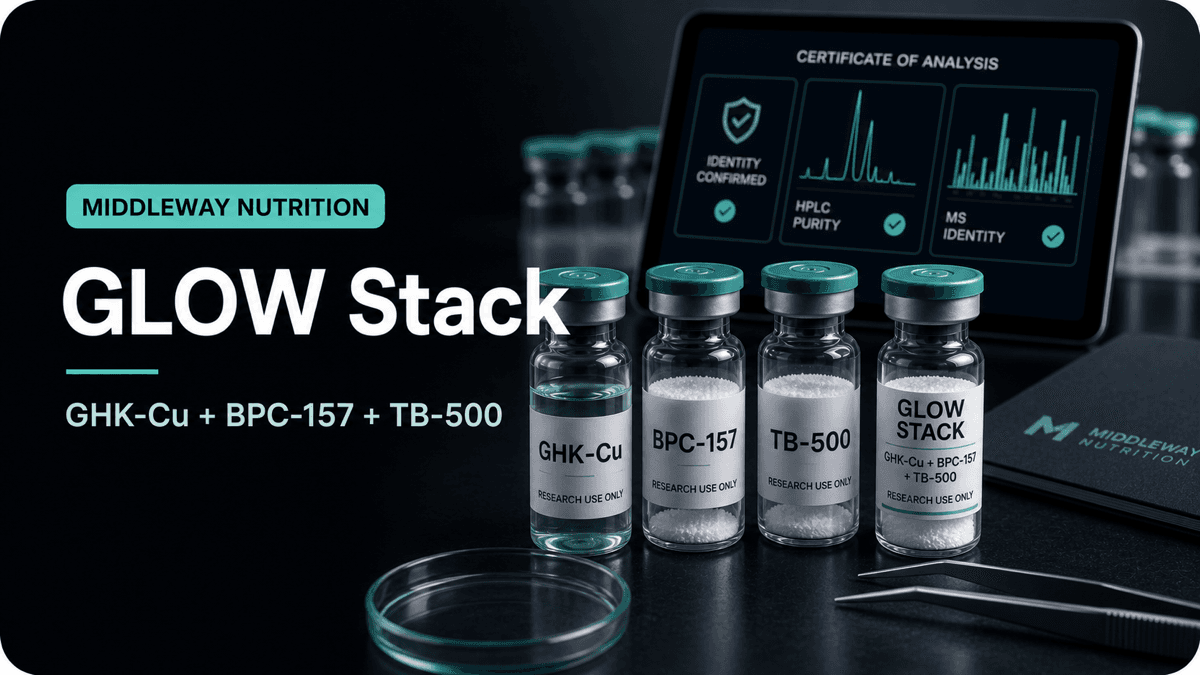
The GLOW stack bundles three of the most popular recovery and skin-research peptides into one vial — GHK-Cu, BPC-157, and TB-500 at the common 5:1:1 ratio. That convenience is exactly why the market is flooded with blends that skip third-party testing, underdose the BPC-157, or hide the copper content behind a pretty label.
If you've been searching where to buy the GLOW peptide stack, this guide is the honest version. You'll learn what a legitimate GLOW blend actually contains, where to source it without getting an underdosed vial, how to read the certificate of analysis (COA) for all three compounds, what it should cost in 2026, and the red flags that most affiliate-driven "best vendor" lists conveniently leave out.
Key Takeaways
- The GLOW stack is not an FDA-approved drug. It is sold for research use only. GHK-Cu has approved topical/cosmetic uses, but the injectable blend is grey market
- Ascension Peptides is our top-rated vendor: every batch third-party tested by Kovera Labs, certificates showing >98% HPLC purity, and 85 batch-specific certificates in a public library
- A real GLOW blend lists the exact mg of each peptide. If a label hides the ratio or just says "70mg blend," you cannot verify what you bought
- Demand a batch COA that covers all three compounds, not a single generic certificate. Purity should read ≥98% by HPLC for each
- Price alone tells you nothing. Cheap blends usually cut testing first, then trim the BPC-157 — the most expensive component to synthesize
Buying GLOW in 2026 means choosing between two formats. Pre-blended vials put all three peptides in one bottle for simpler dosing, while separate-vial kits give you full control over each compound's dose (useful if you want a higher injury-range TB-500 than a pre-blend allows). Both are sold as research chemicals, no prescription required. So when people ask where to buy the GLOW peptide stack, the real question underneath is which vendor you can trust to put the labeled amount of each peptide in the vial and prove it with documentation. Here is what to check before spending a dollar.
What Is in the GLOW Stack, and What It's Used For
GLOW is a nickname for a fixed trio, not a branded drug. Each compound is studied for a different slice of tissue research:
- GHK-Cu (copper tripeptide-1, ~50mg): A naturally occurring copper-binding tripeptide. It is the most clinically studied of the three, with topical evidence around collagen and elastin synthesis and skin remodeling (Pickart & Margolina, 2018). It gives the blend its faint blue-green tint.
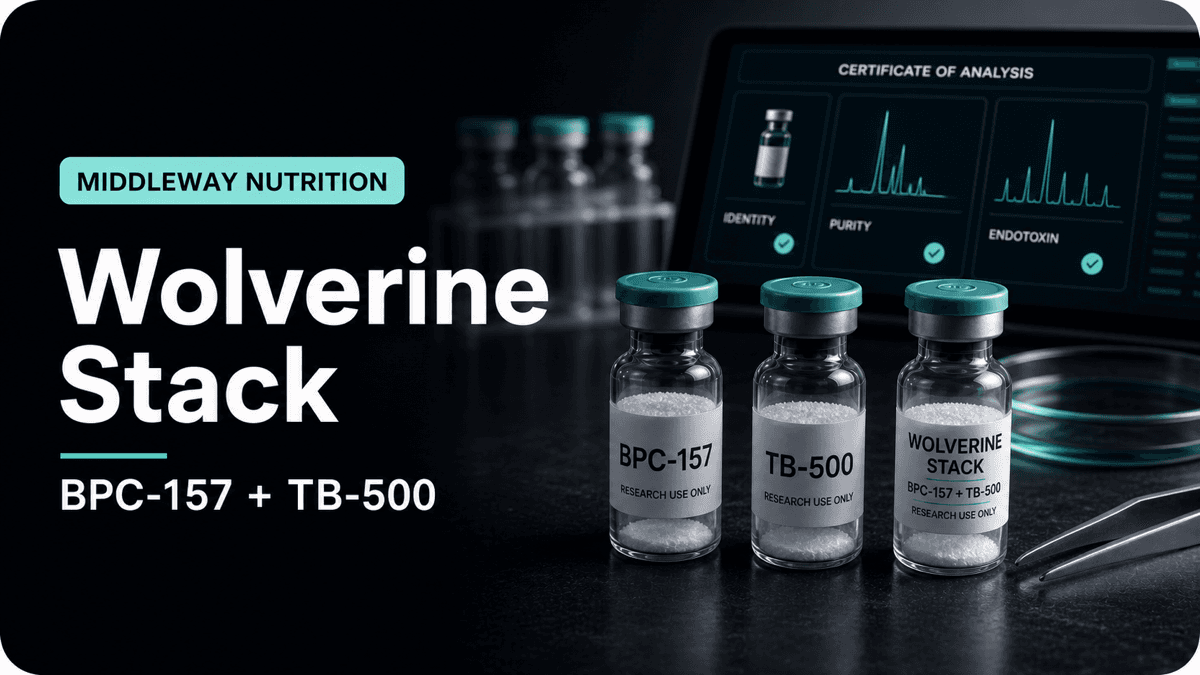
- BPC-157 (~10mg): A synthetic 15-amino-acid peptide derived from a gastric protein, studied in animal models for tissue protection and angiogenesis. It is the headline "recovery" compound in the popular Wolverine stack.
- TB-500 (thymosin beta-4 fragment, ~10mg): A 43-amino-acid polypeptide studied for cell migration and tissue remodeling, with early human thymosin beta-4 trial data behind it.
Important honesty: no published human trial has tested these three together. Every "GLOW result" you read about is extrapolated from single-compound research and community use. Treat outcome timelines as anecdote, not data. If you want the longer breakdown of what each peptide does, our GLOW peptide benefits guide covers it, and peptides for recovery: where the evidence gets thin is a useful reality check.
Where to Buy the GLOW Peptide Stack in 2026
There is no pharmacy counter for the injectable blend and no insurance pathway. You're choosing among research-chemical vendors, and the quality gap between them is enormous. Realistic sourcing breaks down like this:
Pre-Blended GLOW Vials (Simplest)
Most vendors sell a single 70mg vial at the 5:1:1 ratio. You reconstitute once and draw one shot. The tradeoff: the TB-500 dose per injection sits below the standalone injury range, so this format suits skin and general-recovery research more than aggressive repair protocols. It's the most common purchase.
Separate-Vial Kits (Maximum Control)
Some vendors ship three individual vials. This lets you run a higher TB-500 dose, adjust GHK-Cu cycling independently, and pause one compound without losing the others. The catch is more reconstitution math and the well-known mcg/mg trap — BPC-157 is dosed in micrograms while TB-500 and GHK-Cu are in milligrams. Mislabel a vial and you can be off by 1,000x.
Grey-Market Peptide Vendors (Where Most People Buy)
This is the real market. Dozens of vendors, wildly different quality. The good ones source from verified synthesis labs, send every batch to an independent lab, and publish COAs that name the lot number. The bad ones recycle a single generic certificate across every product and hope you don't check. Vendor selection is the entire game here, which is exactly the part of "where to buy GLOW" that decides whether you get what you paid for.
Best Place to Buy the GLOW Stack: Ascension Peptides
Ascension Peptides is the vendor we recommend for the GLOW blend — not because of a commission, but because they handle the part most vendors fudge: verifying three different peptides in one product.
Batch-specific certificates in public. A blend is only as trustworthy as its weakest component. Ascension publishes 85 batch-specific certificates in a public library, so you can match the report to the lot on the vial in your hand, not a months-old generic sheet. We checked one Kovera report (KVR-2026-410047) against the lab's own records, and it matched.
Purity that holds across all three. Every batch is tested by an independent lab (currently Kovera Labs), with certificates showing >98% HPLC purity plus LC-MS identity, net content per vial, endotoxin, a rapid sterility screen and heavy metals. That matters more in a blend than a single peptide, because one underdosed or impure compound quietly drags down the whole vial.
US shipping, priced in USD. Ascension ships within the United States only, with free shipping on orders over $250. The GLOW 70mg vial is $110.00 USD, and buying 3, 5 or 10 units saves 3%, 5% or 10%. New customers get 50% off with code PEPTIDEDECK.
Know the return terms. No vague "pharmaceutical grade" claims without documents to back them. All sales are final, though damaged or incorrect items are replaced if you report them quickly.
If you're ready to order, start at Ascension Peptides and read the batch paperwork before you commit to a protocol.
How to Verify GLOW Quality: COA Deep-Dive
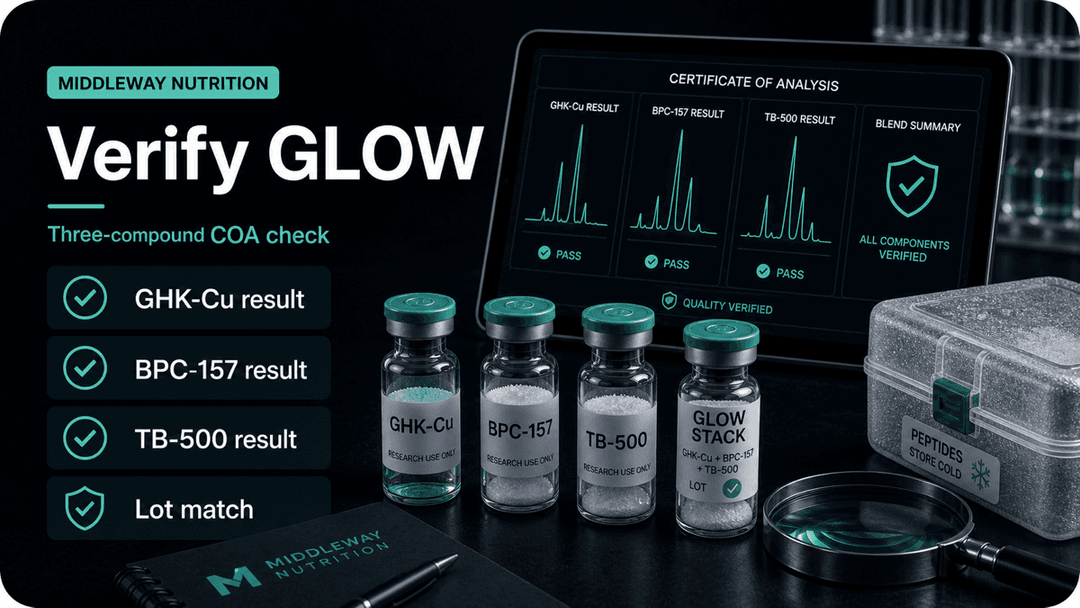
A blend has three places to hide a problem, so the COA bar is higher than for a single peptide.
Batch-Specific, Not Generic
A product-level COA could have been run months ago on a different batch. A batch-specific COA references the lot number printed on your vial and shows the test date. The lot on the vial should match the lot on the certificate. If it doesn't, treat the result as meaningless.
One COA Should Cover All Three (or Three COAs)
For a pre-blend, the testing should address the blend or each component. For a separate-vial kit, you want a COA per vial: GHK-Cu, BPC-157, and TB-500 each at ≥98% HPLC. A single certificate that only names "GLOW blend" with no component breakdown is a yellow flag.
HPLC and Mass Spec
HPLC measures purity — what percentage is actually the labeled compound. Look for ≥98% on each. Mass spectrometry confirms identity by matching molecular weight. HPLC can show "high purity" of the wrong molecule, so identity confirmation matters. Labs like Janoshik and MZ Biolabs actively test peptides and have verifiable certificate IDs you can cross-reference.
COA Red Flags
- No lot number anywhere on the certificate
- Test date older than six months
- A "lab" with no website or verifiable portal
- A certificate that names only one of the three compounds
- "99%" purity claimed with no chromatogram attached
What Does the GLOW Stack Cost in 2026?
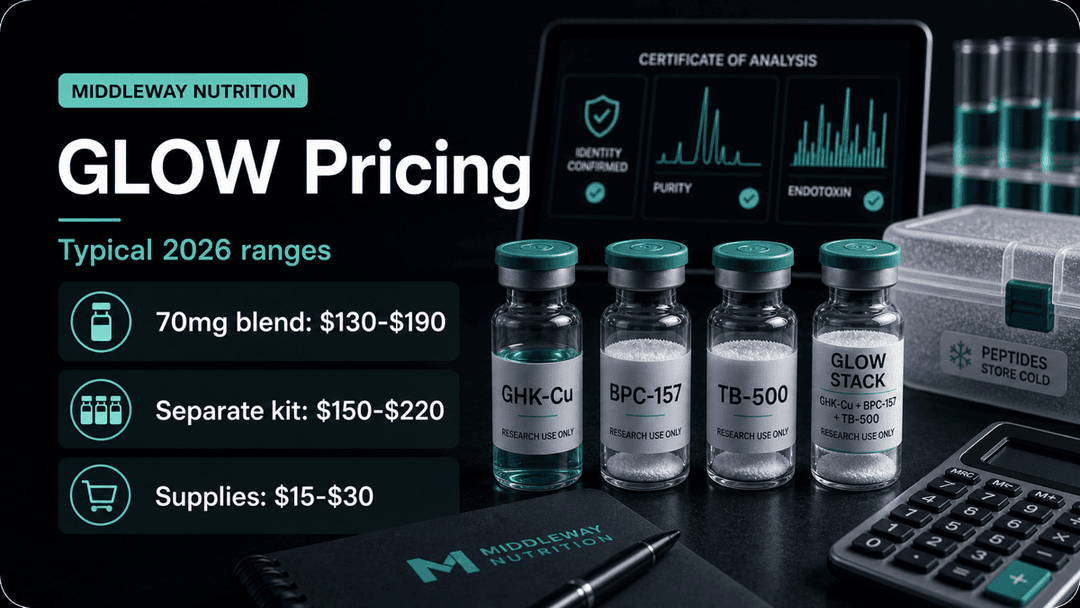
Pricing is fairly tight across legitimate vendors because the component costs are known.
- Pre-blended 70mg vial: roughly $130–$190. The 5:1:1 ratio with full COAs sits in this band. Ascension Peptides sits under it at $110.00 USD, with the batch certificate published in its public library.
- Separate-vial kit (BPC-157 + TB-500 + GHK-Cu): $150–$220 depending on individual vial sizes, since you're often getting more total TB-500 and BPC-157.
- Bacteriostatic water and syringes: budget another $15–$30 for a cycle's supplies; diluent is rarely included.
A blend priced far below $130 with "free shipping" almost always cut a corner. The first cut is testing, the second is BPC-157 quantity, since it's the priciest of the three to synthesize. Spend the extra $20–$30 and get the COA. It is not worth the savings to find out your vial is mostly GHK-Cu.
Red Flags to Avoid When Buying GLOW
- Hidden ratios. "70mg proprietary blend" with no per-compound mg is unverifiable. Walk away.
- Generic COA only. No batch number, no component breakdown, no sale.
- Medical dosing claims. Any vendor telling you how to dose GLOW "for healing" while also calling it a research chemical is talking out of both sides of its mouth.
- No copper coloration mentioned. GHK-Cu reconstitutes with a faint blue-green tint. A blend that's pitch clear may be light on copper tripeptide.
- Prices too good to be true. Cheap usually means underdosed or untested.
- No community footprint. Vendors invisible on r/Peptides and the usual forums, with zero reviews either way, deserve caution.
How to Get the GLOW Stack (Step by Step)
You do not need a prescription to buy GLOW components sold for research use. The practical path:
- Pick a format. Pre-blend for simplicity, separate vials for dose control.
- Choose a vetted vendor. Confirm batch COAs covering all three compounds at ≥98% HPLC before ordering.
- Order with buyer protection. Credit cards offer chargeback recourse if a product is fraudulent; crypto offers privacy but no recourse. Start with a card on a new vendor.
- Reconstitute correctly. A 70mg pre-blend with 3mL of bacteriostatic water gives ~23.3mg/mL. Use bacteriostatic (not plain sterile) water so the solution stays stable for weeks. For separate vials, label each one to avoid the mcg/mg mix-up.
- Store it right. Lyophilized powder at -20°C for the long term; reconstituted solution at 2–8°C, used within a couple of weeks (TB-500 has the shortest reconstituted shelf life). Never freeze a reconstituted vial, and keep it out of light.
For dosing context that translates across this blend, the Wolverine stack dosage guide covers BPC-157 and TB-500 protocols, and GHK-Cu capsules is worth reading if you'd rather avoid injections for the skin side entirely.
Vendor Comparison Table
Top Vendors
Ranked by purity, third-party testing, COA availability, and price.
>98% HPLC · Kovera Labs, endotoxin + heavy metals · US only, free over $250
~99% HPLC · MZ Biolabs · US shipping
≥99% claimed · COA "coming soon" · US 1–2 days
"Lab tested" · Limited info · Varies
"100% pure" · None published · Free over $X
Prices are approximate and change frequently. Always confirm current pricing and pull the live batch COA before purchasing.
Related Buying Guides
Use these next if you are comparing adjacent research-peptide sourcing decisions:
Frequently Asked Questions
Where can I buy the GLOW peptide stack?
GLOW is sold by research-chemical peptide vendors, both as a pre-blended 70mg vial and as separate-vial kits. We recommend Ascension Peptides, which sells the 70mg GLOW vial at $110.00 USD, has every batch third-party tested by Kovera Labs with certificates showing >98% HPLC purity, and publishes batch-specific certificates in a public library. It ships within the US only. Confirm the current COA before ordering.
Is the GLOW stack legal to buy?
The three GLOW compounds are sold as research chemicals and are not FDA-approved for injectable human use as of 2026. GHK-Cu has approved topical and cosmetic uses, while BPC-157 and TB-500 are research-only and are prohibited under WADA for tested athletes. Buying from a domestic vendor for research purposes carries low practical legal risk, but you are operating outside the standard pharmaceutical system.
How much does the GLOW stack cost?
A pre-blended 70mg vial (50mg GHK-Cu + 10mg BPC-157 + 10mg TB-500) typically runs $130–$190. Separate-vial kits run $150–$220 because they usually contain more total TB-500 and BPC-157. Add $15–$30 for bacteriostatic water and syringes. Blends priced well under $130 usually skipped testing or trimmed the BPC-157.
How do I know my GLOW blend is real and high purity?
Demand a batch-specific COA that names the lot number on your vial and breaks out each compound at ≥98% HPLC purity, ideally with mass-spec identity confirmation. Verify the testing lab exists and has a public certificate portal (Janoshik and MZ Biolabs are examples). A reconstituted GHK-Cu solution should show a faint blue-green tint from the copper; a perfectly clear blend may be light on copper tripeptide.
Do I need a prescription for the GLOW stack?
No. The GLOW components are sold for research use, so no prescription is required to purchase them. That also means no medical oversight comes with the order, so quality verification is entirely on you — which is why the COA matters more than the price.
Can I inject all three GLOW peptides at once?
In a pre-blend, the three are already combined and drawn in one shot. With separate vials, you can dose them on the same day but should reconstitute and draw each in its own syringe, since the compounds have different stability and pH characteristics. Never combine separate vials into a single syringe.
What's the difference between the GLOW and Wolverine stacks?
The Wolverine stack is just BPC-157 + TB-500, aimed at tissue repair. GLOW adds GHK-Cu on top, bringing the collagen and skin-remodeling research angle. GLOW is the more complex, skin-plus-recovery blend; Wolverine is the simpler repair-focused pair.
The Bottom Line on Where to Buy GLOW
The GLOW stack's appeal is convenience — three popular research peptides in one vial. That same convenience is what bad vendors exploit, because a blend gives them three places to underdose and one label to hide it behind. Your framework stays simple: verify the per-compound mg, demand a batch COA covering all three, then look at price last.
Ascension Peptides clears those bars — independent Kovera Labs testing on every batch, certificates showing >98% HPLC purity, and batch-specific paperwork you can pull from its public certificate library. Note that all sales are final. If you're ready to order, that's where I'd start.
Medical Disclaimer: The information in this article is for informational purposes only and does not constitute medical advice. The GLOW stack and its components (GHK-Cu, BPC-157, TB-500) are not FDA-approved for injectable human use and are not intended to diagnose, treat, cure, or prevent any disease. Always consult a qualified healthcare provider before beginning any new compound or protocol. The purchase and use of research peptides carries legal and health risks that vary by jurisdiction and individual circumstances.