VIP is one of the most over-promised peptides in the research market right now. Half the vendors selling it can't tell you what receptor it binds, and the other half are quietly recycling a single certificate of analysis across batches they've never tested. That's the part most "buyer's guides" leave out.
If you've been searching where to buy VIP, this guide gives you the version with the red flags left in. You'll learn exactly where VIP is sold in 2026, what a real certificate of analysis looks like for a fragile 28-amino-acid peptide, what it should cost, and how to avoid the underdosed and mislabeled product that floods this corner of the market. VIP is sold strictly as a research chemical, not an approved drug, and that framing matters for every decision below.
Key Takeaways
- VIP (vasoactive intestinal peptide) is NOT an FDA-approved drug. It is sold as a research chemical only. There is no pharmacy or prescription pathway for the research-grade product
- Ascension Peptides is our top pick for VIP: a 10 mg vial at $80.00 USD, every batch third-party tested, certificates showing >98% HPLC purity. Still judge every seller, our pick included, against the same checklist: batch-specific third-party COAs, HPLC purity plus mass-spec identity, endotoxin screening, and honest cold-chain handling
- Demand a batch-specific COA that matches the lot number on your vial. Generic product-level certificates mean nothing
- VIP degrades quickly. Cold-chain handling, proper lyophilization, and prompt reconstitution matter more for this peptide than for most others
- Price is a weak quality signal. A $44 vial with no batch testing is not a bargain, it's a gamble
What VIP Actually Is
Vasoactive intestinal peptide is a naturally occurring 28-amino-acid neuropeptide, first isolated from intestinal tissue by Said and Mutt in the early 1970s. Despite the "intestinal" name, it's produced throughout the body, in the gut, pancreas, lungs, and central nervous system, where it acts as a neurotransmitter, a vasodilator, and an immune signaling molecule.
In research models, VIP binds three G-protein-coupled receptors, VPAC1, VPAC2, and PAC1, and works largely through the cAMP pathway. The published preclinical literature explores it across several areas: smooth-muscle relaxation and blood-vessel tone, anti-inflammatory and immune modulation, blood-brain-barrier support and neuroprotection, gut motility, and circadian rhythm regulation. These are research-context observations in cells and animals, not approved human indications.
It's worth being precise about the "approved drug" question, because vendors blur it. A synthetic VIP analog called aviptadil has been studied in humans, most visibly in COVID-era trials for acute respiratory distress (under the name Zyesami/RLF-100), but it is not FDA-approved. A combination product of aviptadil and phentolamine (Invicorp) is approved in some European countries for erectile dysfunction, but that is a regulated pharmaceutical, not the research peptide you'd buy from a peptide vendor. The lyophilized VIP sold online is unapproved and intended for laboratory research only.
Where to Buy VIP in 2026
There is no legitimate retail or pharmacy channel for research-grade VIP. You won't find it at a compounding pharmacy as a standard offering, and supplement shops that claim to stock it should be treated as a warning sign. In practice there is one realistic lane: online research-peptide vendors.
That sounds simple, but it's where almost all of the risk lives. VIP shows up on dozens of vendor sites, ranging from operations that publish full HPLC and mass-spec data per batch down to dropshippers reselling unverified powder. Because VIP is a short, delicate peptide that's sensitive to heat and freeze-thaw cycles, the gap between a careful vendor and a careless one is wider here than with sturdier compounds. The same listing, "VIP 5mg, 99% pure," can mean a properly tested, correctly lyophilized vial or a degraded one that lost potency in transit.
So the real question isn't whether VIP is for sale. It is, everywhere. The question is which vendors actually verify what they ship.
Our Pick for VIP: Ascension Peptides
Ascension Peptides is where we'd start. It sells VIP as a 10 mg vial at $80.00 USD, and every batch is tested by an independent lab, currently Kovera Labs (older batches by MZ Biolabs). The certificates cover HPLC purity against a >98% pass mark, LC-MS identity, net content per vial, endotoxin, a rapid sterility screen and heavy metals, and 85 batch-specific certificates are published in a public certificate library. We checked one Kovera report (KVR-2026-410047) against the lab's own records, and it matched.
New customers get 50% off with code PEPTIDEDECK. Ascension ships within the United States only, with free shipping on orders over $250, and all sales are final: damaged or incorrect items are replaced if reported quickly.
What to Demand From Any VIP Vendor
Even with a pick, VIP is a compound where we won't hand you a single name and tell you to stop thinking. The catalogues that carry it turn over constantly, and the vendor that documented its last batch properly may not document the next one. So the pick above comes with a standard, not a shortcut, and it's the standard the comparison table further down is scored against.
Batch-specific third-party COAs. Not a single certificate stretched across every run. You want lot-matched analysis from an independent lab, so the document you read corresponds to the vial you receive. Of the other sellers listed below, BioLongevity Labs is the one publishing batch-specific certificates from more than one lab, which makes it the strongest alternative on this page.
Purity you can confirm. Look for a published HPLC figure per batch rather than a sitewide purity claim in marketing copy. For a 28-amino-acid peptide that number is meaningful, the impurity fraction is where truncated sequences and synthesis byproducts hide.
Cold-chain discipline and real stock. VIP is fragile. A vendor holding genuine inventory and describing how they store and ship it is telling you something a dropshipper cannot.
Pricing that makes sense. You should be paying for the lab work that separates a real product from a cheap one, not a marketing premium, and not a price so low that the testing obviously didn't happen.
For transparency: Ascension Peptides is where we buy the compounds they stock, VIP included, so hold its certificates to the same checklist as everyone else's. If you research other recovery and signaling peptides, the same verification logic applies across the board, the same standards we apply in our GHK-Cu and BPC-157 coverage.
How to Verify VIP Quality: The COA Deep-Dive
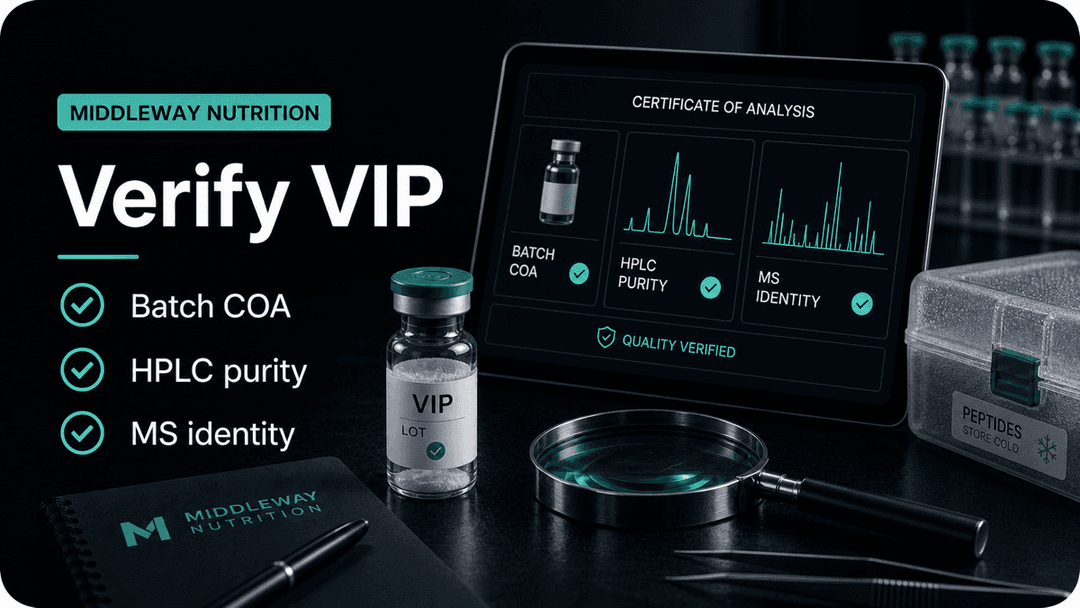
Most guides say "look for third-party testing" and stop. Here's what actually matters for a peptide like VIP.
Batch-Specific vs. Product-Level COAs
A product-level COA is one certificate covering a product line. It might be six months old, from a different synthesis run entirely. Some vendors reuse the same PDF indefinitely.
A batch-specific COA references the exact lot number printed on your vial. It shows the testing date, batch ID, and results for the run you received. The lot on the vial should match the lot on the certificate. If a vendor can't produce that, walk away.
HPLC and Mass Spec, Together
HPLC measures purity, the percentage of the sample that is genuinely VIP. Look for ≥98%, with ≥99% common among the better vendors. Mass spectrometry confirms identity, that the molecular weight matches VIP's roughly 3,326 g/mol. You want both. HPLC can show a high-purity sample of the wrong molecule, and MS catches that. For VIP specifically, also look for endotoxin screening (often reported as <0.1 EU/mg), since contamination is a real concern with bacterially relevant peptides.
Labs like Janoshik and Colmaric Analyticals maintain verifiable portals where you can confirm a certificate's authenticity. If a COA names a "lab" with no website you can find, treat it as unverified.
What VIP Costs in 2026
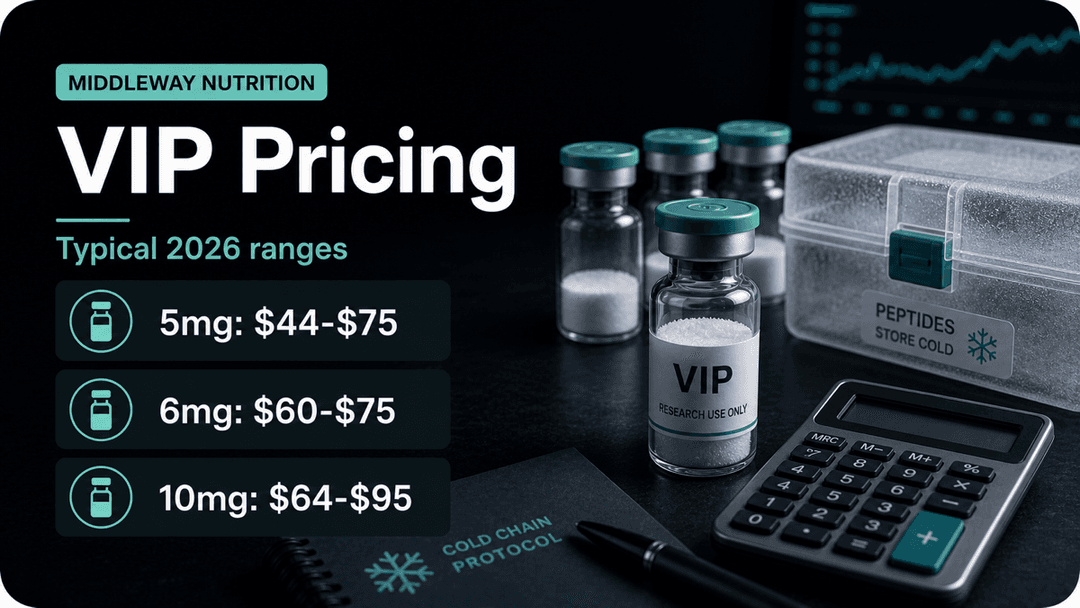
Pricing across the market is fairly tight, which makes the outliers easy to spot.
- 5mg vials: $44–$75. The very low end usually signals a sitewide promo or a testing shortcut, sometimes both.
- 6mg vials: $60–$75. A common size; expect full HPLC/MS documentation from a quality vendor at this price.
- 10mg vials: $64–$95. The best value per milligram if the vendor does proper batch testing.
Bulk discounts of 5–10% for buying several vials are standard. What's not standard, and not a good sign, is a vial priced far below everyone else with no published COA. The synthesis and testing of a real VIP batch cost money. A price that undercuts the whole market is telling you where the corner was cut.
Red Flags to Avoid When Buying VIP
- No batch-specific COA, or a generic one only. This is the single biggest tell. No lot-matched certificate, no sale.
- Vendors making medical or dosing claims. Any seller describing how to use VIP "for CIRS," "for mold illness," or "for gut healing" while also calling it a research chemical is contradicting itself. Good vendors describe research context and stop there.
- Prices that seem too good. A 10mg vial at $30 with free shipping almost always means skipped testing or degraded product.
- No cold-chain mention. For a heat- and freeze-thaw-sensitive peptide, a vendor who says nothing about handling or storage hasn't thought about whether their product survived shipping.
- No reputation anywhere. Check community boards like r/Peptides. Vendors with zero footprint, positive or negative, deserve caution.
How to Get VIP
The practical path is short. There's no prescription required for the research-grade peptide because it isn't sold as a drug, so "how to get VIP" comes down to choosing a vetted vendor and ordering online.
- Pick a vendor that publishes batch-specific COAs. This is the whole decision, really. Start with the comparison table below and rule out anyone offering only a product-level certificate.
- Confirm the COA before paying. Match the lot, check ≥98% HPLC, confirm MS identity and, ideally, endotoxin screening.
- Choose your form. VIP is sold as lyophilized powder for reconstitution, and some vendors also offer a nasal-spray format. The lyophilized vial gives you the most control and the clearest documentation.
- Pay with a method that protects you. Credit cards offer chargeback recourse if the product is fraudulent. Crypto offers privacy but no recourse, save it for vendors you already trust.
A Note on Reconstitution and Storage
VIP arrives as a lyophilized (freeze-dried) powder. In a research setting it's reconstituted with bacteriostatic water and handled aseptically. Store the lyophilized powder cold (refrigerated short-term, frozen at around -20°C for longer storage), reconstitute only what you'll use, avoid repeated freeze-thaw cycles, and keep it out of light. VIP is less stable than peptides like BPC-157 or the recovery compounds in the Wolverine stack, so careless handling is the fastest way to waste a vial.
Vendor Comparison Table
Top Vendors
Ranked by purity, third-party testing, COA availability, and price.
>98% HPLC · Kovera Labs, endotoxin + sterility screen · US only, free over $250
99%+ · Published, multi-lab · US shipping
>99% · Published COA · Free over $200
Listed · COA/LC/MS images · Free over $200
99%+ · Lab results page · Free over $200
≥99% HPLC · Endotoxin reported · US shipping
Prices are approximate and change frequently. Always verify current pricing and COA availability before purchasing.
Related Buying Guides
Use these next if you are comparing adjacent research-peptide sourcing decisions:
Frequently Asked Questions
Where can I buy VIP?
Research-grade VIP is sold online through research-peptide vendors, not pharmacies or supplement stores. Our pick is Ascension Peptides, which sells a 10 mg VIP vial at $80.00 USD with batch-specific certificates in a public library. The sellers carrying VIP change often and the documentation changes with them, so work from the comparison table above, prioritize whoever publishes a batch-specific third-party COA, and confirm that certificate against your vial's lot number before ordering.
Is VIP legal to buy?
VIP sold as a research chemical sits in a legal grey area. The peptide itself is not a scheduled substance, and buying it for research purposes from a domestic vendor carries low practical legal risk. But it is not an FDA-approved drug, it is not sold for human use, and you are operating outside the standard pharmaceutical system. Frame any purchase accordingly.
How much does VIP cost?
In 2026, expect roughly $44–$75 for a 5–6mg vial and $64–$95 for 10mg from quality vendors, with 5–10% bulk discounts common. Be skeptical of vials priced far below the market with no published certificate of analysis, the savings usually come from skipped testing.
How do I know VIP is real and high purity?
Insist on a batch-specific COA whose lot number matches your vial. It should show ≥98% (ideally ≥99%) purity by HPLC, identity confirmation by mass spectrometry, and ideally endotoxin screening. Verify the testing lab is real, names like Janoshik and Colmaric have public portals. No lot number or an unverifiable lab means treat it as unproven.
Do I need a prescription for VIP?
No prescription is required for the research-grade peptide, because it is not sold as a medicine. There is no pharmacy pathway for research VIP. The synthetic VIP analog aviptadil has been studied in humans but is not FDA-approved, and a related combination product is approved only in some countries for a specific use, neither is the same thing as the research peptide vendors sell.
Does VIP come as a nasal spray or only as an injectable powder?
Both formats appear on the market. Most vendors sell lyophilized powder for reconstitution, and some offer a pre-made nasal spray. The lyophilized vial typically comes with clearer batch documentation and lets you verify purity directly, which is why it's the format we'd prioritize when assessing quality.
The Bottom Line on Where to Buy VIP
VIP is a genuinely interesting peptide with a deep preclinical literature, and it's also one of the easiest to buy badly. It's fragile, it's everywhere, and the market is full of sellers banking on the fact that you can't tell a tested vial from a recycled certificate. Your framework should be the same one that works for every research peptide: COA first, reputation second, price last.
Apply those three bars in that order and the shortlist shrinks fast. A seller who will show you a lot-matched certificate before you pay, who has a traceable reputation, and whose pricing is competitive without being suspiciously cheap is the one worth ordering from. If nobody on your list clears all three, the right move is to wait rather than gamble on a vial you can't verify.
Medical Disclaimer: The information in this article is for informational purposes only and does not constitute medical advice. VIP (vasoactive intestinal peptide) sold as a research chemical is not FDA-approved and is not intended to diagnose, treat, cure, or prevent any disease, nor for human consumption. Always consult a qualified healthcare provider before considering any new compound or protocol. The purchase and use of research peptides carries legal and health risks that vary by jurisdiction and individual circumstances.