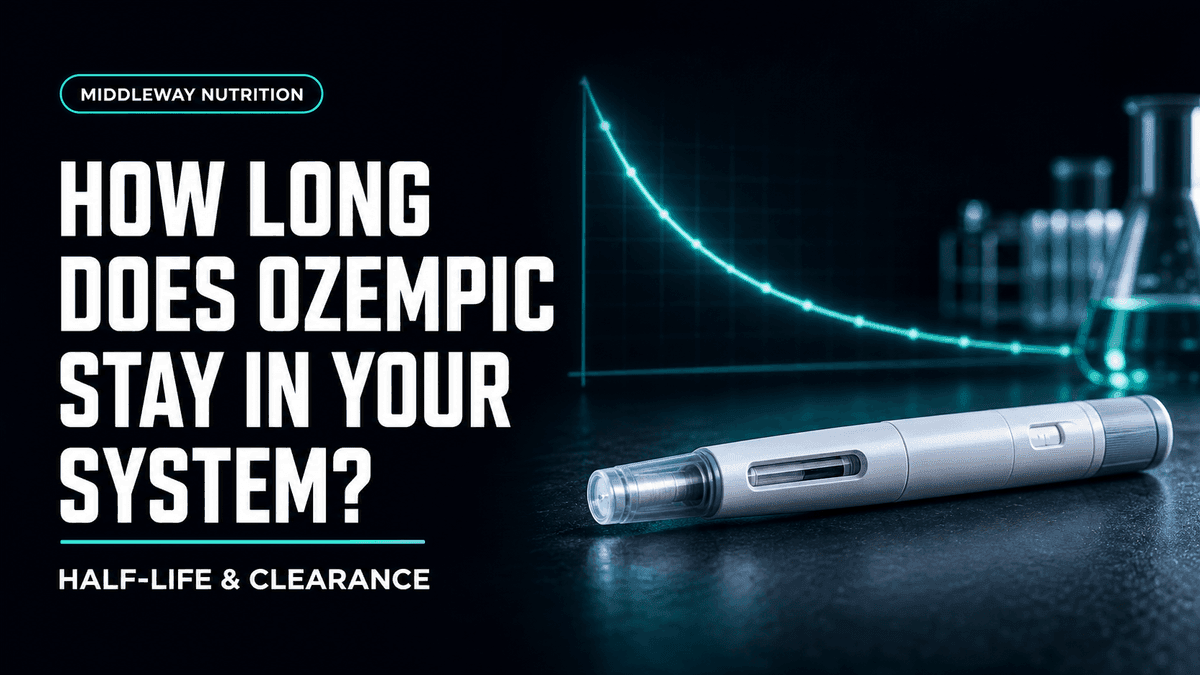
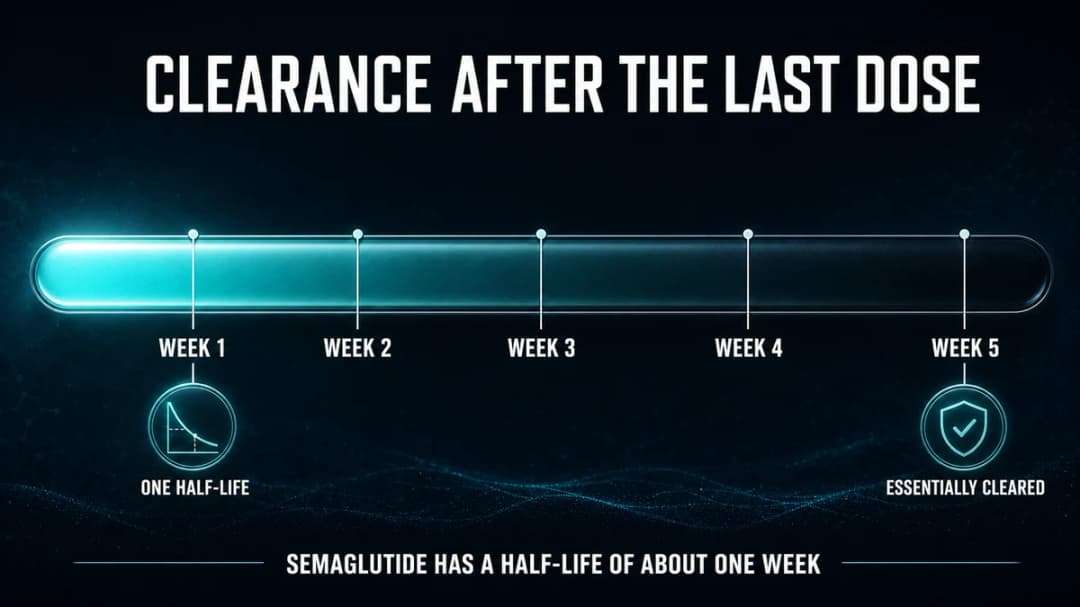
How Long Does Ozempic Stay in Your System? About five weeks after the final injection. The answer to how long does Ozempic stay in your system comes down to one number: semaglutide has an elimination half life of about a week, roughly 165 hours according to the product label, and five half lives is the conventional point at which a drug is treated as cleared.
That long half life is deliberate. It is what allows once weekly dosing, and it is also why nothing about semaglutide happens quickly, in either direction. A dose increase does not reach its full effect for a month, and a decision to stop does not take effect for about the same period.
How Long Does Ozempic Stay in Your System? The Short Answer
Each week after your last dose, roughly half of what remained is eliminated.
| Time since last injection | Approximate drug remaining | What people usually notice |
|---|---|---|
| Week 1 | About 50 percent | Little change. Appetite suppression largely intact |
| Week 2 | About 25 percent | Appetite starting to return for some |
| Week 3 | About 12 percent | Hunger noticeably back. Gastric emptying normalising |
| Week 4 | About 6 percent | Most drug effects gone |
| Week 5 | About 3 percent | Functionally cleared |
| Week 6 onward | Trace only | No meaningful pharmacological activity |
The same arithmetic runs in reverse when starting or increasing a dose. Steady state takes four to five weekly injections, which is why the full effect of a dose step is not apparent in the first week after it.

What Actually Clears It
Semaglutide is not eliminated the way a small molecule drug is. It is a modified peptide bound extensively to albumin, which is precisely what slows its clearance. It is broken down by proteolytic cleavage and beta oxidation of its fatty acid side chain, with the fragments excreted in urine and faeces.
Subcutaneous bioavailability is around 89 percent, and the compound distributes widely in plasma. No dose adjustment is specified for renal or hepatic impairment on the label, though clinical judgment still applies in advanced disease.
This also explains why the clearance estimate is stable across body types. Drugs that partition heavily into fat tissue linger longer in people carrying more of it, and clearance can vary several fold between individuals as a result. Semaglutide does not behave that way. It stays in the plasma compartment bound to albumin, so the five week figure holds reasonably well across the range of people who take it.
One practical consequence is worth drawing out. Because concentrations decline smoothly rather than dropping off, there is no clean moment at which the drug stops working. Appetite returns as a gradient over several weeks, which is why people often describe the period after stopping as a slow drift rather than a switch being flipped.
Why the Clearance Window Matters
Before surgery or endoscopy
Slowed gastric emptying is the concern. Food left in the stomach at induction of anaesthesia raises aspiration risk, and gastroparesis is a recognised effect of this drug class.
Guidance here has evolved. Early advice from anaesthesiology bodies leaned toward holding weekly GLP-1 agonists for around a week before an elective procedure. More recent multidisciplinary guidance has moved toward individual risk assessment, considering symptoms, dose stability and the option of gastric ultrasound or a longer clear liquid diet rather than a blanket hold. Tell your surgical and anaesthesia team you are on a GLP-1 medicine well before the date and follow their instructions rather than a general rule.
Before pregnancy
The label advises discontinuing semaglutide at least two months before a planned pregnancy. The drug clears in about five weeks, so the two month figure builds in a margin for individual variation. If you become pregnant unexpectedly while taking it, contact your prescriber rather than waiting for a scheduled appointment.
When switching to another GLP-1 medicine
A full washout is usually unnecessary. Because semaglutide is dosed weekly, most prescribers start the replacement drug at the point the next semaglutide dose would have been due, at the new drug's own starting dose rather than a matched one. Overlapping tail concentrations are part of why the first weeks of a switch can feel different from starting fresh. Our guide on switching from semaglutide to tirzepatide covers the mechanics.
After a missed dose
If a dose is missed and the next scheduled dose is at least two days away, the label allows taking it as soon as possible. If it is closer than that, the usual advice is to skip and resume the normal schedule. Because clearance is slow, one missed week rarely resets progress. See missed semaglutide dose for the detail.
Side Effects Do Not Stop When the Drug Does
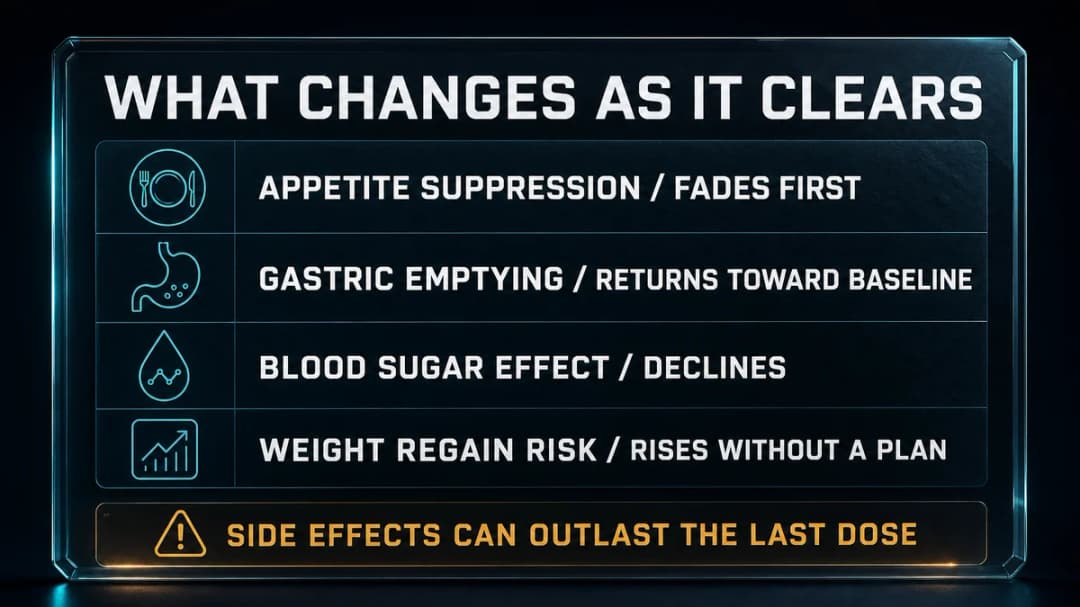
Nausea, constipation and reflux typically resolve within one to three weeks of the last injection as gastric emptying normalises. Appetite returns over roughly the same window.
Two things persist longer. Weight regain plays out over months rather than weeks, driven by the return of appetite rather than by anything remaining in the bloodstream. And blood glucose in people with type 2 diabetes will drift upward as the drug leaves, which needs monitoring and often a replacement therapy rather than a gap.
The stopping GLP-1 washout guide covers what to expect across those first few months.
FAQ
Does Ozempic show up on a drug test?
No. Standard workplace and clinical drug screens look for controlled substances and their metabolites. Semaglutide is not among them and would only be detected by a specific assay ordered for that purpose.
How long until appetite comes back after stopping Ozempic?
Most people notice hunger returning in the second or third week after the last injection, with a full return by week four or five. The change is usually gradual rather than sudden.
How long does Ozempic take to start working?
Some appetite effect appears within the first week, but steady state takes four to five weekly doses. Each dose increase resets that clock, which is why judging a new dose after seven days is premature.
Do I need to stop Ozempic before a colonoscopy?
Ask the team performing it. The concern is retained stomach contents, and current guidance favours individualised assessment over an automatic hold, sometimes with an extended clear liquid diet instead. Do not decide this unilaterally.
Does body weight or kidney function change how long it stays in your system?
Not enough to alter the practical estimate. The label does not specify dose adjustment for renal or hepatic impairment, and the roughly five week clearance window holds across the range studied. Individual variation exists but is modest.